 Vista

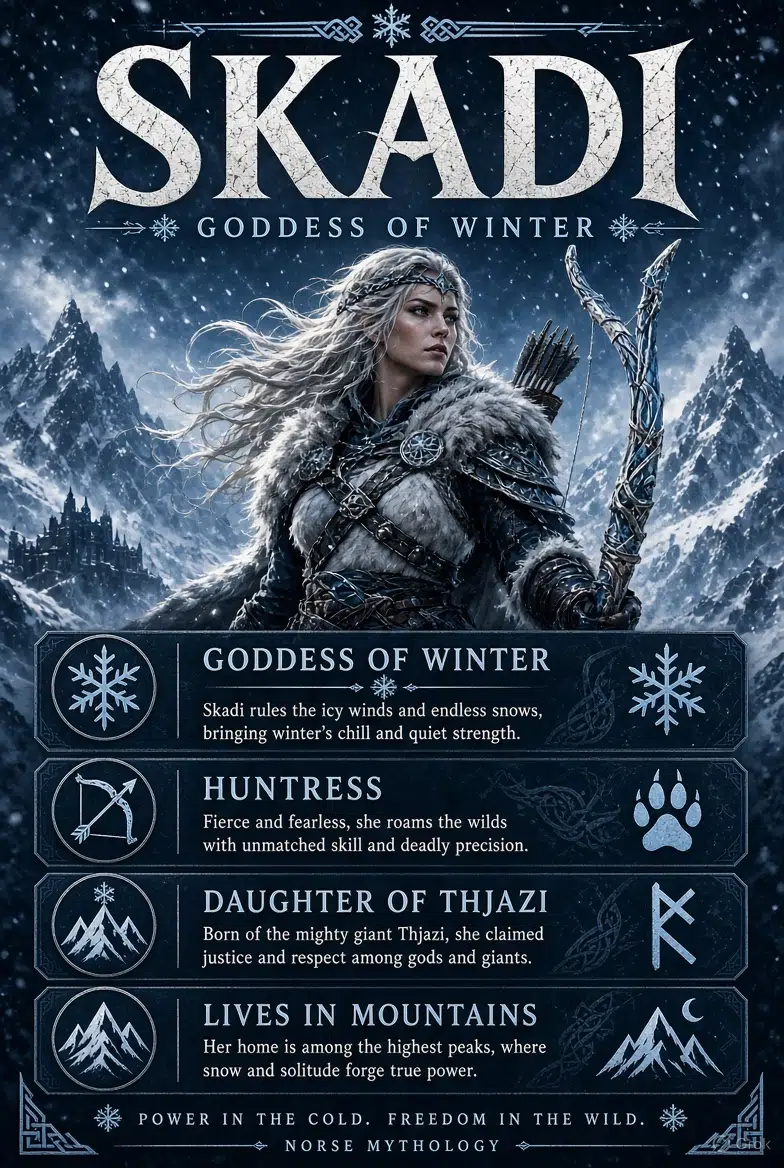
Skaði (Skadi) is a striking figure in Norse mythology, associated with mountains, snowshoes, hunting and a difficult marriage to the sea-connected god Njörðr. She is the daughter of the jötunn Þjazi (Thjazi), whose death follows his theft of Iðunn and her life-renewing apples. Skaði goes to the gods seeking compensation. In Snorri’s familiar account, she is allowed to choose a husband by looking at the gods’ feet, expects Baldr, and accidentally chooses Njörðr. The couple struggle to live together because one loves the mountains and the other the seashore.
This guide covers Skadi Norse mythology, her father, winter and hunting associations, the famous feet-selection marriage, Þrymheimr and Nóatún, the episode where Loki makes her laugh, and the later story of Loki’s binding. Modern ‘ice queen’ images are artistic interpretations, not an official Viking portrait.
Who Is Skadi? Daughter of the Jotunn Thjazi
Skaði is introduced as the daughter of Þjazi, a powerful jötunn who becomes involved in a dangerous story about Iðunn. The term jötunn is often translated as giant, but its members do not all share one standardized body size or moral role. Skaði moves from a jötunn family into the society of the Æsir through a marriage settlement, which makes her an important example of the overlapping worlds of gods and giants. In modern fantasy art she is commonly depicted as an icy queen with blue magic and silver armour. The textual image is more specific: a figure from mountainous surroundings associated with snowshoes and hunting. A responsible beginner guide begins with that origin and the events that bring her to Asgard. It should not claim that the stories prescribe an exact crown, hair colour or supernatural frost attack. Her dramatic personality emerges through negotiations, grief for her father and an unwillingness to abandon her preferred home.
What Happened to Thjazi and Idunn’s Apples?
In Skáldskaparmál, Loki becomes entangled with Þjazi after an encounter involving food and an eagle. He is compelled to help the jötunn obtain Iðunn, whose apples sustain the gods’ youth. With Iðunn absent, the gods begin to age and force Loki to bring her back. Loki uses a bird form, and Þjazi pursues him as an eagle. The gods prepare a fire that destroys Þjazi after the chase reaches Asgard. Skaði is not simply a random warrior attacking the gods for no reason: her arrival follows her father’s violent death. Readers may find this linked sequence more engaging than an isolated ‘Skadi powers list’. It also ties her story to Iðunn, Loki, the Æsir and the unusual consequences of bargains made under pressure. Illustrations of a giant eagle above Asgard may represent the pursuit episode, not a scene in which Skaði transforms into an eagle herself.
Skadi Comes to Asgard Seeking Compensation
After Þjazi dies, Skaði puts on her helmet and war equipment and approaches the gods to demand compensation. The gods do not simply defeat her in a tournament; instead, the dispute becomes a settlement involving marriage and other terms. Such episodes show that Norse myths are not always stories of combat followed by a clear winner. Negotiations, threats and uneasy compromises are also common. In this case the compensation does not erase the violence that came before it. It changes Skaði’s place in the divine community but leaves her independent preferences intact. Some fantasy sites call her Odin’s daughter or Thor’s wife because she appears with the gods, yet the familiar source identifies her as Þjazi’s daughter and later Njörðr’s wife. This is why family trees must distinguish ancestry from marriage or association. A picture of her arriving at the gods’ gathering in armour can be a useful artistic representation of the demand.
Choosing a Husband by His Feet: Why Skadi Chose Njord
The marriage condition in Gylfaginning is one of the strangest moments of the story. Skaði is permitted to choose a husband from the gods, but she may see only their feet. She thinks the most beautiful feet must belong to Baldr, whom she hopes to select. Instead, they belong to Njörðr. The episode can be humorous, but it also reveals that the settlement gives Skaði limited information and an outcome she did not anticipate. It should not be recast as an ordinary modern blind date in which she had unrestricted choice. There is no surviving ancient image showing the exact shoes or positions of all the gods during the selection. An original fantasy poster may depict a line of sandaled feet, Skaði’s puzzled expression and a waiting Njörðr; it should label the scene artistic. The key fact is the mistaken identification and the marriage between a mountain-associated figure and a sea-associated god.
Mountains Versus Sea: Þrymheimr and Nóatún
The married couple struggle because they prefer very different environments. Njörðr is connected with Nóatún and the shore, including the cries of sea birds. Skaði prefers her father’s mountain home Þrymheimr, where wolves are heard. In the prose account they try living for a limited number of nights in each place, but both find the other’s surroundings unpleasant. Njörðr dislikes the wolves of the mountains, while Skaði dislikes the seabirds of the sea. The result is not a simple story of love conquering every difference. It shows incompatible ways of life, even among supernatural beings. The contrast gives artists an immediately readable image: snow-covered peaks on one side, turbulent coastal water on the other. The dialogue should not be turned into precise modern climatic statistics or the claim that either character owned a verified real-world castle.
Why Is Skadi Called the Snowshoe Goddess?
Snorri describes Skaði spending much of her time in Þrymheimr, moving on snowshoes and hunting animals with a bow and arrows. That description underlies her common title as a winter, skiing or hunting goddess. The modern word ‘skiing’ may suggest a sporting discipline, while the old narrative concerns travel and hunting in snowy country. She is not described with a detailed set of ice spells comparable to a fantasy role-playing game. A classic visual symbol is the bow paired with snowshoes or skis, a snowy mountain and a capable hunter. Calling her ‘goddess of winter’ is a common useful shorthand, but readers should know that her source-grounded features are the mountain environment, her equipment and her activities. A tattoo can give those objects a personal meaning without claiming a particular design is a documented Viking Age charm. This helps distinguish Skaði from Ullr, another Norse figure associated in later tradition with archery and snowy movement.
How Does Loki Make Skadi Laugh?
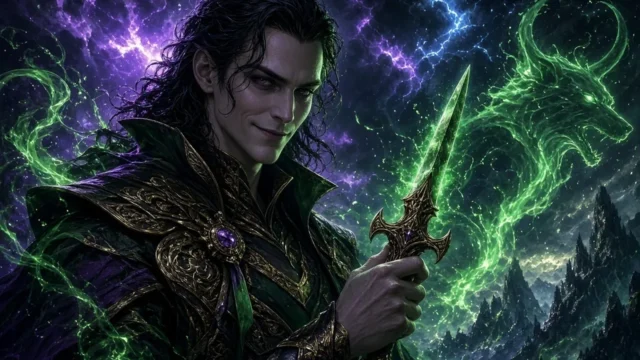
Another condition of the settlement is that the gods must make Skaði laugh, which she believes impossible. Loki performs a bizarre and uncomfortable comic stunt involving a goat and his own body, ultimately making her laugh. The episode has a rough quality that differs from gentle modern family entertainment. It should not be rewritten as a harmless joke invented for children or as a romantic encounter between Loki and Skaði. The effect is that a serious dispute over Þjazi’s death acquires an absurd moment that helps bring the compensation to a conclusion. A public article can explain this without displaying graphic imagery, and an informational poster can simply state that Loki’s comic performance made Skaði laugh. If an image shows Skaði laughing with Loki in an unrelated fantasy setting, that may be a generic interpretation, not a direct illustration of the original event. The story’s strangeness is part of the source, not proof that the characters were real historical people.
Skadi and the Serpent Used to Punish Loki
A darker tradition associates Skaði with the punishment of Loki after his destructive conflict with the gods. In Snorri’s account Skaði takes a poisonous serpent and fixes it above Loki so venom falls onto him. His wife Sigyn holds a bowl to catch the poison, but when she goes to empty it drops reach Loki, and his convulsions are associated with earthquakes in the myth. This is a narrative explanation, not geological science. The story also shows that Skaði’s relationship with Loki is not limited to the humorous goat episode: she can become a severe participant in his punishment. Some online pictures mistakenly identify Sigyn as Skaði or say Skaði is Loki’s wife. Sigyn, not Skaði, is the wife catching venom in the familiar account. Accurately identifying the two women is important for both family-tree and image-search content. A caption of this scene should not imply that all ancient versions attribute precisely identical roles to every participant.
Skadi Images, Ragnarok and Modern Mythology
Skaði works especially well in mountain-themed fantasy wallpapers, bow-and-arrow portraits, snowshoe or ski art and images contrasting winter peaks with the sea. Search phrases include ‘Skadi Norse mythology’, ‘Skadi winter goddess’, ‘Skadi and Njord’, ‘Skadi Thjazi daughter’ and ‘Skadi hunting goddess’. A good informative poster can show her father, husband, two homes and memorable incidents. The surviving major Ragnarök stories do not give Skaði a universally fixed final duel or a precise cause of death, so a website should not invent one simply to fill a timeline. Modern games may give her an elemental ice ability or another romance, but that belongs to their fictional worlds. A truthful article enjoys the visual potential while explaining the text’s limits. Image ALT should identify the visible bow, snowy mountain and character rather than promise proof of a supernatural historical queen.
Frequently Asked Questions
Who is Skadi in Norse mythology?
Skaði is the daughter of Þjazi, associated with mountains, snowshoes, hunting and marriage to Njörðr.
Is Skadi a goddess of winter?
That is a useful modern description, grounded particularly in her snowshoe hunting and mountain associations.
Who is Skadi’s father?
The jötunn Þjazi, killed following the Iðunn apple episode.
Why did Skadi marry Njord?
She selected a husband by looking only at the gods’ feet, thinking she was choosing Baldr.
Why did Skadi and Njord not live happily together?
They preferred different homes: her mountains and his seaside residence.
Did Skadi punish Loki?
In Snorri’s account she fixes the venomous serpent above bound Loki.
Conclusion
Skaði is more than an ice-themed fantasy warrior. Her father’s death, difficult compensation, unexpected marriage to Njörðr and love of the mountains give her a distinctive place in Norse stories. Accurate images should reflect those events instead of borrowing invented game abilities.
Sources and artwork note
Gylfaginning: Skadi, Njord and their homes; Skaldskaparmal: Thjazi, Idunn and Skadi; Academic edition of Skaldskaparmal.
Reviewed 15 November 2026. Art is a fantasy interpretation, not historical evidence.















Share Your Opinion
Comments are closed on this post.