 Vista
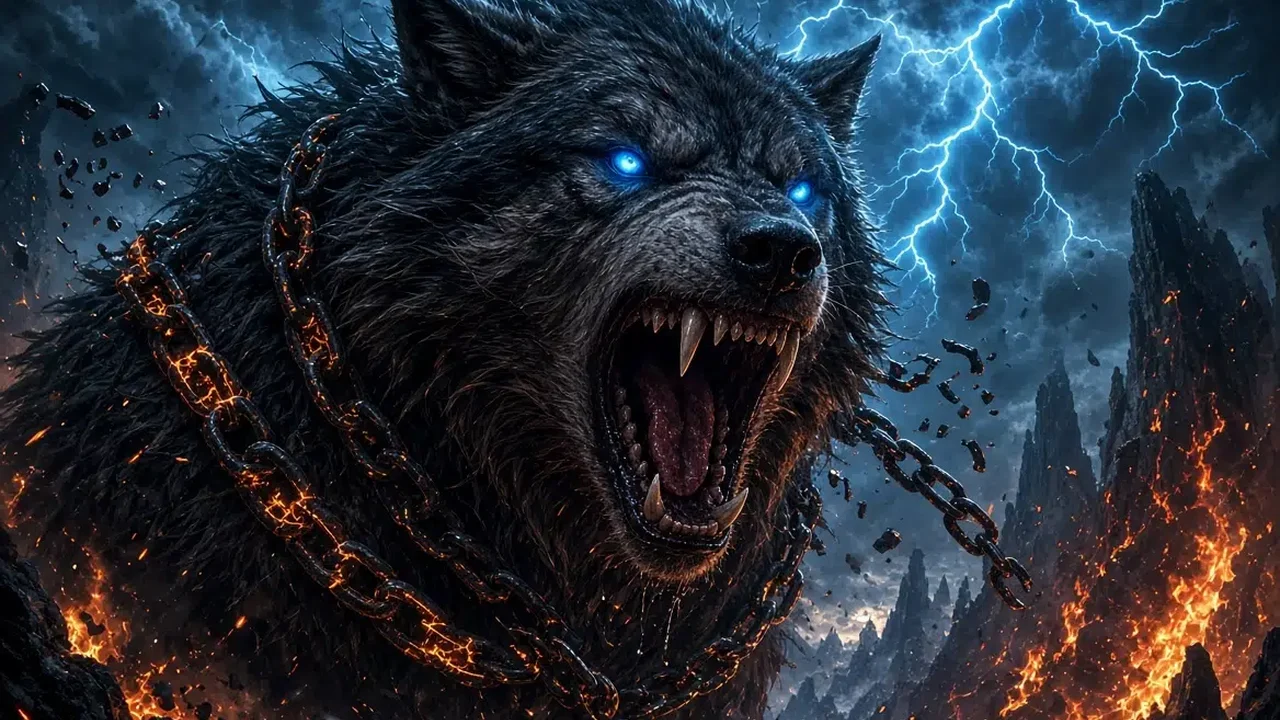
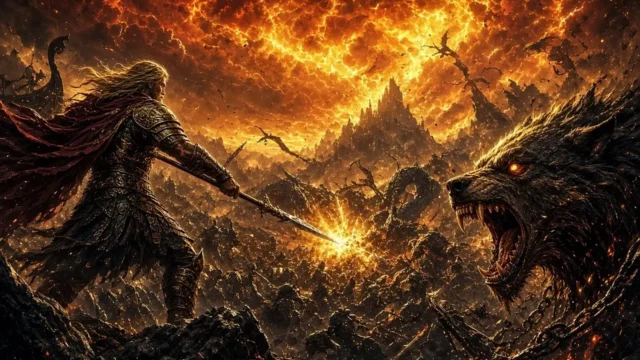
Fenrir in Norse mythology is the enormous wolf born to Loki and the giantess Angrboða. The gods fear that his strength will become a danger, so they attempt to bind him. The final magical restraint, Gleipnir, holds—but only after the god Týr places his hand in Fenrir’s mouth as a pledge, and loses it when the gods refuse to free the wolf. At Ragnarök, Fenrir escapes, swallows Odin and is killed by Odin’s son Víðarr.
People search for Fenrir wolf images, Fenrir Norse mythology story, ‘Why did Tyr lose his hand?’, Fenrir vs Odin and Fenrir vs Jörmungandr. This guide connects the dramatic visual material with the actual narratives and explains why Fenrir is more than a giant fantasy dog. His story asks whether the gods’ attempt to prevent fate helps bring that fate about.
Who Is Fenrir? Loki’s Giant Wolf Son
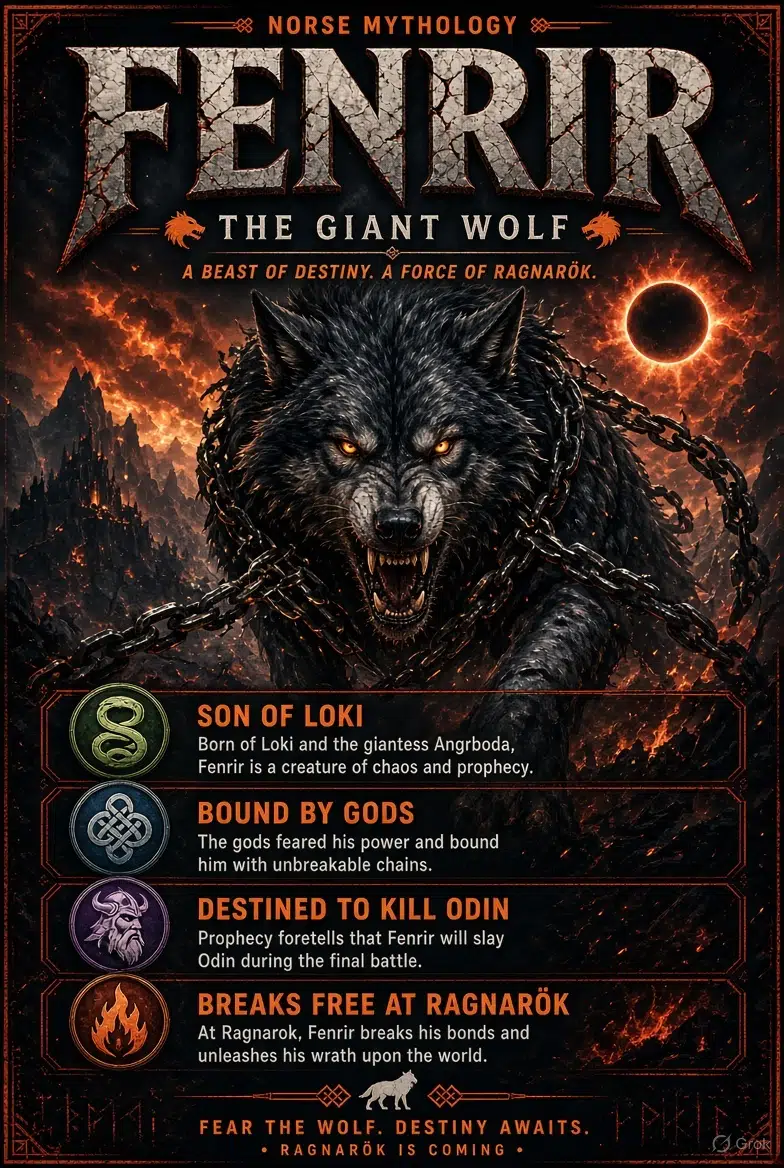
Fenrir is identified as one of Loki’s children with Angrboða. His siblings in the familiar account are Jörmungandr, the serpent associated with the sea surrounding Midgard, and Hel, a figure connected with the realm of the dead. The gods are warned that these children will cause grave trouble. While the serpent is cast into the sea and Hel is given a role among the dead, the wolf is raised under watch because his growing power inspires fear.
It is easy to call Fenrir a ‘monster,’ and his appearance in artwork certainly fits that description. But the myth contains more than a simple beast attacking innocent heroes. He is also a being whom the gods decide they cannot trust, and who in turn recognizes their deception. This dual mistrust is essential to the story of his binding. A portrait of a snarling wolf communicates danger; the larger narrative explains why the danger becomes a conflict about promises.
Why Did the Gods Try to Bind Fenrir?
The gods know a prophecy connects Fenrir to disaster, including Odin’s death. Killing him immediately would have posed its own problems in the narrative, so they resort to restraints. At first they present the challenge as a test of the wolf’s strength rather than openly admitting they intend permanent imprisonment. Fenrir is strong enough to break the earlier fetters Læðing and Drómi, making him even more frightening to the watchers.
This part is often omitted from short online summaries that jump straight to a magic ribbon. But the failed tests establish Fenrir’s strength and his growing awareness that the gods’ friendly words conceal fear. He has reasons to demand a pledge before consenting to another binding. The story is not an instruction about handling dangerous animals; it is a mythic examination of power, prophecy and broken trust.
Gleipnir: The Magical Ribbon Made by Dwarfs
Gleipnir is the final restraint. It looks much too light to hold a giant wolf, which is why Fenrir is suspicious. According to Snorri’s Gylfaginning, the dwarfs fashion it from six fantastic things: the sound of a cat’s footfall, a woman’s beard, mountain roots, a bear’s sinews, a fish’s breath and a bird’s spittle. These are deliberately impossible elements in a wonder tale, not a recipe for a real object.
Artists sometimes show Gleipnir as a glowing chain, even though its deceptively slender, ribbon-like appearance is part of the narrative. If an informational image labels it ‘magic chains made of iron,’ readers lose the point of the trick. A good poster shows the contrast between the huge wolf and the apparently delicate band. That contrast makes the coming betrayal feel plausible and visually memorable.
Why Did Tyr Lose His Hand to Fenrir?
Fenrir agrees to test Gleipnir only if one of the gods places a hand in his mouth as a guarantee of good faith. Others hesitate, and Týr accepts the risk. When Fenrir finds that he cannot break free and realizes the gods do not intend to release him, he bites off Týr’s hand. The episode becomes a defining myth about the god Týr and is often discussed in relation to oaths, courage and responsibility.
It is tempting to describe the episode as a straightforward victory over evil: the wolf was contained, so the gods won. The moral complication is that their promise was not honored. Týr bears the physical consequence of an act in which the gods as a group took part. The myth therefore asks readers to consider the price of security and the cost of a broken pledge. That is one reason a full Fenrir article can offer more value than a gallery of dramatic wolves.
Where Was Fenrir Bound? Lyngvi and the Open Jaws
Snorri describes the binding on the island of Lyngvi, with Gleipnir anchored so the wolf cannot simply run away. A sword is placed to keep his jaws open, and his saliva forms the river Ván in the story. These startling details are often used in fantasy art: huge jaws, a blade and a stone-bound creature beneath a threatening sky. They are elements of a myth, not geographical evidence of a real imprisoned animal.
Search results sometimes give a precise modern location for ‘Fenrir’s prison’ or a photograph purporting to show the original chain. Those claims should be treated with skepticism. The places and objects operate within a legendary narrative. Even when a Norse name resembles an identifiable real-world place, that does not make the supernatural imprisonment a verifiable historical event. Captions should therefore call these pictures artistic depictions of the binding of Fenrir.
Does Fenrir Escape at Ragnarok?
Yes. At Ragnarök, the catastrophic clash involving the gods and their enemies, the bonds that hold Fenrir are broken. The wolf enters the final battle and swallows Odin. This is one of the most famous deaths in Norse mythology. The episode completes the prophecy that motivated the gods to restrain him: despite their elaborate precautions, the threat they dreaded arrives. It is a vivid example of the mythic struggle against fate.
Different texts and retellings vary in detail, and some images add things that are not securely described: an invented army of wolves, magical armor or a named cosmic spell. The essential source-based visual is the immense wolf confronting Odin during the final upheaval. If an article says Fenrir himself kills Thor, it confuses two endings; Thor fights Jörmungandr and dies because of the serpent’s venom.
Who Kills Fenrir? Vidar’s Revenge
After Fenrir has swallowed Odin, Víðarr, one of Odin’s sons, avenges him. In Snorri’s account, Víðarr forces the wolf’s jaws apart in a powerful act and kills it. Some versions describe footwear with a special role in this moment, a detail that should be attributed to the relevant text rather than presented as a universal Norse rule. For mythology readers, the sequence is straightforward: Fenrir kills Odin, and Víðarr kills Fenrir.
That sequence raises a memorable question: if prophecy foretells the outcome, what do the characters’ choices still mean? The binding protects the gods for a time but breaks trust. The final battle still happens. Fenrir is not therefore a helpful pet or a purely modern antihero; he is a dangerous figure whose dramatic fate makes readers think about responsibility and predestination. Art can convey his enormous scale, while the story supplies that moral complexity.
Fenrir Images, Tattoo Meanings and Modern Adaptations
Fenrir is a popular subject for wolf tattoos, dark-fantasy posters and wallpapers. Common imagery includes a gigantic black wolf, broken bonds, runes, Odin and a fiery sky. None of these combinations automatically amounts to an authentic Viking Age design. A modern ‘Fenrir protection tattoo’ can have personal meaning for its wearer, but the specific promise of protection may not be established in the medieval texts.
Games, comics and modern fantasy frequently reinterpret Fenrir, sometimes changing which character is the wolf or giving him a different origin. Such creative versions can be enjoyable, but they should be labeled as adaptations. A useful image gallery offers clear captions like ‘Fenrir bound with Gleipnir’ or ‘Fenrir at Ragnarok’ rather than presenting every massive wolf illustration as the same canonical scene. The Prose Edda and Poetic Edda remain the starting points for checking the underlying myth.
Frequently Asked Questions
Who are Fenrir’s parents?
Loki and Angrboða are Fenrir’s parents in the familiar Norse tradition.
Why did Tyr lose his hand?
He placed it in Fenrir’s jaws as a pledge while the gods tested Gleipnir and was bitten when the promise was broken.
What is Gleipnir?
A deceptively slender magical binding made by dwarfs from six impossible ingredients.
Who does Fenrir kill at Ragnarok?
Fenrir swallows Odin during the final confrontation.
Who kills Fenrir?
Odin’s son Víðarr avenges his father and kills the wolf.
Conclusion
Conclusion: The terrifying Fenrir wolf is not memorable merely because of his teeth. The binding, Týr’s sacrificed hand, the broken promise and the prophecy fulfilled at Ragnarök create a story with stakes on both sides. The fantasy illustrations show the scale of the creature; the older texts reveal why his fate matters.
Sources: World History Encyclopedia; The Binding of Fenrir with source citations; Oxford — Prose Edda. Reviewed 14 November 2026. All art is illustrative.




Share Your Opinion
Comments are closed on this post.