 Vista

Orpheus and Eurydice is one of Greek mythology’s most tragic love stories. After Eurydice dies from a snakebite, her husband Orpheus, a musician whose lyre can move even the hardest hearts, descends into the underworld to plead for her return. His music persuades the rulers Hades and Persephone to release her on one condition: he must lead the way out without turning to look back until they have left the realm of the dead. Near the exit, Orpheus grows anxious, looks over his shoulder and loses Eurydice again. This sequence survives in the particularly influential accounts of the Roman poets Virgil and Ovid. Their versions overlap but do not share every detail. The myth speaks about love, grief, trust and a moment that cannot be undone.
Who was Orpheus in Greek mythology?
Orpheus is a legendary musician, poet and singer whose music is said to charm animals, trees and even stones. In a common genealogy his mother is Calliope, the Muse associated with epic poetry, while his father is Oeagrus in some accounts or Apollo in others. These variations remind readers that Greek myth is not organized around a single biological family registry. His supernatural music, rather than physical weaponry, makes him extraordinary among the celebrated heroes.
He is also associated with Thrace and with musical or religious traditions later described as Orphic. The sources and dates of those traditions are complex, and historians do not simply assume a single verified man authored every text attributed to Orpheus. The famous underworld story is best approached through the actual surviving poems. A modern portrayal of a singer in ancient dress does not tell us what a real historical Orpheus looked like, because his identity as a legendary character is inseparable from myth.
How did Orpheus and Eurydice meet and marry?
The famous story presents Eurydice as Orpheus’s wife. In Ovid’s Metamorphoses Book 10, the marriage begins with troubling signs. Hymen, the deity of marriage, arrives but offers no happy blessing, and the wedding torch gives off smoke rather than a clear auspicious flame. The imagery foreshadows the tragedy that follows. The poem does not provide a long modern romantic courtship with precise dates and conversations; later adaptations often invent these details.
Eurydice is not merely a prize carried between worlds. Her death, the condition of her return and the final separation give her an essential place in the narrative. The surviving major versions concentrate heavily on Orpheus’s sorrow, but a responsible modern retelling can acknowledge the loss of Eurydice’s own future without pretending an ancient poet wrote extensive first-person dialogue that is not there. The wedding’s ominous tone provides a powerful literary contrast with the brief hope of bringing her back.
How did Eurydice die? The snakebite in Ovid and Virgil
In Ovid, Eurydice is in the grass among companions when a venomous serpent bites her foot or ankle, causing her death. Virgil’s Georgics Book 4 supplies an influential variation in which she flees the advances or pursuit of Aristaeus, a figure linked to pastoral life, and does not notice a dangerous snake in her path. These should be distinguished: saying Aristaeus caused the snakebite through pursuit is grounded in the Virgilian version, but the same detailed pursuit should not automatically be attributed word for word to Ovid.
Both versions establish that the lovers’ happiness ends abruptly. Snake imagery is familiar in Greek myths, but the story is not a biological account of a specific venom or an ancient case report with a medical treatment. The serpent is a literary instrument of sudden mortal vulnerability. It also explains why the next phase is so extraordinary: Orpheus cannot simply heal Eurydice with music in the living world. He must challenge the established boundary between life and death.
Why did Orpheus descend into the underworld?
Orpheus cannot accept the loss and resolves to enter the realm of the dead. In Ovid’s telling he approaches the shadowy regions through the Taenarian gate, a mythic entrance. The route takes him past powers associated with the underworld and toward its rulers. The journey is unlike that of a warrior seeking a monster to kill: Orpheus carries a lyre, not an army, and hopes to achieve through music what force cannot.
In the poem, his song describes love’s power and asks that Eurydice be allowed to return to a life cut short. The plea is not an attempt to conquer Hades or make the underworld disappear. It appeals to the rulers’ recognition of love and loss. Death is a central fact of mortal life even within Greek myth. The extraordinary request therefore requires a special permission, which makes the condition attached to it dramatically important.
How did Orpheus’s music persuade Hades and Persephone?
Orpheus’s song moves the inhabitants of the underworld. Ovid describes famous punished figures pausing in their torments: Tantalus stops reaching for water, Ixion’s wheel stills and Sisyphus rests upon his stone. Even the fearful Furies are portrayed as weeping. The scene makes music powerful not by causing physical destruction but by interrupting the established order through compassion and wonder.
Hades and Persephone are persuaded to make an exception for Eurydice. This is notable because the underworld usually does not release the dead on ordinary human request. The scene should not be described as Hades falling in love with Orpheus or losing a duel; the result comes from listening to a heartfelt song. In another myth Hades and Persephone are central to the abduction and recurring return of Demeter’s daughter, a separate plot with different conditions.
What condition did Hades set for Eurydice’s return?
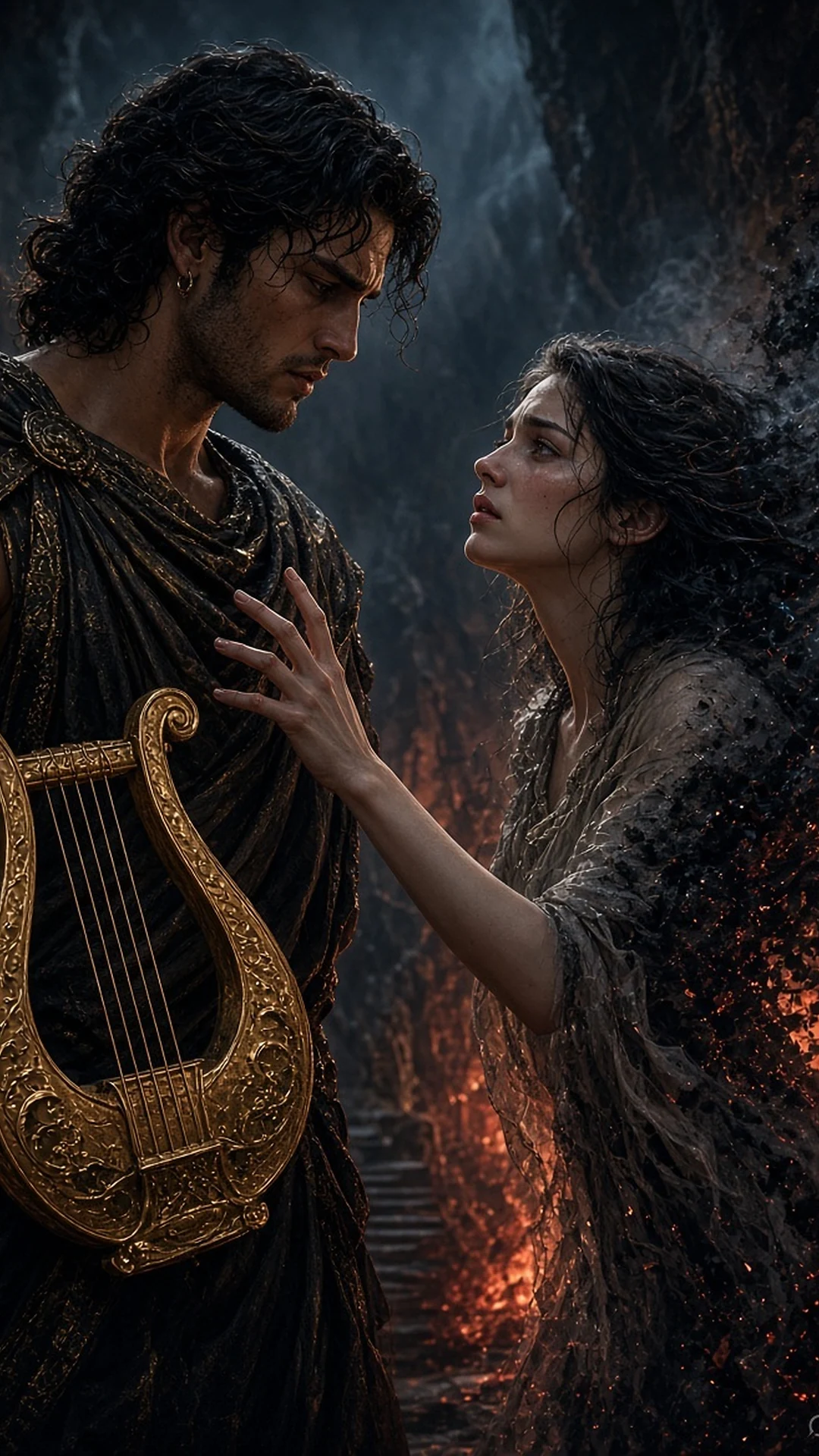
Orpheus is told that Eurydice may follow him up toward the living world, but he must not turn around and look at her before they have emerged. The couple begin climbing a steep, dim and quiet path. Orpheus leads, while Eurydice follows behind. He cannot look directly to confirm that she is still there without breaking the terms. This makes the return emotionally dangerous even though the rescue appears to have been granted.
The rule is sometimes reduced to “do not look at the light” or “never speak her name.” Those are not the central conditions in Ovid’s major narrative. The restriction concerns looking back before both have crossed the boundary. Its precision matters: the tragedy happens not because Orpheus refuses to travel, but because he is too near the end to bear the uncertainty. He must trust the promise and endure a final stretch without visible proof.
Why did Orpheus look back at Eurydice?
As the exit approaches, Orpheus becomes afraid that Eurydice is not following or may be lost again. He longs to see her and turns. In Ovid’s Metamorphoses 10, that anxious, loving glance immediately invalidates the promised return. Eurydice slips back toward the underworld, and Orpheus reaches for her but grasps only air. The scene is devastating precisely because the forbidden act appears small and human, not an act of violence.
Different retellings emphasize doubt, impatience, love or a momentary failure of trust. Ovid gives the turn a strong emotional motivation rather than making the hero deliberately cruel. In his account Eurydice does not launch into a long accusation; her farewell is brief, and the poem portrays the loss with tenderness. It would be misleading to write as an unqualified fact that she hated Orpheus for looking back, or that he meant to send her to the dead deliberately.
What happened to Orpheus after losing Eurydice twice?
Orpheus tries to return below, but he cannot simply repeat the exception. In Ovid, the ferryman resists allowing him another crossing. He remains beside the waters in grief and then returns to the upper world. The poem shifts toward his songs and other tales, showing that his art survives but cannot restore the particular future he wanted. The loss changes his relationship with the world around him, though later authors portray his personal life in different ways.
Ovid’s Metamorphoses Book 11 recounts a further tragic ending for Orpheus, killed by women associated with Bacchic frenzy in the poet’s narrative. His dismembered head and lyre travel along a river, and the poem later pictures his shade meeting Eurydice again in the afterlife. That poignant reunion belongs to Ovid’s later episode; it should not be used to claim that he successfully brought Eurydice back alive after the first failure. Different narrative levels require distinct wording.
What is the message of Orpheus and Eurydice?
A common interpretation reads the forbidden backward glance as a problem of trust. Another emphasizes the fragility of hope after losing someone, because Orpheus’s love makes the uncertainty unbearable. The story can also be understood as a reflection on how art offers consolation without abolishing death. Music moves Hades, yet even its extraordinary power has limits. Those themes help explain why the legend has inspired opera, poetry, cinema and painting for centuries.
Readers should not reduce the plot to “if you love somebody, never look at them” or treat the story as a medical illustration of grief. The instruction exists within a supernatural agreement in a fictional world. Its enduring appeal comes from a recognizable emotional tension: an anxious person wants immediate reassurance, but acting too soon can destroy a delicate possibility. The narrative invites thought without imposing a single ancient moral statement on every modern relationship.
Was Orpheus’s story originally written by Homer?
The best-known extended accounts of Orpheus and Eurydice are in Virgil’s Georgics Book 4 and Ovid’s Metamorphoses Book 10, both Latin works from the Roman era. Orpheus as a figure has earlier Greek associations, but it would be inaccurate to say the entire familiar snakebite, underworld plea and backward-glance narrative appears as a single episode in Homer’s Iliad. The later poets contribute memorable details and distinct emphases.
This distinction is especially useful for an educational article. “Greek mythology” names a tradition of stories, not a promise that every surviving version was written in Greek by a single author. Roman poets frequently reworked Greek legends, and their texts are themselves major primary literary sources. A short source note gives the reader a better foundation than a misleading claim about one mythical holy book containing every Greek story.

Orpheus and Eurydice timeline
| Stage | Event | Source nuance |
|---|---|---|
| Marriage | Orpheus weds Eurydice | Ovid: ominous wedding signs |
| Death | Eurydice bitten by snake | Virgil adds Aristaeus pursuit |
| Descent | Orpheus enters underworld | Music is his means |
| Plea | Hades and Persephone agree | Conditional permission |
| Climb | Eurydice follows behind | No turning back |
| Failure | Orpheus looks back too soon | Second loss |
| Aftermath | Grief and later death | Ovid Books 10–11 |
Five FAQs about Orpheus and Eurydice
How did Eurydice die?
She died after a snakebite; Virgil connects the accident with fleeing Aristaeus.
Why did Orpheus go to the underworld?
He hoped to bring his dead wife Eurydice back through the power of his music.
What did Hades tell Orpheus?
He could lead Eurydice out but must not look back at her until they had left the underworld.
Why did Orpheus look back?
Ovid emphasizes fear of losing Eurydice again and a desire to see her while they were almost safe.
Did Eurydice come back to life?
The attempt failed when Orpheus turned early; Ovid later depicts their shades together after his death, not a successful return to living life.
Original sources and conclusion
Read Ovid, Metamorphoses Book 10 for the marriage, snakebite, plea and backward glance; Book 11 for the later fate of Orpheus; and the University of Virginia translation for another text of Book 10. Compare Perseus Digital Library for Virgil’s Georgics 4. Conclusion: extraordinary music briefly wins a chance against death, but one anxious backward glance loses Eurydice again. Updated 14 November 2026. Posters are imagined scenes.



























Share Your Opinion
Comments are closed on this post.