 Vista
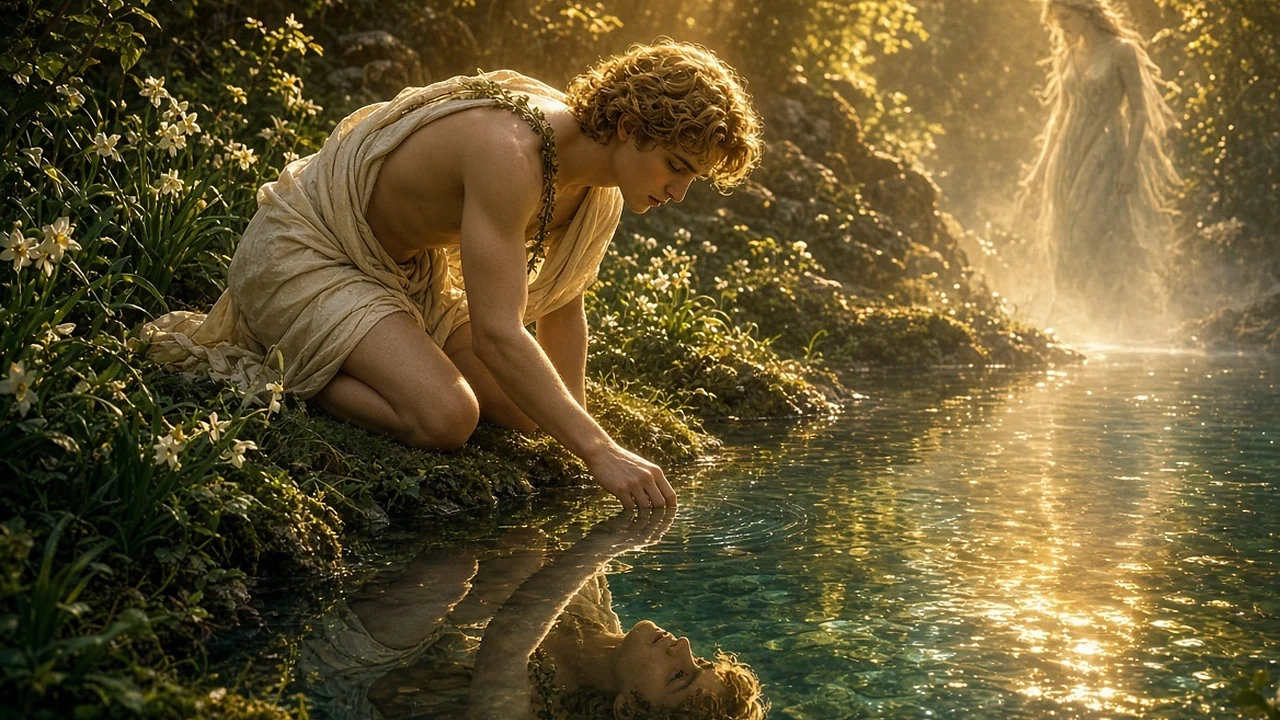
Narcissus and Echo is a Greek myth of a beautiful young man who falls in love with his own reflection and a mountain nymph condemned to repeat the words of others. In Ovid’s Metamorphoses Book 3, Echo is punished by Juno, the Roman name for Hera, after using conversation to distract the goddess. Echo later loves Narcissus, but he rejects her. After another rejected admirer asks that Narcissus experience unreturned love, a divine power answers the appeal. Narcissus sees a beautiful face in a clear pool, not realizing it is his own. Unable to reach or leave the image, he wastes away; a narcissus flower appears where his body should be. The story is not simply a lesson that anyone who looks in a mirror is selfish: it is a tragic poem about rejection, mistaken perception and desire.
Who were Narcissus and Echo in Greek mythology?
Narcissus is a youth renowned for extraordinary physical beauty. In Ovid he is the son of the river god Cephisus and the nymph Liriope. Admirers include young men and women, but Narcissus’s pride prevents them from approaching him successfully. Echo is a mountain nymph, an Oread, who once had the ability to talk freely and at length. Her later restriction to repeating the words of others gives her a very different difficulty from Narcissus’s inability to love anyone outside himself.
The two characters are linked by a painful imbalance. Echo wants to speak her own feelings but cannot choose the words she needs. Narcissus can speak but cannot recognize that the beloved face he sees is his own. In the same poem, their problems become mirrors of each other: one is denied a voice and the other loses himself to an image. The legend uses supernatural changes to explore conditions that feel emotionally familiar, rather than offering proof of any real transformation into a sound or flower.
What did Tiresias predict about Narcissus?
Before the tragic events, the nymph Liriope asks the blind prophet Tiresias whether her child will live a long life. In Ovid, Metamorphoses 3.339–358, he replies with a condition often rendered as “if he does not know himself.” The warning seems obscure because Narcissus is still a child, and no one can know in advance how the youth will react to seeing his reflection. The prophecy sets up the poem’s dramatic irony.
The words should not be reduced to the ordinary philosophical advice “know yourself.” Ovid reverses that familiar ideal in a tragic situation: recognizing himself in the pool becomes entangled with his destruction. Later readers may interpret this as an ironic comment on self-knowledge, identity or obsession. Those are interpretations of the literary scene, not a prediction about how long an actual person would live after looking into water.
Why did Hera or Juno punish Echo?
Ovid tells us that Juno, Hera’s Roman counterpart, is searching for her husband Jupiter, the Roman name for Zeus, when Echo repeatedly engages her in lengthy conversation. The distraction gives other nymphs time to get away. Realizing what has happened, Juno restricts Echo’s tongue so that she can repeat the ends of words or phrases spoken by someone else but cannot start a normal conversation on her own.
The punishment is especially cruel because Echo’s ability to communicate is changed into an imitation of other voices. She can still understand and desire, but she cannot speak freely. The story should not imply that Hera literally invented the scientifically observable acoustic echo. Sound reflections are physical phenomena; Ovid supplies a supernatural poetic explanation for why a voice seems to return from valleys and mountains. The imagery also prepares the reader for Echo’s later attempt to communicate her love to Narcissus.
How did Echo fall in love with Narcissus?
Echo notices Narcissus while he is hunting in the woods. She follows him secretly, deeply attracted to him but unable to make the first verbal approach. When Narcissus becomes separated from his companions, he calls out, and Echo repeats the final words. A strange exchange follows in which he hears his own words returned from an unseen place. He asks the unknown speaker to come together with him, and Echo enthusiastically repeats the phrase, believing it finally gives her an opening.
Echo rushes toward Narcissus and tries to embrace him. He rejects her sharply, refusing intimacy. She withdraws in humiliation and hides among lonely places. Ovid later describes her body wasting away until only voice and stone-like remains are left. Readers may debate Narcissus’s lack of compassion, but the scene should not be rewritten as a consensual relationship. Echo’s longing is one-sided, and the loss of her own voice makes the rejection particularly painful.
Who cursed Narcissus to fall in love with himself?
Ovid connects Narcissus’s fate with a plea from one of his rejected admirers, who asks that Narcissus himself experience desire that cannot be fulfilled. The poem describes a divine response associated with Rhamnusia, commonly identified with the goddess Nemesis, who is connected with retribution. This makes the reflection episode a response to the youth’s treatment of others, not merely a random accident when he pauses to drink water.
It is easy to oversimplify the story by saying Echo personally casts the curse at Narcissus. In Ovid’s narrative the plea comes from another rejected admirer, while Echo’s grief is a separate part of the plot. Nor should the curse be described as a clinical psychiatric diagnosis or an experiment in mirror psychology. Its logic is poetic and moral: a person who dismisses everyone else’s desire is made to understand unreciprocated love from the inside.
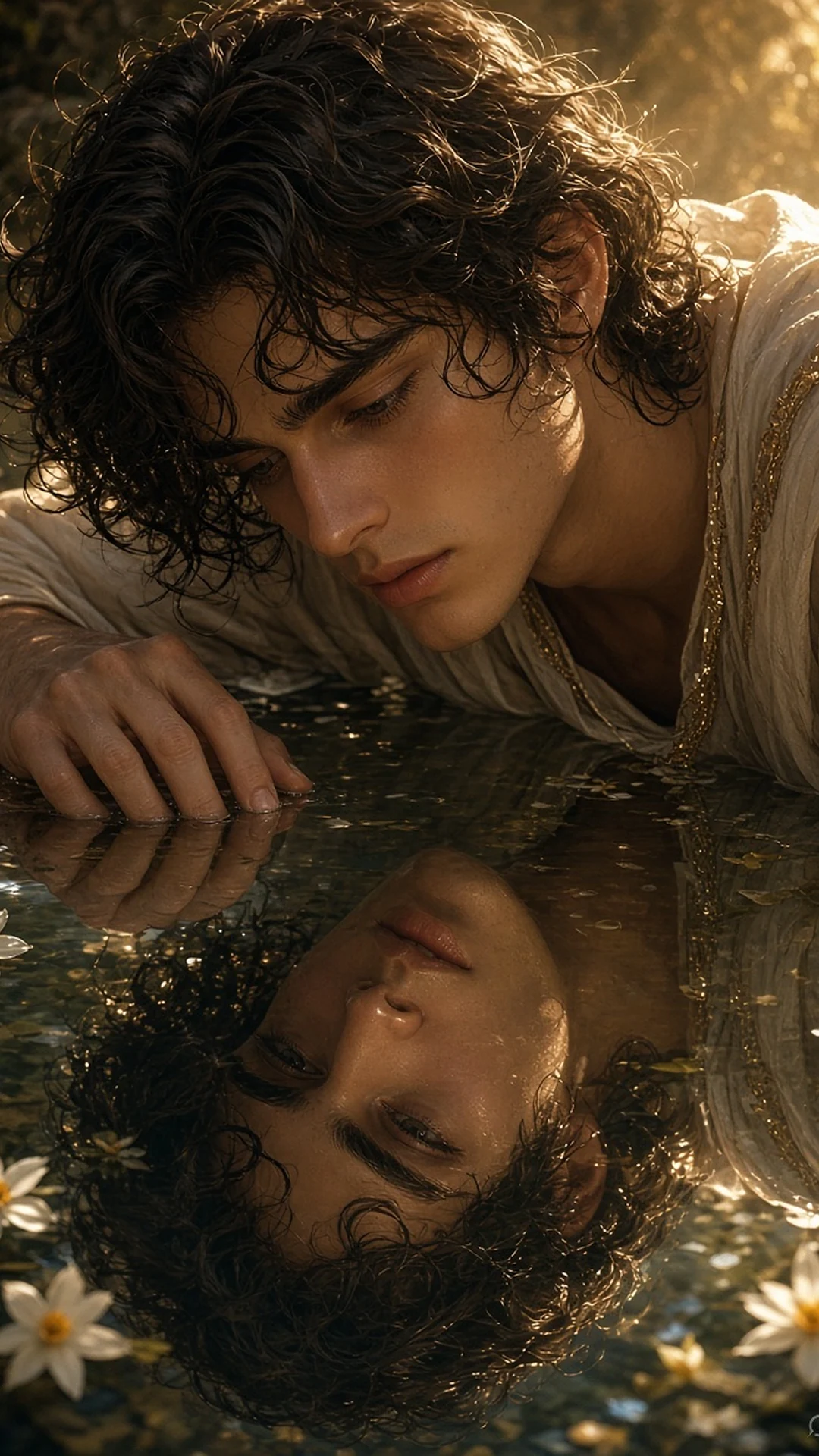
What did Narcissus see in the water?
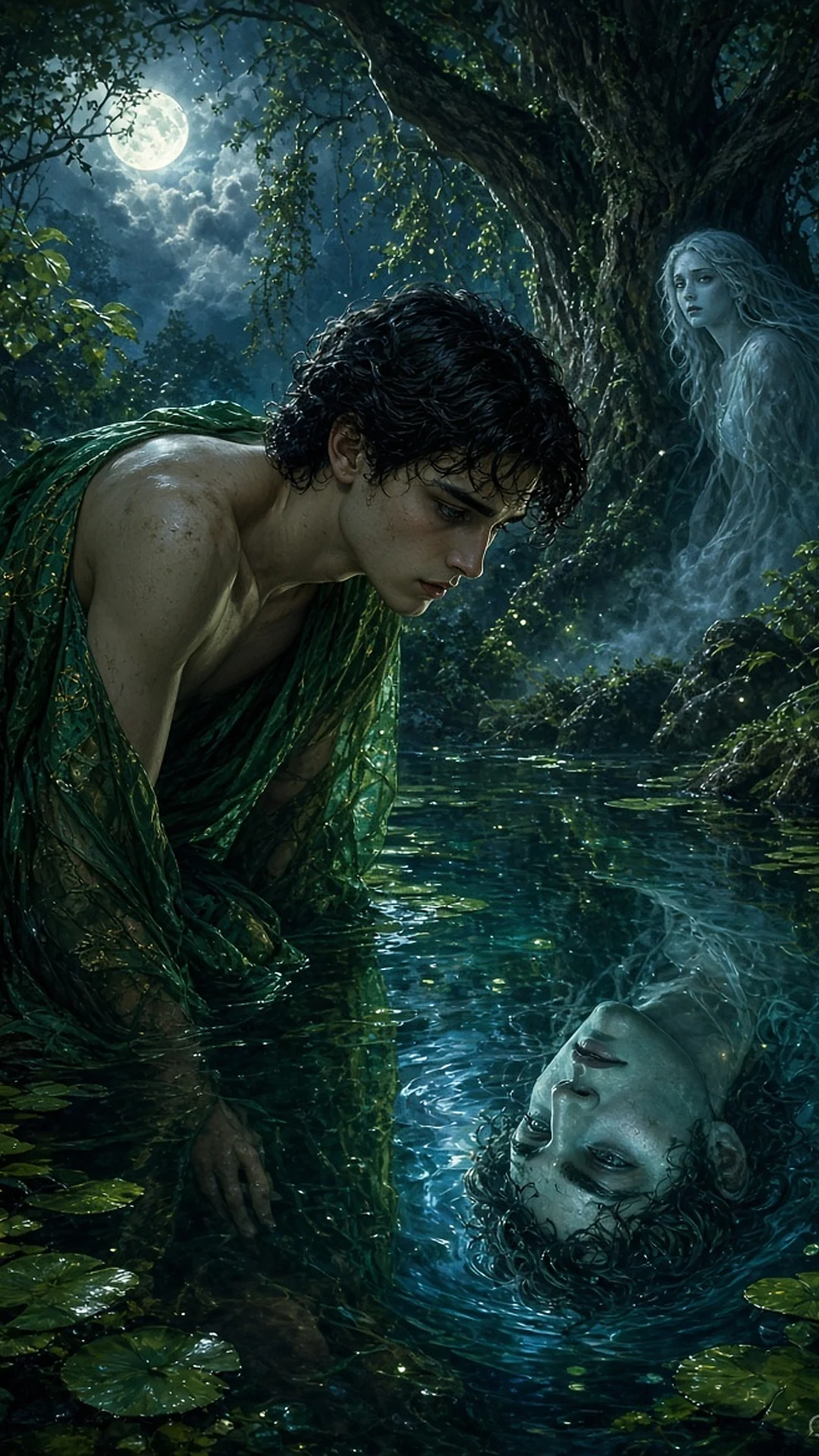
At a clear, undisturbed spring, Narcissus kneels to drink. He sees a beautiful face in the water’s reflection and becomes captivated, believing for a time that he is looking at another person. The image mirrors his movements and expressions. When he tries to kiss or touch it, the water disturbs the surface and the face disappears or changes. He cannot understand why the beloved person seems close enough to see yet impossible to embrace.
The key dramatic irony is that the reader knows the truth before Narcissus does. Ovid carefully describes his discovery: he eventually realizes that the object of his longing is his own image. Recognition does not release him. He cannot separate the beauty he desires from the impossibility of reaching it as another individual. A modern illustration showing two distinct lovers standing in the pool would miss the tragedy, because there is no second real person there.
How did Narcissus die and become a flower?
Narcissus remains beside the water, consumed by unattainable longing. He loses strength and gradually wastes away. In Ovid the exact poetic description involves his fading body and the lamentation of the nymphs. Echo, despite her earlier rejection, repeats his cries and participates in the sorrow. When others prepare his funeral, they find no body; instead there is a flower with white petals surrounding a yellow center, associated with the narcissus.
The change belongs to the genre of metamorphosis, where a human or divine story gives a plant, animal or natural feature its mythic meaning. It does not establish that flowers historically evolved from a human corpse. Narcissus is also not killed by the reflection physically dragging him under water in Ovid’s main account. The decisive process is his fixation, exhaustion and transformation. That distinction matters when comparing the ancient poem with later films and sensational retellings.
Is Narcissus the source of the word narcissism?
The modern term narcissism draws on the mythological name Narcissus. In ordinary speech, people may use “narcissistic” to mean excessive self-admiration or disregard for others. But a fictional boy fixated on his reflection is not a modern clinical case study, and it would be irresponsible to diagnose someone solely because they enjoy taking selfies or care about appearance. Mental health professionals use careful criteria and context rather than a single mythological comparison.
In the literary story Narcissus’s behavior damages his relationship with admirers and finally his own life. That may inspire discussion of empathy, boundaries and the difference between confidence and disregard for other people. The scientific meanings of reflection, sound and psychological traits belong to separate disciplines. A reliable educational page can explain the word’s cultural origin while not treating a two-thousand-year-old poem as a diagnostic manual.
Echo versus Narcissus: whose tragedy matters more?
Although the title often names Narcissus first, Echo has her own tragedy. She is deprived of a normal speaking voice before she ever meets him. Her longing becomes almost impossible to express, and her rejection leads to withdrawal and physical fading. The plot then turns to Narcissus, whose problem is the opposite: he has a voice and a body, yet he can only respond to his own image. Both characters are isolated in different ways.
The two transformations also correspond to familiar natural phenomena: Echo becomes a voice without a visible person; Narcissus becomes a visible flower without the human life that once admired beauty. Neither explains the science of acoustics or botany. Together they offer a thoughtful narrative about communication, desire and the limits of appearances. This balanced reading avoids treating Echo as nothing more than background decoration beside a beautiful young man.
Did Greek myth and Ovid tell exactly the same version?
The character of Narcissus has Greek roots, but the most influential complete narrative joining Echo and Narcissus survives in the Roman poet Ovid’s Metamorphoses Book 3. Some Greek sources and local accounts differ in the circumstances of Narcissus’s obsession, including other explanations for the reflection or the character’s death. A modern article should state the author instead of claiming every detail was written by Homer or Hesiod.
Roman names such as Juno and Jupiter appear in Ovid’s version; their Greek counterparts are Hera and Zeus. This is a normal feature of Roman adaptations of Greek-connected myths. Readers who want to compare the wider traditions can consult a separate Greek-versus-Roman mythology article, but the source for Echo’s specific curse remains the passage in Ovid. Correct attribution preserves both traditions without collapsing them into one allegedly original manuscript.
Narcissus and Echo story timeline
| Stage | What happens | Key character |
|---|---|---|
| Prophecy | Tiresias warns about self-recognition | Narcissus |
| Curse | Juno limits speech to repetition | Echo |
| Encounter | Echo approaches and is rejected | Both |
| Prayer | A rejected admirer asks for retribution | Narcissus |
| Reflection | He loves the face in the pool | Narcissus |
| Tragedy | He fades away and dies | Narcissus |
| Transformation | Flower appears in his place | Narcissus |
Five FAQs about Narcissus and Echo
Why was Echo able only to repeat words?
In Ovid, Juno punished her for distracting the goddess so that other nymphs could escape Jupiter’s attention.
Did Narcissus fall in love with a real person in the pool?
No. He fell in love with his own reflection, initially mistaking it for someone else.
Who punished Narcissus?
A rejected admirer prays that Narcissus experience unreturned love; the response is associated with Nemesis.
What happened to Narcissus in the end?
He wasted away beside the pool and a white-and-yellow narcissus flower was found in place of his body.
Is the story a medical explanation of narcissism?
No. It inspired the modern word but remains a literary myth, not a clinical diagnosis.
Sources and conclusion
The complete paired narrative is Ovid, Metamorphoses 3.339–510; compare the University of Virginia translation of Book 3. For mythological variants see Theoi’s Narcissus dossier. Conclusion: Echo loses independent speech while Narcissus loses himself to an image, and their connected tragedies explore rejected affection and the danger of mistaking appearances for human connection. Updated 14 November 2026. Images are illustrative myth art.

















Share Your Opinion
Comments are closed on this post.