 Vista
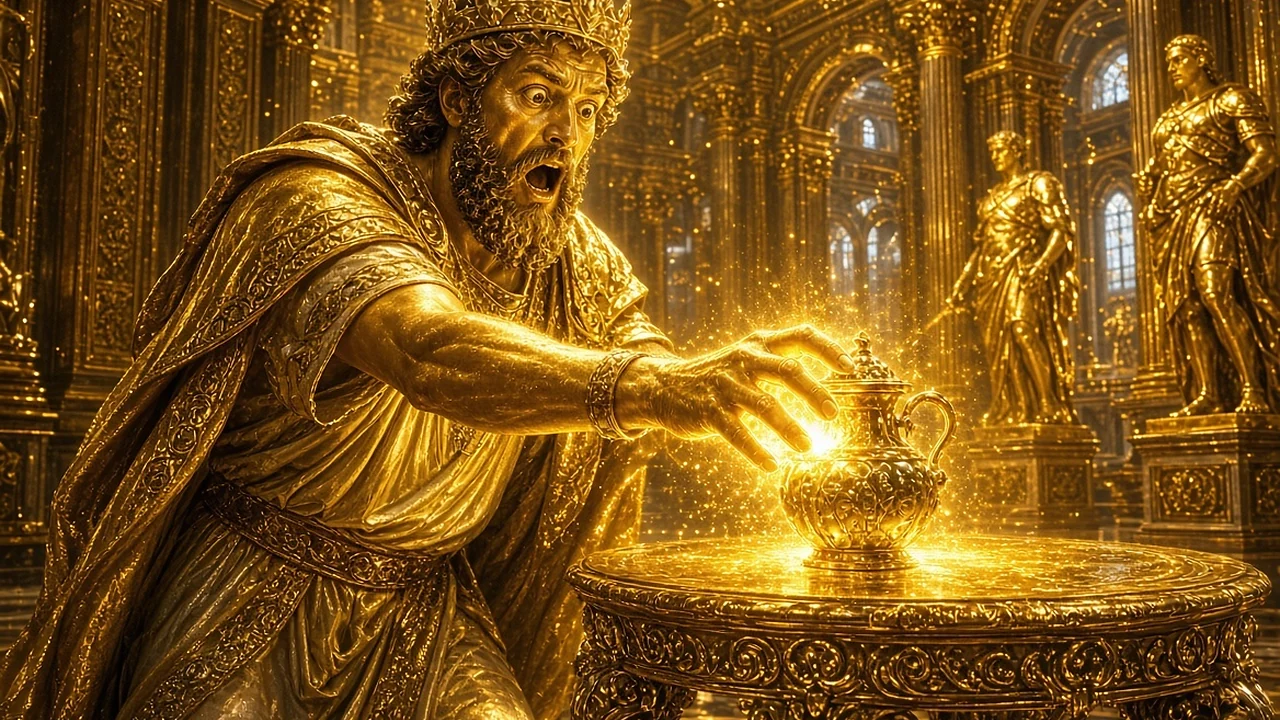
King Midas story is a famous myth about a ruler whose wish that everything he touched should turn to gold became a terrible burden. In Ovid’s Metamorphoses Book 11, the god Bacchus (Dionysus) rewards Midas for his kindness to the god’s companion Silenus. Midas chooses the Golden Touch, only to discover that food and drink become useless metal when he handles them. He begs the god to remove the gift and is told to wash in the River Pactolus, whose golden sands the story explains. A separate Midas tale tells how he gained donkey ears after siding with Pan over Apollo in a music contest. The lesson about greed is well known, but not every popular detail—including a daughter turned into a statue—appears in Ovid’s main account.
Who was King Midas in Greek mythology?
Midas is a legendary ruler closely associated with Phrygia in Anatolia, in what is now part of Turkey. His name is also known from discussions of ancient Phrygian history, but the supernatural Golden Touch belongs to myth and literary storytelling. We should not confuse the existence of rulers or traditions associated with the name Midas with proof that anyone could transform wooden furniture or bread into precious metal by touching it.
The king is usually remembered for an impossible wish, yet his literary character has at least two prominent stories: the wealth that becomes a curse and the judgment that makes his ears resemble those of a donkey. These are connected in Ovid’s narrative but ask different questions. The first considers what happens when wealth defeats basic human needs. The second considers poor judgment, pride and whether a ruler’s opinion deserves automatic respect. Reading them separately makes the complete Midas cycle more informative than a three-sentence morality tale.
How did Midas meet Silenus and the god Dionysus?
In Ovid’s Metamorphoses Book 11, Silenus, an elderly companion and teacher figure associated with Bacchus or Dionysus, becomes separated from the god’s followers. Local people bring him to Midas, who recognizes his connection with Dionysian rites and entertains him generously. The poem describes ten days and nights of celebration before the king returns Silenus to Bacchus. The kindness of this act becomes the reason Midas is offered a special reward.
This starting point is often missing in short adaptations that begin with a mysterious fairy appearing out of nowhere. In the classical passage the reward comes from Dionysus/Bacchus, the deity associated with wine, celebration and transformative experiences. Silenus matters because his return triggers the offer. Midas could ask for many things, but his particular choice reveals what he values at that moment. The episode is not a biblical parable or an early Homeric account; its famous extended form is recorded by a later Roman poet drawing on Greek traditions.
What was King Midas’s exact Golden Touch wish?
Asked to select his reward, Midas requests that anything his body touches become gold. Bacchus grants the wish, though the narrative suggests that the choice is foolish. At first Midas is delighted. He tries touching natural objects and other everyday things to prove the power works. A twig, stone or ear of grain may become a golden object in scenes from the poem and later art. The ability appears to promise unlimited wealth without mining, commerce or work.
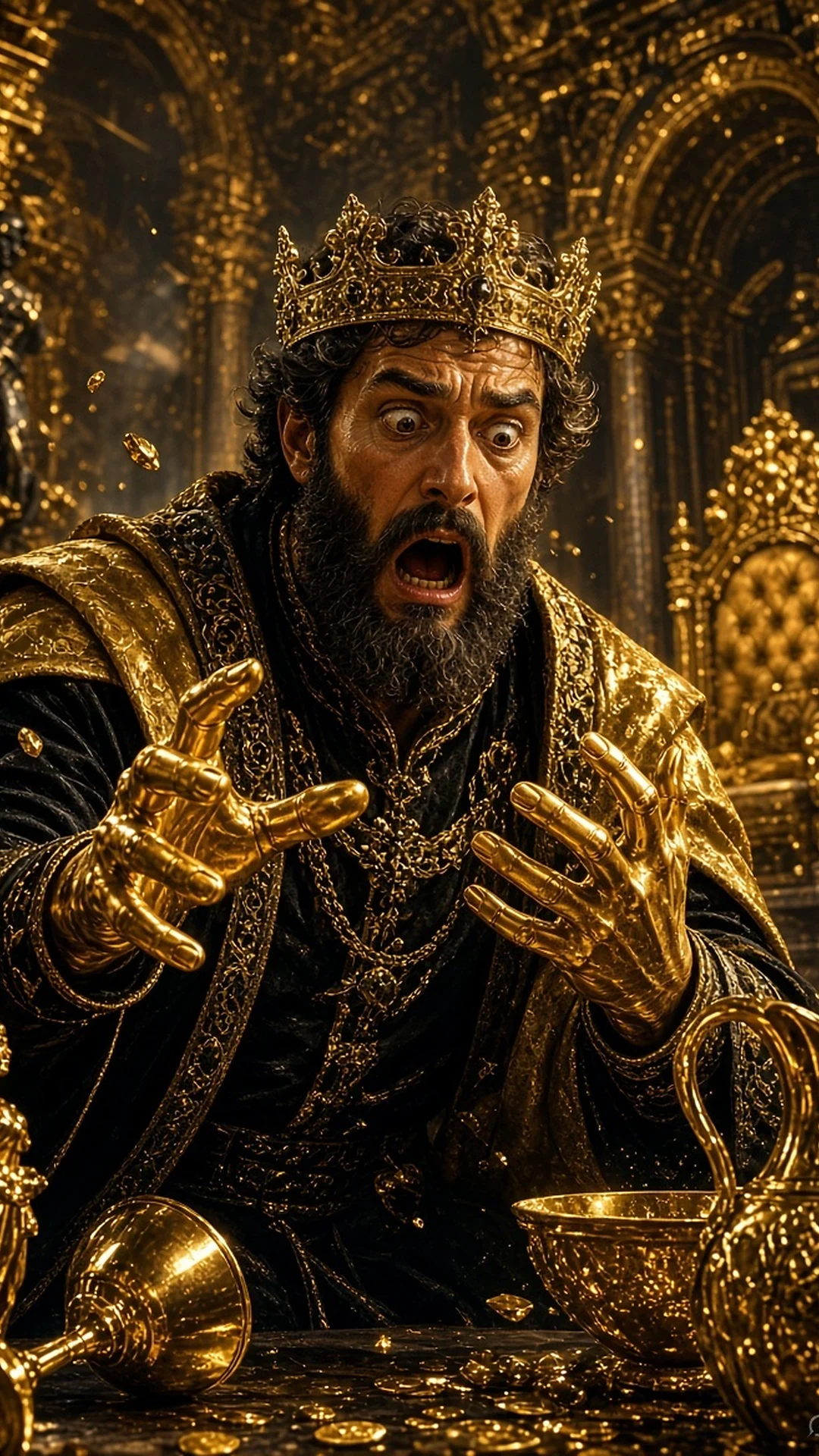
But the wish contains a fatal problem: the power affects things he does not want to turn into metal. A feast cannot nourish a person if food becomes solid gold before it reaches the mouth. In a world where survival requires eating and drinking, the supposed greatest gift threatens to leave its owner hungry and thirsty. The story does not require a complicated financial calculation to show that abundance of one commodity is meaningless when it destroys everything else needed for life.
Why couldn’t Midas eat or drink after the wish?
Midas’s excitement changes into despair when he sits down to eat. As he touches bread and other food, it becomes metal rather than something he can consume. Even wine or liquid he tries to drink is transformed. Ovid portrays the punishment as a reversal: what seemed like boundless luxury makes the king incapable of enjoying an ordinary meal. The contrast is especially strong because a wealthy royal household would normally have access to elaborate banquets and pleasurable celebrations.
In modern terms, the legend shows a mismatch between price and usefulness. Gold can be valuable as a material, but a metal sandwich will not prevent starvation. A person’s true well-being depends on relationships, health, sustenance and ordinary experiences, not on acquiring a single scarce substance. These are modern ways to discuss the ancient plot, not direct scientific or economic claims by the Roman poet. The narrative communicates the danger through a vivid physical impossibility.
Did King Midas turn his daughter into a golden statue?
Many modern children’s books and videos show Midas hugging a beloved daughter, only to turn her into gold. It is a powerful dramatic addition because it gives the king an immediate family tragedy that helps him recognize his mistake. However, the scene should not be attributed as a definite episode of Ovid’s Metamorphoses Book 11. Ovid’s central Golden Touch account emphasizes the transformation of objects, food and drink and the king’s desperation, rather than presenting this particular daughter-statue episode.
This does not mean modern retellings containing the daughter are forbidden or worthless. Adaptations often change older myths to teach children or make the emotions clearer. The important requirement is honest labeling. A post that says “In the famous modern version his daughter turns to gold, but this is not in Ovid’s telling” gives readers both the familiar scene and the source difference. Claiming an ancient eyewitness described the daughter would undermine trust in an otherwise valuable mythology article.
How did King Midas get rid of the Golden Touch?
Realizing that he cannot live with the power, Midas begs Bacchus to remove it. The god directs him to a river associated with the region of Pactolus and instructs him to wash, thereby transferring the strange power from his body. Midas follows the instructions, and the ability no longer afflicts him. The golden quality becomes associated with the river’s sands in the etiological explanation, connecting a local landscape feature with the legendary event.
The River Pactolus is a real geographic name known in antiquity, but the existence of gold-bearing deposits is not evidence that a king once transferred magic into the water. Ancient myths frequently explain a place name or natural feature through an extraordinary narrative. A careful caption should distinguish a photograph of a modern river from an imagined scene of Midas bathing after his desperate plea. The key ending is that the king values ordinary life more than the power he had originally begged to possess.
Why did King Midas get donkey ears?
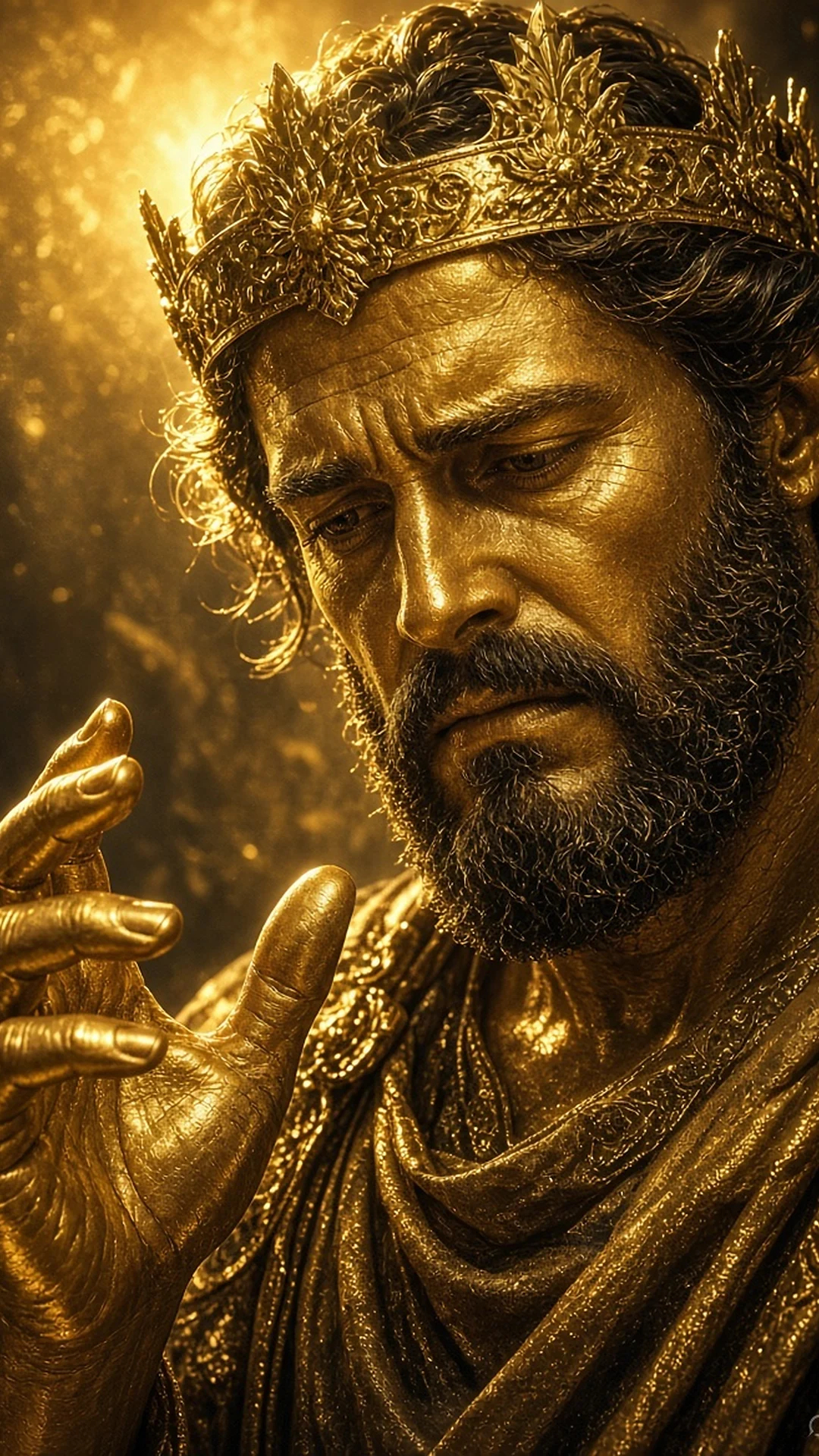
Ovid tells another episode in which Midas leaves the busy world of wealth and becomes involved in a musical competition. The woodland god Pan plays on pipes, while Apollo performs with his instrument. The mountain god Tmolus judges the competition in Apollo’s favor, but Midas is unhappy with the result and favors Pan’s rustic music. Apollo responds by changing Midas’s ears into those of a donkey, marking the foolish judgment on his body.
Unlike the Golden Touch, this punishment does not make food impossible to eat. It humiliates a person who assumes his own taste should overrule the recognized judgment. The two stories share a broader point about unreliable human choices. Midas misjudges what reward would make him happy and later misjudges a musical contest. But these are different episodes, so “Midas got donkey ears because he tried to sell gold” is not an accurate account of the ancient narrative.
How did the secret of Midas’s ears get revealed?
Midas hides the donkey ears under headgear, but his barber discovers the embarrassing secret when cutting his hair. The barber is forbidden to tell anyone, yet the knowledge becomes impossible to keep inside. In Ovid’s story he digs a hole in the ground, whispers the secret into it and covers it up. Later reeds grow in that place, and the wind causes them to repeat the secret. The king’s carefully concealed transformation is made public by nature itself.
The episode belongs to the family of stories about secrets that cannot remain hidden forever. Children often remember the whispering reeds better than the contest, which makes the tale attractive for illustrations. Still, the scene is a supernatural explanation for the movement and sound of reeds, not a claim that real plants record speech. It also shows how later readers can draw lessons about foolish decisions, power and the social pressure to preserve a ruler’s dignity.
What does “Midas touch” mean in modern English?
The idiom “the Midas touch” usually means a talent for turning ventures into commercial successes or making money from many projects. A businessperson described this way is expected to create value wherever they work. Ironically, the original myth warns that unlimited gold can bring terrible consequences. The phrase tends to remember the miraculous profit-making ability while leaving out the king’s starvation and his plea to escape the gift.
That difference between idiom and full myth is worth explaining. If someone says a designer has the Midas touch, they are using a metaphor, not reporting supernatural chemistry. A complete article can give a practical example and still encourage readers to explore the deeper source. The most convincing moral is not simply “never want money”; it is that choices focused on one attractive benefit can ignore essential human needs and create dangers the person failed to anticipate.
Was Midas a Greek or Phrygian king?
The legendary Midas is closely tied to Phrygia, a region in Anatolia rather than the mainland Greek city-states. Greek and Roman authors tell stories about him, and the name also appears in the broader history of ancient Phrygian rulers. A story being part of Greek mythology does not require its setting to be Athens or Olympus. Greek literature regularly describes figures and places across Anatolia, the Aegean and the wider Mediterranean.
The proper distinction is between a historical culture and a supernatural literary episode. Archaeological study can investigate ancient Phrygia, its rulers and gold-bearing landscapes. It cannot verify a touch that transforms a flower into metal merely because the king’s name resembles historical evidence. Labeling Ovid’s narrative as a Roman-era literary version of a Greek-connected legend is more precise than claiming the same detailed text was written by Homer.
King Midas story timeline and source differences
| Step | Event | What to remember |
|---|---|---|
| Hospitality | Midas welcomes Silenus | Dionysus rewards him |
| Wish | Everything touched turns gold | Gift seems valuable |
| Consequence | Food and drink transform | Ordinary life becomes impossible |
| Release | Washing in Pactolus | Power removed |
| Music contest | Midas favors Pan | Apollo gives donkey ears |
| Secret | Barber whispers into ground | Reeds reveal it |
| Modern retelling | Daughter turns to gold | Do not cite as Ovid’s scene |
Five FAQs about King Midas
What was King Midas’s wish?
He asked Dionysus to turn everything he touched into gold.
Why did the Golden Touch become a curse?
It changed food and drink into metal, threatening Midas’s basic survival.
Did Midas turn his daughter into gold?
That scene is familiar from later retellings but is not in Ovid’s central Golden Touch narrative.
How did Midas lose the Golden Touch?
At Bacchus’s direction, he washed in the River Pactolus.
Why did Midas grow donkey ears?
In a separate musical contest story, he judged Pan’s music better than Apollo’s.
Primary sources and conclusion
The principal extended version is Ovid, Metamorphoses Book 11, covering Silenus, the wish, Pactolus and the musical contest. For character background and collected evidence see Theoi’s Midas dossier. Conclusion: the Golden Touch teaches that limitless riches cannot replace food and ordinary life, while the donkey-ears episode exposes another kind of poor judgment. Updated 14 November 2026. Visuals are mythic artwork.




















Share Your Opinion
Comments are closed on this post.