 Vista

Prometheus story is the ancient Greek myth of a Titan who defied Zeus and brought fire to humanity. In the early poems of Hesiod, Prometheus tricks Zeus during a dispute over sacrifice, secretly carries away fire in a hollow fennel stalk, and suffers a terrifying punishment: he is bound while an eagle eats his liver, which grows back. The hero Heracles later kills the bird and brings relief. The punishment is also linked to the creation of Pandora, whose jar introduces human suffering in a connected story. Prometheus is often called the benefactor of humankind, but a source-based explanation must distinguish Hesiod’s early account from later plays and retellings about the origin of civilization.
Who was Prometheus in Greek mythology?
Prometheus belongs to the family of the Titans, the older generation of Greek deities who precede the familiar Olympian regime. Hesiod identifies him as a son of Iapetus, with brothers including Epimetheus, Atlas and Menoetius. The two brothers Prometheus and Epimetheus are often associated in modern explanation with forethought and afterthought. That contrast becomes especially meaningful when Epimetheus ignores a warning about accepting a gift from Zeus.
The word “Titan” does not imply Prometheus is simply a random soldier fighting on Cronus’s side in the Titanomachy. Various Titan-descended figures interact with Zeus in different ways. Prometheus becomes famous because he repeatedly challenges the divine ruler over the treatment of humans. At different moments he is clever, protective, deceptive and willing to suffer. Reducing him to either a flawless superhero or an irredeemably evil thief would erase the contradictions that make the story influential.
What happened at Mecone? The trick of the sacrificial portions
In Hesiod’s Theogony, an event at Mecone explains a dispute involving the distribution of a sacrificed animal. Prometheus divides an ox into misleading portions. He hides desirable meat and entrails under the unattractive covering of the stomach, while he places bones under appealing white fat. The arrangement invites Zeus to choose a portion that looks valuable but contains bones. Zeus recognizes or responds to the deception in a scene whose wording leaves room for discussion of his knowledge and intentions.
The episode connects with an ancient Greek practice of assigning sacrificial portions to gods and humans. It is not a photograph of an actual banquet or proof that every ancient community performed a ritual in exactly this way. The mythic explanation matters because it sets up the quarrel over fire. Zeus’s response to the deception makes a skill essential to human life into an object of divine control. That move transforms a dispute about offerings into a much larger story about the human condition.
Why did Prometheus steal fire for humans?
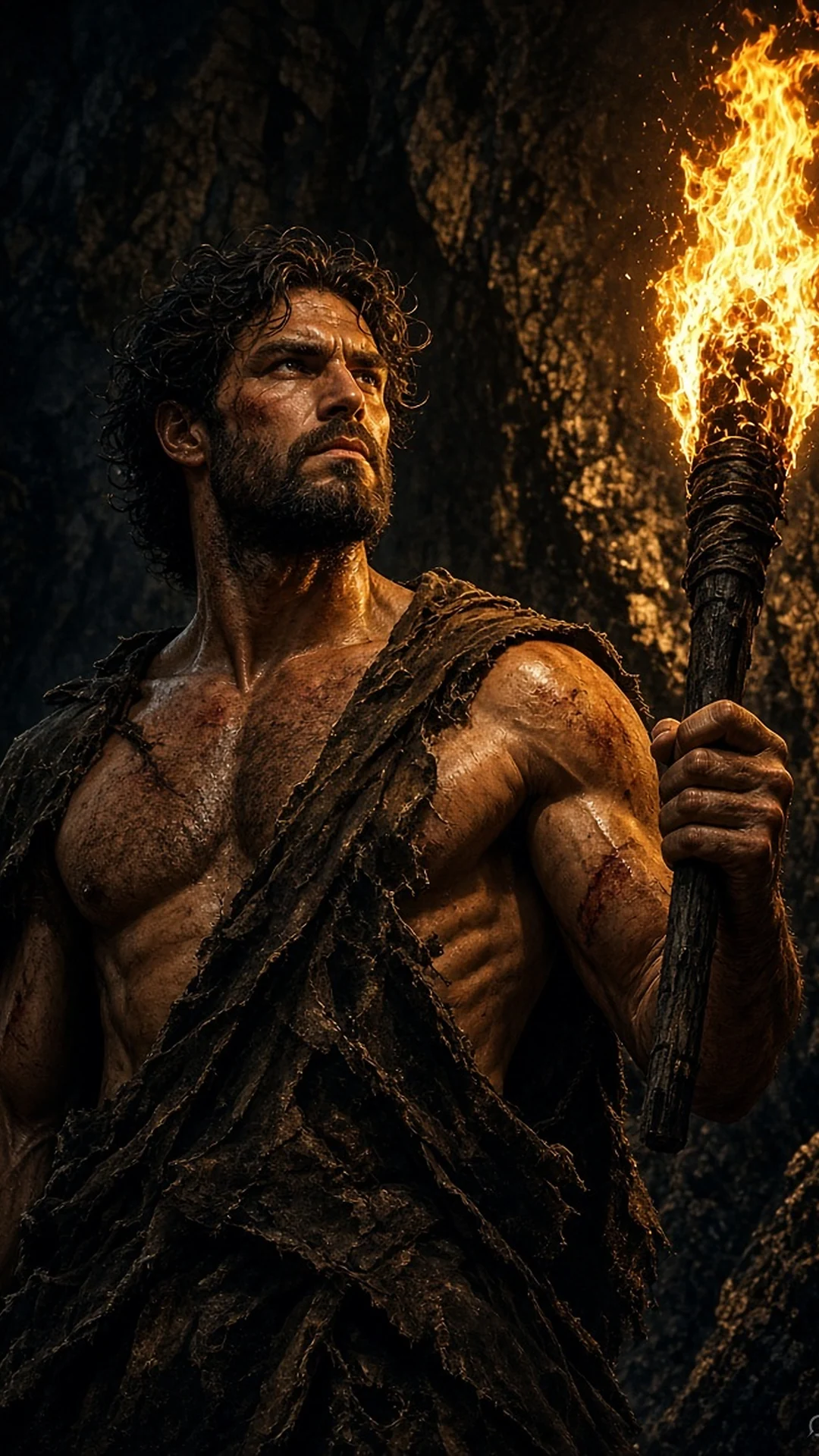
After the sacrificial deception, Zeus withholds fire from mortals. Prometheus secretly takes fire and returns it to humankind. Hesiod gives the memorable image of hiding a glowing spark within a hollow fennel stalk. This is not a modern match, lighter or futuristic machine: the plant stalk belongs to the ancient imagination and is key to the episode’s symbolism. The god can conceal a small light even when the ruling Olympian has tried to keep a vital power out of human hands.
Fire is useful for cooking, warmth, craft and working with materials. Those modern descriptions help explain why the gift seems essential, though we should not pretend Hesiod included a detailed scientific lecture about metallurgy or human evolution. Fire becomes a symbol of human survival and technical capacity. The action also raises a difficult question: when does helping others justify defying a powerful ruler? Different writers and readers interpret that challenge differently, while Hesiod’s story makes the act a central offense against Zeus.
How did Zeus punish Prometheus with an eagle?
Zeus orders a brutal and prolonged punishment. Prometheus is bound, and an eagle repeatedly feeds on his liver. The organ grows again, ensuring that the torment continues rather than ending after one attack. Hesiod’s Theogony describes the eagle’s recurring feeding and later intervention by Heracles. The scene is horrific even when narrated in brief, and educational adaptations for young readers may want to avoid unnecessarily graphic imagery while still acknowledging what the source says.
The story should not be presented as evidence that a real human liver can regrow indefinitely after being completely consumed. It is a supernatural punishment in a divine narrative. The location of Prometheus’s binding is described more specifically in later traditions, often connecting it with the Caucasus, but one should not automatically attribute every mountain detail to the same concise Hesiodic passage. A dramatic image of a bound Titan with a bird is an illustration of literature, not a historical eyewitness picture.
How did Heracles free Prometheus?
Heracles, known more widely in English as Hercules, appears in important versions as the hero who eventually ends Prometheus’s suffering. In Hesiod’s Theogony, he kills the eagle that is feeding on Prometheus, relieving the Titan. The poem links this with Zeus’s willingness to permit his son’s honor or glory to increase. Other retellings elaborate the release, the chains and the negotiation involving divine authority. Readers should identify which version they mean before describing the ending.
The rescue is particularly interesting because Heracles is a son of Zeus, the god responsible for the punishment. That makes the eventual relief more complicated than a straightforward duel between the Titan and an enemy champion. The story allows different relationships within the divine family to overlap. It also links two search topics: Prometheus’s fire and punishment, and Heracles’s broader adventures. The latter has a separate set of twelve famous labours and should not be reduced solely to the eagle episode.
How is Pandora connected with Prometheus?
In Hesiod’s Works and Days, Zeus’s response to Prometheus’s deception and theft of fire includes the creation of Pandora, an attractive but dangerous divine gift. Hephaestus shapes her, and Athena, Hermes and other deities contribute qualities. Prometheus warns his brother Epimetheus not to accept a gift from Zeus. Epimetheus nevertheless receives her, and the narrative proceeds toward the opening of a container that releases suffering among humans.
One important detail often lost in modern illustrations is that Pandora’s container in Hesiod is a large storage jar, or pithos, not the small jewelry box of popular English usage. Elpis, commonly translated Hope or Expectation, remains under its lid. Its meaning has attracted debate; a careful summary should not pretend the text provides a single universally accepted emotional lesson. The related myths explain the link between human fire, divine punishment, hardship and hope while preserving their distinct episodes.
Did Prometheus create humans from clay?
Many modern retellings say Prometheus made the first humans from clay. That idea belongs to an important stream of later Greek and Roman literary tradition, including versions associated with Apollodorus or Ovid and other retellings. It should not simply be quoted as the opening premise of Hesiod’s most famous fire-theft passage. In Hesiod, humans already exist as recipients of the fire and participants in the sacrificial arrangement. The subject of human origins belongs to overlapping but distinct stories.
The difference illustrates how a character can accumulate roles across centuries. A benefactor who steals fire can also become a divine craftsman in another telling. Some later writers turn Prometheus into a larger symbol of technical invention and human progress. Those adaptations are valuable parts of literary history, but it is still important to say which text includes which event. This article focuses chiefly on the early fire-and-punishment cycle rather than treating all versions as if Hesiod wrote them in one continuous chapter.
Prometheus Bound: how is the later drama different?
The tragedy Prometheus Bound, traditionally attributed to Aeschylus though its authorship is debated by scholars, greatly develops the Titan’s defiance and suffering. Prometheus speaks at length about what he has given humankind and the tension between power and justice. His conflict with Zeus becomes a sustained dramatic debate instead of a brief genealogical episode. The play also introduces or emphasizes other figures and prophecies in ways that change how an audience experiences the character.
When a popular article says that Prometheus invented every human craft, medicine and language, it may be combining later dramatic claims with early Hesiodic material. That is acceptable as a comparison if the authors are named. It is inaccurate to say the whole expanded inventory appears word for word in Works and Days. Ancient myths are dynamic, and their literary transformations can be explained without sacrificing evidence or making the articles needlessly complicated.
What does the Prometheus story mean?
One familiar modern reading treats Prometheus as a symbol of rebellion against unjust power and the value of knowledge. Another sees the tale as a warning that divine boundaries and social arrangements have consequences when violated. Hesiod’s own moral framing is not identical to the sympathetic portrait in every later play or novel. A balanced interpretation recognizes the Titan’s assistance to humans as well as the deception and serious divine retaliation that drive the plot.
Fire is particularly effective as a symbol because it can be both beneficial and dangerous. It helps people survive yet can also burn and destroy. Likewise, technical knowledge creates choices and responsibilities rather than automatic happiness. Readers may draw lessons about foresight, helping others or the risks of using power, but those lessons are modern interpretations. They should be introduced as possible readings rather than falsely attributed as an ancient quotation.

Prometheus story timeline
| Stage | Event | Core source |
|---|---|---|
| Divine family | Prometheus born to Titan Iapetus | Hesiod, Theogony |
| Mecone | Sacrificial portions arranged deceptively | Hesiod, Theogony |
| Fire withheld | Zeus conceals fire from humans | Hesiod |
| Fire stolen | Prometheus carries it in a fennel stalk | Hesiod |
| Retribution | Prometheus bound, eagle attacks liver | Hesiod |
| Pandora | Divine gift and jar explain human hardships | Works and Days |
| Relief | Heracles kills the eagle | Theogony |
Prometheus myth: five FAQs
Why did Prometheus steal fire?
He defied Zeus’s withholding of fire and gave humans an essential resource in Hesiod’s myth.
How did Prometheus carry the fire?
Hesiod describes concealing it in a hollow fennel stalk.
What was Prometheus’s punishment?
He was bound while an eagle repeatedly ate his liver, which grew back.
Who rescued Prometheus?
Heracles killed the eagle and ended the torment in the early Hesiodic account.
How is Pandora related to the story?
Zeus creates the gift of Pandora in the connected punishment narrative, following the conflict over fire.
Sources and conclusion
For the sacrificial trick, fire theft, punishment and eagle see Hesiod, Theogony 507–616. For Pandora and Epimetheus see Hesiod, Works and Days 42–105. For a dramatically different treatment compare Prometheus Bound, traditionally attributed to Aeschylus. Conclusion: the Prometheus myth links the human gift of fire with divine authority, severe punishment and eventual relief through Heracles. Its meaning grows when we keep the early epic and later play distinct. Updated 14 November 2026. Images are illustrative.
















Share Your Opinion
Comments are closed on this post.