 Vista

Greek creation myth begins not with Zeus creating everything but, in Hesiod’s Theogony, with Chaos, followed by Gaia (Earth), Tartarus and Eros. Gaia brings forth Ouranos, the starry Sky, and later the divine generations of Titans, Cyclopes and Hundred-Handers appear. A succession of conflicts leads from Ouranos to Cronus and ultimately to Zeus, whose Olympian order becomes dominant. This is an ancient Greek story about the origins of gods and their world, not a scientific account of the Big Bang. Other Greek poets and Orphic traditions offer different accounts, so it is more accurate to talk about Greek creation myths than one unchanging universal version.
How was the world created in Greek mythology?
The most influential surviving Greek account of beginnings is Hesiod’s Theogony, an early epic about the birth and succession of divine beings. Its description, beginning around line 116, is better understood as a cosmogony, an account of how an ordered world emerges, and a theogony, a story of how gods are born. Hesiod does not begin with Zeus already sitting on Olympus and designing individual planets. He starts with fundamental beings or conditions, then shows relationships and struggles that lead toward the Olympian world.
The earliest verses may feel strange because the poem does not provide the modern narrative of a creator making the universe from nothing at a definite instant. Some beings simply come into existence, while others are born through unions or other acts. This was meaningful within ancient poetic and religious thought, but the text does not describe observational astronomy. Readers comparing myths should first identify Hesiod as the source rather than assume every Greek author gave the same opening line.
Chaos: was it empty space or disorder?
Hesiod’s opening says Chaos came first. In modern English, “chaos” often means disorder, confusion or a dangerous mess. In scholarly discussion of the ancient Greek term Khaos, however, it may suggest a yawning gap or opening. That is not the same as the scientific concept of a quantum vacuum, a black hole or a nebula. A video that presents a modern telescope image as the actual picture of Hesiod’s Chaos is illustrating a metaphor, not recording an ancient object.
From Chaos emerge Erebus, associated with darkness, and Nyx (Night). Their union later brings Aether and Day in Hesiod’s lines. Such relationships show how the poet personifies parts of experience that humans recognize: darkness, nighttime, daylight and upper air. The figures are not merely scenery because they take part in genealogies. The story’s early movement is from elemental conditions toward a world populated by powers with names and relationships.
Gaia, Tartarus and Eros: the first divine realities
After Chaos, Hesiod describes Gaia, the broad Earth who provides a stable foundation, Tartarus in the deep region beneath, and Eros, the powerful force of desire. Eros here should not automatically be imagined as the familiar winged child Cupid from much later art. In Hesiod’s opening, desire is a primordial power that affects divine and human beings. The word “first” also needs care: the poem has an order of appearance, but those entities are not described as employees waiting for a king to appoint them.
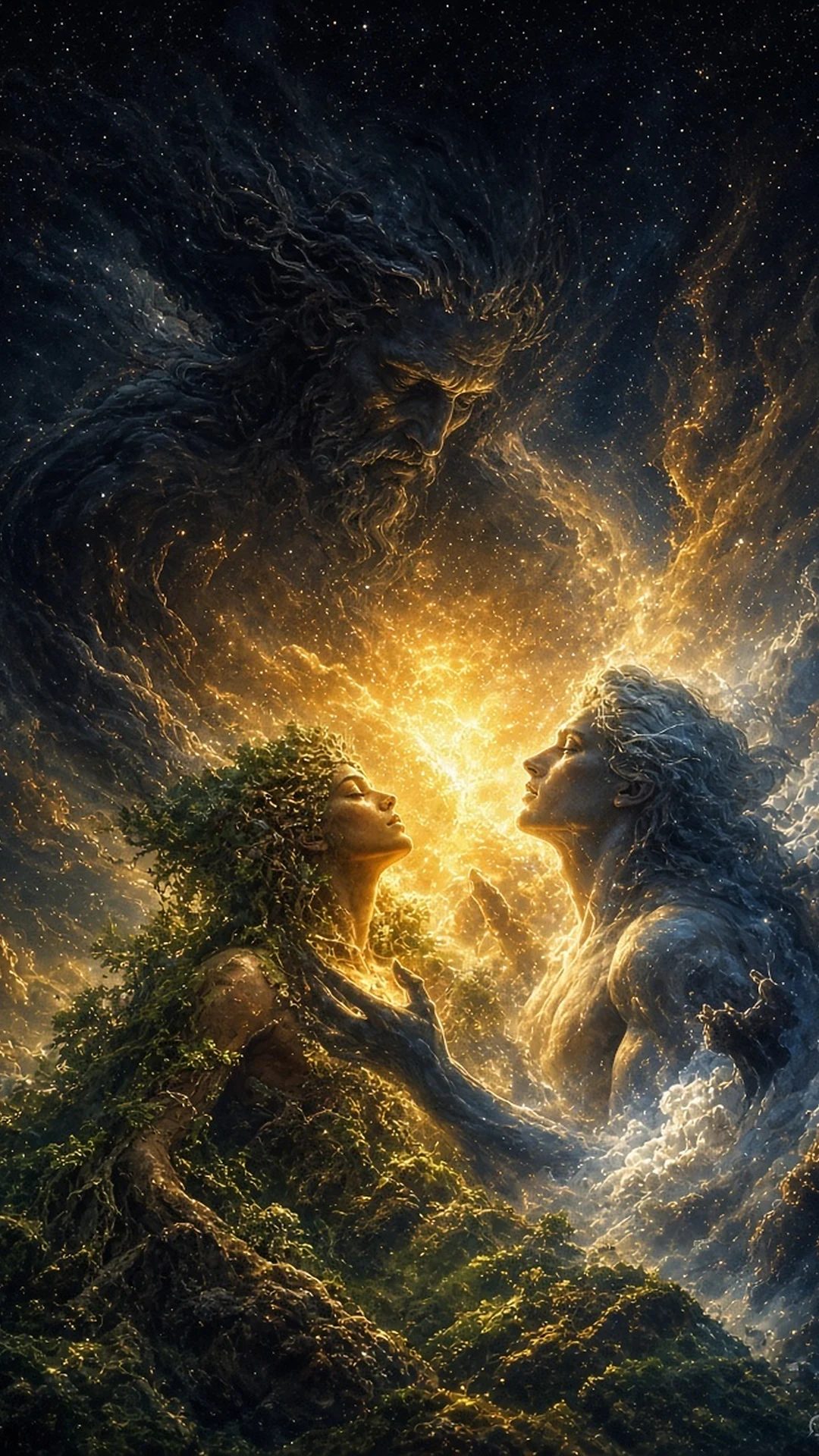
Gaia is a central mother-figure in the genealogy. She produces Ouranos (Uranus), the starry Sky, described as corresponding to or covering Earth. She also brings forth mountains and the sea personified as Pontus. Ancient Greek literature can present these as divine beings with family relationships. When we casually say “Gaia is the planet Earth,” we should remember that this is a modern shorthand and not a literal physical explanation of the formation of rock, ocean and atmosphere.
Gaia and Ouranos: where did the Titans come from?
Gaia and Ouranos produce an important generation of descendants, notably the Titans. These include Oceanus, Coeus, Crius, Hyperion, Iapetus and Cronus, along with Titan daughters such as Rhea, Themis, Mnemosyne, Phoebe and Tethys. From this generation come many later figures and divine functions. The relationships explain why Zeus, Apollo, Artemis, Athena and other well-known gods belong to later stages of the family tree rather than being present as the first beings.
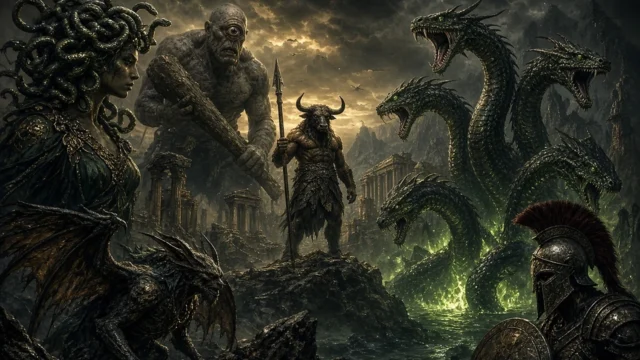
The same family history introduces the Cyclopes and Hundred-Handers, extraordinary beings whose strength matters in the war between divine generations. Their role differs from the one-eyed shepherd Polyphemus encountered by Odysseus. Treating every Cyclops as the same character is a common error. Hesiod uses divine genealogy to build toward the cosmic conflict, while later heroic epics use similarly named beings in very different adventures.
Why did Cronus overthrow Ouranos?
Hesiod tells a disturbing story in which Ouranos suppresses or conceals his children, causing Gaia to suffer. She prepares a weapon, a curved sickle, and asks her offspring to help her. Cronus volunteers. When Ouranos approaches Gaia, Cronus attacks and castrates his father, ending that generation’s rule. The story is violent and symbolic; it should not be rewritten as a straightforward example of a kind son peacefully inheriting a kingdom.
The act also has far-reaching consequences. In Hesiod’s narrative, the scattered blood and other material give rise to additional divine figures, and the birth of Aphrodite is associated with the sea foam around the severed member. Other Greek traditions give her a different parentage, especially the Homeric association with Zeus and Dione. This is a useful example of why a family-tree infographic must identify its source. Hesiod’s version and a later or alternative tradition need not be forced into one seamless chart.
Cronus and Rhea: how the next generation began
Cronus becomes the leading figure in the next ruling generation and marries his sister Rhea. Their six well-known children are Hestia, Demeter, Hera, Hades, Poseidon and Zeus. A prophecy warns Cronus that one of his children will overthrow him, mirroring his own action against Ouranos. In fear he swallows his newborn children. Rhea, grieving over the loss, devises a way to keep Zeus safe. The sequence shows the mythic pattern of rulers being frightened of the next generation.
Zeus is hidden, often associated with Crete, while Rhea gives Cronus a stone wrapped like an infant. Cronus swallows the stone instead. Zeus survives and grows strong. Some local Cretan accounts add caves, caretakers or protective dances, but not every detail appears in the same early poem. Distinguishing the core Hesiodic story from local variants avoids telling students that a single source contains every colorful later episode.
Zeus, the Titanomachy and the rise of Olympus
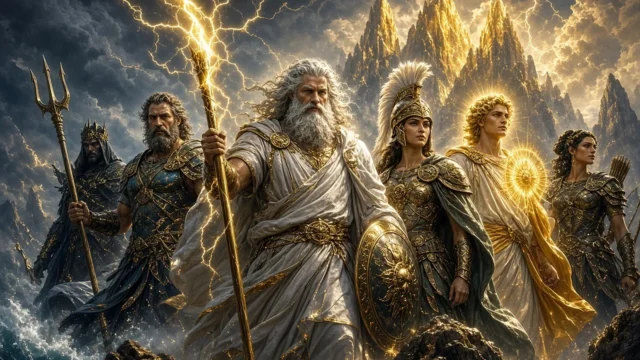
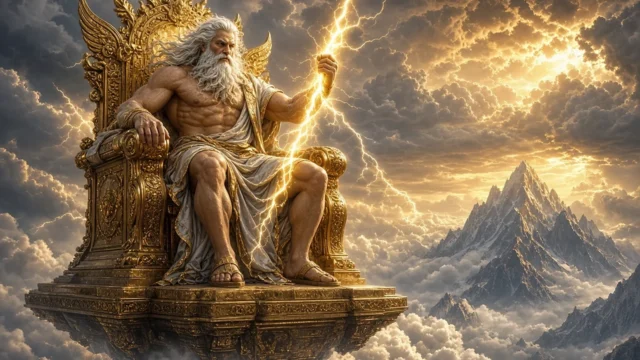
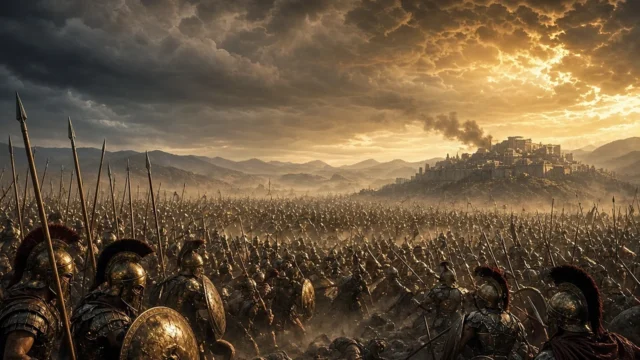
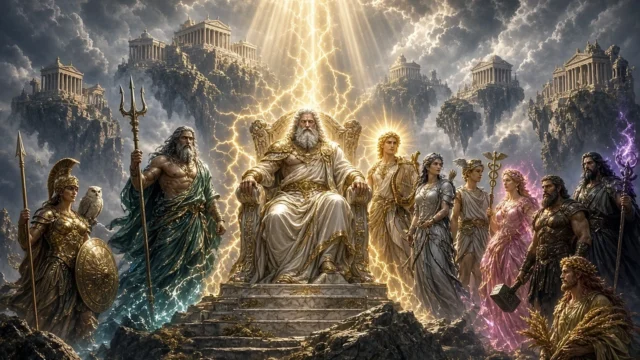
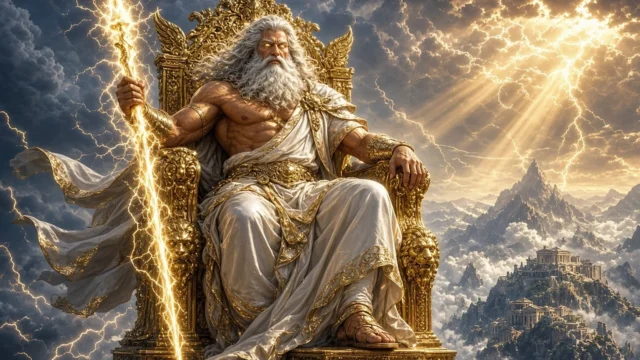
After being saved, Zeus eventually brings about the release of his siblings and leads a new alliance against the opposing Titans. In the Titanomachy, a war described by Hesiod as lasting ten years, the Cyclopes and Hundred-Handers become powerful supporters of Zeus. Thunder and lightning help establish his characteristic authority. The defeated Titans are confined to Tartarus, the deep region introduced in the earliest cosmogonic passage.
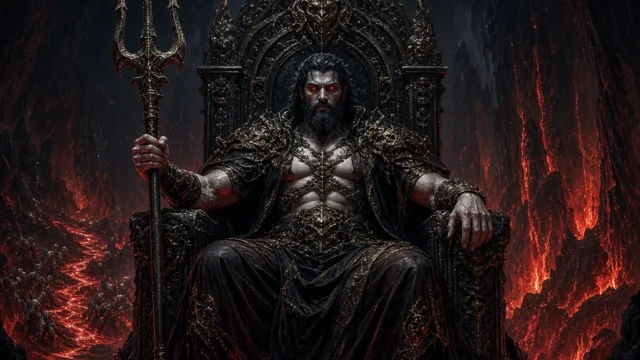
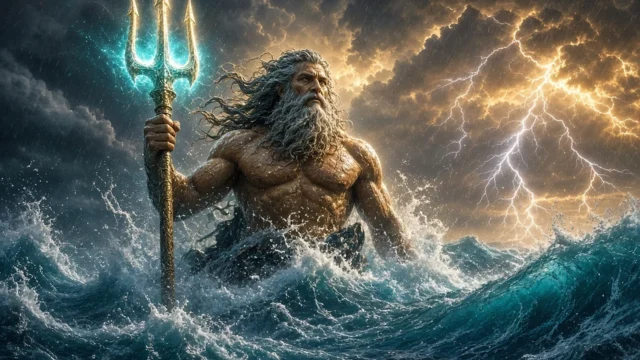
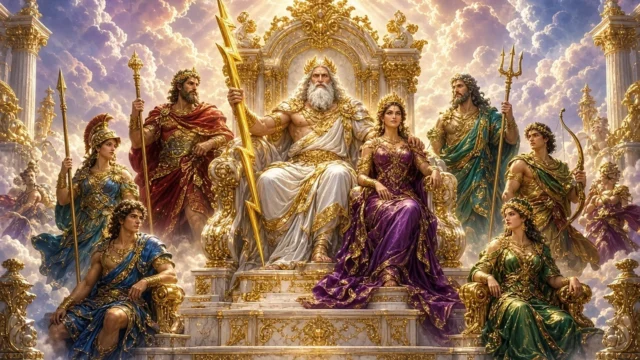
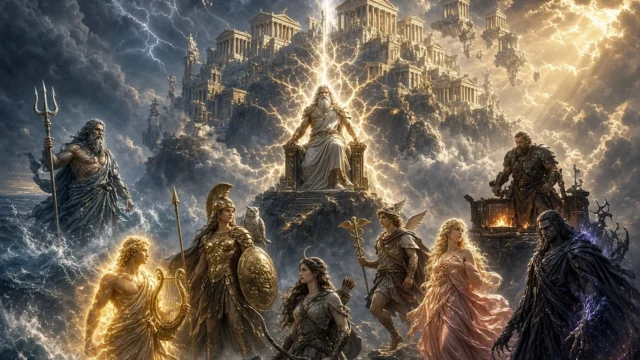
The outcome connects the poem’s opening to the familiar Greek divine world. Zeus becomes king of the Olympian gods, but he does not create the primordial forces that existed before him. Poseidon and Hades later have significant cosmic domains of sea and underworld. The succession is about changing divine rule, not an act of destroying the whole previous universe and constructing a new one from nothing. Such distinctions keep the story coherent without turning it into a modern superhero origin film.
Where do humans fit into Greek creation stories?
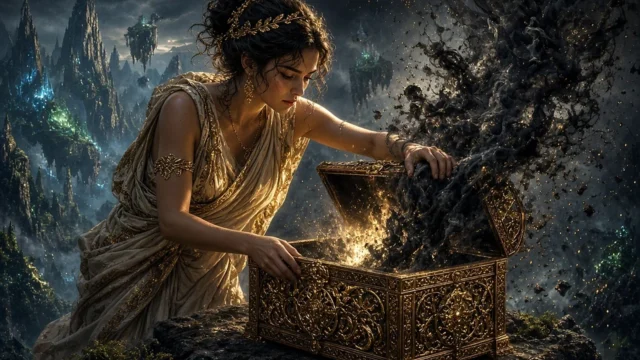
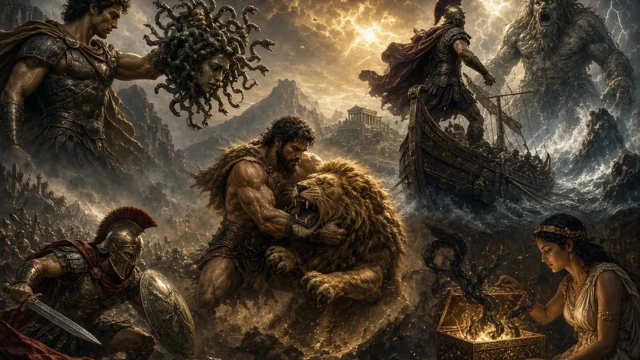
Many quick online explainers confuse the Theogony with a single definitive Greek account of the creation of humanity. Hesiod is primarily developing the divine genealogy and cosmic order. His Works and Days discusses the ages of humankind and the hardships of mortal life, including the story of Pandora. Traditions about Prometheus shaping humans from clay are especially familiar from later sources and adaptations, and should not automatically be attributed to the exact opening lines of Theogony.
Greek stories therefore have different narrative tasks. A cosmogony concerns the beginnings of the cosmos, a theogony concerns the gods, and an anthropogony would concern human origins. A specific author may combine some of these themes, but a website should not pretend the Greeks had a single canonical creation chapter identical to a modern textbook. Separating those questions is especially useful for readers who search “who created humans in Greek mythology?” after encountering Zeus’s family tree.
Did every Greek tradition start with Chaos?
No. The Hesiodic opening is famous and influential, but Orphic and other poetic or philosophical traditions tell different accounts of primordial beginnings. Some bring forward Night, a cosmic egg, primordial Eros or other stages, and the surviving evidence itself comes from multiple periods and sources. Later Roman writers reinterpret or retell Greek figures within their own literary framework. A responsible article should say “according to Hesiod” rather than “all Greeks always believed” whenever presenting the sequence Chaos–Gaia–Ouranos–Titans.
Modern readers sometimes compare the account with scientific cosmology or creation stories from Indian traditions. Broad themes like emergence from an early state occur in several cultures, but they do not prove an identical scriptural event or common historical character. Our Greek vs Hindu mythology comparison discusses the limits of such parallels. The ancient literary source and its cultural purpose must remain visible.

Greek creation myth in one chronological table
| Stage | Figures | Why it matters |
|---|---|---|
| Primordial beginning | Chaos, Gaia, Tartarus, Eros | Fundamental powers appear |
| Earth’s descendants | Ouranos, mountains, Pontus | Sky and sea gain names and kinship |
| Early divine generations | Titans, Cyclopes, Hundred-Handers | Later conflicts become possible |
| First succession | Cronus overthrows Ouranos | Older divine rule changes |
| Second succession | Zeus survives Cronus | A new generation challenges the Titans |
| New order | Titanomachy; Olympian leadership | Zeus’s kingship is established |
The table is an outline of Hesiod’s mythical order, not a scientific timeline or an archaeological dating chart. It also does not claim that all local Greek traditions arranged every episode this way. The family tree is best read as a guide to relationships in the poem.
Five FAQs about Greek creation mythology
Who created the world in Greek mythology?
Hesiod begins with Chaos and the emergence of other primordial beings, not one Olympian god who creates everything from nothing.
Was Chaos an evil monster?
No. In Hesiod’s cosmogony Chaos is a primordial condition or being; the modern word “chaos” can mislead readers.
Who were Gaia and Ouranos?
Gaia personifies Earth and Ouranos the starry Sky; they are ancestors of the Titans in Hesiod’s genealogy.
Was Zeus the first Greek god?
No. Zeus belongs to a later generation and becomes ruler after divine succession conflicts.
Is the Greek creation myth the same as the Big Bang?
No. It is an ancient poetic and religious narrative, not an experimentally supported physical model of cosmic origins.
Ancient sources and conclusion
Read Hesiod, Theogony, especially lines 116 onward for primordial beings, Titans and succession. Compare Hesiod, Works and Days for human hardship and the ages of humankind. A second research entry point is the Perseus Digital Library. Conclusion: Hesiod’s Greek creation story explains how primordial forces, divine generations and cosmic kingship lead to the Olympians. It is neither a science lesson nor the only ancient Greek version. Updated 14 November 2026. Images are artistic interpretations.



Share Your Opinion
Comments are closed on this post.