 Vista
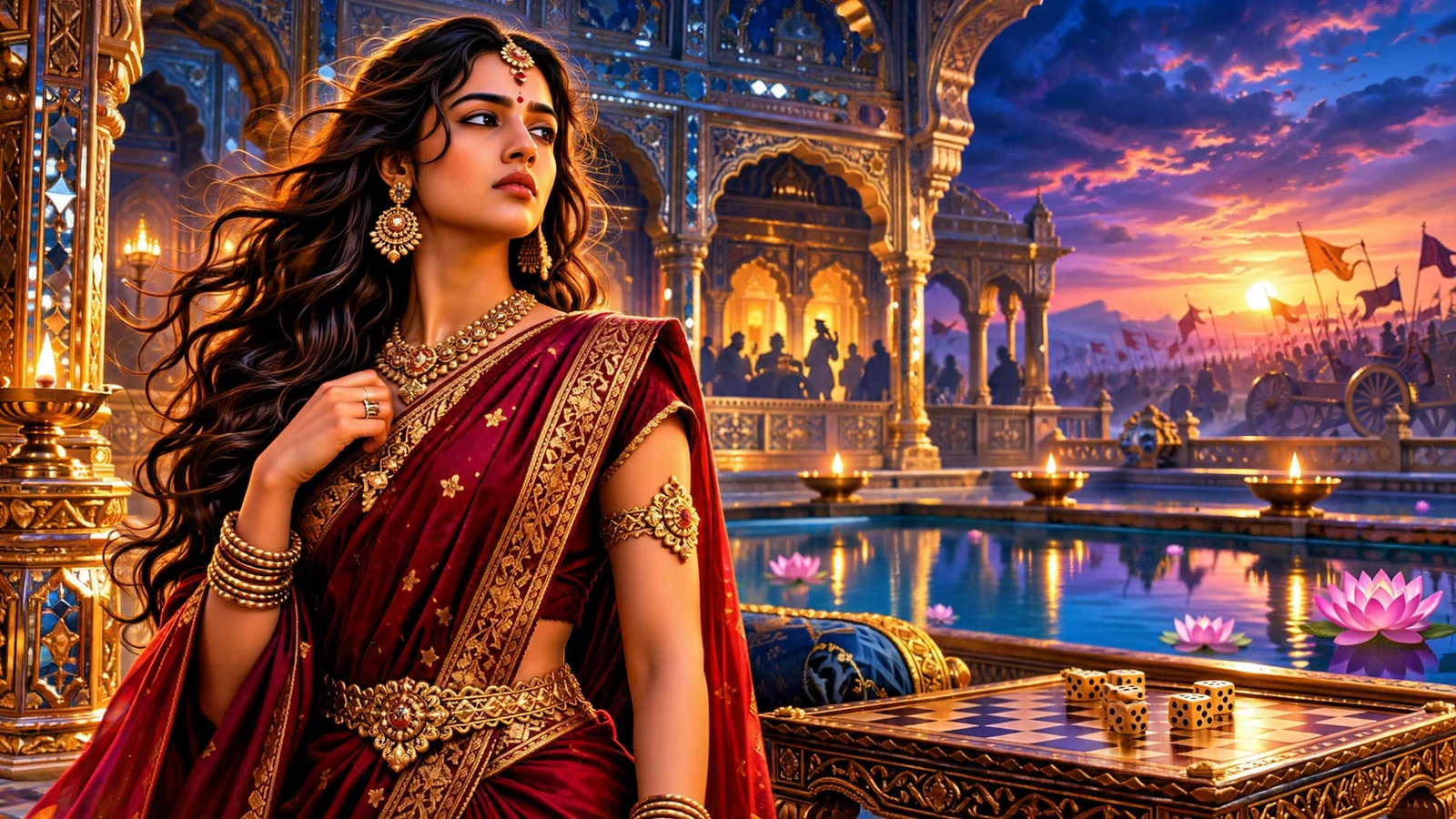
The Palace of Illusions is Chitra Banerjee Divakaruni’s 2008 English-language novel that retells the Mahabharata through the voice of Panchaali, better known as Draupadi. Its central achievement is not changing every event of the epic. It changes whose thoughts we hear. A woman often remembered through her marriage, humiliation and the great war becomes the narrator of her own ambitions, jealousy, affection, anger and difficult choices. This guide explains the plot, the meaning of the mysterious palace, the major characters and the ending. It also separates the novelist’s imaginative decisions from the much older epic tradition.
Reader note: The first part gives a spoiler-light introduction; the later plot and ending sections contain major spoilers. This is a guide to a literary work, not a substitute for reading the novel or a claim that its fictional additions are established religious history.
What Is The Palace of Illusions About?
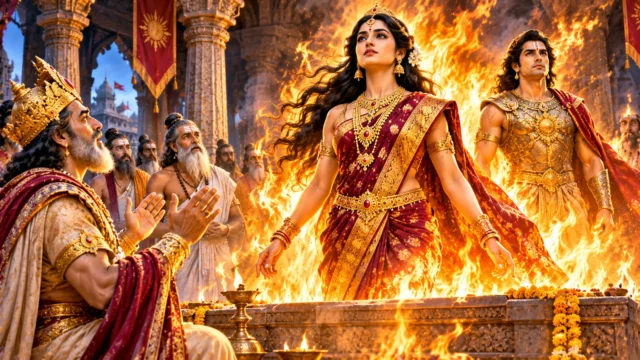
Imagine knowing that your birth has a purpose before you have had the chance to decide what you want from life. That is the position Panchaali occupies. Born from a ritual fire into the royal house of Panchala, she grows up surrounded by predictions, expectations and political rivalries. Her father, Drupad, is obsessed with an old grievance. Her brother Dhrishtadyumna, whom she affectionately calls Dhri, is both companion and another child shaped by someone else’s plans. Panchaali resists being treated as merely a useful daughter whose marriage will serve a king’s strategy.
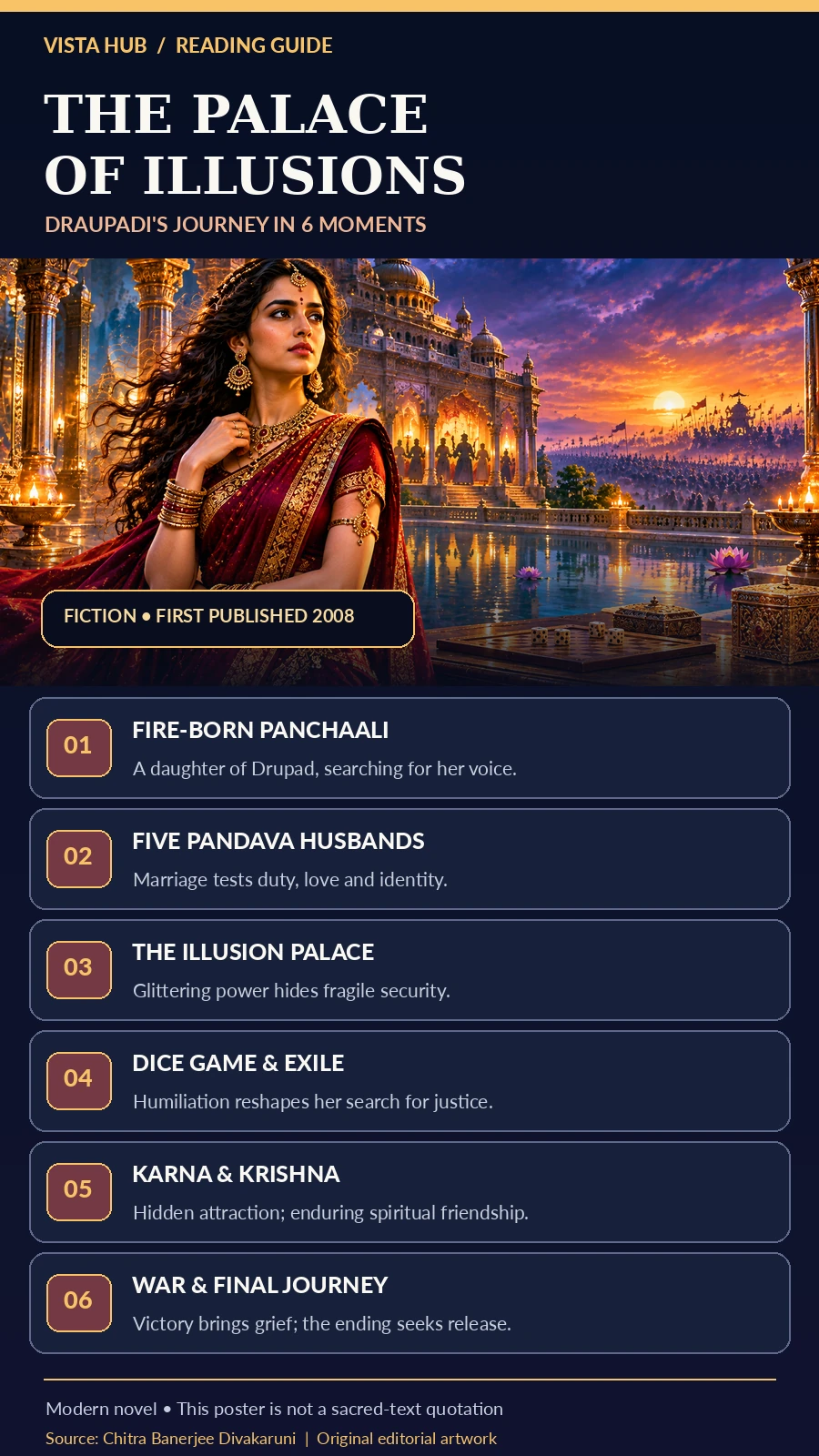
Divakaruni follows Panchaali through her marriage to the five Pandava brothers, the magnificent palace associated with their rising fortunes, the disastrous dice game, years of exile and the war at Kurukshetra. The framework will be familiar to many Mahabharata readers. But the emphasis moves away from a catalogue of heroic achievements toward the intimate cost of decisions. What does power feel like when everyone can discuss your future except you? How can someone demand justice without becoming consumed by revenge? What survives when a long-awaited victory destroys almost everyone it was meant to protect?
The author calls Panchaali a fiery voice in a world dominated by warriors and rulers. That approach makes the book an accessible introduction to the emotional stakes of the epic, while also creating interpretive choices that a reader should not automatically attribute to Vyasa’s Mahabharata. The original English novel first appeared in 2008; page counts vary by edition, so a quotation or chapter reference should always be checked against the copy being used.
Plot Summary, Part One: Fire, Childhood and Marriage
A child of fire who wants her own story
Panchaali’s remarkable birth gives her a public identity long before she develops a private one. Drupad’s desire for revenge against Drona hangs over the royal household. Her brother Dhri grows up under the weight of martial expectations, while she searches for knowledge about the wider world and resents the narrow space allotted to princesses. The novel gives the young narrator a stubborn personality, curiosity and a running conversation with the stories people tell about her. Her sense of being watched by fate is not passive. She tests what she can question, what she can learn and what she may have to accept.
This is where the first-person narration matters. In a standard plot outline, the fire birth is one remarkable event before the marriage story begins. Here it is the starting point for a lifelong problem: Panchaali hears what other people expect her life to accomplish before she understands what happiness might mean to her. Her connection with Krishna becomes important because he speaks to her with a mixture of warmth, teasing and insight. He does not simply appear as a distant god giving instructions. In the novel, their relationship allows Panchaali to reconsider the motives behind her actions.
The swayamvara and an unexpected marriage
The famous marriage contest brings warriors to Panchala, and the outcome links Panchaali to Arjuna and, unexpectedly, to all five Pandava brothers. The novel explores the emotional and social cost of that arrangement rather than treating it as a curious fact to be memorized. It also gives Panchaali a complicated private response to Karna, a warrior who stands politically opposed to her new family. Her attraction to him is a significant element of Divakaruni’s interpretation; it should not be presented as a universally accepted fact of the older epic.
Marriage does not settle the central tension. Panchaali has to navigate a shared household, different personalities and the strong influence of Kunti, the Pandavas’ mother. Her relationships with Yudhishthira, Bhima, Arjuna, Nakula and Sahadeva are not interchangeable. Love, duty, strategy and insecurity are uneasily mixed. Readers who expect a simple romance may be surprised by how much of the novel is about managing authority and belonging. The question is not only whom Panchaali loves, but whether a woman can shape the rules of the household that has been arranged around her.
Plot Summary, Part Two: The Palace, Dice Game and Exile
The palace that gives the novel its name
As the Pandavas establish themselves at Indraprastha, the palace becomes a dazzling statement of prosperity and prestige. Its deceptive architecture and almost magical surfaces make it extraordinary to enter. For Panchaali, the place promises something more personal than royal luxury: space to define her life on her own terms. Yet its wonders create a dangerous confusion between appearance and reality. What looks like a permanent triumph can disappear when power shifts. What appears solid may conceal uncertainty.
A visit involving Duryodhana and the palace’s illusions becomes part of the chain of humiliation, resentment and rivalry. Retellings differ in how they portray who laughs and what is said, so the details should not be transferred from a modern novel into every version of the ancient epic. Divakaruni uses the palace to question Panchaali’s pride as well as the court’s fragile political order. It is both a place she loves and a warning about believing that beauty, wealth or intelligence can insulate a family from catastrophe.
The dice game changes everything
Yudhishthira’s gambling turns the household’s security into a terrible vulnerability. Kingdom, status and freedom become objects in a contest dominated by hostile rivals. Panchaali’s public humiliation at the Kaurava court is among the most disturbing events in the story. Divakaruni asks the reader to experience it not merely as a dramatic scene that will motivate future warriors, but as a violation felt by the person at its centre. Her questions about who has the right to stake another human being strike at the moral weakness of a court that claims to honour dharma.
The catastrophe does not end when the gathering disperses. It reshapes Panchaali’s relationship with her husbands and her understanding of justice. She remembers both the cruelty of her opponents and the failures of those who should have defended her. This is one reason the novel’s emphasis on the female perspective matters: the suffering cannot be conveniently reduced to a reason for men to fight later. It changes how Panchaali sees herself, the people close to her and the meaning of a promised restoration.
Exile is not an empty waiting period
The Pandavas’ years away from power are often summarized quickly in popular timelines. In this novel, exile becomes an extended period of resentment, introspection and altered relationships. Panchaali is forced to live far from the luxurious home she had made her own. Ordinary discomforts sharpen questions of identity: is she still a queen without a palace, and does an injury lose its force simply because years have passed? The experience also reveals the different kinds of love and loyalty offered by her husbands, especially the care associated with Bhima.
The final period spent in disguise requires vigilance and a loss of familiar status. The episode involving Keechaka reminds readers that danger does not vanish when people stop wearing royal insignia. Meanwhile, plans for reclaiming power bring the coming war closer. Panchaali’s anger is understandable, but the novel refuses to make rage uncomplicated. She can correctly condemn an injustice and still be troubled by what retaliation may demand from people who had no part in the original wrong.
Plot Summary, Part Three: The War and the Ending Explained
Major spoilers begin here. If you want to discover the final revelations yourself, skip to the character and theme sections before returning.
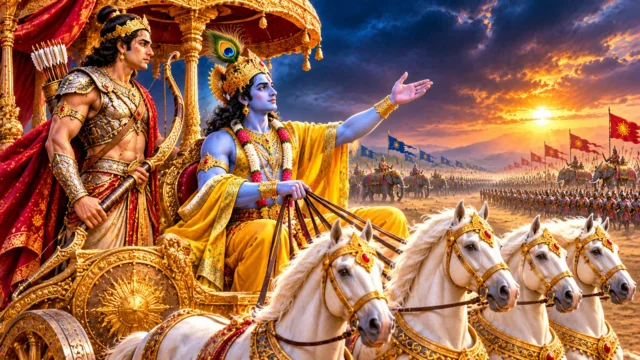
The Kurukshetra conflict brings the competing claims of kinship, duty and revenge to a devastating conclusion. The narrative does not glorify every act on the battlefield. For Panchaali, the deaths are counted through relationships as much as through armies: teachers, brothers, sons and rivals are not abstract pieces on a board. The fate of Karna is particularly charged because the novel has created a private emotional tension between him and Panchaali. His death makes the earlier possibilities of their relationship permanently unreachable.
The war’s aftermath undermines a simple victory story. Panchaali experiences profound grief, including the loss of her sons, and must face a world full of people who have lost husbands, children and homes. Political success cannot reverse the harm. One notable dimension of the novel’s later movement is the attention given to the surviving women and to the work of rebuilding lives. There is a shift from asking who deserves punishment to asking what responsibility remains after punishment has been delivered.
What happens to Panchaali at the end?
After the war and the passing of years, the Pandavas relinquish worldly power and begin their final journey toward the Himalayas. Panchaali cannot complete the ascent in the ordinary physical sense. As her life ends, the story turns inward, allowing her to reconsider the loves and disappointments that shaped her existence. Krishna’s friendship acquires a deeper spiritual meaning, one not measured by possession or public approval. The novel also resolves Panchaali’s emotional connection with Karna through an imaginative vision of reunion and release.
The ending is not a conventional reward for winning a battle. It suggests that freedom comes when the narrator is no longer confined by the roles, judgments and regrets that held her in life. This is Divakaruni’s literary ending to Panchaali’s story, informed by but not identical to every traditional account of the Pandavas’ final journey. Readers can understand it as a reflection on self-knowledge, spiritual love and the limits of earthly success without asserting that a fictional scene is a historical report.
Main Characters: Who Matters and Why?
Panchaali / Draupadi: She is the narrator, not a neutral historian. Her observations are sharp but selective; sometimes pride or pain affects how she interprets another character’s actions. That subjectivity is the point. Rather than presenting a flawless heroine, Divakaruni gives readers a complicated person whose intelligence, ambition and anger can be admirable and troubling at the same time. She is neither simply a victim nor entirely free to choose her path.
Krishna: In the novel, Krishna is a confidant whose teasing wisdom and timely interventions help Panchaali question her certainties. His importance grows toward the ending, when she recognizes that lasting care need not demand conformity. The relationship is emotionally intimate but should not be misreported as a conventional romance between Panchaali and Krishna.
Karna: Karna represents talent, wounded pride, social exclusion and the road not taken. Panchaali’s hidden attraction gives the novel a powerful source of inner conflict. Readers should distinguish that invented or expanded romantic emphasis from the varied Mahabharata traditions. Karna is not simply an idealized alternative husband; his choices and political commitments remain morally consequential.
The five Pandavas: They share a marriage but not one personality. Yudhishthira raises questions about principles and poor judgment, Bhima often expresses practical devotion, and Arjuna embodies skill, distance and longing. Nakula and Sahadeva are part of the larger family arrangement rather than interchangeable figures. Their differences make Panchaali’s marriage an ongoing negotiation rather than one completed ceremony.
Kunti, Dhri and Drupad: Kunti’s authority complicates household politics. Dhri offers Panchaali the companionship of someone who understands the unusual circumstances of her birth. Drupad’s grievance illustrates how parents and rulers can turn children into instruments of old conflicts. Together they show that a person may inherit duties and enemies before choosing either.
Key Themes and the Meaning of the Palace of Illusions
Appearance, pride and the limits of control
The title works on more than one level. The physical palace is memorable because it tricks perception, but its name also fits the identities people build for themselves. Panchaali wants a home that will belong to her; her opponents want visible markers of supremacy; the Pandavas expect prosperity to secure their future. Every one of these hopes can be undermined. The palace therefore reflects the distance between what people believe they own and what they can actually control.
It also explains the novel’s movement from splendour to loss. The architecture does not cause every bad choice, but it becomes a fitting symbol for the confidence that precedes disaster. A reader need not accept that all ambition is wrong to see the warning. The problem is what happens when position, admiration or revenge becomes the only measure of a meaningful life.
A woman’s perspective without a perfect heroine
Calling the book a feminist retelling does not mean Panchaali is always right or that every man is portrayed as cruel. The more interesting achievement is that the reader must take her interior life seriously even when she is jealous, angry or mistaken. The novel asks why the women of an epic should remain silent while the men around them make decisions that determine their futures. Panchaali’s narration expands moral responsibility rather than merely reversing the original hierarchy.
That perspective also makes her public humiliation more than a turning point in the political plot. The violence of the incident lies partly in the surrounding failure to see her as a person with a claim to dignity. Her subsequent desire for justice is comprehensible, even while the story asks whether revenge is capable of giving her back what was taken.
Love, resentment, destiny and agency
The relationships with Krishna and Karna work in different registers. Karna evokes possibility, attraction and regret; Krishna represents a friendship that ultimately opens into spiritual reflection. Neither should flatten the other, and neither removes the consequences of Panchaali’s real choices. The novel repeatedly asks how far anyone can resist a destiny shaped by family, prophecy and political pressure. It does not provide a simple answer. Its characters act, hesitate, misjudge and then live with results they could not fully foresee.
There is also an important distinction between agency and control. Panchaali may gain more ability to speak and act, but she cannot command the feelings of others or undo a war. By the final pages, the most significant freedom is not political command over a palace. It is a changed understanding of herself.
How Is This Novel Different from the Original Mahabharata?
The Palace of Illusions is mythological fiction inspired by the Mahabharata, not a new critical edition of the Sanskrit epic. It uses familiar characters and events while emphasizing dialogue, private feelings and psychological motivations imagined by a modern author. Panchaali as the central first-person voice is a deliberate artistic choice. Her sustained romantic longing for Karna, in particular, should be described as the novel’s interpretation rather than a settled fact about the epic across all recensions and regional retellings.
The older epic has many voices, digressions and layers of moral reasoning. A modern novel must select what to show, condense long stretches of time and create a consistent emotional arc. That can help beginners enter the story, but it also changes the balance of perspectives. When comparing a novel scene to scripture, ask: Which episode appears in the epic? What has the novelist added or reinterpreted? Does the scene serve historical inquiry, devotional understanding or literary characterization? These are related but different activities.
| Question | In Divakaruni’s novel | For reading the Mahabharata |
|---|---|---|
| Who narrates? | Panchaali speaks in the first person. | Multiple voices and narrative frames. |
| Main interest | Her emotional choices, marriage, grief and identity. | Broad dynastic, ethical, religious and philosophical concerns. |
| Karna relationship | A private, emotionally charged attraction. | Interpretations vary; do not treat the novel’s romance as a universal epic claim. |
| The palace | Personal dream and symbol of illusion. | An extraordinary court within a larger political story. |
| Best reading purpose | Literary reinterpretation and character analysis. | Exploring the epic’s textual and interpretive traditions. |
Is The Palace of Illusions Worth Reading? FAQs
The novel is a strong choice for readers who want character-driven mythological fiction, a female narrator and an accessible bridge into the emotional world of the Mahabharata. It is less suitable as the only reference for exact Sanskrit passages or historical claims. A good approach is to enjoy the novel on its own terms and then compare selected episodes with a reputable translation of the epic. Readers sensitive to coercion, humiliation, war and the deaths of children should know that the story contains heavy material.
Who wrote The Palace of Illusions and when was it published?
Chitra Banerjee Divakaruni wrote the novel, first published in 2008. Specific page counts differ across the Doubleday, Picador and later editions.
Who is the narrator of The Palace of Illusions?
Panchaali, also known as Draupadi, tells the story in the first person. Her subjective thoughts are a feature of the fiction rather than neutral evidence for every event in the epic.
Is The Palace of Illusions a true story or an original Mahabharata text?
It is a modern novel based on the Mahabharata tradition. It is neither an eyewitness account nor the original Sanskrit epic.
Does Draupadi love Karna in this novel?
The book explores Panchaali’s concealed attraction to Karna as a major emotional thread. That portrayal belongs to Divakaruni’s fictional retelling and must not be generalized to all versions of the epic.
What does the Palace of Illusions symbolize?
The palace represents status and the dream of control, but also the fragility of appearances. Its dazzling beauty cannot protect its inhabitants from pride, rivalry and loss.
What happens at the end of The Palace of Illusions?
Panchaali joins the Pandavas’ final journey, confronts her mortality and reaches a spiritual understanding of love and release. The novel gives her connection with Krishna and Karna special imaginative emphasis.
Can beginners read it without knowing the Mahabharata?
Yes, particularly if they enjoy character-focused novels. Knowing basic relationships among the Pandavas, Kauravas, Krishna and Karna helps; a family tree or concise epic introduction can make the experience smoother.
Is this the same kind of book as Yajnaseni by Pratibha Ray?
Both center Draupadi, but they are different novels with distinct voices, backgrounds and literary choices. For a comparison rather than a detailed single-book summary, see the related article linked below.
Final Takeaway and Further Reading
The book matters because it makes a familiar epic feel newly uncertain. Panchaali does not simply explain what happened at court or in battle; she asks what those events felt like to a woman expected to remain composed while powerful people made the rules. The title’s illusion is finally larger than architecture: triumph can disguise grief, resentment can disguise attachment and social roles can disguise a person’s inner life. Read this as an imaginative literary retelling, then return to the Mahabharata with more questions rather than assuming the two are interchangeable.
Sources and edition notes: Author’s official book page; Pan Macmillan synopsis; Kirkus review; Penguin Random House edition information. This is an original critical overview, not an excerpt from the book. Reviewed 13 November 2026.
Related reading in English
- Mahabharata from Draupadi’s Perspective: Retellings Compared
- Draupadi’s Birth from Fire: The Story of Yajnaseni
- Karna in Mahabharata: The Tragic Hero




Share Your Opinion
Comments are closed on this post.