 Vista
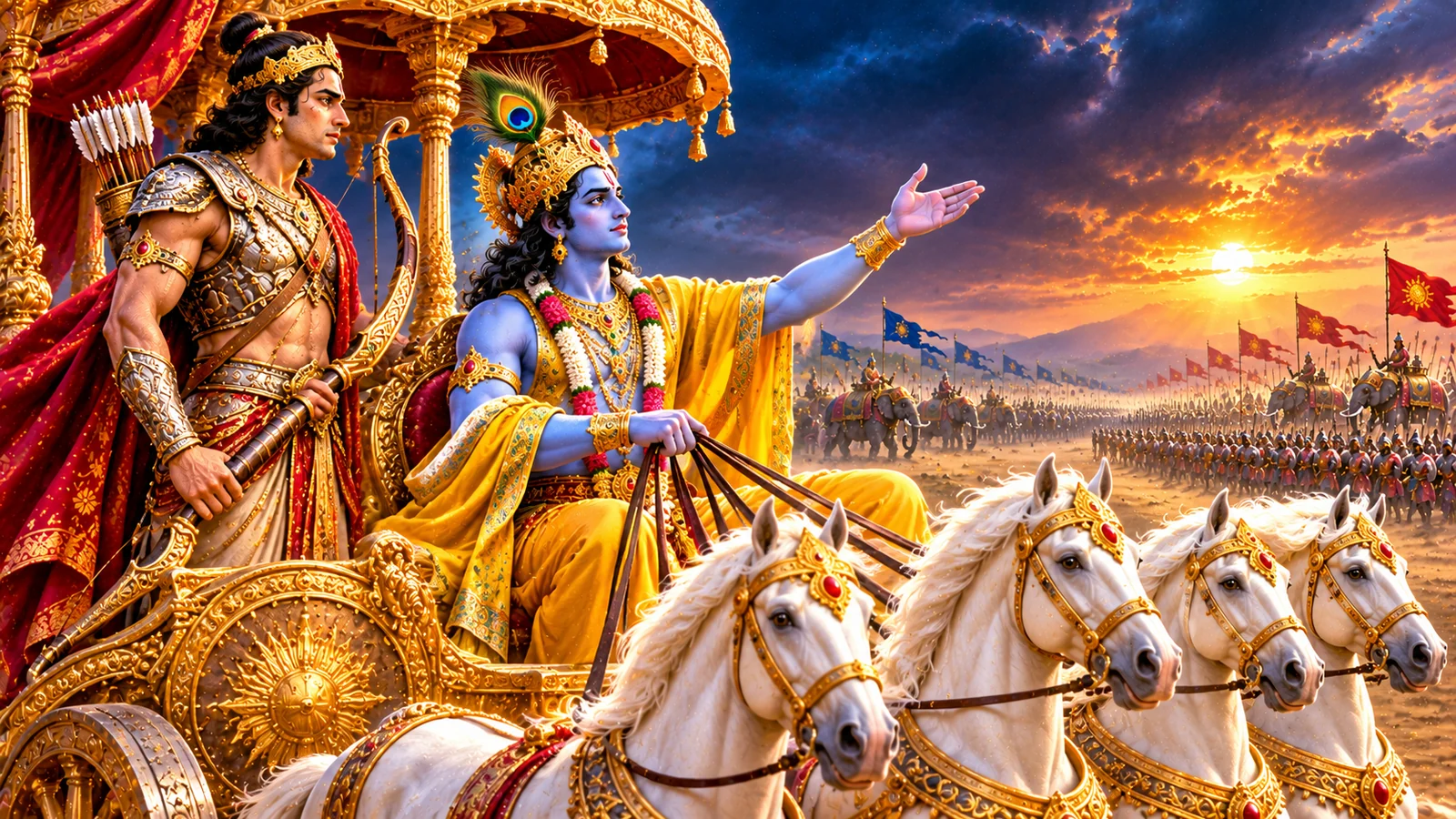
Quick answer: Krishna did not enter the Kurukshetra War as an ordinary armed warrior because he had explicitly promised to remain unarmed and not fight when he offered Arjuna and Duryodhana a choice before the battle. Arjuna chose Krishna’s personal presence; Duryodhana received Krishna’s formidable Narayani forces. Krishna then became Arjuna’s charioteer, counsellor and spiritual guide. He was certainly not neutral: he supported the Pandavas and influenced critical decisions, but he did not take up a regular combat role. The episode is narrated in the Udyoga Parva, Book 5, Section 7 of the Mahabharata. Later scenes involving Bhishma show just how emotionally and morally demanding this pledge became.
This is a more interesting answer than the internet claim that Krishna “refused to fight because he was afraid” or that he “did nothing except preach.” The first claim is not supported by the epic; the second overlooks his diplomacy, judgement, charioteering and intervention. To understand why Krishna made this choice, we need to trace the events before the war, what the two rival cousins actually selected, and what the Bhagavad Gita means in that setting.
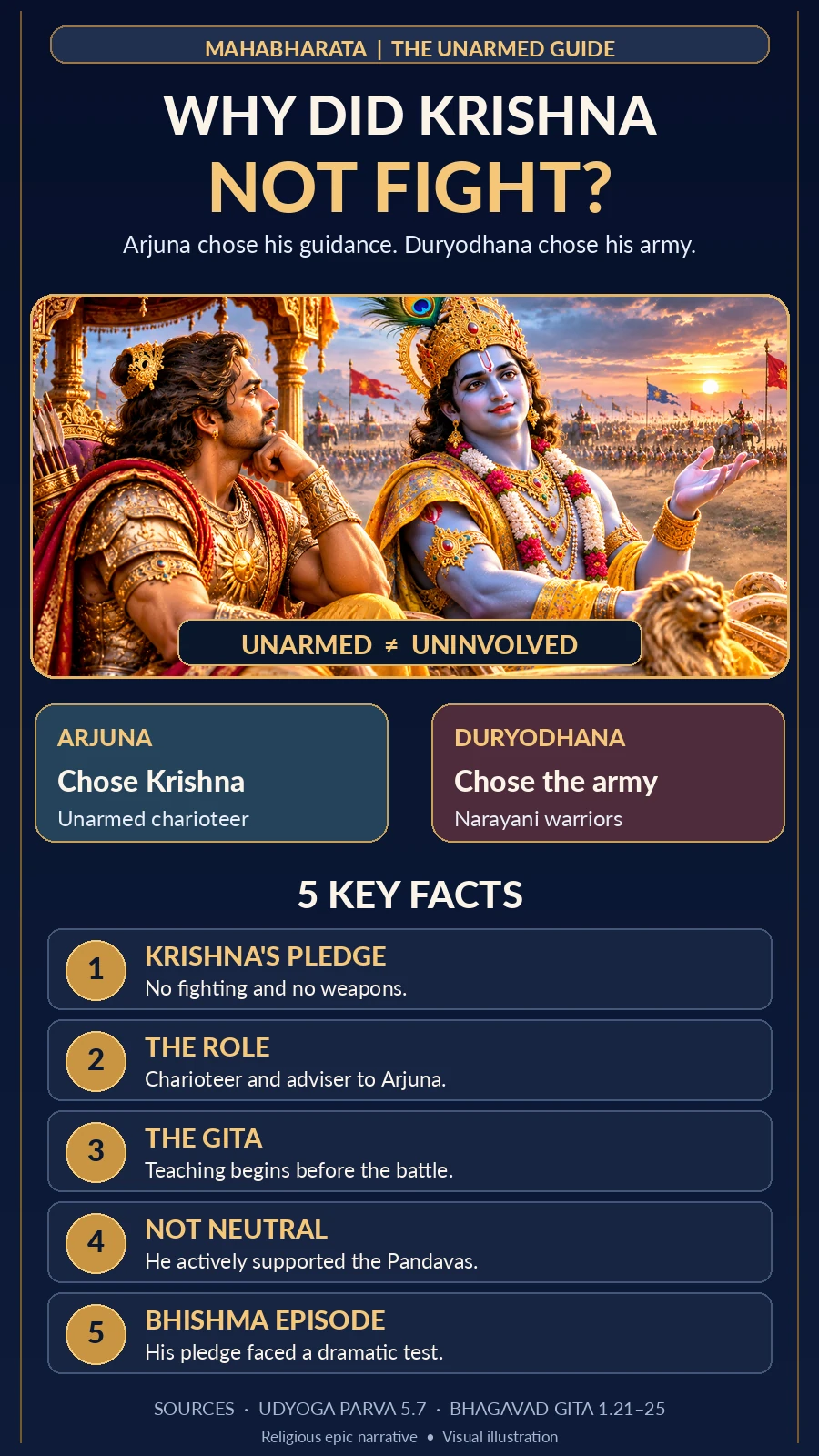
1. The Decision Happened Before Kurukshetra: Arjuna and Duryodhana at Dvaraka
As the rivalry between the Pandavas and Kauravas approached war, both sides sought allies. Krishna was related to and respected by people on both sides, so his support carried enormous value. The Udyoga Parva describes Arjuna and Duryodhana arriving at Dvaraka while Krishna was resting. Duryodhana sat near his head; Arjuna stood near his feet. When Krishna woke, he first saw Arjuna, although Duryodhana claimed to have arrived first. Both asked for support.
Krishna acknowledged the competing claims, and gave Arjuna the first choice as the younger of the two. The decision was not a contest in which one man successfully tricked the other. Krishna himself framed the two options. One side could have his skilled fighting force, remembered as the Narayani Sena; the other could have Krishna alone, with an explicit pledge that he would not fight or bear weapons in the battle.
That distinction matters. The text does not describe a magical rule that made Krishna incapable of fighting. It describes a promise he made and an allocation to which the candidates agreed. In a huge conflict shaped by relationships and duties, Krishna put a boundary around his own participation. Both men knew the offer. Their different responses reveal what each considered most valuable.
2. Krishna or the Narayani Sena: What Exactly Was the Choice?
Duryodhana was delighted to receive a military force. He measured support in warriors and visible strength. Arjuna deliberately chose Krishna, even after being told that Krishna would not fight. This is one of the epic’s most memorable contrasts: a powerful army on one side, the unarmed presence of a trusted guide on the other. Modern retellings often turn the scene into a simple morality play in which Duryodhana is foolish and Arjuna instantly knows the secret of victory. The original narrative is slightly more nuanced.
When Krishna later asked Arjuna why he selected someone who would not fight, Arjuna spoke of Krishna’s incomparable renown and expressed a longstanding wish to have him drive his chariot. The text does not reduce Arjuna’s answer to a modern slogan like “strategy always beats numbers.” That is a reasonable lesson readers may draw, but it is an interpretation, not a verbatim quote from the Mahabharata.
An additional point is often missed: some accounts conflate the Narayani Sena with every soldier allied to the Kauravas. Krishna’s force was one element in a much larger coalition. Duryodhana also approached other commanders, and the epic mentions Kritavarman’s contingent separately. The story is about a deliberate selection from two offered alternatives, not the claim that the entire Kaurava army belonged to Krishna.
| The offer | Arjuna / Pandavas | Duryodhana / Kauravas |
|---|---|---|
| Choice made | Krishna personally | Narayani fighting force |
| Krishna’s status | Unarmed, non-combatant | Not on their side personally |
| Immediate advantage | Counsel, presence and charioteering | Additional trained warriors |
| What the story illustrates | Trust and judgement | Reliance on visible military strength |
3. Why Did Krishna Promise Not to Take Up Weapons?
The Udyoga Parva tells us what Krishna promised: he would not fight and would lay aside weapons. It does not provide one tidy psychological sentence saying “Krishna refused solely because of reason X.” Readers should be wary when a website treats a modern explanation as a line spoken in the original Sanskrit. Several themes, however, help us understand the narrative choice.
First, his promise allows both sides to receive a form of assistance while his own position is clearly defined. Second, the story places a meaningful limit on a person of immense influence: power need not be expressed by personally striking an opponent. Third, Krishna’s role makes the epic’s ethical conversations possible. A warrior Arjuna might only exchange blows with enemies; a charioteer Krishna can respond to Arjuna’s crisis of conscience and direct his attention to the meaning of duty.
These are literary and philosophical readings, not claims that all Hindu communities agree on a single hidden motive. Many Vaishnava traditions view Krishna as the Supreme Lord, whose ability is unrestricted even while he freely accepts a human-facing role. Other readers focus on him as a shrewd statesman and adviser within the epic. In either reading, not fighting does not mean being powerless. It means choosing a different form of action and accepting the obligations of one’s word.
4. Krishna Became Arjuna’s Charioteer, Not a Passive Spectator
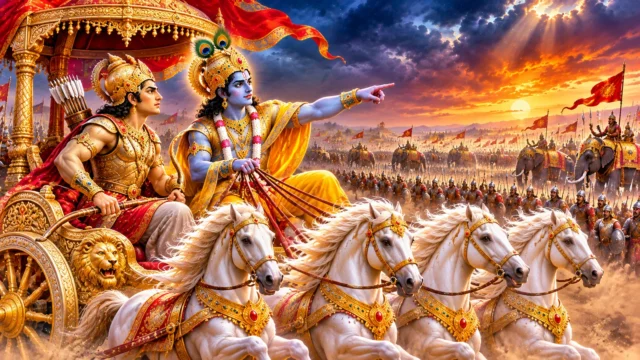
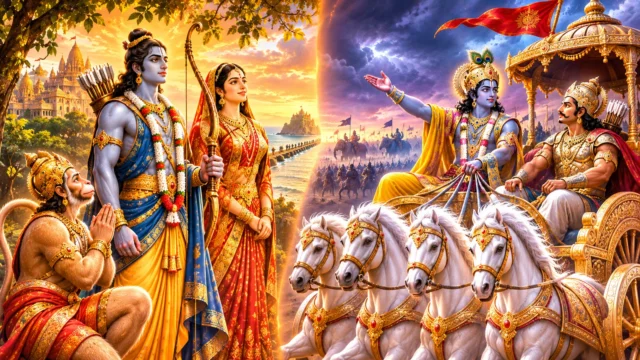
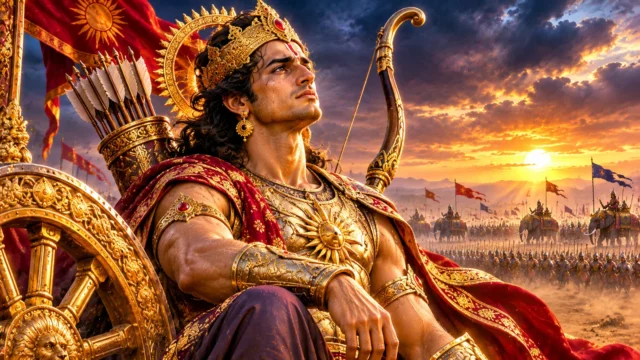
The word sarathi means charioteer, a role with real responsibility on a battlefield. Krishna handled the horses, placed the chariot where Arjuna needed it, read the situation and offered counsel. At the opening of the Bhagavad Gita, Arjuna asks Krishna to move the chariot between the two assembled armies so he can see whom he must face. Krishna does so, as described in Gita 1.21–25. That simple scene places Krishna in the center of an extraordinary personal and ethical confrontation.
The battlefield does not suddenly become easy for Arjuna because he has a divine friend. He sees relatives, teachers and companions across the line and is overwhelmed. The question becomes whether he can fight at all, and what responsible action should mean under conditions in which every available choice causes pain. Krishna’s position beside him makes a sustained dialogue possible. Instead of offering a weapon, Krishna offers a way to understand the crisis.
It would also be wrong to infer that a charioteer was merely a servant without agency. In epic warfare, positioning, timing, communication and situational judgement could matter immensely. Krishna’s contribution was active and consequential, but different in kind from an archer’s or mace-fighter’s role. The contrast helps explain why Arjuna’s choice is narratively powerful.
5. What Did Krishna Teach Arjuna in the Bhagavad Gita?
The Bhagavad Gita appears within the Bhishma Parva of the Mahabharata. Its teaching begins with Arjuna’s distress, not with a celebration of violence. Krishna explores several connected ideas: the enduring nature of the self (atman) in many interpretations, action without attachment to its rewards, disciplined understanding, devotion, self-knowledge and the responsibilities of one’s situation. Different schools interpret these teachings differently, and a thoughtful article should not pretend every reader must reach the same conclusion.
The Gita is often compressed into “just do your duty.” That loses much of the argument. Arjuna is not simply told to stop feeling or to obey any order blindly. The dialogue asks how to act when one’s familiar social roles, emotions, ethical concerns and awareness of consequences are in conflict. Krishna challenges Arjuna to consider motives, impermanence and the distinction between action and the craving to possess results.
The distinction matters for the question about Krishna’s participation. Krishna can be understood as a guide to action without needing to personally perform Arjuna’s action for him. The warrior must decide and act; the teacher helps him examine what acting means. Readers should not extract this story as an endorsement of contemporary violence. The Gita belongs to a specific epic and religious setting, and its many commentarial traditions demand careful reading.
6. Did Krishna Remain Neutral Between the Pandavas and Kauravas?
No. A decision not to fight with weapons is not the same as political or moral neutrality. Krishna repeatedly sought a settlement before war in the epic narrative, and his presence and counsel supported the Pandavas. In the battle he drove Arjuna’s chariot and influenced strategy. He did not stand apart from the struggle as an indifferent observer. This is one of the most important corrections to make when answering the popular keyword “Why Krishna did not fight in Mahabharata.”
It is also important not to confuse Krishna with Balarama, who is described in the Udyoga Parva as declining to join either side in the conflict. Their choices were related but different. Balarama’s refusal to take a side is not proof that Krishna refused all participation. Similarly, Krishna’s commitment to the Pandavas did not mean every difficult tactic of war became ethically unproblematic. The epic repeatedly revisits the tension between declared rules, promises, survival and justice.
A precise answer is therefore: Krishna chose the Pandava side in a non-combat role. He did not remain neutral; he did not serve as a normal armed soldier. That distinction prevents two opposite myths from spreading: that he was absent from the war, and that he fought every decisive duel himself.
7. Did Krishna Break His Promise When He Rushed at Bhishma?
Here the story becomes more complicated. During Bhishma’s formidable fighting, an episode tells of Krishna becoming intensely distressed or angry and rushing toward Bhishma. The famous popular image is Krishna lifting a chariot wheel as Arjuna moves to restrain him. This is often described as the moment Krishna nearly broke, or symbolically tested, his promise not to take up a weapon.
There is an important textual caution. Readers may encounter different details depending on the edition, translation or devotional retelling. The Mahabharata’s Bhishma Parva and later Vaishnava presentations, including a scene remembered in the Bhagavata Purana, are not always rendered with identical weapon imagery. Some accounts describe his discus or a comparable weapon; others emphasize the chariot wheel. The responsible statement is that Krishna’s non-combat pledge was dramatically challenged in the Bhishma episode, not that a single movie-style frame is identical in every Sanskrit source.
The image matters because it exposes another side of Krishna’s role. He is not a detached lecturer uninterested in the cost of war. His concern for Arjuna and the Pandava forces gives the vow real dramatic weight. Yet the scene does not turn him into a routine warrior for the remainder of the eighteen days. For a beginner, this is the key difference between an exceptional near-intervention and sustained armed participation.
8. Did Krishna Use Strategy to Help the Pandavas Win?
Yes, Krishna’s counselling and participation in decisions are major features of the epic. The battles and personal vows of Bhishma, Drona, Karna and Duryodhana present situations in which military tactics and ethical constraints collide. Krishna frequently advises others about how to respond. But reducing his entire role to “Krishna won by cheating” is as shallow as claiming he merely sat on the chariot and watched. The Mahabharata is renowned precisely because its central decisions are uncomfortable.
Not every action attributed to Krishna in a modern television production has the same form in every textual version. A careful reader distinguishes (1) events found in a named Sanskrit passage, (2) the interpretation advanced by a devotional or academic commentator, and (3) later cinematic amplification. One reason the epic remains valuable is that it allows readers to debate whether protecting justice can coexist with morally troubling tactics, rather than pretending there is a simple answer.
It is reasonable to say Krishna’s strategic support was crucial within the narrative. It is not responsible to translate that into an unsupported claim that all battles were effortless, predetermined or free of human agency. Arjuna, Bhima and their allies still bear risks and responsibilities. Krishna’s choice of an unarmed role focuses attention on leadership without direct force, a theme that continues to attract global readers.
9. Krishna’s Choice vs Arjuna’s Choice: The Deeper Meaning
A popular summary says, “Duryodhana chose an army, Arjuna chose wisdom.” As a modern memory aid, this is useful, provided it is not presented as a literal quotation from the epic. The original exchange includes kinship, precedence, Arjuna’s wish for Krishna’s charioteering and the offer of non-combatant help. Each participant made a choice under the information he had. In an age of quick mythological reels, those extra details often disappear.
The story invites a broader question: when facing a difficult situation, what can a trusted guide contribute that a larger collection of resources cannot? In ordinary life, knowledge, restraint, moral clarity and timing can shape decisions. That does not mean resources are unimportant. It means the capability to use them well is also decisive. Duryodhana’s selection of soldiers makes sense within his framework of political power; Arjuna’s selection of Krishna reflects a different kind of relationship and aspiration.
This interpretation becomes even richer when placed beside the Gita. Krishna does not remove all uncertainty or spare Arjuna from choice. He helps him deliberate. For readers who approach the story religiously, that is an expression of divine grace. For literary readers, it is a striking model of guidance and responsibility. Both can recognize that Krishna’s refusal to fight personally is the condition that makes his teaching role so prominent.
10. A Clear Timeline: From Krishna’s Offer to His Battlefield Guidance
| Stage | What happens | Why it matters |
|---|---|---|
| Before the war | Arjuna and Duryodhana visit Krishna in Dvaraka | Both seek his support |
| Two options | Krishna offers either his Narayani warriors or himself unarmed | His non-combatant pledge is stated openly |
| The selections | Arjuna chooses Krishna; Duryodhana takes the force | Guidance and force are separated |
| Role accepted | Krishna agrees to drive Arjuna’s chariot | He supports the Pandavas without becoming an ordinary fighter |
| Battlefield opening | Arjuna asks Krishna to position the chariot between armies | The Gita’s ethical crisis begins |
| Bhishma confrontation | Krishna’s pledge faces a dramatic test | A notable exception-like episode, not routine armed service |
An easy mistake is to say that Krishna delivered the Gita because he could not use weapons. The text never requires that causal claim. He had freely chosen a role before the battle. The dialogue emerges because Arjuna faces an acute crisis, not because a rule forces Krishna to fill time with a sermon. Similarly, the war is traditionally narrated as lasting eighteen days, but the Gita scene occurs at its beginning, not after eighteen days of fighting.
11. Myth vs Fact: Four Claims About Krishna’s Non-Combat Role
Claim: Krishna refused to fight because he feared the Kaurava warriors. The epic’s offer provides no support for this. The issue is an explicit pledge and choice, not described cowardice.
Claim: The Pandavas received Krishna and his entire army. No. In the choice episode, Arjuna takes Krishna while Duryodhana receives the Narayani soldiers.
Claim: Krishna never influenced the battle. False within the epic narrative. He advises Arjuna, drives his chariot and participates in consequential decisions.
Claim: Krishna fought throughout Kurukshetra and killed every major opponent. Also false. The Bhishma confrontation is exceptional and textually nuanced; most direct battle actions belong to the warriors.
A final caution: these are claims about a religious epic, not independently verified statements about excavated battles or scientifically demonstrated supernatural interventions. An article can be faithful to the narrative while acknowledging the difference between scripture, interpretation and history.
Frequently Asked Questions About Krishna and the Mahabharata
Why did Lord Krishna decide not to fight in the Mahabharata?
He openly promised to remain unarmed and non-combatant when offering a choice between himself and his soldiers in the Udyoga Parva. He then served as Arjuna’s charioteer and guide.
Who got Krishna’s Narayani Sena?
Duryodhana chose the Narayani fighting force, while Arjuna selected Krishna’s personal, non-fighting assistance. The Narayani force was not the whole Kaurava army.
Was Krishna neutral in the Kurukshetra War?
No. Krishna supported the Pandavas and guided Arjuna, even though he was not an ordinary armed combatant. Balarama’s decision to avoid siding with either army was different.
Why did Arjuna choose Krishna instead of a powerful army?
The Udyoga Parva records Arjuna’s esteem for Krishna and his wish that Krishna drive his chariot. The popular idea that he valued guidance over numbers is a reasonable interpretation.
Did Krishna ever lift a weapon against Bhishma?
Traditions describe a dramatic rush at Bhishma and an intervention involving a weapon or chariot wheel. Details differ between the Mahabharata and later devotional retellings; he did not become a routine warrior afterward.
What was Krishna doing during the eighteen-day war?
He drove Arjuna’s chariot, guided him through the Gita’s opening crisis and contributed advice to the Pandava side throughout important episodes of the narrative.
Did Krishna teach the Bhagavad Gita before or after the war?
The Gita is situated at the opening of the Kurukshetra battle, when Arjuna hesitates on seeing those assembled to fight.
Related Reading on Vista Hub
Conclusion: An Unarmed Choice That Shaped the Story
Krishna’s refusal to fight personally is not a small footnote. His promise separates soldiers from counsel, creates the famous choice between Arjuna and Duryodhana, and makes the charioteer–teacher relationship central to the Mahabharata. He was unarmed, but not uninvolved; he guided the Pandavas without becoming a regular battlefield fighter. The scene with Bhishma reminds us that this restraint was not always easy. Above all, the story asks a timeless question: can judgement, trust and responsibility matter more than the display of force? Read the Udyoga Parva episode and the opening Gita chapter together, and the reason for Krishna’s role becomes much clearer.
Textual Sources and Further Reading
- Mahabharata, Udyoga Parva, Book 5, Section 7 — full English text of Krishna’s offer and Arjuna’s choice.
- Mahabharata, Udyoga Parva, Chapter 7 — Sanskrit and translation.
- Bhagavad Gita 1.21–25 — IIT Kanpur’s text and translations.
- Mahabharata, Bhishma Parva — read the relevant Krishna–Bhishma intervention in a named translation and compare it with later devotional tellings.
Editorial note (13 November 2026): This article explains characters and events within epic and devotional traditions. Interpretive lessons are identified as interpretations, not as universal historical or scientific conclusions.


Share Your Opinion
Comments are closed on this post.