 Vista
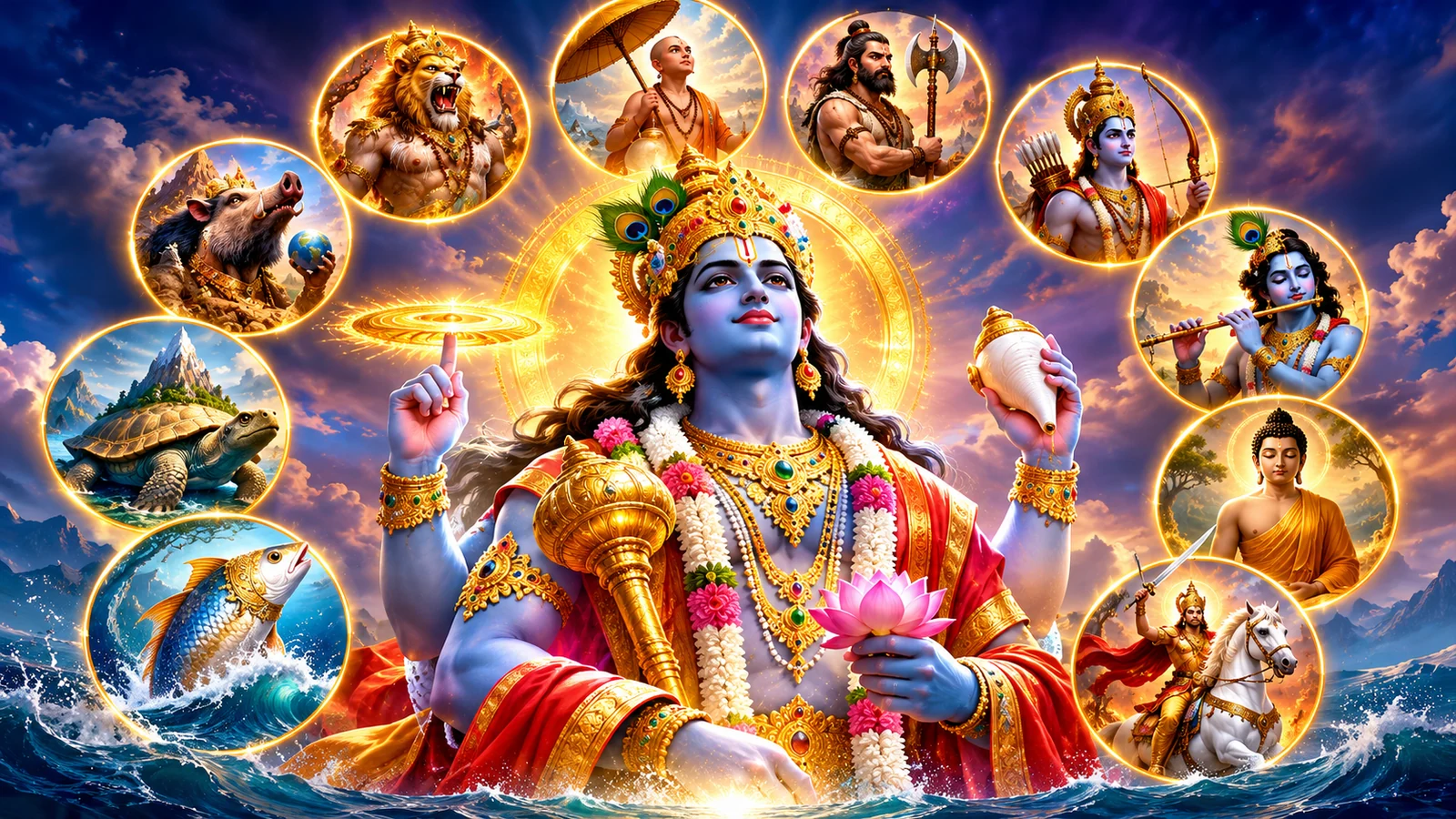
Quick answer: A widely taught sequence of Lord Vishnu’s ten avatars (Dashavatara) is Matsya, Kurma, Varaha, Narasimha, Vamana, Parashurama, Rama, Krishna, Buddha and Kalki. The ninth name is not universal: some Vaishnava traditions include Balarama rather than Buddha, and certain traditional lists place Balarama and Krishna in the eighth and ninth positions. Kalki is described as a future avatar. The names are a guide to a living religious tradition, not a fixed scientific chronology.
If you are exploring Indian mythology for the first time, the question is not only who were Vishnu’s ten avatars? Each manifestation appears in a story about a different crisis: a flood, a threatened earth, a tyrannical ruler or a difficult moral choice. Together they explain how many Hindu traditions understand the protection of dharma, a term connected with moral responsibility, order and the right way to act. This article gives the ten names in order, their memorable stories and the important differences between traditional lists.
Dashavatara at a Glance: All 10 Names in Order
| Order | Avatar | Form or familiar identity | Main idea in the story |
|---|---|---|---|
| 1 | Matsya | Fish | Protecting life and knowledge through a flood |
| 2 | Kurma | Tortoise | Supporting Mount Mandara during ocean churning |
| 3 | Varaha | Boar | Raising the threatened earth from cosmic waters |
| 4 | Narasimha | Man-lion | Protecting Prahlada from Hiranyakashipu |
| 5 | Vamana | Dwarf brahmin | Challenging King Bali through three steps |
| 6 | Parashurama | Axe-bearing warrior-sage | Confronting the misuse of royal power |
| 7 | Rama | Prince of Ayodhya | Duty, exile and the struggle against Ravana |
| 8 | Krishna | Teacher, friend and statesman | Guidance on action, devotion and dharma |
| 9 | Buddha / Balarama | Traditions differ | Distinct theological interpretations |
| 10 | Kalki | Future manifestation | Renewal of dharma at the close of an age |
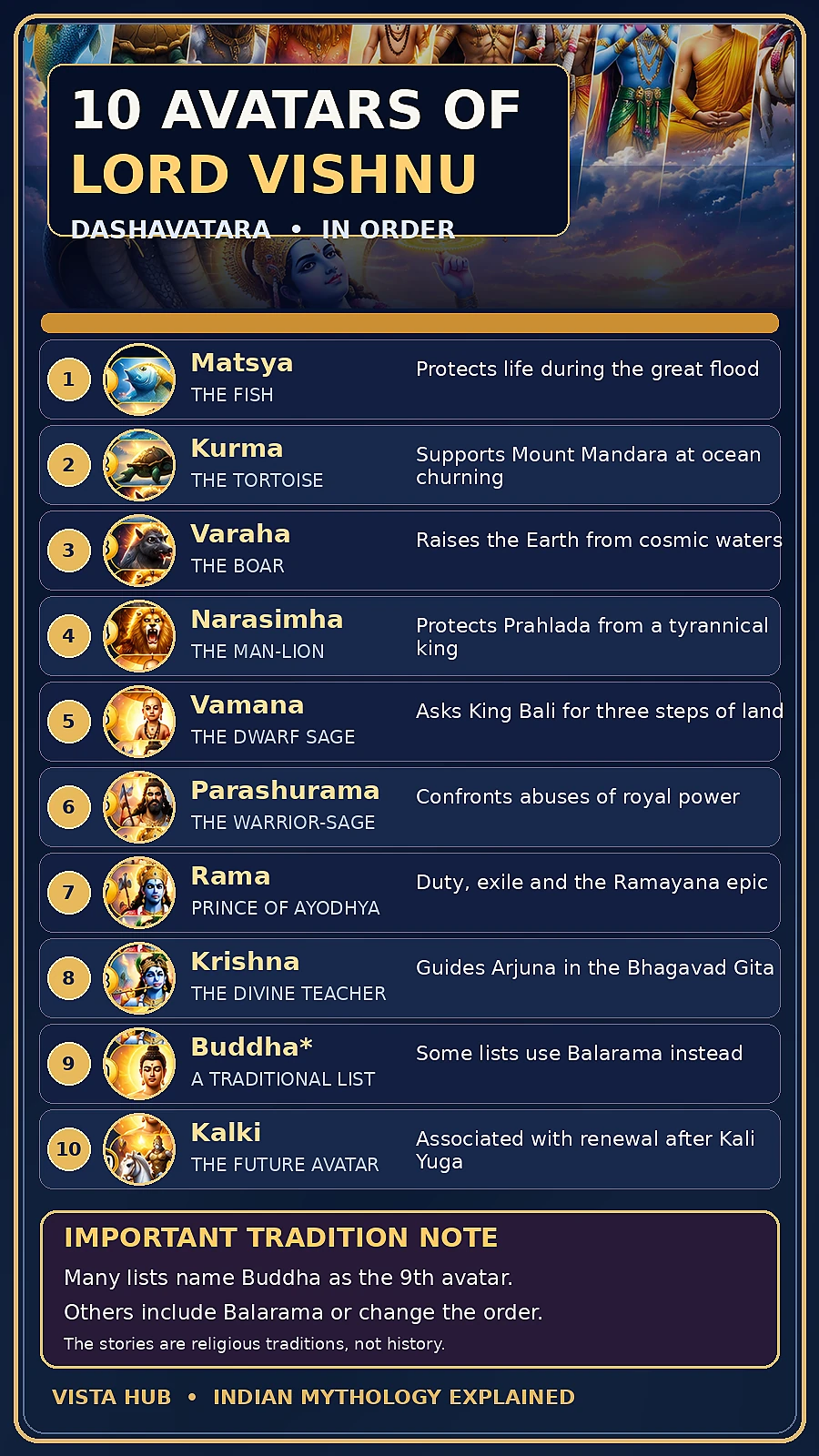
Important: This is a frequently used teaching sequence. The broader Hindu scriptural tradition describes more manifestations of Vishnu than just these ten. The ninth entry in the table is intentionally shown as a variation, not as an unresolved spelling error.
What Does ‘Avatar’ Mean, and Why Does Vishnu Take Different Forms?
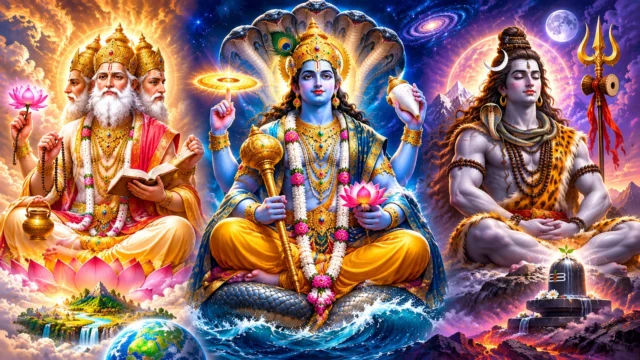
The Sanskrit word avatara can be understood as a divine descent or manifestation. Vishnu is widely recognized as a protector or sustainer of cosmic order, particularly in Vaishnava traditions. In popular explanations, an avatar appears when ordinary beings cannot restore the balance of dharma on their own. The forms are strikingly different because the challenges are different: a fish can guide a vessel across a flood, a tortoise can provide a foundation, and a prince can face the duties of kingship.
The Bhagavad Gita 4.7–4.8 offers a familiar religious framework for divine manifestation when dharma declines and wrongdoing increases. Those verses are not themselves an exhaustive numbered list of Dashavatara. Different Puranas, devotional hymns, regional traditions and temple arts preserve different lists or emphasize different narratives. This is why a careful introduction should say “a commonly followed Dashavatara order” rather than “the only authentic ten.”
The Ten Avatars of Vishnu: Stories and Significance
1. Matsya Avatar — The Fish and the Great Flood
In a well-known flood narrative, Manu encounters a small fish that grows into an extraordinary being. The fish warns him of impending destruction and helps guide a boat through dangerous waters. Some versions emphasize the survival of living beings, while others also emphasize the safeguarding of sacred knowledge. The central image is memorable: what initially appears vulnerable becomes the protector of something much larger. Matsya’s story speaks to preparing for a crisis, preserving wisdom and recognizing responsibility before disaster arrives. It should be described as a sacred narrative, not as independently verified evidence of one particular prehistoric flood.
2. Kurma Avatar — The Tortoise Supporting the Mountain
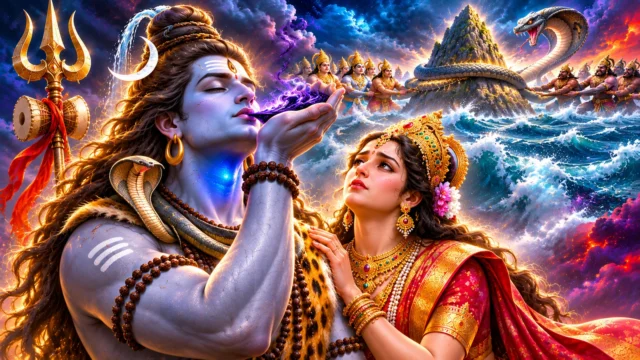
The devas and asuras cooperate to churn the ocean of milk in search of amrita, the nectar linked with immortality. They use Mount Mandara as a churning rod and the serpent Vasuki as a rope, but the mountain requires support. Vishnu takes the form of Kurma, a great tortoise, and supports the mountain. The image illustrates an overlooked kind of strength: not every important contribution is dramatic or visible. Kurma’s steady presence makes the larger task possible. The churning story also warns that cooperation driven by ambition can produce unexpected dangers, including the terrible poison associated with Shiva’s Neelkanth narrative.
3. Varaha Avatar — The Boar Who Rescues the Earth
The earth, often personified as Bhudevi, is carried into or submerged beneath cosmic waters in a story involving the asura Hiranyaksha. Vishnu manifests as Varaha, a boar of extraordinary power, defeats the adversary and lifts the earth to safety. Artists often depict the earth resting upon Varaha’s tusk. The story is not a zoological description of an animal species; it is a religious image of rescuing a threatened world. Its enduring meaning is protection at a cosmic scale. Varaha also challenges the assumption that divinity must always appear in an elegant human shape. In the mythology, an unexpected form is exactly what the moment requires.
4. Narasimha Avatar — The Man-Lion and Prahlada
Hiranyakashipu, a powerful ruler, attempts to make himself invulnerable through unusual protections and demands devotion to himself. His son Prahlada remains devoted to Vishnu despite severe threats. Vishnu appears as Narasimha, neither simply a human nor an ordinary lion, to bring an end to the ruler’s persecution. Well-known retellings place the confrontation at a threshold and at a time that evades the ruler’s apparent safeguards. The story is about more than a frightening figure: it questions arrogance, the limits of power and the courage of a person who refuses to abandon conviction. Details vary in the texts and later devotional drama.
5. Vamana Avatar — Three Steps of Land and King Bali
Vamana arrives as a small brahmin seeker before King Bali, who is celebrated for generosity but also holds extraordinary power. Vamana asks for only three paces of land. When Bali agrees, the visitor expands into the cosmic form often called Trivikrama, covering the worlds with his strides. This narrative has more than one emphasis. Some tellings explore the limits of earthly sovereignty; others admire Bali’s willingness to keep his promise and surrender. The lesson is not simply that a small figure outsmarted a king. It is a complex conversation about humility, gifts, duty and whether generosity survives when the cost becomes personal.
6. Parashurama Avatar — The Axe-Bearing Warrior-Sage
Parashurama, whose name refers to Rama with an axe, appears as a fearsome warrior associated with conflicts against oppressive rulers. His narratives involve his father Jamadagni, questions of family duty and the misuse of political power. Unlike a simple superhero tale, Parashurama’s story is often morally uncomfortable: when force is used to confront injustice, what prevents anger from becoming destructive in its own right? Traditional versions differ in particulars, and readers should avoid presenting the violence in these stories as a modern model for behavior. The figure is important because he highlights a tension between discipline, power, retribution and responsibility. He also appears in narratives connected with later heroes.
7. Rama Avatar — The Prince, Exile and the Ramayana
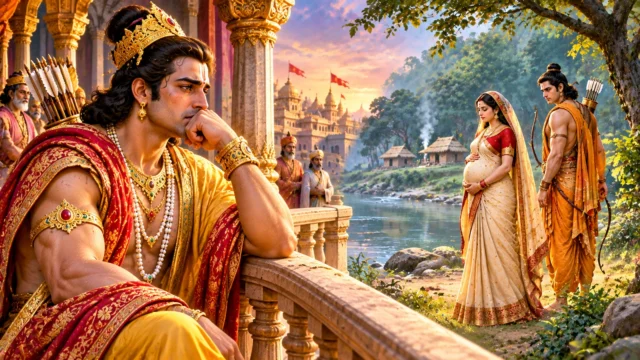
Rama, prince of Ayodhya and hero of the Ramayana, is known for his devotion to duty amid painful decisions. Exiled from the kingdom, he lives in the forest with Sita and Lakshmana. After Sita is abducted by Ravana, Rama builds alliances, notably with Hanuman and the vanara forces, and confronts Ravana. The epic is often introduced as the victory of good over evil, but it also explores loyalty, grief, leadership and the cost of fulfilling obligations. Different Ramayana traditions interpret characters and events in different ways. Those variations deserve attention, especially when discussing difficult subjects such as Sita’s treatment, rather than pretending every version offers the same answer.
8. Krishna Avatar — The Divine Teacher and Friend
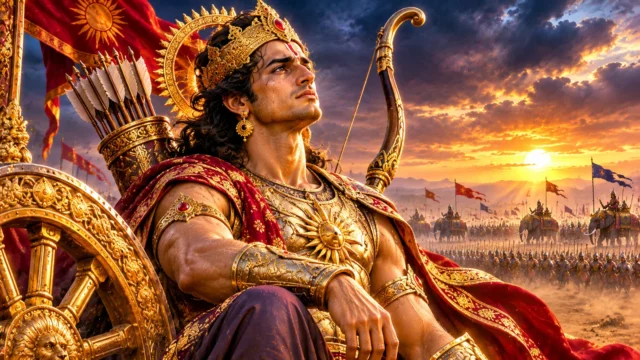
Krishna appears in a rich range of narratives: childhood stories in Vraja, loving devotional traditions, diplomacy and leadership in the Mahabharata, and the teaching of the Bhagavad Gita. On the battlefield at Kurukshetra, Krishna counsels the troubled Arjuna about action, duty, knowledge and devotion. In many popular Dashavatara lists, Krishna is eighth. However, Vaishnava theological schools do not all describe his relation to Vishnu in exactly the same way. Some understand Krishna as the supreme source, not merely as one item in a sequence. The story of Krishna therefore cannot be reduced to a weapon, a battle or a single motivational quotation; his importance crosses philosophy, poetry, worship and narrative.
9. Buddha or Balarama — Why the Lists Differ
One familiar list gives the ninth place to Buddha; another includes Balarama, Krishna’s elder brother. The difference is a real feature of Hindu religious history, not a mistake that can be corrected with a single universal rule. Some traditional arrangements put Balarama eighth and Krishna ninth, while a celebrated poetic sequence by Jayadeva treats Krishna as the divine source of the incarnations. When Hindu traditions identify the Buddha as an avatar, they interpret him within a Hindu theological framework. That should not be presented as the Buddhist tradition’s own definition of Gautama Buddha. For an educational poster, it is best to show the variation openly and to name which sequence is being used in the surrounding article.
10. Kalki Avatar — The Future Renewal of Dharma
Kalki is a future avatar in many Hindu narratives and is associated with the end of Kali Yuga and the renewal of righteous order. Paintings commonly show a rider and a white horse, while descriptions vary in detail. Kalki’s place in the Dashavatara expresses a hope that moral disorder will not have the final word. It does not give readers a scientifically verified timetable or a reason to trust modern rumors claiming an exact arrival date. Religious calendars and cosmological calculations need to be discussed as traditions rather than as independently verified predictions. Because Kalki is presented as future, his iconography is symbolic and anticipatory, not an image of an event historians can photograph.
Is Buddha the Ninth Avatar, or Is Balarama Eighth?
This is one of the most important points for readers searching for the 10 avatars of Lord Vishnu in order. Many quick-reference lists name Krishna eighth and Buddha ninth. Other lists give Balarama a place alongside Krishna and do not include Buddha in that particular ten. Jayadeva’s Gita Govinda also follows its own arrangement, with Krishna praised as the source who takes on the forms. These differences exist because the Dashavatara is a traditional grouping that has been developed through different texts and communities.
A school chart can use the familiar order, but it should include one sentence acknowledging alternatives. A scholarly article should go further and specify the text or lineage on which it relies. This approach does not weaken the stories. It allows readers to see how Indian mythology has been preserved and interpreted over centuries, and why communities may cherish somewhat different visual sequences. The Bhagavata Purana mentions many divine manifestations beyond a single ten-name list.
Which Yuga Does Each Avatar Belong To?
Some simplified charts place Matsya, Kurma, Varaha and Narasimha in Satya Yuga; Vamana, Parashurama and Rama in Treta Yuga; Krishna in Dvapara Yuga; and Kalki toward the conclusion of Kali Yuga. These are traditional teaching associations and are not completely uniform across accounts. The Buddha or Balarama variation also affects the order shown in a particular chart. Presenting a single graphic with exact modern calendar dates would imply more agreement and historical certainty than the sources support.
The four yugas are part of Hindu cosmology, in which time is described through recurring ages. The idea is different from archaeological timelines or the scientific study of evolution. Readers can learn the conventional associations while still asking which text a chart follows. For a beginner, remembering the story and its purpose is usually more valuable than memorizing a disputed year or insisting every episode occurred in the same historical way.
Are the Ten Avatars Evidence of Evolution? Myth, Symbolism and Science
People sometimes notice that a familiar Dashavatara sequence begins with a fish, proceeds through animal and human-animal forms, then includes human figures. That has inspired modern comparisons with biological evolution. It can be an interesting analogy, but it is not scientific evidence that the ancient stories anticipated Darwinian evolutionary theory or documented actual biological stages. The ten narratives were created and transmitted in religious and literary contexts, while evolution is studied through genetics, fossils and other testable evidence.
The comparison is also not perfect: the traditional lists vary, and their purpose is not to classify species. It is more responsible to explore the symbolism of rescue, support, justice, self-restraint and renewal than to advertise a devotional sequence as a proven scientific discovery. Similarly, Kalki’s future appearance belongs to religious expectation, not confirmed prediction. These distinctions make the article more useful for both believers and curious international readers.
What Can Modern Readers Learn From Dashavatara?
Matsya highlights preparation and protecting knowledge; Kurma reminds us of quiet support; Varaha evokes responsibility toward the world; and Narasimha challenges arrogance and coercion. Vamana asks whether generosity includes humility. Parashurama raises difficult questions about anger and justice. Rama invites debate about duty and relationships, while Krishna offers a profound discussion about making decisions when every option carries a cost. The Buddha/Balarama variation encourages historical curiosity rather than needless arguments over one official list. Kalki symbolizes hope for renewal.
These are possible contemporary readings, not rules that every Hindu school teaches in exactly the same words. The best way to explore Dashavatara is to read a carefully translated account, understand its context and then reflect on what its central dilemma means. In children’s learning materials, concise captions can introduce the ten names. Older readers can go deeper by comparing editions of the epics, Puranas and devotional poetry.
Frequently Asked Questions About Vishnu’s Ten Avatars
What are the 10 avatars of Vishnu in sequence?
A widely used order is Matsya, Kurma, Varaha, Narasimha, Vamana, Parashurama, Rama, Krishna, Buddha and Kalki. Some traditional lists include Balarama instead of Buddha or use a different arrangement.
Which avatar is half-human and half-lion?
Narasimha is represented as a man-lion. His story centers on protecting the devotee Prahlada and ending the tyranny of Hiranyakashipu.
Is Krishna the eighth avatar of Vishnu?
Krishna is eighth in one common list. Other devotional systems describe his divine status differently, and some sequences place Balarama before Krishna.
Is Buddha considered an avatar of Vishnu by every Hindu?
No. Some Hindu texts and traditions include Buddha in the Dashavatara, while others include Balarama. Buddhist traditions have their own understanding of the Buddha.
Has Kalki avatar already appeared?
In many traditional Dashavatara accounts, Kalki is a future manifestation. Online claims asserting a verified arrival date should not be treated as established fact.
Are there only ten avatars of Vishnu?
No. The ten are a memorable grouping. Puranic literature describes many other manifestations and sometimes characterizes divine manifestations as innumerable.
Conclusion: Ten Forms, Many Traditions, One Continuing Question
The Dashavatara is not simply a list of fantastic characters. It is a collection of narratives about protection, moral conflict and renewal. Learn the familiar order, but remember the genuine variation involving Buddha and Balarama. A reader who asks which text, which tradition and what meaning will understand Vishnu’s avatars better than someone who treats a single viral chart as the final word.
Sources and reading: Bhagavad Gita 4.7, IIT Kanpur Heritage; Dashavatara textual variations and references. Sacred stories are presented as mythology and religious tradition, not independently verified historical events. Editorial review: 12 November 2026.














Share Your Opinion
Comments are closed on this post.