 Vista
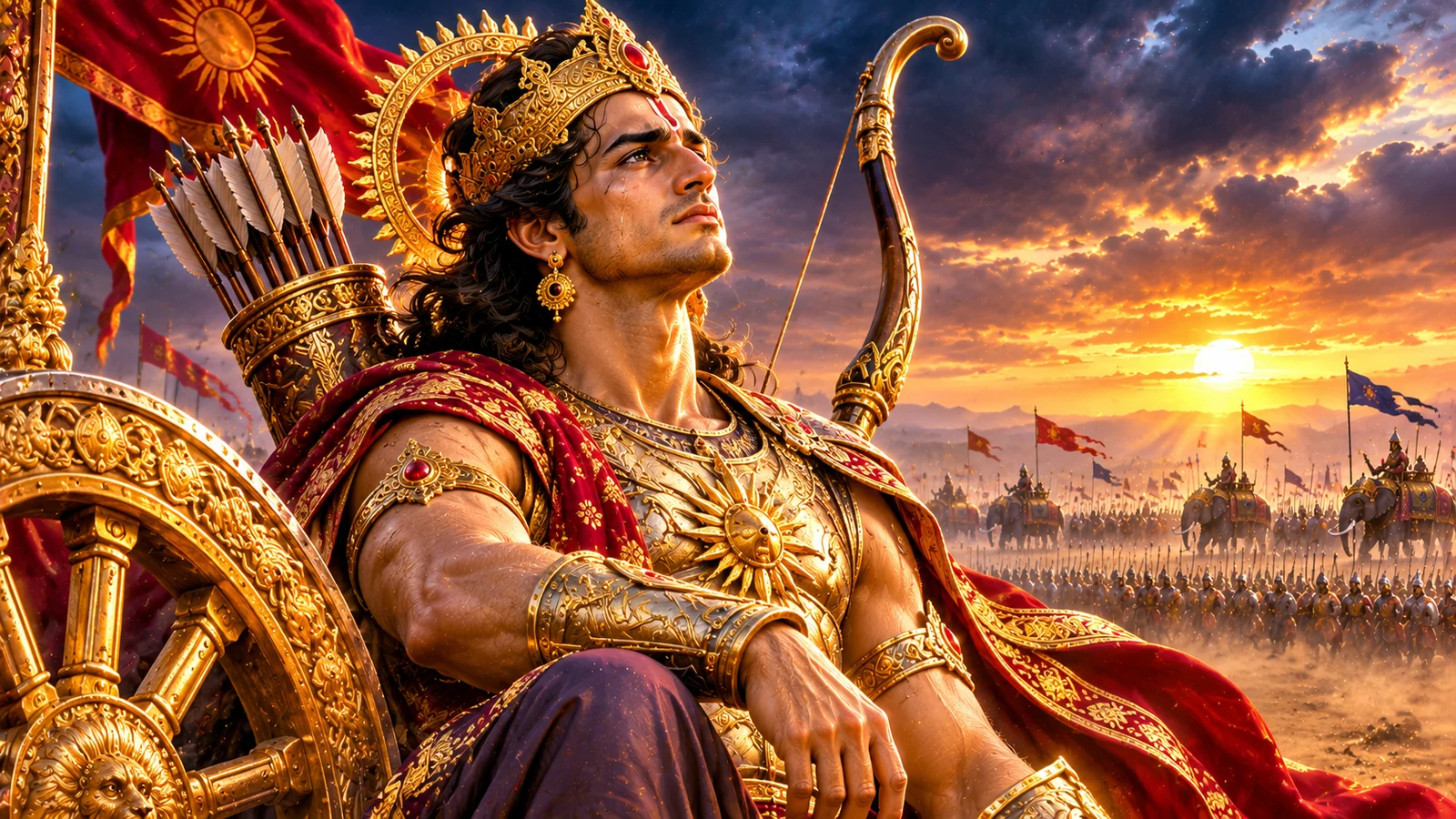
Karna is one of the most compelling and morally complicated figures in the Mahabharata. Born to Kunti and the sun deity Surya, raised by Radha and Adhiratha, and later crowned king of Anga by Duryodhana, he is remembered for extraordinary archery, generosity and unwavering friendship. Yet his loyalty also drew him into decisions that caused serious harm. Karna is a tragic hero not because he was always right, but because exceptional strengths and grievous mistakes coexist in the same person. His story cannot be reduced to a contest in which fate alone defeated an innocent warrior. The epic gives him moments of compassion, pride, resentment, integrity and cruelty. To understand his death on the seventeenth day of the Kurukshetra war, we need to understand the difficult choices that brought him there.
Who Was Karna? Family, Names and the Secret of His Birth
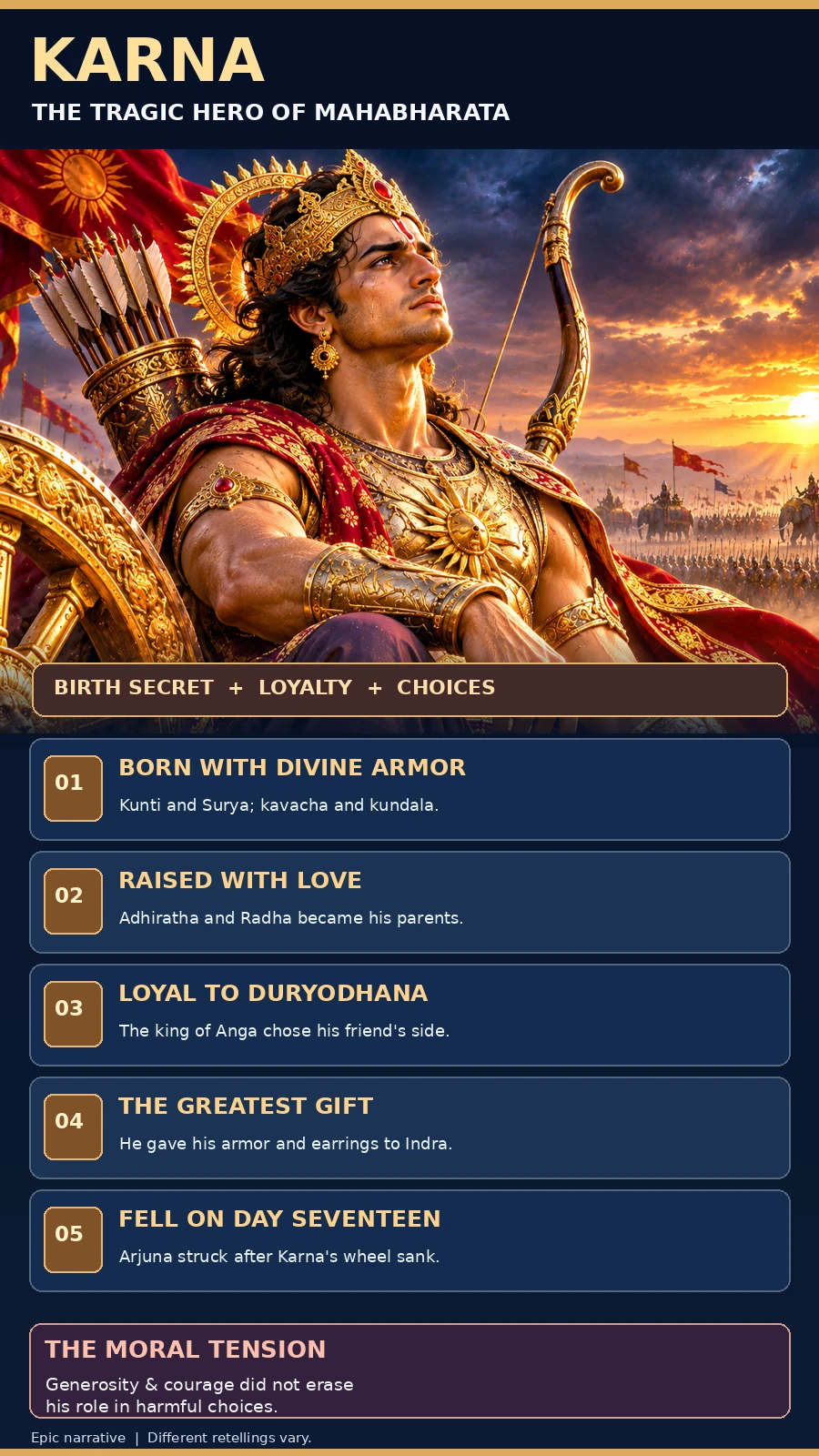
Karna’s story begins before the Pandavas are born. In the epic, the young princess Pritha, better known as Kunti, receives a mantra that allows her to call upon a deity. She invokes Surya, and a child is born with extraordinary natural armor (kavacha) and earrings (kundala). Afraid of the consequences of an unmarried birth in her social circumstances, Kunti places the baby in a container and releases him upon the river. The abandoned infant is discovered and lovingly raised by Adhiratha, traditionally described as a charioteer, and his wife Radha. Their care is not a footnote: Karna later identifies himself with the family that nurtured him.
He is called Vasusena in accounts referring to his birth and natural ornaments, Radheya after his adoptive mother and Suryaputra because of his divine parentage. Kunti is also the mother of Yudhishthira, Bhima and Arjuna, as well as the twins Nakula and Sahadeva by different circumstances described in the epic. Karna is therefore their elder maternal brother, a relationship concealed from the brothers until the war’s aftermath. Karna himself learns of his parentage before battle through conversations with Krishna and Kunti. A popular internet summary sometimes says he fought without knowing his identity until the moment he died; that claim misses those crucial prewar dialogues.
The origin narrative belongs to sacred epic literature. It should be presented as a traditional account, not as a scientifically verified birth record. Its enduring human question is easy to recognize: How much should ancestry determine who we are, and how much should the love of those who raised us matter?
Karna’s Education, Ambition and Humiliation
As a young man Karna is determined to excel at archery. The Mahabharata contains several episodes about his training and rivalry with Arjuna. Accounts describe his study under teachers associated with martial knowledge, including Drona and Parashurama. Karna’s life is repeatedly marked by arguments about lineage and entitlement. The distinction between the honor attached to a warrior’s skill and the honor attached to inherited status becomes especially painful when he appears in the martial exhibition at Hastinapura and challenges Arjuna.
Duryodhana recognizes Karna’s skill and, in the celebrated account of the tournament, makes him king of Anga. This move offers Karna social standing and a powerful ally at a moment when he is being challenged about his birth. But the story also invites a less comfortable question: Was Duryodhana helping a gifted outsider because it was right, because he wanted an ally against the Pandavas, or for both reasons? The epic’s political setting makes it hard to separate generosity from strategic advantage.
Karna’s pride is understandable when read against repeated social insults. Still, wounded pride does not remove responsibility for later actions. He comes to measure himself against Arjuna, and this rivalry becomes entangled with the increasingly destructive ambitions of Duryodhana. Their friendship gives him recognition but gradually narrows the options he is willing to consider. This is an important distinction: the character’s social struggle is a reason to understand his anger, not permission to approve of everything he does.
Why Did Karna Remain Loyal to Duryodhana?
The emotional center of Karna’s life is gratitude. Duryodhana publicly supports him and grants him the kingdom of Anga. Karna responds with fierce loyalty even as war approaches. When Krishna approaches him before the battle and tells him the truth of his birth, the political consequences are extraordinary: Karna is older than the Pandavas and could, in the logic of the conversation, occupy a place of supreme honor if he joined them. Yet he declines. He knows that Duryodhana has relied upon him to oppose the Pandavas and he does not wish to abandon the friend who helped him rise.
Karna also explains his debt to Radha and Adhiratha. They are the people who loved and raised him; announcing a new identity for political gain would carry painful personal consequences. This passage is one of the epic’s strongest responses to the idea that biological parentage is the only form of family. The choice is dignified in one sense, but there is a tragic cost: Karna’s loyalty helps sustain Duryodhana’s war even when that cause has been implicated in injustice.
Friendship is admirable, but loyalty becomes morally dangerous when it requires participation in another person’s wrongdoing. Karna’s situation is powerful precisely because both statements can be true. He can be grateful to Duryodhana and still be accountable for how he uses his power. Readers who treat him as a flawless victim miss the tension the story creates.
Kavacha, Kundala and the Price of Generosity
Karna’s generosity is one of the qualities most closely linked to his name. A famous episode in the Vana Parva describes Indra, the father of Arjuna, approaching Karna in disguise to ask for his natural armor and earrings. Surya warns Karna about the danger, but Karna gives them away. In return, he receives a powerful weapon, often called Vasavi Shakti, which can be used only once. The scene captures two very different dimensions of generosity. It shows the astonishing extent of Karna’s commitment to giving, and it shows that a noble-looking gift can reshape a conflict in painful ways.
Later, Karna uses the single-use weapon against Ghatotkacha, Bhima’s son, during the night fighting. The decision removes a formidable threat to the Kaurava forces but leaves Karna without that particular weapon for his anticipated duel with Arjuna. This turning point is important to the final battle, but it should not be simplified into a claim that Karna was invincible in every other circumstance. Epic weapons, prophecies and vows operate inside a sacred narrative rather than following rules of modern ballistics.
The famous label Daanveer Karna, or Karna the great giver, celebrates this side of his personality. Yet giving away valuable possessions and treating other people justly are separate moral tests. One virtue cannot automatically cancel failures in another part of life.
Parashurama’s Curse and the Other Misfortunes
Karna’s relationship with Parashurama adds another tragic complication. In a well-known episode Karna obtains training while concealing or misrepresenting his background. When Parashurama discovers the deception, he curses Karna so that his knowledge of a crucial weapon will fail him at a decisive moment. The narrative is frequently told with the scene of an insect painfully biting Karna while he remains still so as not to disturb his sleeping teacher. Different adaptations place emphasis on different aspects of the encounter.
Another curse is connected with Karna accidentally killing a Brahmin’s cow. This episode is associated with the loss or sinking of his chariot wheel in his last battle. Readers sometimes encounter social-media lists of five or seven ‘official curses’ and a precise sequence in which each one activated. Such neat inventories often mix textual episodes, later explanations and television dramatizations. It is better to identify the particular incident and the version of the epic being used.
The curses express a world in which actions have consequences, but they do not erase human agency. Karna’s misfortunes arise from many sources: the circumstances of his birth, discrimination, rivalry, deception, allegiance, a divine bargain and decisions in battle. Reducing the whole tragedy to a single curse is emotionally dramatic but less faithful to the story’s complexity.
Karna and Draupadi: Why His Moral Failures Matter
No serious character analysis of Karna should omit the humiliation of Draupadi in the Kuru assembly. The Mahabharata portrays Karna as siding with the Kauravas and directing harsh, degrading words at Draupadi. These actions are ethically important. Readers may sympathize with Karna’s own experiences of insult, yet that sympathy does not justify insulting another vulnerable person. His behavior in the assembly shows how someone harmed by prejudice can still choose to harm others.
Another widely repeated claim concerns Draupadi allegedly rejecting Karna at her svayamvara because of his birth. The wording and presence of that scene vary across textual traditions; popular dramatizations often present one version as undisputed. A careful article should avoid claiming that every critical edition contains the same exchange. The assembly episode remains a serious issue regardless of how a reader evaluates the disputed svayamvara tradition.
During the war, Karna is also connected with the broader Kaurava campaign that results in the death of Abhimanyu in an unequal confrontation. The precise responsibility of individual warriors should be described through the text rather than inflated into convenient one-line accusations. The larger point is clear: Karna’s alliance has consequences for people beyond himself and Duryodhana. Admiring his courage while ignoring those consequences turns a complex character into a caricature.
Kunti’s Plea: The Brother Karna Could Not Become
Shortly before the war, Kunti approaches Karna and reveals that she is his mother. Her request is heartbreaking: she wants him to join the Pandavas and avoid fighting his own brothers. Karna answers with a mixture of hurt, attachment and restraint. He cannot overlook the abandonment that shaped his life, and he will not desert Duryodhana. Yet he offers Kunti a limited assurance: apart from Arjuna, he will not seek to kill her other sons. At the end of the conflict she will still have five sons, whether Karna or Arjuna survives the duel.
This conversation is sometimes presented as proof that Karna was either entirely merciful or entirely resentful. It is neither. The offer reveals genuine restraint toward his brothers, while his continued commitment to Duryodhana keeps the coming violence in motion. Kunti’s secrecy is understandable within the epic’s portrayal of social fear, but the story also shows the painful cost of delayed truth. The revelation arrives when it is almost too late to prevent catastrophe.
The scene also revisits an important question about adoption. Karna’s bond with Radha and Adhiratha remains real after he discovers the truth of his birth. His refusal is not simply the stubbornness of a warrior seeking fame. It is also the decision of a son who refuses to erase the people who cared for him.
Karna vs Arjuna: What Happened on Day Seventeen?
Karna becomes commander of the Kaurava forces after the deaths of earlier commanders. His great duel with Arjuna takes place on the seventeenth day of the eighteen-day Kurukshetra war. Shalya drives Karna’s chariot, while Krishna drives Arjuna’s. The rival archers exchange powerful attacks. In the decisive episode, Karna’s chariot wheel becomes stuck in the ground. He attempts to free it and appeals to the rules of honorable combat, asking for a pause.
Krishna answers by recalling occasions when Karna and the Kaurava side failed to protect others, including Draupadi’s humiliation and wrongdoing during the war. Arjuna then releases the fatal arrow. The episode is disturbing because the appeal to fair combat is not inherently absurd; the epic places it against a history of broken rules and accumulated grievances. It is not enough to say that Karna was ‘killed fairly’ or ‘murdered unfairly’ without explaining the underlying debate. The death scene presents a collision between battlefield ethics, revenge, political necessity and the consequences of earlier actions.
The divine armor is no longer with Karna, and the weapon received from Indra has already been spent on Ghatotkacha. Curses are associated with his failing options. But none of these details alone explains everything. His ultimate defeat arises at the intersection of numerous narrative threads, making the scene one of the epic’s most haunting conclusions.
Was Karna a Hero, a Villain, or Both?
A useful way to judge Karna is to consider his virtues and failures separately before asking how they influence one another. His generosity is extraordinary, his determination impressive, and his loyalty to those who raised and supported him deeply moving. He repeatedly confronts pain related to identity and recognition. At the same time, he supports Duryodhana even when that support involves humiliation, exclusion and war. He participates in moral failures that do not disappear because his own suffering is real.
Calling Karna a tragic hero is an interpretive label, not a formal verdict delivered by one verse. It means a figure of great ability whose choices, weaknesses and circumstances contribute to catastrophe. His tragedy is not that the universe punished a perfect man for being generous. It is that a capable and sometimes noble man made decisions that trapped him within a destructive conflict. That is why he remains more interesting than a one-dimensional champion.
The questions Karna raises still matter: Does gratitude require unconditional loyalty? Is courage enough without justice? Can one be mistreated and still bear responsibility for mistreating others? What happens when recognition arrives from someone whose larger cause is harmful? The Mahabharata invites disagreement rather than offering an effortless answer.
Karna’s Life at a Glance
| Question | Answer in the epic narrative |
|---|---|
| Birth mother and divine father | Kunti and Surya |
| Adoptive parents | Radha and Adhiratha |
| Important names | Vasusena, Radheya, Suryaputra, Karna |
| Political patron and close friend | Duryodhana |
| Kingdom | Anga |
| Famous gift | Natural kavacha and kundala given to Indra |
| Special weapon | One-use Vasavi Shakti, later used on Ghatotkacha |
| Key rival | Arjuna |
| Final battle | Day 17 of Kurukshetra war |
| Major ethical controversy | Participation in Draupadi’s humiliation and the Kaurava cause |
What Can We Learn From Karna’s Story?
The most valuable lesson is not ‘always choose loyalty’ or ‘always give everything away.’ Those slogans are too simple. Karna shows why values must be weighed together. Gratitude matters, but so does the effect of our allegiance on other people. Courage matters, but so does the cause for which it is used. A painful childhood can help explain resentment without turning every later injury into a justifiable response. The epic’s power lies in allowing these truths to coexist.
Read the older source passages alongside retellings, particularly the Vana Parva stories of his birth and armor, the Udyoga Parva discussions with Krishna and Kunti, and the Karna Parva account of his final battle. Section numbering may differ among editions, so check the book and episode rather than relying solely on a viral quote. Do not confuse literary or devotional narrative with a verified historical biography. Respect for the epic is compatible with asking careful questions about its moral complexity.
Frequently Asked Questions About Karna
Who were Karna’s real parents?
Kunti is his birth mother and Surya is his divine father in the Mahabharata narrative. Radha and Adhiratha are the parents who raise him.
Why is Karna called Radheya?
The name honors his adoptive mother Radha, underscoring the family bond he values throughout his life.
Why did Duryodhana make Karna king of Anga?
At the martial exhibition Duryodhana offers him status and support, strengthening a lasting friendship and a political alliance against the Pandavas.
Did Karna know he was Kunti’s son before the war?
Yes. His conversations with Krishna and later Kunti before the war make that knowledge central to his decision to remain with Duryodhana.
Why did Karna donate his armor and earrings?
His celebrated commitment to giving leads him to surrender his natural kavacha and kundala to Indra. He receives a one-use weapon in exchange.
On which day was Karna killed?
Arjuna kills Karna on day seventeen of the eighteen-day Kurukshetra war, during a duel described in the Karna Parva.
Was Karna morally perfect?
No. The epic gives him impressive virtues but also serious moral failures, particularly his conduct toward Draupadi and his support for the Kaurava cause.
Conclusion
Karna endures because he is neither a spotless hero nor a disposable villain. His generosity, friendship and determination earn admiration, while his complicity in injustice demands criticism. He learns the truth of his birth yet chooses the family and friend who shaped his life. His death closes an intense rivalry but leaves a far larger ethical question open: When loyalty and justice pull in opposite directions, what should a person do? The Mahabharata makes that question difficult—and Karna unforgettable.
Sources and Further Reading
- Mahabharata, Vana Parva, Karna’s birth and the story of his armor: Read the source
- Mahabharata, Udyoga Parva, Karna’s conversation with Krishna: Read the source
- Mahabharata, Udyoga Parva, the Kunti–Karna dialogue: Read the source
- Mahabharata, Karna Parva, the final duel and death: Read the source
Editorial note: This article discusses a sacred epic and its varied retellings. Characters, weapons and events are described within that narrative, not as independently verified historical or scientific facts. Updated 12 November 2026.
Related reading
- The 18 days and rules of the Kurukshetra War
- Parashurama and the difficult balance between duty and justice
- Bhagavad Gita: text, authenticity and practical understanding

















Share Your Opinion
Comments are closed on this post.