 Vista

Legal update (11 November 2026): BNSS Section 173 governs information about cognizable offences, including information given regardless of territorial area. A police refusal does not mean every complaint can automatically be registered as an FIR; the nature of the reported offence and legal procedure matter. Preserve a copy and acknowledgement, and use the statutory senior-officer or magistrate route where appropriate. Read BNSS 173. This is general information, not individual legal advice.
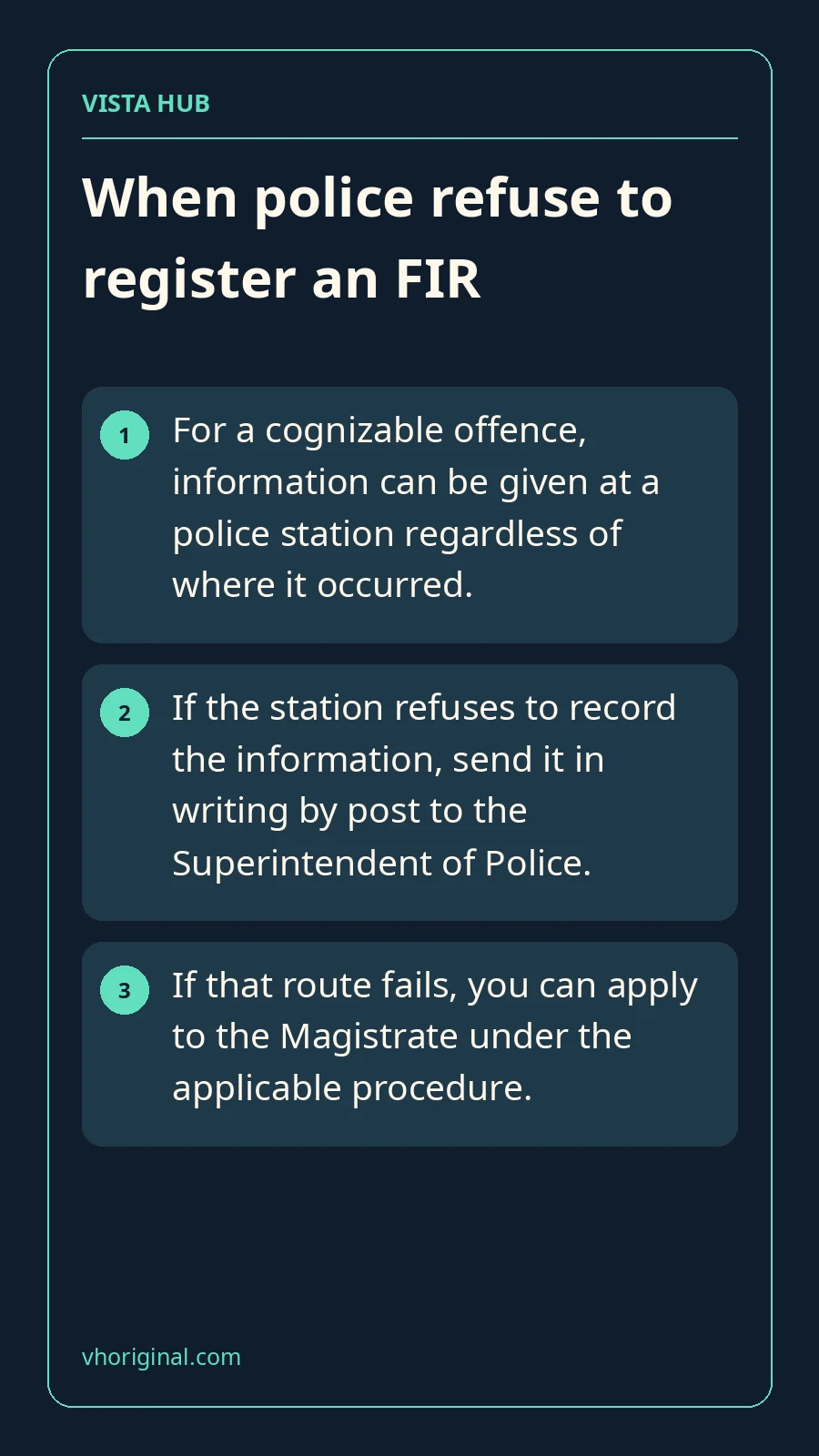
When Police Refuse to Register Your Complaint: The First Steps
Imagine a serious incident occurs, and you rush to the police station, only to be told, “Not here,” “Come later,” or “This is a personal matter.” Such a response can be confusing and distressing. Instead of escalating the situation, it’s crucial to have a clear, written account of the incident and proof that you submitted a complaint. Understanding the difference between an FIR, a simple application, and an Uncognizable Offence (NC) entry is essential for moving forward. This guidance is based on general principles under the current legal framework. In cases of immediate danger, injury, or violence, prioritize your safety and seek medical help first. Do not spend so much time drafting a written application that you delay receiving urgent assistance.
FIR and Complaint Acknowledgement: Not Always the Same
The process for recording information about a cognizable offence is outlined under Section 173 of the BNSS (Bharatiya Nagarik Suraksha Sanhita). It’s important to remember that not every family or financial dispute automatically constitutes a cognizable offence. The legal nature of the incident depends on the facts presented. Therefore, simply filing a complaint doesn’t guarantee that all the sections you desire will be applied. The acknowledgement of your application, a Station Diary reference, and an FIR number can all be distinct. Carefully read what is written on any document you receive. Ask for clear information about whether a record has been made, in what format, and what the next steps are. If there’s any misunderstanding, request a written clarification. The current primary reference is the text of the BNSS law from the Ministry of Home Affairs. Older online templates might use CrPC numbers; ensure you are using the current procedure after verification. Note that BNS (Bharatiya Nyaya Sanhita) and BNSS are distinct laws; do not present procedures under a single name without differentiating.
Zero FIR and Electronic Complaints
Section 173(1) of the BNSS provides a framework for reporting information about a cognizable offence, irrespective of the geographical area where the incident occurred. This means that you should not assume that the jurisdiction is a reason to prevent the proper recording of information. The concept of a Zero FIR is understood in this context. If you submit information electronically, the legal requirement to sign it within three days for it to be officially recorded is important. Not every online form or email constitutes a completed e-FIR. Follow the instructions on official portals and from relevant authorities. Refer to the FIR and e-FIR guideline documents from the Bureau of Police Research and Development (BPR&D) and official government clarifications. Avoid uploading your full identification or sensitive evidence to unofficial private websites.
Primary Investigation Exceptions and Limitations
The law provides for a preliminary inquiry under specific circumstances. For cognizable offences where the punishment is three years or more but less than seven years, a preliminary fact-finding may be conducted within fourteen days, with prior permission from an officer of at least the rank of Deputy Superintendent of Police. This does not mean that every complaint can be indefinitely stalled under the guise of an inquiry. When inquiring about the status of your application, ask specifically: “What process is underway, and what is its reference?” Avoid concluding that an inquiry means illegality or that any waiting period is justified simply because the police have stated it. Seek legal advice for specific situations.
Applying to a Senior Officer If Registration is Refused
If your request for registration is refused under Section 173(4) of the BNSS, you can send a written summary of the incident, along with a copy of your earlier complaint and any available acknowledgement, to the Superintendent of Police. For commissionerate areas, verify the correct office and official contact details separately. The application should clearly state:
Subject: Request for Action Regarding Registration of Information of a Cognizable Offence.
Applicant: [Name and Contact Details]
Incident: [Date, Time, Location]
Information provided at the concerned police station on [Date]; available acknowledgement / reference [___].
The response received or the difficulty encountered [State facts only].
Conclude your request with a clear plea: “I am attaching the sequence of events and available evidence. Kindly evaluate the information as per applicable law and take necessary action for registration and investigation. Please inform me of the receipt reference and the next steps.”
This is not a universal court application for all cases. If appropriate action is still not taken, you may have the option to file an application before a Magistrate. For necessary affidavits, previous follow-ups, and related procedures, consult with a lawyer. You can refer to relevant clarifications from the BPR&D as a primary reference.
Presenting Evidence and Chronology Clearly
Organize the information about the incident chronologically. Clearly distinguish between what you personally witnessed, what others told you, and your own assumptions. If you don’t know the name of the accused, do not invent one; provide an honest description of what you observed. Avoid creating false witness statements or fabricated screenshots. If you have messages, transaction records, photos, or medical documents, keep the original files secure. Ensure that cropped screenshots do not alter the context. Keep a simple record of when and from whom you received evidence. If you hand over original documents, ask for a written acknowledgement and keep a copy for yourself. Preserving proof of your complaint submission is vital. Keep postal receipts, tracking information, official emails, and any replies in a dedicated folder. Do not provide different, embellished stories to different offices. If you realize a mistake, clearly communicate the correction; do not hide the previous version. For example, if you are reporting a financial fraud in Nashik, mention the date you paid the money, the beneficiary’s details, and the exact assurances given. Not getting the money back does not automatically make every case a criminal matter; facts of transactional fraud must be presented separately. In sensitive cases, do not publicize the victim’s identity or private documents on social media, as public pressure can impact the investigation. Use appropriate official channels and legal aid. Do not trust promises of guaranteed FIR registration for a fee. If you cannot afford legal assistance, inquire about eligibility for aid from the District Legal Services Authority. During consultations, present all previous applications and responses. Instead of saying “How many days have passed,” provide a precise timeline of events. This makes it easier to determine the appropriate next application. If you have previously filed an application for the same incident elsewhere, mention it. Concealing prior information can complicate matters. Number each page of your application and attach a brief list of enclosures. Clearly indicating where the specific evidence is located within a large file makes it easier to read. Exclude rumours and personal criticisms. If you have a language barrier, seek assistance to clarify information in a language you understand. Read what is written before signing, or request someone to explain it to you. Point out any statements that you did not make. Upon receiving a copy, keep it safe and use the same reference number in future correspondence. Mentioning the previous acknowledgement number in subsequent applications helps track the same incident.
Frequently Asked Questions
Can I file a complaint about an incident in another district?
There is a legal framework to report cognizable offences regardless of the jurisdiction. Inquire about the proper recording and transfer process.
Does sending an email mean an FIR has been registered?
No. You need to verify the electronic record, obtain a signature if required, and follow the subsequent official procedures.
Is an FIR necessary for every complaint?
The legal nature of the incident is crucial. A simple complaint, an Uncognizable Offence (NC) entry, and an FIR are distinct.
What if I still don’t get help after approaching a senior officer?
For further recourse, such as filing an application before a Magistrate, consult with a lawyer with all your documentation. This is general legal information. For specific cases, immediate danger, or court applications, seek independent legal assistance.
This information is for general guidance only. For specific legal matters, urgent risks, or court applications, seek independent legal assistance.
Related reading
- Police Calling Without FIR: Written Notices, BNSS 35 and Your Rights in India
- How to remove name from false FIR: Section 482 CrPC quashing petition in High Court explained























Share Your Opinion
Comments are closed on this post.