Police calling without an FIR: verify the call and your role first
A caller says: “Come to the station. Someone has complained against you.” You receive no FIR number and no written notice. Paying out of fear or disappearing can create more problems. Verify the officer and station, ask for the complaint reference and your role, and request the appropriate written process where attendance is required.
Not every police conversation before an FIR is unlawful. Preliminary inquiry, witness information, protection and crime prevention involve different powers. Equally, a phone call is not automatically a legally served attendance notice. This guide explains a practical Indian response without promising immunity from investigation or arrest. Special statutes and court orders may change the position.
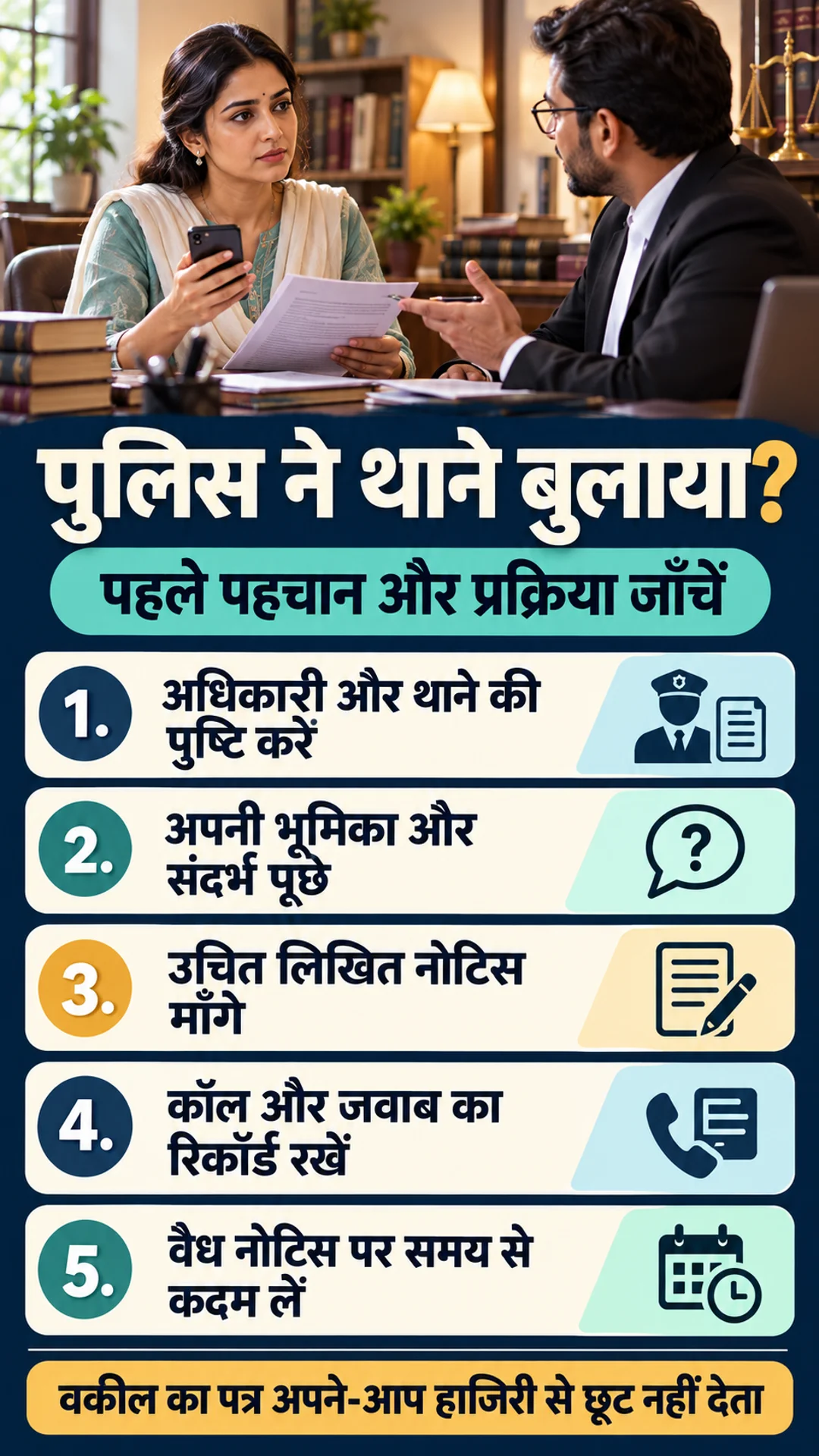
Five immediate steps
- Ask for the officer’s name, rank, station, official contact, complaint/FIR/diary reference and purpose.
- Clarify whether you are being contacted as a witness, complainant or person facing allegations.
- Keep a factual dated note of the call and preserve messages.
- Independently confirm through a station number obtained from the official police website.
- Request the relevant written notice/order; promptly act on deadlines in a genuine notice.
Phone call, police notice and court summons are different
A station call may provide information or arrange an appointment. A court summons is a judicial process. A police appearance notice and an order requiring a witness to attend have separate provisions. Identify the document, issuing authority, section, place and date before deciding how to respond. Do not assume every communication labelled “summons” has the same legal effect.
BNSS 173(3) permits preliminary inquiry for certain cognizable offences punishable with three years or more but less than seven years, subject to prior permission from an officer not below DSP and other conditions, within fourteen days. This is not a blanket permission for indefinite questioning. It also means absence of an FIR number alone does not prove that every contact is unlawful.
A useful response is: “I am willing to cooperate according to law. Please identify yourself, provide the complaint reference, clarify my role and communicate the applicable written attendance process.” If money, an OTP or installation of an unfamiliar app is demanded, independently verify first. A caller ordering you to stay confined at home on a video call is not ordinary police-station attendance.
Section 41A CrPC and BNSS 35: when appearance notices apply
Older guidance refers to section 41A CrPC. The corresponding appearance-notice provision is now BNSS 35(3). The new criminal laws took effect on 1 July 2024, while savings provisions can keep the CrPC applicable to certain existing proceedings. Confirm which procedure governs your matter instead of assuming the date of a new call alone decides it.
BNSS 35(3) provides for a notice where a reasonable complaint, credible information or reasonable suspicion concerns a cognizable offence and arrest is not required under section 35(1). In Satender Kumar Antil on 15 January 2026, the Supreme Court emphasised that notice is the rule for offences punishable up to seven years, while arrest requires the statutory necessity and recorded reasons.
Comply with the terms of a valid notice. Continued compliance provides protection under section 35(5), but arrest with legally sufficient recorded reasons is not completely ruled out. A notice is not a bail order. Keep proof of attendance. If illness or a genuine travel obstacle prevents compliance, promptly request another date with evidence. Sending the request is not the same as obtaining permission.
FACT: is a WhatsApp notice sufficient?
In Satender Kumar Antil, the Supreme Court’s 21 January and 16 July 2025 rulings rejected WhatsApp and other electronic messages as substitutes for prescribed service of section 41A/BNSS 35 notices. This does not automatically invalidate every court summons or communication under other provisions. Preserve the message, verify it with the station, request proper service and obtain advice about the specific document. Do not disappear in reliance on a technical objection.
Witness attendance under BNSS 179 has separate safeguards
During investigation, BNSS 179 allows written orders seeking attendance of a person acquainted with the case facts. It refers to persons within the officer’s own or adjoining police-station limits. If another state contacts you, get the document, your role and your location examined rather than assuming the same attendance rule applies to everyone.
Under section 179, a woman, a male below fifteen or above sixty, a mentally or physically disabled person, or a person with acute illness cannot be required to attend somewhere other than their residence. Voluntary attendance is separately permitted. This is a witness-attendance safeguard, not a universal exemption from arrest or from every notice addressed to an accused person.
Where applicable, request examination at your residence and attach relevant age or illness evidence. Avoid circulating your entire medical history. Provide only what supports the request. Saying “women never have to answer police notices” or “senior citizens cannot be arrested” would misstate the protection. Ask for a written response and keep your submission record.
Police pressure in a civil dispute: document the actual conduct
A loan, tenancy, business payment or property dispute needs careful assessment. Ordinary non-payment differs from allegations of fraud, forgery, threats or violence. Police may examine allegations of an offence, but station pressure should not become an alternative court for collecting a contested civil debt or imposing a settlement. The dispute’s label alone does not settle criminal jurisdiction.
Suppose another party demands ₹50,000 although you have receipts showing payment. Prepare a one-page chronology, relevant agreement and bank records. Avoid speculative explanations or a huge collection of unrelated private chats before understanding the allegation. In a complaint about pressure, identify the precise demand, date, officer and words actually used. Separate facts you witnessed from assumptions.
Do not sign blank papers, unread settlements or inaccurate admissions. An ordinary police-investigation statement recorded under BNSS 181 is not signed by its maker; a complaint, acknowledgment of a notice, arrest memo and other documents are different. Identify each document and ask for a copy instead of treating every signature as either compulsory or prohibited.
Written response and SP/DCP complaint: adaptable templates
These are general samples, not prescribed official forms. Use truthful facts and include an existing notice number and deadline. Preserve office acknowledgment or Speed Post tracking as appropriate. There is no special legal postal product called a “registered email”: send from your own email to a verified official address and retain the message and response.
1. Request for reference and the written attendance process
To: Station House Officer / Investigating Officer, [station, district]
Subject: Request for clarification of telephone call dated [date] and attendance process
Sir/Madam,
I received a call from [number] at [time], asking me to attend [place/date]. I am willing to cooperate according to law. Please provide the officer’s name/rank, complaint/FIR/diary reference where available, my role, purpose and the applicable written notice/order.
[If a notice exists, state its reference and compliance status.]
[For a genuine obstacle, state the reason, evidence and requested alternative date/residential examination basis.]
Please communicate the decision and further procedure in writing. This request does not claim an exemption from a valid notice or order.
Name, necessary address, contact, date
Attachments: relevant records
2. Request to SP/DCP to review alleged improper pressure
To: Superintendent of Police / relevant DCP, [district/commissionerate]
Subject: Review of attendance procedure and alleged pressure in [reference, if known]
Sir/Madam,
[Briefly state dates, times, station, officer and the actual demands.]
I requested clarification/proper notice on [date]. [Describe any actual threat, payment demand or pressure to settle, accurately.]
I remain willing to cooperate with lawful inquiry/investigation. Please verify the facts, ensure the appropriate procedure and review this complaint about improper pressure. Kindly provide an acknowledgment/reference and information about action taken.
Name, contact, date
Attachments: call log, received messages, earlier submission/receipt and necessary dispute records
Find the correct SP/DCP address on the official district or state police website. Do not send identity documents to an unknown WhatsApp number or post them in public comments. Keep the complaint reference for a calm follow-up. Complaining to a superior officer does not automatically stay investigation, cancel a notice or provide court-ordered protection against arrest.
Lawyer representation, attendance and an actual arrest risk
A lawyer can present your account, examine a notice and request rescheduling or appropriate safeguards. A representation letter does not automatically replace attendance that the law requires personally. Permission may be needed from the officer or court. If arrest is a real concern, promptly assess anticipatory bail or another suitable remedy with a lawyer instead of relying on an unanswered email.
If attending, tell a trusted person the station, officer and expected time, take relevant document copies and keep your lawyer’s contact available. Do not physically obstruct a lawful search, seizure or arrest; obtain advice about the process and receipts. Destroying records, influencing witnesses or giving a false identity can make the situation worse. Cooperation and protection of your rights can proceed together.
If arrested, request the grounds, arrest memo, information to a relative and legal assistance. BNSS 38 provides access to an advocate of your choice during interrogation, though not throughout the entire interrogation. For immediate danger use 112. For legal assistance contact NALSA 15100 or the District Legal Services Authority; eligibility for free legal aid is assessed under the applicable rules.
Advice
Build a clear record: verify identity, clarify the role and process, provide truthful relevant documents, comply on time or obtain permission, and escalate where necessary. Confrontation, bribery or disappearing is not a practical solution. The right response changes depending on whether you are a witness, a complainant or someone facing an allegation.
Related guides
- Anticipatory bail and an arrest risk
- High Court quashing of a false FIR
- Cyber cell account freeze and written requests
FAQ: police calling without FIR in India
Can police never contact me before an FIR?
There is no such absolute rule. Preliminary inquiry and other lawful circumstances may exist. Clarify the identity, purpose, role and applicable written process.
Must I immediately go alone after a phone call?
Verify the call and request the appropriate process. Respond promptly to a genuine notice/order or urgent lawful circumstances. A universal yes or no is unreliable without knowing the facts.
Does a BNSS 35 notice completely prevent arrest?
Compliance provides important protection, but arrest supported by legally adequate recorded reasons is not impossible. Get individual assistance where a real risk exists.
Can my lawyer attend instead of me?
A lawyer can submit representations. Required personal attendance is not automatically excused; confirm the necessary permission.
Will an SP email stop every police call?
There is no guarantee. It creates a record and seeks review. Compliance with a valid notice or court order remains a separate obligation.
Official sources
- BNSS official text: sections 35, 38, 173, 179–181
- Supreme Court: Satender Kumar Antil, 15 January 2026
- Supreme Court: Satender Kumar Antil, 16 July 2025
- NALSA: legal aid and helpline
Disclaimer: General legal information for India, not individual legal advice. State procedure, special statutes and the facts may change the available remedies. Fact-checked: 13 October 2026. No guarantee of exemption from attendance/arrest or resolution within a fixed period.