
Legal disclaimer
This article explains general Indian legal procedure, reviewed on 9 October 2026. It is not advice for a particular FIR or a promise of protection from arrest. An advocate must assess the alleged offence, applicable law, case stage and actual orders. Use lawful remedies and comply with valid notices and court conditions.
Start with the actual legal situation
If you genuinely fear arrest, the useful question is which lawful remedy fits the accusation and present stage. Anticipatory bail is one possible remedy for a person apprehending arrest on an accusation of a non-bailable offence. It is not permission to hide, ignore investigation or prevent every future arrest regardless of the allegations.
First obtain the FIR, complaint or notice through the appropriate lawful route, where available. Note the police station, FIR number, alleged provisions, dates and your stated role. An informal threat from another person is not the same as an existing warrant. Conversely, not yet receiving a summons does not necessarily mean there is no investigation or arrest risk.
Tell your advocate whether you have already been arrested in this particular case, whether earlier applications were decided and whether any conditions apply. After arrest in the same case, the usual route is regular bail rather than treating anticipatory bail as a retrospective release order. Different-case custody raises separate legal questions that require specific advice.
CrPC Section 438 and BNSS Section 482
For proceedings governed by the Bharatiya Nagarik Suraksha Sanhita, 2023, the anticipatory bail provision is Section 482. The corresponding older CrPC provision is Section 438. BNSS began operating on 1 July 2024, subject to its savings provisions. Section 531 requires attention to the relevant pending proceeding; the offence date alone does not answer every transitional question. [1]
Do not confuse Section 482 BNSS with Section 482 CrPC. The latter concerns the High Court’s inherent powers, commonly discussed in quashing cases. BNSS places the relevant inherent powers in Section 528. A petition asking to quash an FIR and an anticipatory bail application seek different reliefs and should not be described as interchangeable.
The ordinary anticipatory bail framework concerns apprehended arrest for a non-bailable accusation. Bailable offences have a different bail framework. The fact that an offence is called non-bailable does not mean bail can never be granted: it generally means release is assessed under the relevant discretionary provisions rather than the ordinary bailable-offence entitlement.
Step 1: Assess real risk and statutory restrictions
Discuss why arrest is genuinely apprehended. Relevant material may include the FIR, an investigation notice, police communication, existing litigation and specific allegations. A vague fear without a factual basis is different from a concrete accusation. Do not manufacture a notice, exaggerate police contact or omit adverse facts to make an application seem urgent.
Check special statutory restrictions before assuming the general provision is available. Section 482(4) BNSS excludes the specified offences under BNS Section 65 and Section 70(2). Other special statutes can contain their own restrictions or tests. An internet template cannot determine whether a statutory bar applies or whether an exception recognised by binding law is available. [1]
The court may consider the nature and gravity of the accusation, the applicant’s attributed role, antecedents, risk of fleeing and the need for a fair investigation. Calling a complaint false does not establish falsity. Give the advocate documents that support your position and facts that may need explanation, including prior orders and applications.
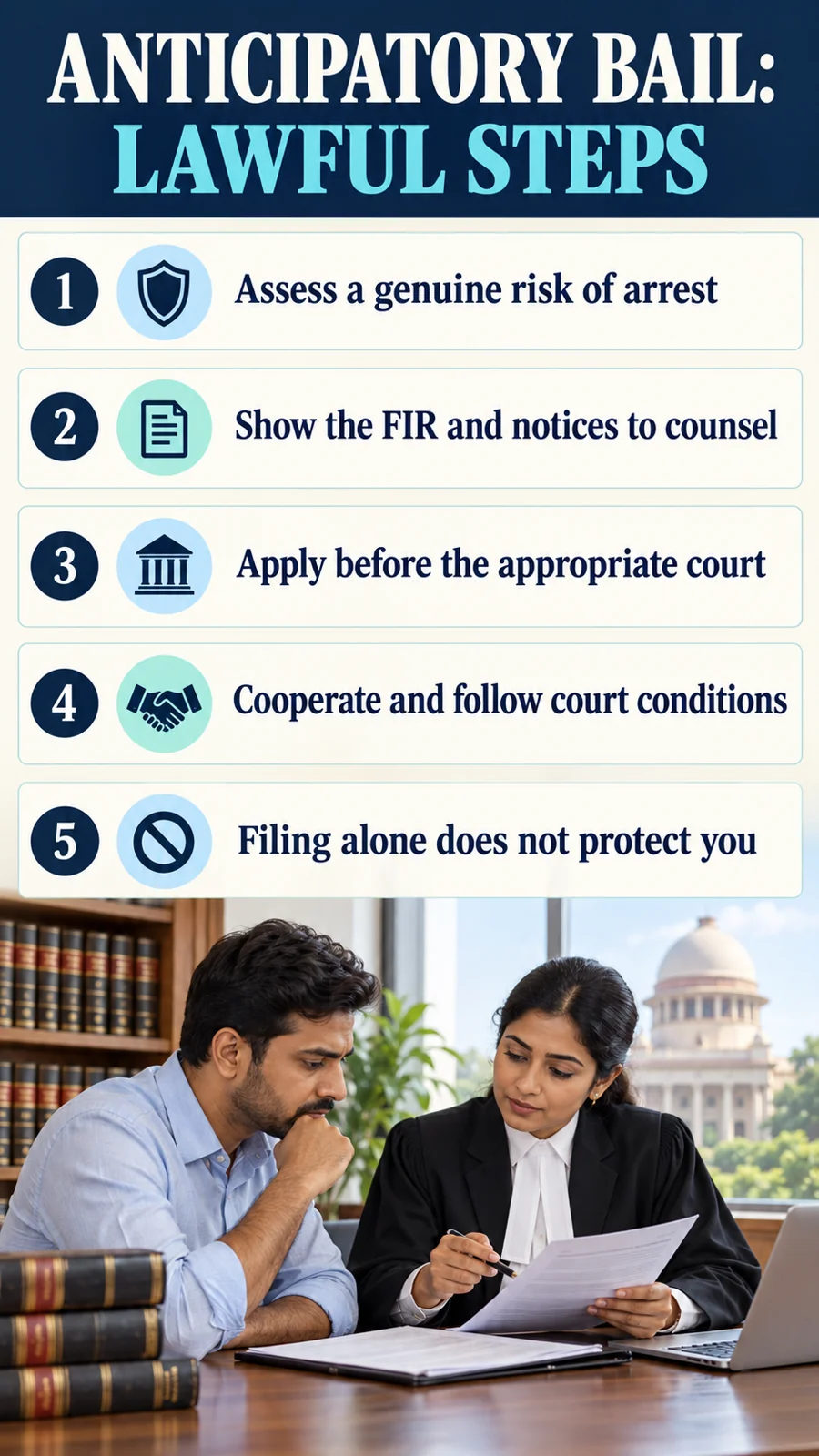
FACT: Filing an anticipatory bail application does not itself protect you from arrest. Protection depends on an actual order, its scope and compliance with its conditions.
Step 2: Choose the appropriate court and prepare papers
BNSS Section 482 identifies the High Court and Court of Session as the courts that may grant the relevant direction. Which court should be approached first and how the application is presented depend on jurisdiction, local procedure and the facts. Do not assume that any Magistrate or any court in India can issue the same relief. [1]
Where a matter involves another State, ask about jurisdiction and any narrowly appropriate transit protection. Such relief is not a permanent replacement for approaching the competent court. Avoid treating location changes as a way to defeat the investigation. Your advocate should identify the actual police station, competent forum and necessary procedural steps.
Prepare a truthful chronology, copies of the available FIR or complaint, relevant notices, identity and address information, previous bail orders and genuine supporting records. Filing requirements may include an affidavit and prescribed documents. There is no universal paperwork list, fee or guaranteed number of hearing days for every court and offence.
Step 3: Request the precise relief needed
The application should explain the alleged role, legal grounds, arrest apprehension and proposed cooperation. If immediate protection is needed, counsel may seek an appropriate interim order. A filing receipt, diary number, hearing listing or counsel’s assurance is not a judicial direction that prevents arrest. Obtain and read the actual signed order.
The prosecution may oppose the request and the court may seek information about the investigation. Depending on the facts, the court can grant relief, impose conditions, limit protection or refuse the application. Anticipatory bail does not decide whether the accusation is ultimately proved. Investigation and later trial can continue despite a protective bail order.
A genuine defence should be presented accurately without coaching witnesses or altering electronic records. Do not contact a complainant to pressure them into changing a statement. If a settlement is relevant, its effect depends on the offence and governing law. Private agreement alone does not automatically cancel an FIR, guarantee bail or bind the criminal court.
Step 4: Understand and comply with conditions
Section 482(2) BNSS expressly contemplates conditions concerning availability for interrogation, avoiding inducement or threats to people acquainted with the facts and not leaving India without prior permission. The court may impose other lawful conditions appropriate to the case. Follow the wording of your actual order rather than a general online summary. [1]
Cooperation does not mean giving fabricated answers or surrendering every legal right. Ask counsel about lawful responses, required attendance and any difficulty complying. Preserve genuine evidence and keep a reliable record of attendance or submissions. A missed date or unavoidable problem should be addressed promptly through the appropriate process, not ignored until enforcement action begins.
The order may require execution of a bond or provision of sureties through the stated procedure. Understand the amount, forum, deadline and documents required. Paying a private intermediary does not complete a judicial bond process. Keep copies of the order and compliance records available, and seek clarification if the authorities interpret a condition differently.
How long does anticipatory bail last?
In Sushila Aggarwal v State (NCT of Delhi), (2020) 5 SCC 1, the Constitution Bench explained that anticipatory bail protection need not invariably be restricted to a fixed period or end merely at a particular procedural stage. Case-specific circumstances can justify limitations or appropriate conditions. This is not a promise that every order is unlimited. [2]
The same judgment discusses the foundational approach in Gurbaksh Singh Sibbia v State of Punjab, (1980) 2 SCC 565. The remedy requires judicial assessment of facts and personal liberty; rigid shortcuts are unreliable. Read the operative part of the order, especially any duration, surrender requirement, reporting condition or direction to seek another form of bail.
A grant of protection is also not immunity against every later case. Its scope concerns the accusation and conditions covered by the order. Breach of conditions, interference with witnesses or other legally relevant circumstances can lead to a cancellation request or further orders. Keep the advocate informed about new allegations, notices and changes in the case stage.
Refusal, existing warrants and investigation notices
If the application is refused, get the reasoned order and urgent advice about the appropriate next remedy. Do not assume an appeal, fresh application or filing in another court automatically creates interim protection. Disclose previous decisions honestly. The permitted next step depends on the case, forum, grounds and any current arrest or warrant position.
An existing warrant or proclamation can materially affect the advice. Anticipatory bail is not a universal way to bypass a direction to appear. Tell counsel about every order and missed hearing. A lawful investigation notice also needs a response; the fact that an application is pending does not turn that notice into an optional invitation.
If police action is immediate, seek prompt legal assistance and communicate the actual protective order, if one exists. Do not resist physically or rely on a social-media script. Counsel can address compliance, clarification and urgent judicial relief. Each available remedy should be assessed on the real record rather than a claim that arrest is always prohibited after filing.
Frequently asked questions
1. Can anticipatory bail be sought before an FIR is registered?
Registration is not the only possible starting point, but a genuine, sufficiently grounded apprehension and the applicable law matter. Ask counsel to assess the specific accusation rather than relying on a blanket future-arrest request.
2. Is protection automatic after filing the application?
No. There must be a relevant court order. Check whether interim relief was actually granted and read its conditions and duration.
3. Does anticipatory bail mean the FIR is cancelled?
No. Bail, quashing, discharge and acquittal are different remedies or outcomes. Investigation can continue subject to applicable law and orders.
4. Can I stop attending investigation after bail?
No general permission follows. Follow lawful notices and the specific cooperation conditions. Seek clarification or modification where a real difficulty arises.
5. Is every anticipatory bail order permanent?
No. The governing judgment rejects a compulsory fixed expiry in every case, but the court can impose justified conditions or limitations. The actual order controls.
Advice
Take the FIR or available accusation, notices and complete order history to an advocate promptly. Understand arrest apprehension, anticipatory bail, regular bail and quashing separately. Seek precise relief, confirm any interim order and comply honestly. Where resources are limited, ask the relevant legal services authority about eligibility for legal aid. Avoid anyone promising guaranteed protection or asking you to fabricate material.
Related reading: How to reduce traffic challan in Lok Adalat: Virtual court procedure and penalty waiver rules · Is call recording admissible in Indian court? Privacy issues and Section 65B certificate mandate
Official sources and judgments
[1] Ministry of Home Affairs — BNSS, particularly Sections 482, 528 and 531: https://www.mha.gov.in/sites/default/files/2024-04/250884_2_english_01042024.pdf
[2] Supreme Court — Sushila Aggarwal v State (NCT of Delhi), 29 January 2020, discussing Gurbaksh Singh Sibbia: https://api.sci.gov.in/supremecourt/2017/28027/28027_2017_3_1501_20088_Judgement_29-Jan-2020.pdf
[3] NALSA — legal services and assistance information: https://nalsa.gov.in/faqs/
Detailed legal disclaimer
This educational article does not encourage absconding, false affidavits, destruction of evidence, intimidation, bribery or violation of court conditions. No bail, timetable, immunity from arrest or platform-policy approval is guaranteed. An advocate must check current law, statutory restrictions, jurisdiction and individual facts. This disclaimer does not remove legal duties or protect unlawful conduct.