Legal disclaimer
This article provides general legal information for India, reviewed on 9 October 2026. It is not advice for an individual dispute. Consult an advocate about the applicable marriage law, court, deadlines and existing orders.
Can a maintenance order be reduced?
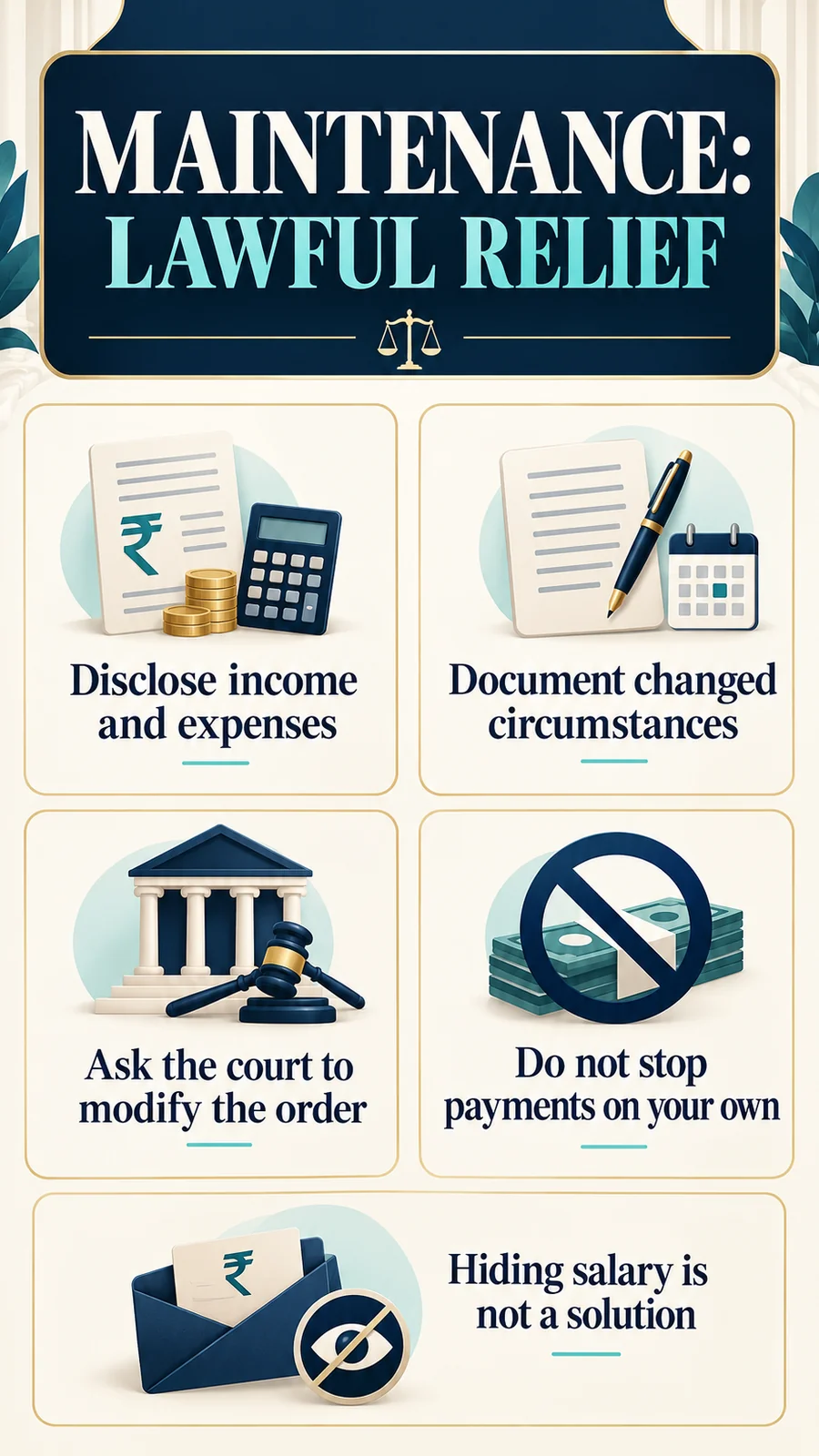
A court can reconsider maintenance where the applicable law and evidence justify it. Hiding salary, moving money to relatives or filing an inaccurate affidavit is not a lawful way to reduce the amount. The practical route is to disclose finances honestly, identify the problem with the assessment and request appropriate relief. An application does not itself suspend an existing payment obligation.
Maintenance can arise under different laws. The financial assessment and available remedy depend on whether the order concerns interim support during matrimonial proceedings, permanent alimony, summary maintenance or relief under domestic violence legislation. A child’s claim must also be considered separately. Avoid treating every payment described as “alimony” as the same legal obligation.
FACT: There is no universal salary percentage that automatically fixes maintenance in every Indian case. A smaller payslip is not, by itself, proof that the amount should fall.
Identify the law behind the order
Section 24 of the Hindu Marriage Act, 1955 concerns litigation expenses and support during proceedings for a spouse without sufficient independent income. Section 25 addresses permanent alimony and includes powers to vary an order on a change in circumstances. These provisions do not govern every marriage in India; other personal laws and statutes may apply. Read the actual order and the provision under which it was passed. [1]
For new proceedings within its scope, Section 144 of the Bharatiya Nagarik Suraksha Sanhita, 2023 provides summary maintenance, while Section 146 addresses alteration on proof of changed circumstances. The BNSS commenced on 1 July 2024. Its savings provision, Section 531, matters for proceedings already pending under the Code of Criminal Procedure. The old Section 127 CrPC may therefore remain relevant in a saved case. [2]
Genuine grounds to put before the court
An involuntary job loss, documented reduction in working hours, disabling illness or a substantial change in legitimate dependants’ needs may be relevant. Present the dates, cause and financial effect. A resignation designed to depress apparent income, or an unexplained transfer of a business, can undermine the application. Courts may examine earning capacity and the wider financial picture rather than accept an isolated monthly figure.
Another issue may be an inaccurate assessment of recurring income: a one-time reimbursement treated as a monthly payment, an expired contract or an amount attributed to the wrong person. Explain the error using records covering a meaningful period. Do not deduct every personal preference or new borrowing from income and assume that only the balance can be considered for maintenance.
The other spouse’s income needs careful analysis
Evidence of the recipient’s actual, sufficient independent income can matter. Education, qualifications or theoretical ability to work do not necessarily establish current income sufficient for support. A temporary earning opportunity is different from a stable income. The court also considers reasonable needs and the circumstances of the marriage. Collect evidence through lawful disclosure and court processes, not unauthorised access to a spouse’s accounts.
A child’s maintenance is not automatically cancelled because the other parent earns or remarries. Schooling, healthcare and day-to-day care may require their own assessment. Similarly, statutory conditions that may affect a wife’s summary maintenance should not be imported indiscriminately into another statute. Allegations need evidence, and child support requires distinct attention even where a spouse’s entitlement is disputed.
Use complete financial disclosure
Prepare salary slips, employer correspondence, tax returns, bank statements, business accounts where relevant, rent records and evidence of necessary medical expenses. Include investments, rental income, bonuses, retirement benefits and other relevant resources in the disclosure required by the court. Explain a gap or fluctuation rather than silently omit it. A bank credit may need context, but context should be supported by documents.
Keep a clear list of liabilities, with loan agreements and payment history. Distinguish necessary expenses from optional spending. If relatives depend on you, provide the facts supporting that responsibility. A readable monthly summary helps the court understand the documents; it cannot replace them. Preserve originals and submit the formats, verification and supporting documents your advocate and court require.
What Rajnesh v. Neha adds
In Rajnesh v. Neha, decided on 4 November 2020, the Supreme Court addressed financial disclosure, assessment of maintenance and overlapping proceedings. Its disclosure framework helps parties present a fuller financial picture. Where circumstances change, an updated or supplementary affidavit may be appropriate. A party should also disclose earlier maintenance proceedings and orders rather than make each court assess support without that context. [3]
An existing award under another law may require adjustment or set-off; it does not justify silently stopping one payment. Place the earlier order, amounts actually paid and the relief sought before the relevant court. The judgment is a framework for fair assessment, not a guarantee that a particular job loss or expense will produce a particular reduction.
False affidavits can create a separate legal problem
A deliberately false statement on oath can expose a person to false-evidence proceedings, apart from adverse findings in the maintenance case. Sections 227–229 of the Bharatiya Nyaya Sanhita address giving or fabricating false evidence and its punishment. For false evidence in judicial proceedings, Section 229 provides imprisonment up to seven years and a fine up to ₹10,000, subject to the offence being established and the applicable procedure. This is a statutory maximum, not an automatic sentence for every discrepancy. [4]
The date of the alleged conduct and transitional rules determine whether the BNS or the earlier IPC applies. Court-related offences also have procedural safeguards governing prosecution. An allegation by the opposing spouse does not itself establish guilt. If you discover an honest error in your affidavit, promptly obtain advice about correcting it transparently; do not create a second false document to conceal the first mistake.
Choose the right procedural remedy
First obtain the complete order and identify whether the objection is to an original factual or legal error, or to a later change in circumstances. Those situations can require different remedies. Your advocate can assess a modification application, appeal or revision as available under the relevant statute and forum. Deadlines and maintainability differ, so do not rely on a generic online petition for every case.
State the precise relief requested, the evidence supporting it and the treatment sought for existing arrears. If urgent interim protection is needed, ask for it expressly and obtain an order. Do not assume that filing papers, receiving a listing date or sending an email to the other side creates a stay. Retain proof of each payment and comply with directions unless the court changes them.
A practical example
Suppose a salaried person loses employment after a maintenance order. The useful material is the termination letter, final settlement, recent bank statements, tax records and evidence of genuine efforts to obtain work. Savings, severance benefits and other income remain relevant. The application should explain the actual change, rather than claim that all financial capacity disappeared on the last working day.
The court may accept, partly accept or reject the requested reduction depending on the facts and law. The effective date of any change, arrears and child-related expenses need explicit attention. An informal understanding between spouses may help settlement, but obtain appropriate legal recording where a court order exists. A settlement must be voluntary and should address its financial terms clearly.
Frequently asked questions
Does paying an EMI guarantee lower maintenance?
No. The court assesses relevant needs, resources and genuine liabilities. A new voluntary loan does not automatically take priority over support.
Can I pay half while the application is pending?
An application alone does not amend the order. Ask the court for appropriate interim directions rather than deciding the amount yourself.
Is an employed wife automatically ineligible?
No. Actual income, sufficiency, needs and the applicable provision matter. Employment alone is not a universal disqualification.
Can both spouses seek relief under Section 24 HMA?
The provision refers to either spouse, subject to its conditions. Other maintenance provisions have different beneficiaries and tests.
What if another court has already awarded maintenance?
Disclose the order and payment record and request appropriate adjustment. Avoid assuming that two proceedings permit double recovery or unilateral non-payment.
Advice before filing
Organise the facts chronologically, use complete records and explain the specific change you want the court to recognise. Ask your advocate to check the forum, deadlines, current order, payment history and urgent relief needed. Honest disclosure and a focused application provide a lawful basis to argue for a fair amount; concealment creates additional risk without settling the underlying obligation.
Related reading: How to avoid jail in cheque bounce case: Section 138 NI Act defenses and settlement rules · What happens if personal loan is not paid in India? Defaulter rights, civil recovery, and RBI rules
Official sources and judgment
[1] India Code — Hindu Marriage Act, 1955, Sections 24 and 25: https://www.indiacode.nic.in/handle/123456789/1560
[2] Ministry of Home Affairs — BNSS, Sections 144, 146 and 531: https://www.mha.gov.in/sites/default/files/2024-04/250884_2_english_01042024.pdf
[3] Rajnesh v. Neha, (2021) 2 SCC 324, judgment dated 4 November 2020, government-hosted copy: https://cdnbbsr.s3waas.gov.in/s3ec04e0126439e08ddfbdf4faa952dc91/uploads/2024/07/2024072220.pdf
[4] Ministry of Home Affairs — BNS, Sections 227–229: https://www.mha.gov.in/sites/default/files/2024-04/250883_english_01042024.pdf
Detailed legal disclaimer
This educational article does not encourage concealment of income, false evidence, misleading affidavits or non-compliance with court orders. Statutes, judgments and procedure must be applied to the facts and may change. No result, reduction, platform-policy approval or protection from liability is promised. Obtain advice from an advocate before acting; this disclaimer does not remove anyone’s statutory rights or responsibilities.