 Vista

What was the largest flying pterodactyl ever? In everyday language, many people mean the largest pterosaur: Quetzalcoatlus northropi, a giant Late Cretaceous flying reptile with an often-cited 10–11 metre (33–36 foot) wingspan. That is roughly the span of a small aircraft. Its famous fossils were found in Texas, United States—not Mexico, despite its name’s connection to the Mexican deity Quetzalcoatl. Scientists reconstruct its size from incomplete bones, so spectacular claims about exact measurements, posture or flight ability deserve context.
Interest in the largest flying pterodactyl has grown alongside the November 2026 Mexico pterodactyl viral video. But modern sightings and prehistoric fossils are separate subjects. This guide focuses on what museums and peer-reviewed research actually establish about giant flying reptiles, size comparisons, flight, fossil locations and Mexico’s real pterosaur history. None of that evidence confirms a pterosaur flying over Ciudad Juárez today.
Largest Flying Pterodactyl: Quetzalcoatlus at a Glance
Scientific name: Quetzalcoatlus northropi. Group: Azhdarchid pterosaur. Age: Late Cretaceous, roughly 67 million years ago. Fossil region: Big Bend area, southwestern Texas. Wingspan: frequently estimated at about 10 metres, with museum presentations often giving roughly 10–11 metres. Reality check: all pterosaurs are extinct, and this creature was not a dinosaur. The American Museum of Natural History and Natural History Museum describe its enormous scale.
Quetzalcoatlus is important not simply because of its size, but because its anatomy forced scientists to examine how the biggest flying animals could launch, travel and feed. Its long neck, elongated jaws and extraordinarily modified forelimbs give it an outline quite unlike the standard dinosaur image. Its size also illustrates a critical lesson for image searches: photographs of skeletons are real scientific evidence, while pictures of the animal alive are interpretations made from that evidence.
How Big Was Quetzalcoatlus Compared With a Person?
Imagine an animal standing on the ground with a beak and head reaching far above an adult human, then extending two wings whose combined span could match the width of a small plane. That comparison helps convey its scale, but do not mistake a full-body painting for a direct measurement. A fossil skeleton is incomplete; scientists must infer missing dimensions from preserved wing bones, related species and biomechanics. A wingspan measures from one wingtip to the other, not the height of a standing animal.
A 2021 scientific anatomical description assessed material from Big Bend and discussed changing historical estimates. Some early claims were much larger than the values used by most modern museum reconstructions. The scholarly debate is a reason to print numbers with “approximately,” rather than turn a picture into a precise ruler. For a familiar visualization, the University of Michigan Museum of Natural History exhibits a life-sized model with roughly a 35-foot wingspan.
When editing a human-versus-pterosaur comparison chart, designers should label the horizontal dimension as wingspan, not body length. Avoid mixing feet and metres without conversion or implying the creature was 11 metres tall. An adult human shown beneath the extended wings can be helpful, provided the proportions are clearly illustrative and the numeric scale is independently checked.
Quetzalcoatlus vs Pteranodon vs Pterodactylus: Size Comparison
The popular term “pterodactyl” tends to blend several very different animals. Quetzalcoatlus was a giant azhdarchid. Pteranodon, often illustrated with a distinctive backward-pointing head crest, was a different, large pterosaur. Pterodactylus was another genus and generally far smaller than the giants. All three belong to Pterosauria, but they are not interchangeable species.
| Flying reptile | Approximate wingspan | Why it matters |
|---|---|---|
| Quetzalcoatlus northropi | About 10–11 m (33–36 ft) | Among the largest known flying animals; incomplete fossil material makes estimates approximate. |
| Pteranodon | About 6–7 m in large forms | Famous crested pterosaur, smaller than the giant azhdarchids. |
| Pterodactylus | Typically much smaller, around 1 m in familiar reconstructions | The formal genus behind the popular word “pterodactyl.” |
The figures in this comparison are rounded, because fossils vary and species are reconstructed from different amounts of material. A peer-reviewed study of giant pterosaur sizes uses a Quetzalcoatlus estimate of roughly 10–11 metres and compares it with much smaller genera. Museums may cite somewhat different values as reconstructions develop. That variation is normal scientific uncertainty, not evidence for a sensational new species.
Another distinction matters: pterosaurs were not the direct ancestors of today’s birds. They were a separate evolutionary branch of flying reptiles, while birds are living dinosaurs. Their wings worked differently. A pterosaur’s enormous fourth finger supported the main wing membrane, while bird wings are covered in feathers and are built from modified forelimb bones.

Where Were the Largest Pterosaur Fossils Found? Texas, Not Mexico
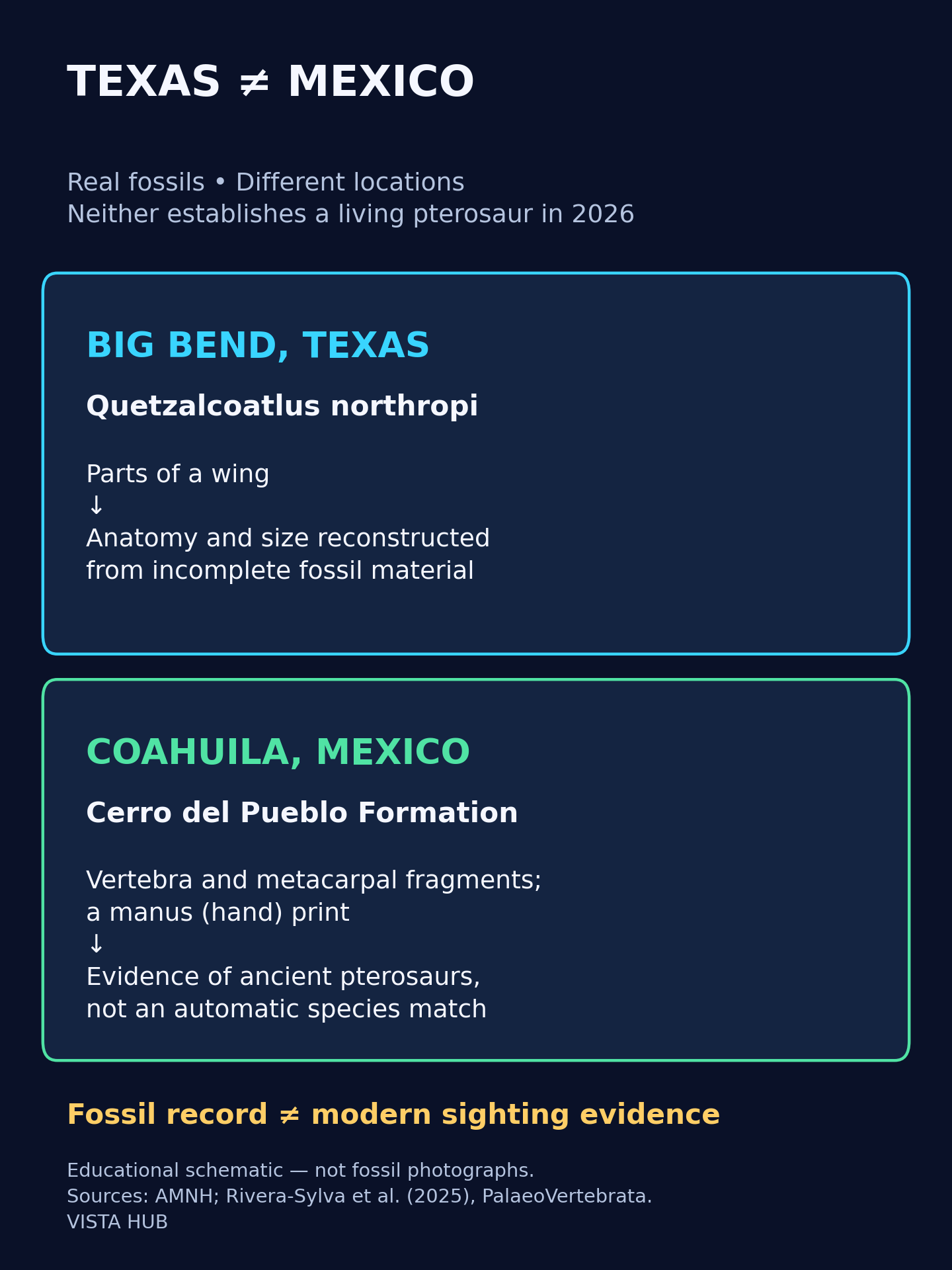
The first famous Quetzalcoatlus northropi finds came from the Javelina Formation in what is now Big Bend National Park, Texas. Researchers from the University of Texas at Austin investigated remains from that region during the 1970s. Later studies returned to the fossil material and explored the relationship between the largest specimens and smaller forms. The U.S. National Park Service and the University of Texas pterosaur collections provide useful institutional background.
Why, then, does the name sound Mexican? The genus name honors Quetzalcoatl, a feathered-serpent deity of Mesoamerican tradition. The specific name northropi honors aviation pioneer Jack Northrop. Names can reflect culture, anatomy or people; they do not necessarily reveal the discovery location. Searching “Quetzalcoatlus Mexico fossil found” can therefore produce misleading summaries that confuse the name’s origin with the fossil’s provenance.
“New Mexico pterodactyl” creates a second place-name problem. New Mexico is a U.S. state; Mexico is a separate country; and the viral Ciudad Juárez story refers to a city in Chihuahua, Mexico. A page about Texas fossils should not imply that the 2026 sighting occurred in New Mexico or that the Quetzalcoatlus type specimen was discovered there.
Did Real Pterosaurs Live in Mexico? What Fossils Show
Yes. Mexico’s ancient fossil record contains pterosaur material even though there is no accepted evidence of living pterosaurs today. A 2025 study in PalaeoVertebrata investigated pterosaur remains from the Late Campanian Cerro del Pueblo Formation in Coahuila, northeastern Mexico. That work adds to knowledge of flying reptiles in the ancient ecosystems of North America.
That distinction is exactly what a meaningful science article should preserve: real Mexican fossils do not validate a modern viral-video claim. Fossils can tell us that pterosaurs existed millions of years ago in the region. They cannot establish that an extinct species survived undetected until 2026. In addition, a fossil attributed to an unidentified pterosaur does not automatically belong to Quetzalcoatlus northropi. Taxonomic identifications depend on diagnostic anatomy.
The Coahuila discoveries are also a useful way to distinguish geological and political geography. Ancient animals crossed habitats that looked nothing like the modern borders on a map. Scientists interpret formations, sedimentary environments and fossil associations to reconstruct those ecosystems. The existence of fossils in Mexico is scientifically significant on its own and does not need a dramatic survival narrative.
How Could a Pterosaur This Big Fly?
The size of Quetzalcoatlus raises a fascinating mechanical question. An ordinary small bird can launch with a rapid leg-powered jump and flap, but giant pterosaurs had different body plans. One influential reconstruction proposes that powerful forelimbs and hindlimbs helped the animal vault into the air before its wings began producing lift. This four-limbed launch is discussed by researchers at the University of Texas.
That is a scientific hypothesis supported by biomechanics, not an eyewitness description of the species in action. Flight performance estimates depend on assumptions about mass, muscle power, wingspan, wing shape and atmospheric conditions. Experts continue to test those assumptions and compare interpretations. Oversimplified illustrations showing a gigantic pterosaur flapping like a sparrow can be entertaining, but they should not replace the anatomical evidence.
Some museum accounts also describe these long-legged pterosaurs as terrestrial hunters that may have foraged in a manner loosely comparable to large wading birds. Their jaws and long necks provide clues about how they might have captured small prey. This “giant heron” analogy is helpful for behavior and posture, but it does not mean the ancient reptile was a heron or that a heron in a modern viral video is its descendant.
Real Quetzalcoatlus Pictures: Fossils, Skeletons and Reconstructions
A search for “Quetzalcoatlus real pictures” generally returns at least three different kinds of material. Fossil photographs show preserved specimens or replica casts. Museum-mounted skeletons show how scientists assembled and interpreted the material. Life reconstructions add surfaces, colors, posture and scenery not preserved directly in the bones. They can be scientifically informed and visually dramatic while remaining reconstructions rather than historical photographs.
The featured illustration for this guide is a conceptual depiction, not an authentic photograph from the Cretaceous. Readers seeking primary source images should begin with University of Texas fossil resources, the American Museum of Natural History, or the University of Michigan’s exhibition. These institutions identify which specimens, casts and reconstructions they display.
For any wingspan comparison infographic, place a scale marker next to the silhouette and name the species. A Quetzalcoatlus drawing without the “approximately” label can easily be recycled with invented dimensions. An explanatory figure is most useful when its labels and sources remain visible after someone shares the image without the surrounding article.
Does the 2026 Mexico Pterodactyl Video Show Quetzalcoatlus?
No verified evidence connects the viral recording from Ciudad Juárez to Quetzalcoatlus or any living pterosaur. Local authorities rejected the prehistoric identification, and the world-wide debate around the footage illustrates how uncertain silhouettes can be mistaken for familiar fictional creatures. A video cannot identify a giant pterosaur merely because an object appears to have long wings. Without reliable distance, physical measurements and anatomical detail, species-level claims are speculation.
Readers interested in the current news should use the separate Mexico pterodactyl video real-or-fake report. The present article has a different goal: answer the enduring science questions about the biggest flying reptile, where its fossils were found, and what real Mexican paleontology reveals. Treat a social media rumor as a starting point for curiosity, not as scientific proof.
Frequently Asked Questions About the Largest Flying Pterodactyl
What was the biggest flying pterodactyl ever?
Quetzalcoatlus northropi is among the largest known pterosaurs, with a commonly cited wingspan of approximately 10–11 metres. “Pterodactyl” is a loose popular term; scientists use “pterosaur” for the wider group.
Was Quetzalcoatlus discovered in Mexico?
No. Its well-known type material comes from Big Bend in Texas, USA. Its name refers in part to the Mexican deity Quetzalcoatl.
Could Quetzalcoatlus really fly?
Leading reconstructions treat it as a flying animal and investigate how a four-limbed launch could work. Exact flight performance remains an area of biomechanical research.
Are there pterosaur fossils in Mexico?
Yes. Research documents pterosaur remains in Mexico, including material reported from Coahuila. Fossils are not evidence that pterosaurs survive in the present day.
Is a pterosaur the same animal as a dinosaur or bird?
No. Pterosaurs were flying reptiles in a separate evolutionary lineage. Birds are dinosaurs; they are not living pterosaurs.
Can I find a real photo of a living Quetzalcoatlus?
No verified modern photograph exists. Museums provide genuine fossils, reconstructions and sometimes life-size models based on the fossil record.
Conclusion: A Real Giant, a Verified Fossil Story
The largest flying “pterodactyl” in popular searches was not the animal claimed in a viral Mexico video. It was a huge prehistoric pterosaur represented by fossils, most famously Quetzalcoatlus northropi from Texas. Its approximate 10–11 metre wingspan remains astonishing even without any sensational claim. Mexico itself has a genuine pterosaur fossil record, and new geological studies continue to enrich that story. The best images combine visual wonder with labels that distinguish actual fossil evidence from living-animal reconstructions.
Research checked: November 19, 2026. Primary references: AMNH; Natural History Museum; PalaeoVertebrata 2025 Mexican fossils study; 2021 Quetzalcoatlus taxonomy; UT Austin 2021 flight research.
Related English guide: Mexico pterodactyl pictures: four visuals explained.


















Share Your Opinion
Comments are closed on this post.