 Vista

Need human body school project models with pictures? This guide offers five educational diagrams: Heart Blood Circulation, a Lungs Technical Model, the Breathing Explanation, a Kidney Nephron 3D Model and the Human Reflex Arc. Students in approximately Classes 6–11 can compare how the circulatory, respiratory, urinary and nervous systems perform different tasks while cooperating to maintain the body. Each image is available through Vista Hub’s established 15-second image-view and download route. These are simplified classroom representations, not complete medical models. A bottle-and-balloon lung project cannot show every part of breathing, and not every reflex follows exactly the same neural route. No painful or medical procedure is needed.
How do the four body systems work together?
The circulatory system transports blood and the substances it carries. The respiratory system brings air into the lungs and exchanges gases between air and blood. The urinary system, especially the kidneys, helps regulate water, salts and removal of metabolic wastes. The nervous system detects signals and coordinates responses. They interact continuously rather than operating as independent boxes. Oxygen taken up in the lungs is carried to tissues by circulating blood. Nerve signals can regulate breathing and circulation, while kidney function affects fluid balance. A school chart should use separate labels for each system before showing their connections.
Picture 1: Human Heart and Blood Circulation
The human heart usually has four chambers: right atrium, right ventricle, left atrium and left ventricle. Blood returning from the body enters the right side and is pumped toward the lungs. Oxygenated blood returning from the lungs enters the left side and is pumped out to the body. Check the direction of pulmonary arteries and pulmonary veins. The idea that every artery carries oxygenated blood is incorrect; the pulmonary artery carries relatively deoxygenated blood. Red and blue colours in diagrams are educational conventions. Blood inside human veins is not literally bright blue. Clear circulation arrows are more important than decorative colouring.

View / Download after 15-second wait
Picture 2: Bottle-and-Balloon Lungs Model
A common classroom lungs model uses a rigid bottle as an approximate chest cavity, balloons representing lungs and a flexible sheet at the bottom to mimic the diaphragm. Pulling the sheet downward increases the enclosed volume and can lower pressure, drawing air into the balloons. The construction is an analogy, not the full anatomy of ribs, pleural membranes, air sacs and breathing muscles. Real breathing also uses muscles between the ribs. An adult should prepare any cut bottle edges, and small balloon fragments should be kept away from young children. Do not label every model component as an exact biological equivalent.

View / Download after 15-second wait
Picture 3: How inhalation and exhalation differ
During ordinary inhalation, the diaphragm contracts and moves downward, increasing thoracic cavity volume. The pressure difference allows air to enter the lungs. Quiet exhalation typically involves relaxation and elastic recoil, reducing volume and moving air outward. In a bottle model, moving the flexible sheet back upward can represent the reverse process. Gas exchange, however, occurs across tiny alveolar surfaces in real lungs and is not directly demonstrated by a simple balloon expanding. Explain this difference to students rather than suggesting that the lungs actively pump themselves using a mechanism identical to a rubber balloon.
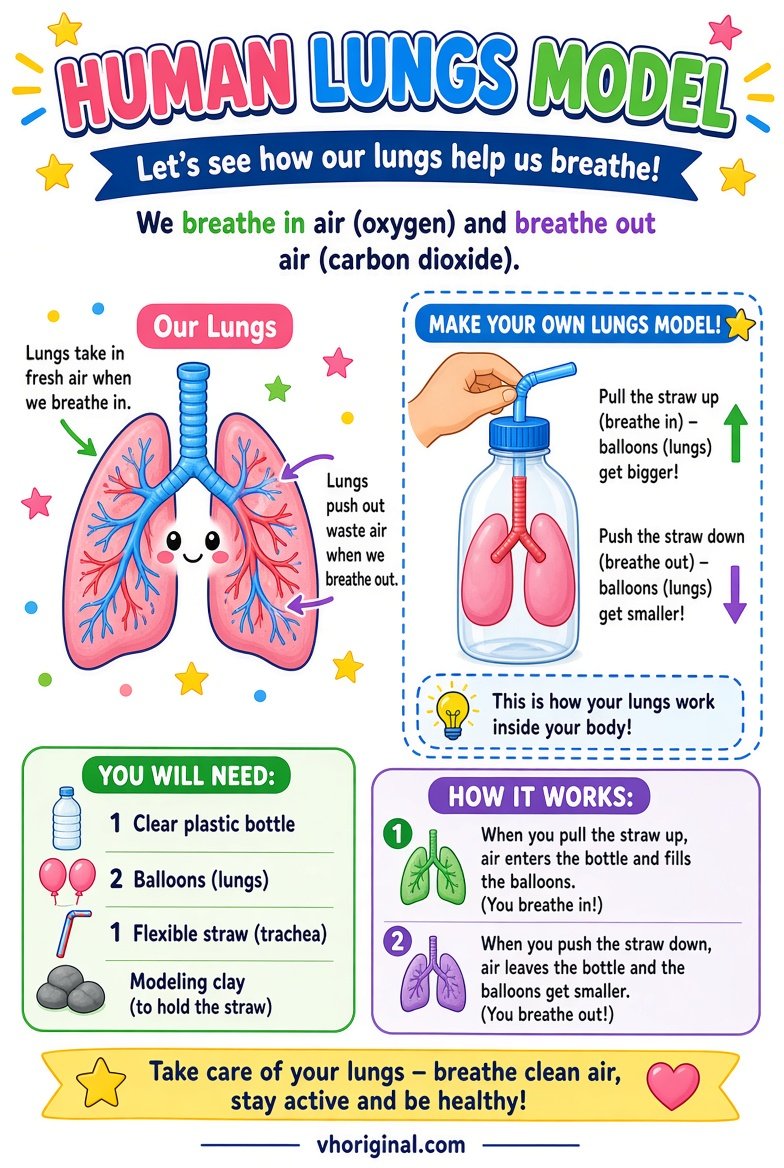
View / Download after 15-second wait
Picture 4: Kidney Nephron 3D Model
A nephron is a kidney’s functional unit. At the glomerulus, filtration allows water and many small dissolved substances to enter the nephron system while most blood cells and large proteins remain in circulation under normal conditions. The tubules then reabsorb useful substances and water and secrete certain other substances. The resulting fluid contributes to urine, which travels toward collecting structures and eventually through ureters to the bladder. Ureters carry urine, not blood. A kidney does much more than ‘store waste’: it helps maintain fluid, electrolyte and acid-base balance. Label the glomerulus, tubules, collecting duct and urine pathway correctly.
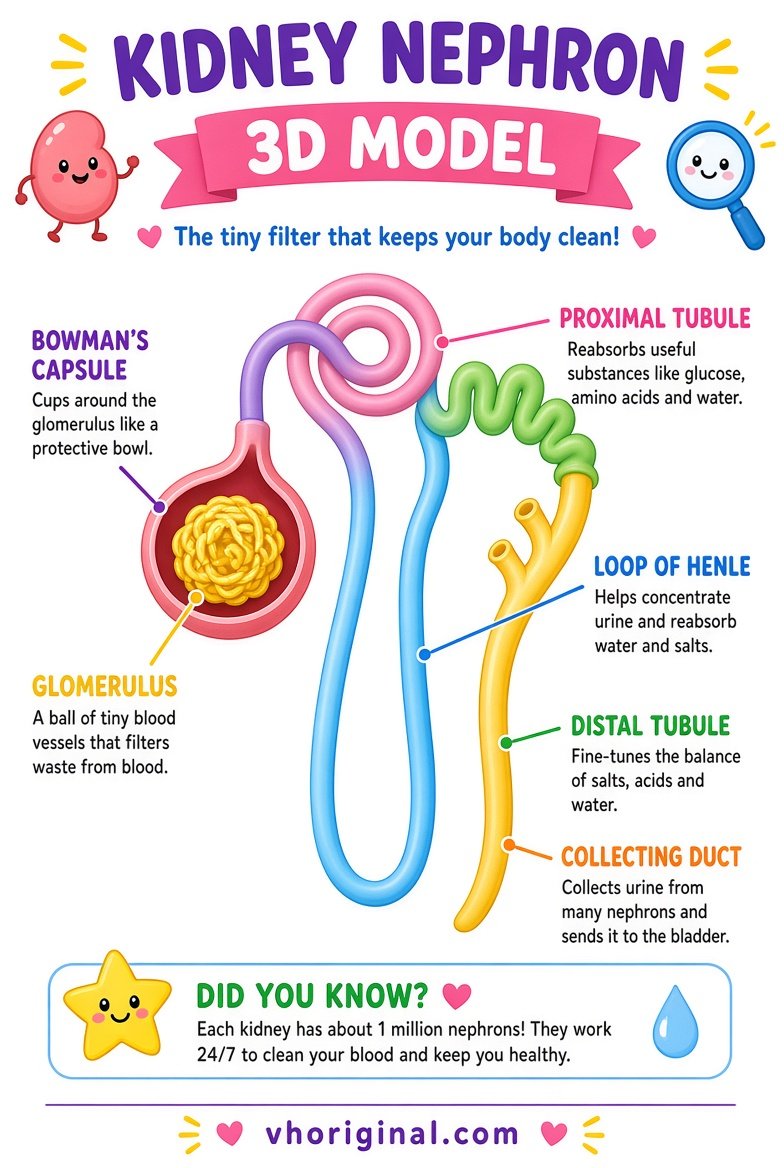
View / Download after 15-second wait
Picture 5: Human Reflex Arc Working Model
A reflex is a rapid, relatively automatic response mediated by a neural pathway. In an illustrative withdrawal reflex, a receptor detects a stimulus, a sensory neuron carries information to the spinal cord, and motor pathways activate an appropriate muscle response, sometimes through interneurons. The brain may become aware of the event, but some reflexes involve brainstem circuits or other pathways, so ‘the brain is never involved in reflexes’ is false. Avoid deliberate pain, burns or electrical stimulation in classroom demonstrations. Coloured paper arrows and neuron labels can explain the sequence without using a real person’s nerves or triggering an uncomfortable reaction.

View / Download after 15-second wait
Materials and step-by-step model preparation
Use cardboard, paper, glue and coloured labels. Identify heart chambers and blood-flow direction, illustrate the diaphragm in a lungs model, draw glomerulus and tubules, and show sensory-to-motor reflex pathways. Avoid real medical instruments or uncomfortable body experiments.
Questions for a school viva
Explain where pulmonary arteries carry blood, where gas exchange occurs, what kidneys do and how reflexes operate. Answers: toward the lungs, at alveoli, filtration and fluid regulation, and through various neural pathways. Check diagram arrows rather than claiming every reflex bypasses the brain.
Download, safe demonstrations and final checks
All five posters retain the 15-second ad-supported download route. Keep balloon fragments away from children and supervise bottle cutting. Do not perform painful reflex tests, electrical stimulation or breath-holding challenges. Verify circulation arrows, nephron labels and diaphragm movements.
Frequently asked questions
How many chambers does a human heart have?
Four: two atria and two ventricles.
What does a balloon lungs model demonstrate?
How changes in cavity volume and pressure can move air, with important simplifications.
What happens in a nephron?
Filtration, reabsorption and secretion contribute to urine formation.
Are all reflexes controlled only by the spinal cord?
No. Different reflex circuits may involve the spinal cord, brainstem or other pathways.
Conclusion and sources
A good body-systems school project distinguishes circulation, breathing, kidney function and neural reflexes while openly acknowledging what each model cannot show.
Related school projects: Life Cycle Charts · Science Working Models
References: MedlinePlus — Human Anatomy; NIDDK — How Kidneys Work; OpenStax — Reflexes.
Explore more: 44 school project models, charts and pictures








Share Your Opinion
Comments are closed on this post.