 Vista
Need a fractions wheel maths model or printable fraction strips chart for school? This guide includes two educational posters that make parts of a whole easier to compare. A strip chart can show halves, thirds, quarters, sixths and eighths, while a circular wheel provides an engaging way to see sectors of equal size. Students in roughly Classes 3–7 can make both using ruler, card and coloured paper. The central rule is important: **fractions of one whole must be divided into equal parts**, not just visually attractive irregular sections. Each image remains connected to Vista Hub’s existing 15-second ad-supported download page, with no direct-file bypass.
What does a fraction represent?
A fraction can represent equal parts of a whole or a relation between quantities. In 3/4, the upper number is the numerator and the lower number is the denominator. In a simple area model, the denominator tells how many equal pieces make up the whole and the numerator tells how many have been selected. For example, three out of four equal sections of one chocolate bar represent three quarters. Always name the whole before comparing pieces. Half of a large cake is not necessarily the same quantity of cake as half of a small one.
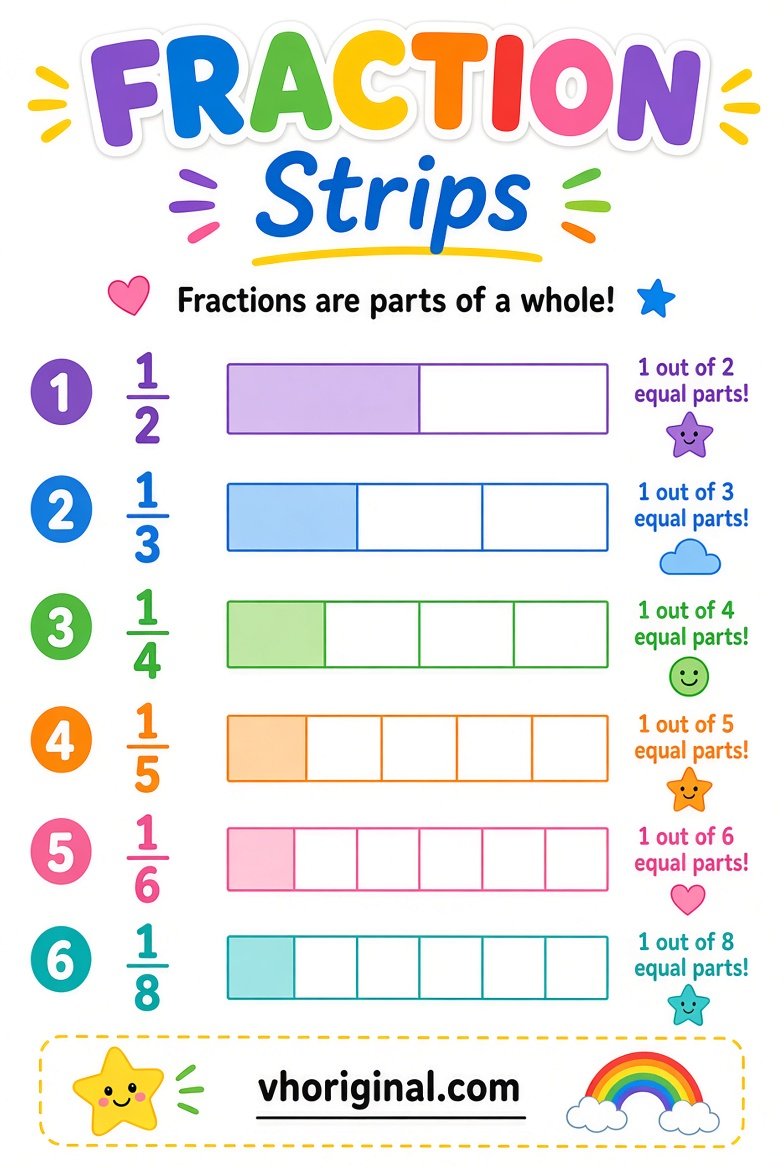
Picture 1: Printable Fraction Strips
Fraction strips are equal-length bars divided into various numbers of equal sections. One strip shows the whole; another shows halves, another thirds, and others quarters or eighths. When their total length is the same, pupils can see that 1/2 occupies the same distance as 2/4 or 4/8. The printed picture may scale differently across screens and printers, so check the actual dimensions before cutting. A strip that is shorter overall than the others makes the visual comparison misleading. Use a ruler and write each fraction over its intended segment rather than guessing from a coloured design.
View / Download after 15-second wait
Picture 2: Fraction Wheel Maths Model
A fractions wheel divides a paper circle into equal angular sectors. Two equal sectors show halves, four show quarters, and eight show eighths. The central angles for these are 180, 90 and 45 degrees respectively. Use a protractor or careful folding to create accurate partitions. Multiple concentric rings can show different fraction denominators, provided each ring represents its own full circle. An arrow or rotating cover can help learners point to selected parts. The wheel need not turn quickly or use electronics. Uneven slices cannot correctly represent equal quarters merely because four different colours are used.

View / Download after 15-second wait
How do equivalent fractions work?
Equivalent fractions use different numerator-denominator pairs to represent the same value, such as 1/2, 2/4 and 3/6. Multiplying the numerator and denominator by the same nonzero number produces an equivalent fraction. This works in reverse when simplifying by a common factor. The strip chart visualises the relationship by aligning equal wholes at the same starting point. For instance, two quarter-width pieces occupy the same distance as one half-width piece. If the underlying bars have different full lengths, that demonstration breaks down. Label the whole and the equal divisions consistently.
Adding and comparing fractions correctly
When denominators match, add the numerators and keep the denominator: 1/4 + 2/4 = 3/4. To combine different denominators, find a common denominator first: 1/2 + 1/4 becomes 2/4 + 1/4, or 3/4. Simply adding both numerator and denominator gives an incorrect answer. The wheel and strips can be used to check the result visually. Ask children whether one eighth is smaller than one quarter of the same whole. It is. Colour alone does not determine the value; the number of equal parts and the amount selected do.
Materials and steps for fraction strips
Use clean A4 paper, cardboard, ruler, pencil, markers, glue and safe scissors. Choose a convenient total bar length and draw several bars of exactly that length. Divide one into halves, another into quarters and another into eighths, marking equal measurements carefully. Add other denominators when appropriate to the class. Colour individual sections without changing their widths. If printing a template, verify that the page has not been scaled and distorted. Children should have help with sharp cutting tools and be able to explain why all bars must represent the same sized whole for a fair comparison.
Step-by-step rotating fraction wheel
Draw a circle using a safe round template. Mark its centre and use a protractor to divide it into equal angles. Shade halves or quarters and label the sections clearly. A separate ring can illustrate eighths if the assignment requests more complexity. Attach a light paper pointer with a suitable classroom-safe fastener, taking care that no sharp point is exposed. Ask a student to show which regions represent 2/4 and how that equals 1/2. Do not label unequal sectors with equal unit fractions. A static wheel is also effective and easier to carry than a spinning design.
Viva questions and common mistakes
Teachers may ask which number is the denominator, why 1/2 equals 2/4 and what angle represents a quarter-circle. Pupils should answer by pointing to the partitions. A common mistake is drawing four slices of different sizes and calling them equal quarters. Another is lining up bars representing different-sized wholes. When adding unlike denominators, avoid adding the top and bottom numbers directly. Verify any generated poster with a ruler or protractor before copying it. Clear labels and correct measurements give the project real educational value, rather than just an attractive chart.
Image downloads and final checklist
Both posters use the existing 15-second ad-supported download page. Verify strip lengths and wheel angles before printing. Use school images as references for hand drawings, and supervise cutting and small fasteners. Every fraction needs an identified whole.
Frequently asked questions
What does the denominator show?
How many equal parts make up one whole in the basic area model.
Are 1/2 and 2/4 equivalent?
Yes, both have the same value.
What angle is one quarter of a circle?
90 degrees.
Should all fraction strips have equal overall length?
Yes, when comparing equal-sized wholes visually.
Conclusion and sources
Two correctly measured fraction models can make equal parts, equivalence and basic addition much easier to understand.
Related school resources: School Project Front Page · Project File Decoration
References: Math is Fun — Fractions; Math is Fun — Equivalent Fractions.
Explore more: 44 school project models, charts and pictures









Share Your Opinion
Comments are closed on this post.