 Vista
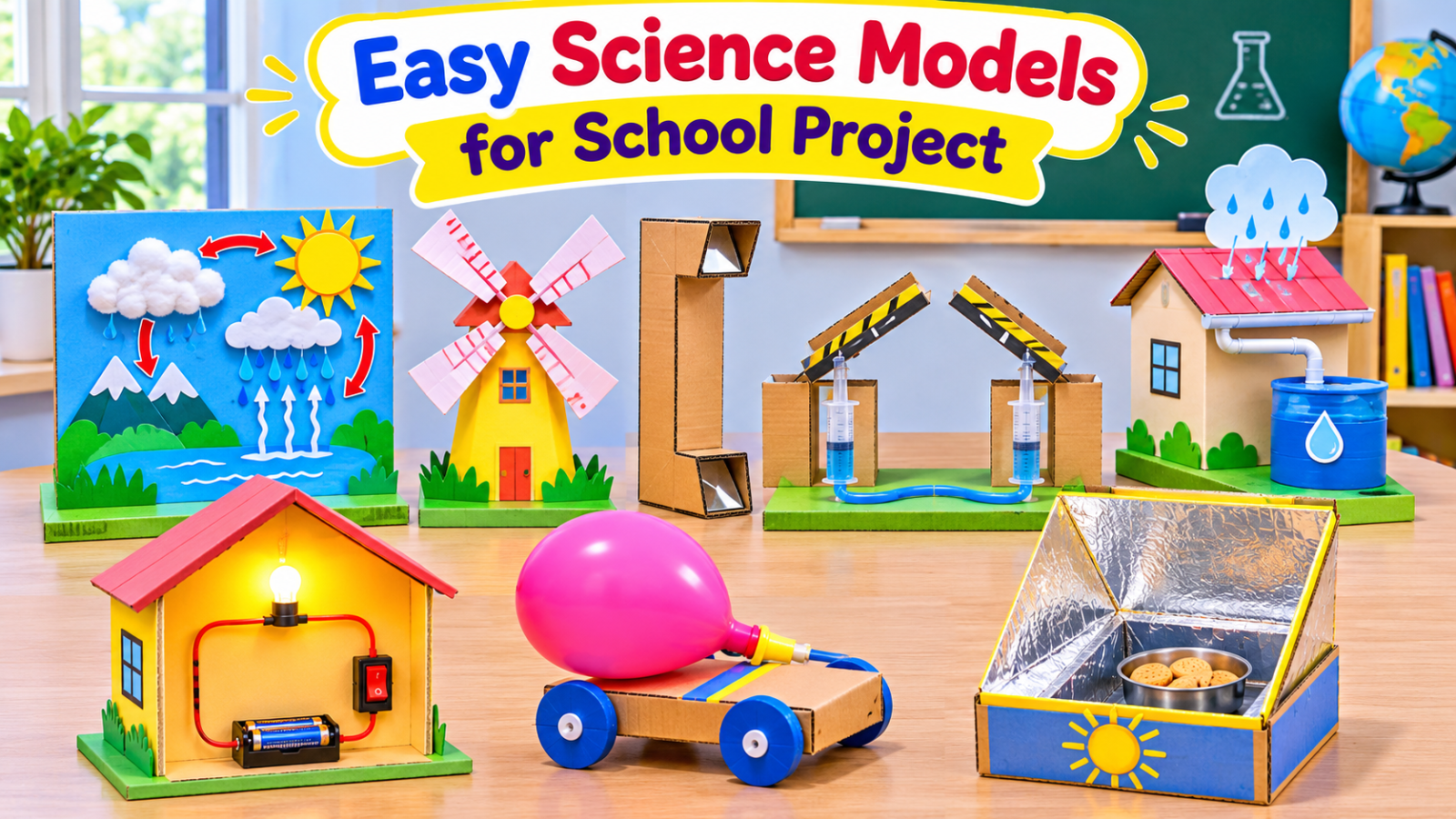
Which science model is easiest for a school project? Choose a concept the child can build and explain. Here are eight easy science models for school projects: a water cycle diagram, paper windmill, periscope, hydraulic lift, rainwater harvesting system, simple electric circuit, balloon-powered car and solar cooker demonstration. Each has a large picture, a simple construction idea, the science behind it and essential safety advice.
Not every model needs a motor or live demonstration. Some are best as labelled cardboard displays, especially for younger children. Others can show a small effect when an adult supervises them. A useful school model is one that illustrates a real concept and that the student can describe confidently in their own words.
How to choose an easy school science project by class
Classes 1–3: Try a dry water-cycle chart or a paper rainwater-harvesting model. These can be explained without electricity or sharp tools. Classes 4–5: A paper windmill, periscope or balloon car can help children observe motion or light. Classes 6–8: A water-based hydraulic lift, a teacher-approved low-voltage circuit or a sunlight-heating display can introduce more detailed physics and engineering.
Read the school assignment carefully. If it asks for a working model, the pupil should demonstrate a visible effect and explain it. A paper windmill may spin in air, but it does not produce electricity without a suitable generator. If the task asks for a science exhibition display, a well-labelled static model can still be appropriate. The best choice depends on age, available materials, preparation time and safety rules.
For a science fair, consider adding a question and a small comparison test rather than only displaying the craft. For example, you can test how a balloon car travels on two floor surfaces, keeping the rest of the setup unchanged. Record what happened and discuss what might explain the difference. This adds observation and basic scientific method to the project.
Materials needed for these eight science models
Many projects use ordinary recycled cardboard, small paper boxes, coloured paper, pencils, tape, glue, ruler, plastic bottles and drinking straws. A water-cycle display needs only paper and markers. A pinwheel needs paper blades and a safe mounting. A periscope needs two child-safe plastic mirrors, while a hydraulic demonstration needs two clean plastic syringes without needles and an appropriate water-filled tube.
A balloon car needs lightweight wheels, axles, a straw and a balloon. An electrical project requires a suitable low-voltage educational kit with a battery holder, switch, correctly rated LED and appropriate resistor, chosen with a teacher. A solar-heating demonstration uses a small box, dark paper and a reflective flap. Avoid buying expensive equipment before checking whether the school permits it.
Young children should not use craft knives, mains electricity, hot-glue guns, exposed wires, sharp metal pins or hot water. Adults should prepare any parts that need cutting or special connections, and the student should understand the model before demonstrating it in school.
Eight easy science working models with pictures and steps
Open each poster to see it at full size. The illustrations explain concepts; they are not certified electrical diagrams, pressure-device plans or instructions for heating food safely. Read the notes under the images and follow the actual equipment manufacturer’s instructions where relevant.
1. Water Cycle School Model
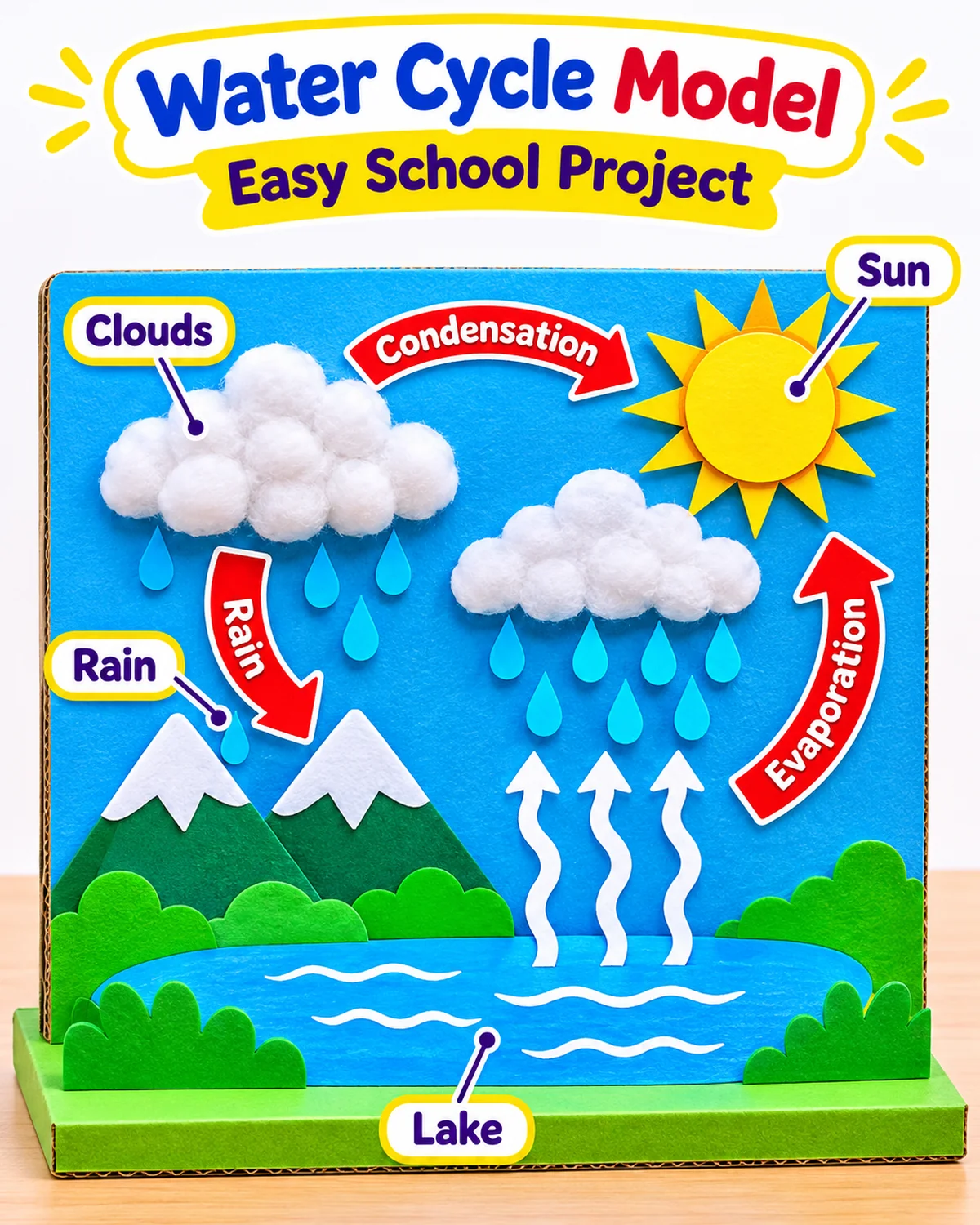
Science concept: Illustrates evaporation, condensation and precipitation, with the Sun supplying energy and gravity helping water fall.
How to make: On cardboard, draw the Sun, a body of water, clouds, mountains and rain. Use clearly marked arrows for water vapour rising, droplets forming and rain returning to the ground. A dry labelled poster is sufficient for younger children.
Safety: Avoid boiling water, steam or hot plates. A miniature water experiment needs adult supervision.
2. Paper Windmill Model
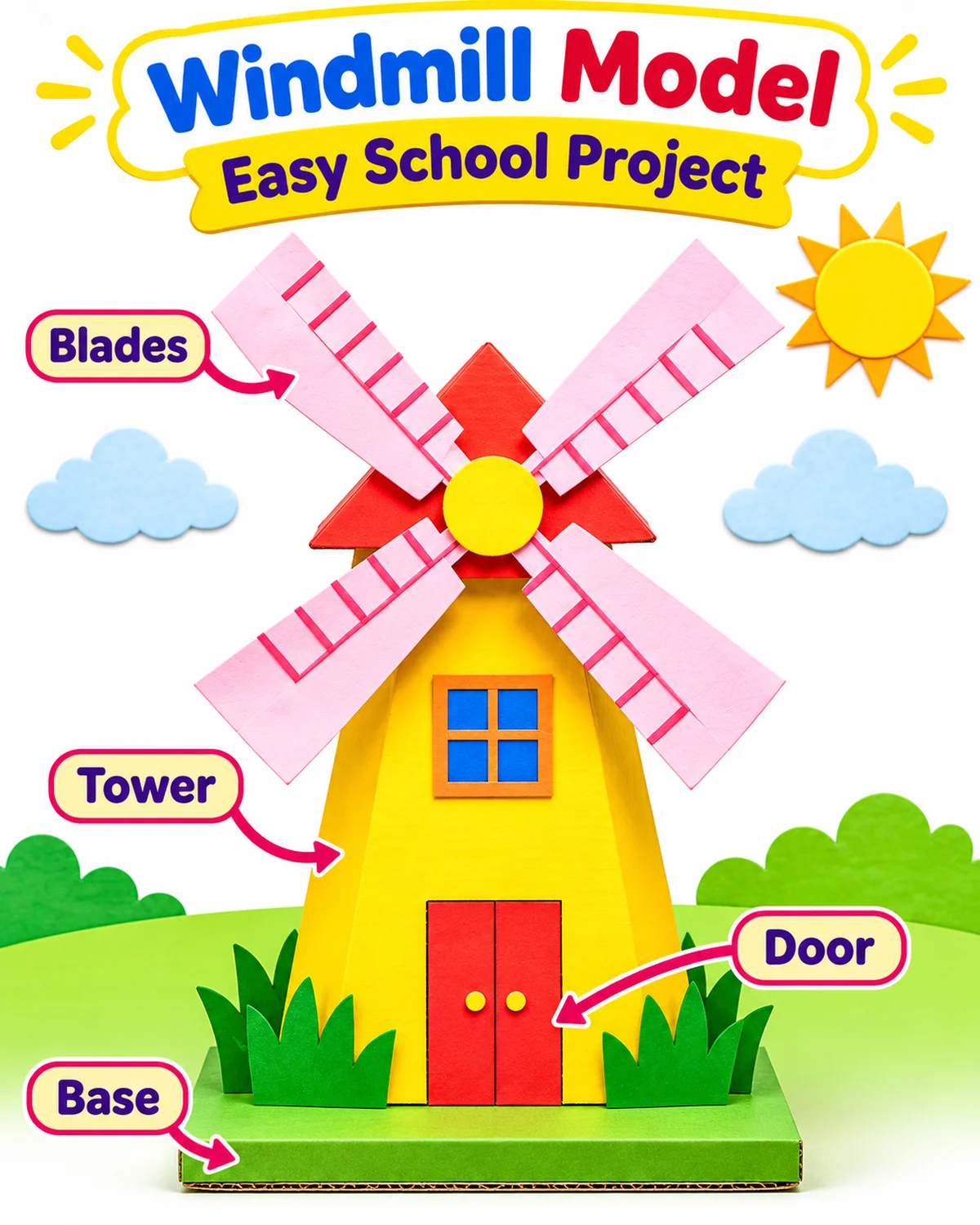
Science concept: Shows how moving air exerts a force and can turn lightweight blades.
How to make: Make four broad paper blades, attach them to a small central hub and mount the pinwheel on a stable stand. Blow gently or let a light breeze turn it. Compare the effect when the airflow direction changes.
Safety: Have an adult secure any pin or sharp rotating part. A paper pinwheel is not automatically an electricity generator.
3. Periscope Model With Mirrors
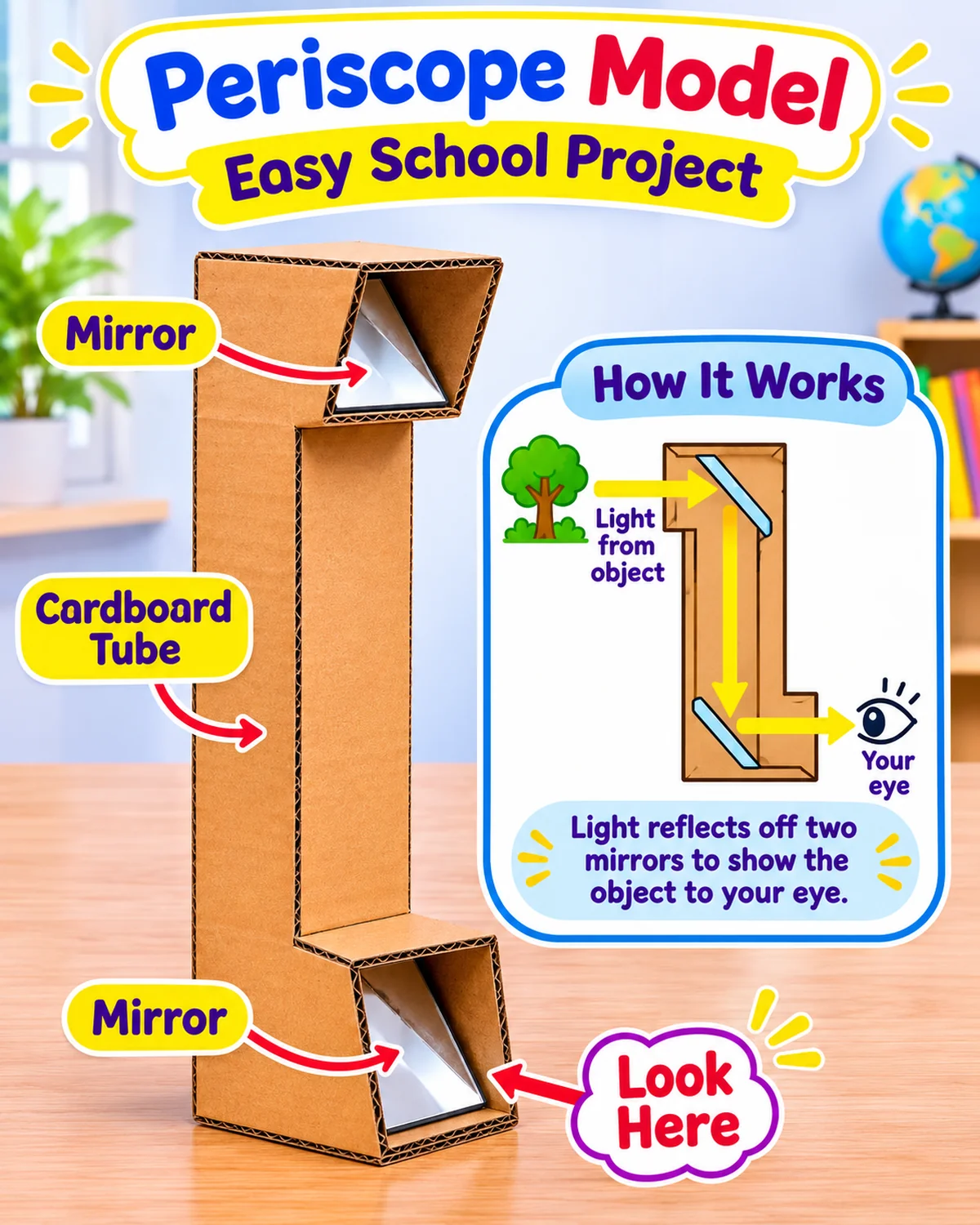
Science concept: Demonstrates the reflection of light using two mirrors angled to guide a view around an obstacle.
How to make: Make a long cardboard tube or box with a viewing window near the top and another near the bottom on opposing sides. Fit two smooth-edged plastic mirrors at roughly 45° so light from the upper opening reaches the eye at the lower opening.
Safety: Use child-safe acrylic mirrors instead of cutting glass. Never use a periscope to look at the Sun.
4. Simple Hydraulic Lift

Science concept: Demonstrates how pressure applied to a confined liquid can transmit motion through tubing.
How to make: Use two clean needle-free plastic syringes connected by a suitable tube. With adult help, fill the system with water and gently push one plunger to move the other. A very light cardboard platform can be attached for a visible demonstration.
Safety: Do not add a needle or heavy weight, use medication or aim pressurised water at people.
5. Rainwater Harvesting Model
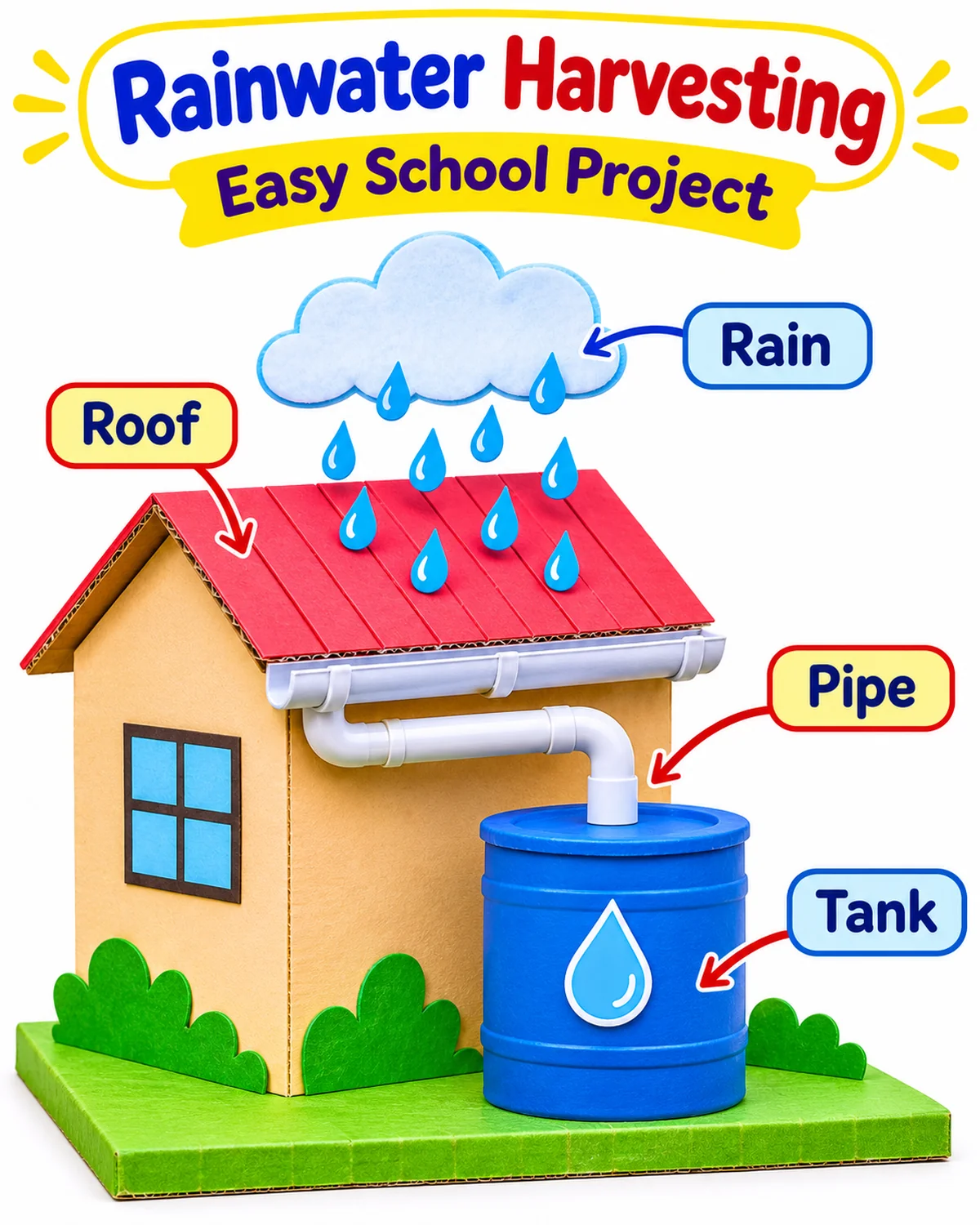
Science concept: Shows how runoff from a roof can be routed to a storage container instead of flowing away.
How to make: Build a small cardboard house with a sloping roof. Add a straw as a gutter and direct its outlet into a small clean plastic collection bottle. Pour a little clean water onto the roof during a supervised display.
Safety: Collected demonstration water should not be treated as drinkable. Real systems need suitable filtration and maintenance.
6. Simple Battery Electric Circuit
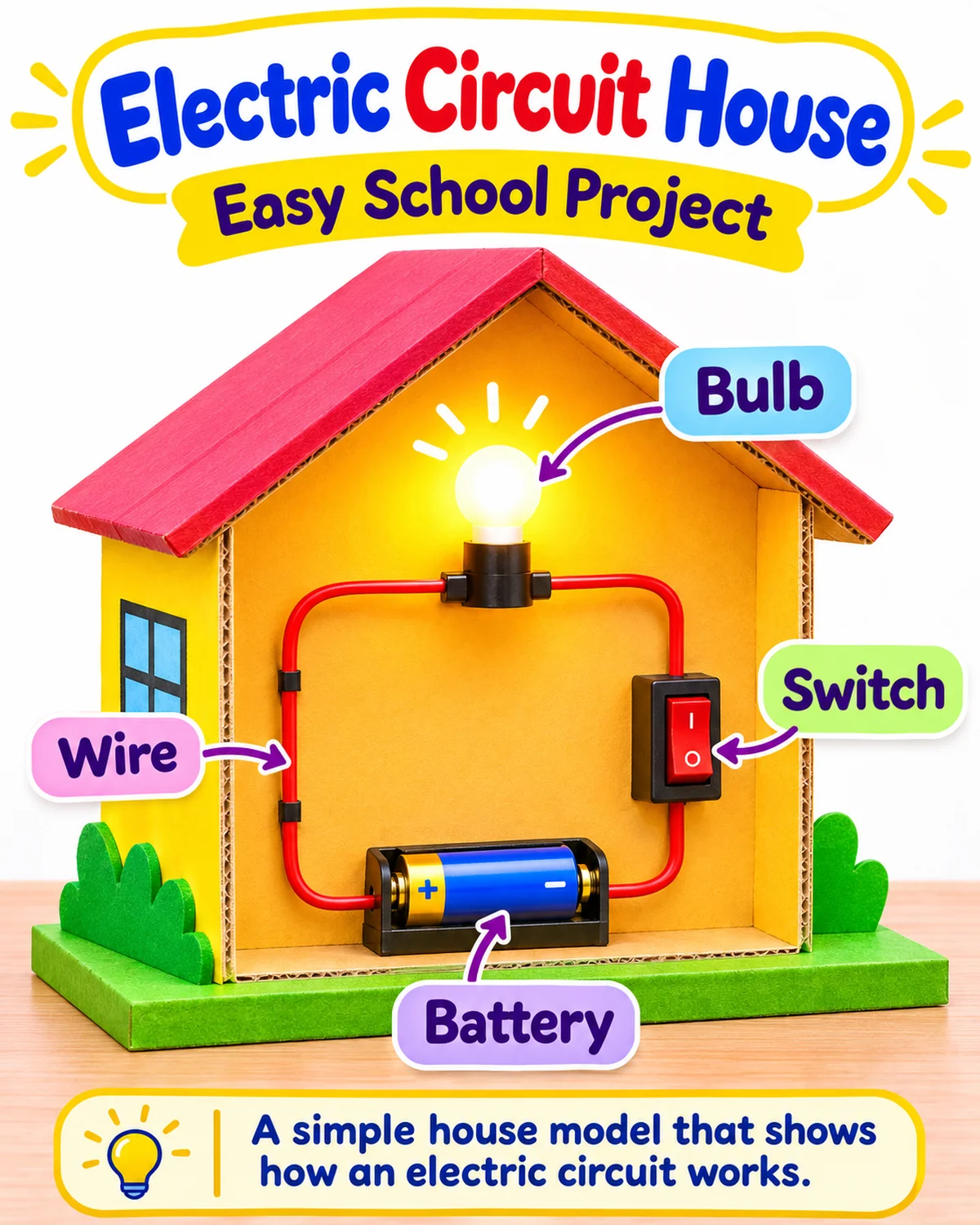
Science concept: Shows how a complete low-voltage circuit can power a suitable LED and how a switch interrupts the path.
How to make: Use a purpose-built educational battery kit with a battery holder, correctly rated LED, suitable resistor and switch. Ask a teacher to check all parts before connecting them. Record the difference between an open and a closed switch.
Safety: Never use household mains electricity, exposed mains wires, improvised chargers or short-circuited batteries.
7. Balloon-Powered Car
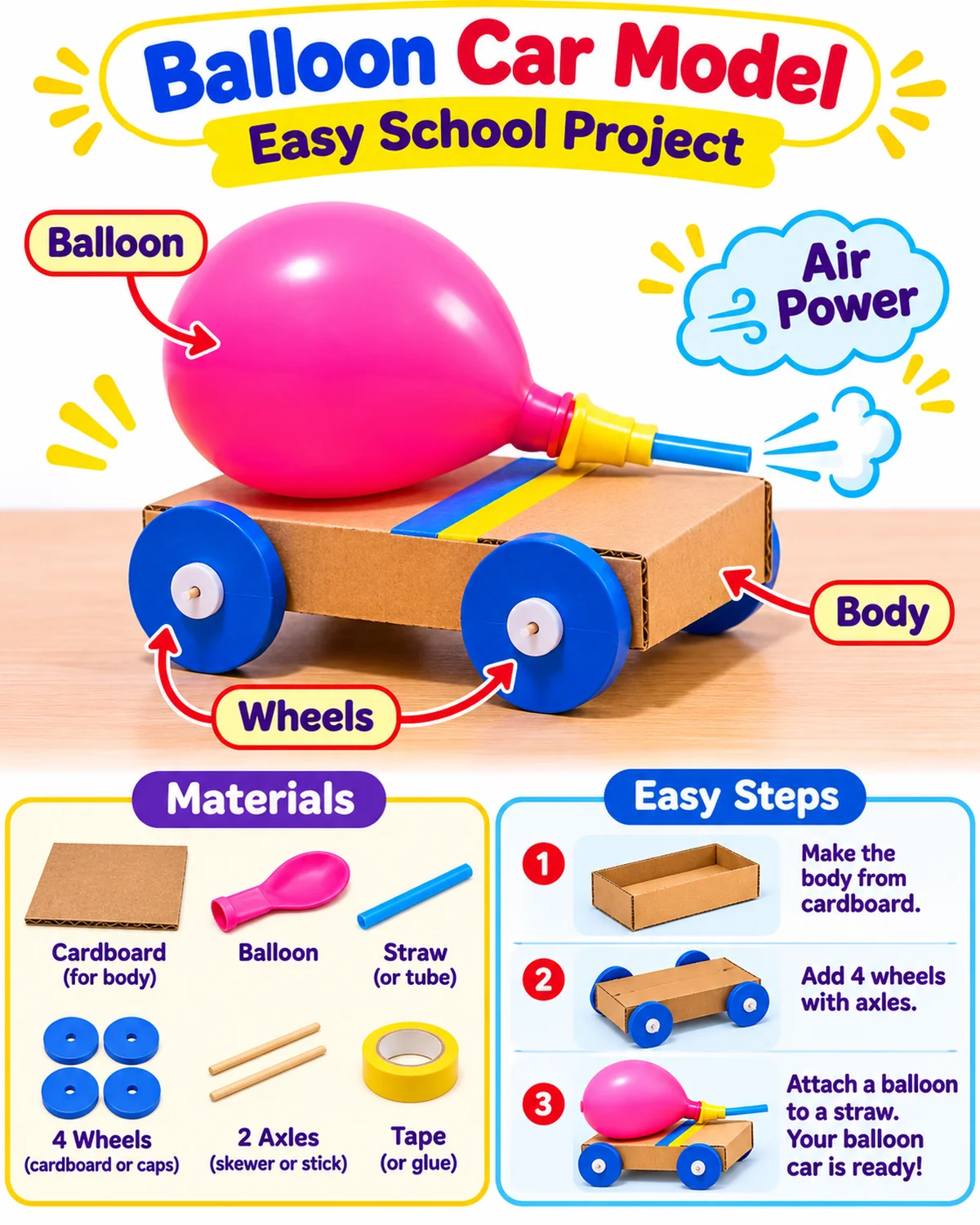
Science concept: Illustrates how air expelled backwards can drive a lightweight vehicle forwards.
How to make: Make a tiny cardboard chassis with four wheels on simple axles. Secure a balloon to a straw pointing backwards. Inflate it with an adult’s help, place the car on a clear floor and release the air to observe its movement.
Safety: Burst balloons and small wheels can present a choking hazard; supervise young children and check for latex allergy.
8. Solar Cooker Demonstration
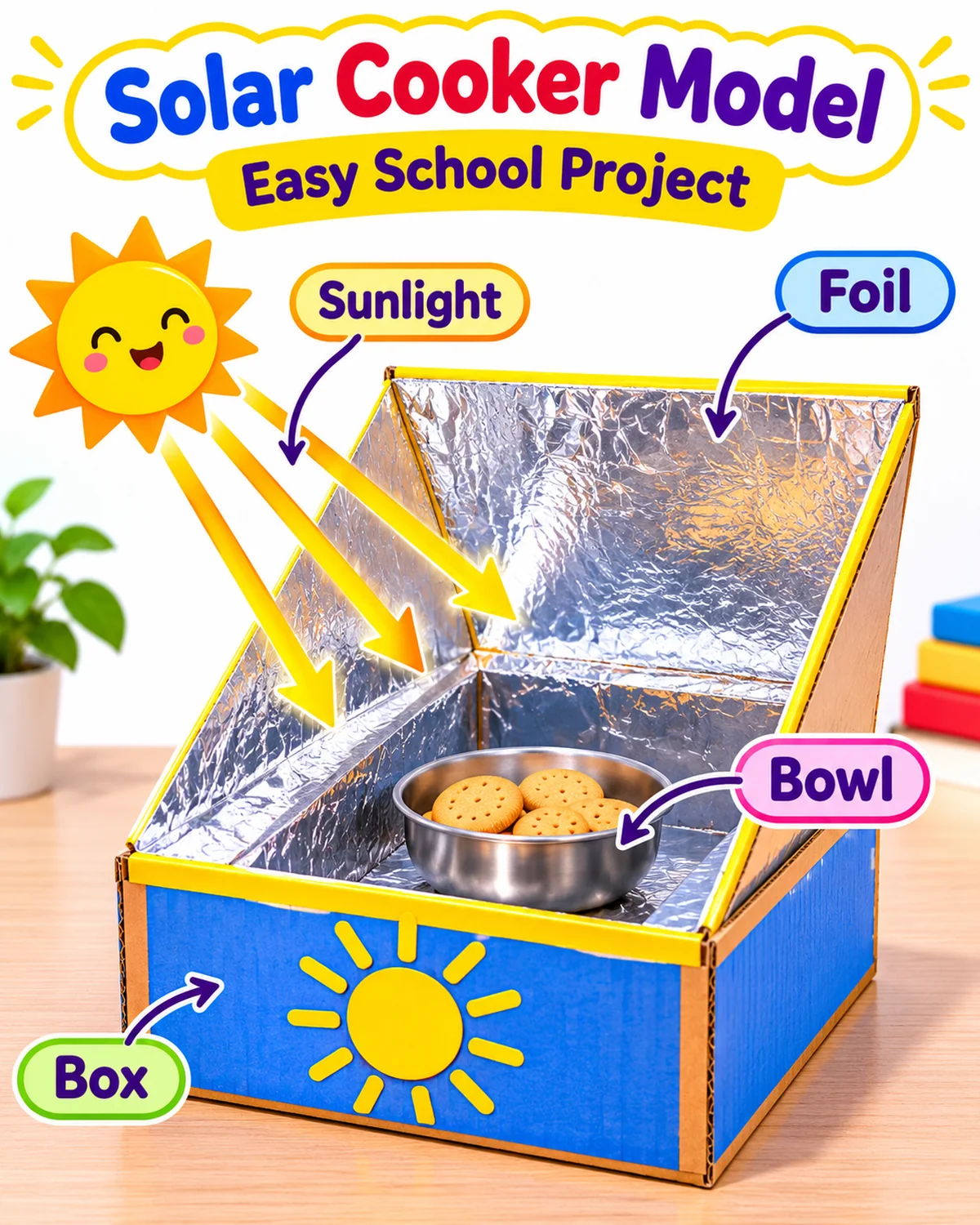
Science concept: Shows how sunlight can warm a dark surface and how a reflective flap can redirect light into a box.
How to make: Line a small box with dark paper and add a lightweight reflective flap and a transparent safe cover. Put it in sunlight with adult supervision and observe how its temperature may change. A simple labelled display is an alternative.
Safety: Sunlight reflections can harm eyes and the box can become hot. Do not let children handle hot contents or assume food is safe to cook.
What science does each school model teach?
Water cycle: Liquid water can evaporate into water vapour, condense into tiny droplets and return through precipitation. Sunlight provides energy for evaporation, while gravity helps water move downward. The USGS beginner water-cycle diagram is a good teaching reference. Windmill: A moving stream of air can transfer energy to rotating blades. A paper pinwheel shows rotation; an electricity-generating wind turbine has additional components.
Periscope: Mirrors reflect light, changing its direction so a viewer can see from another height or around an obstacle. Hydraulic lift: Pressure can be transmitted through a confined liquid. Rainwater harvesting: Roof runoff can be collected in a storage container when a system is designed and maintained appropriately. The small cardboard system is a demonstration, not a tested drinking-water supply.
Electric circuit: An appropriately powered LED lights when a suitable closed circuit allows current to flow, while an open switch interrupts the path. Balloon car: Air expelled backwards can push the car forwards. This concept is explained in Science Buddies’ balloon-car activity. Solar cooker: Absorbing sunlight may increase the temperature of a dark surface; real cooking performance depends on weather, materials, heat losses and design.
How to prepare a winning school science exhibition display
- Choose a model that meets the teacher’s assignment and the child’s age.
- Write one question, such as “How does a periscope change the path of light?”
- Collect only the materials needed for a safe demonstration.
- Build a stable cardboard base and clearly label the components.
- Test the model with an adult if it involves water, moving pieces, batteries or heat.
- Record what happened rather than guessing at numerical results.
- Prepare a short explanation of the science and an everyday use.
- Pack the model securely and check the school’s rules on wet or electrical demonstrations.
A student should be able to say: “This is my model. It demonstrates this scientific concept. These are its main parts. When I change this, I observe that.” Teachers may ask why the result occurs, whether the model has any limitations and where the same idea appears in everyday life. A small, accurate model explained well is often more educational than a large device that the child cannot discuss.
Safety checklist for children and teachers
Use only approved low-voltage kits for circuit experiments, never a household socket or cut mains wires. Keep water away from electrical setups. Use needle-free syringes with water only; do not lift heavy objects or create excessive pressure. Prevent young children from handling sharp mirror edges, pins and craft cutters. Keep deflated or torn balloons away from small children, and remember that some people are allergic to latex.
A reflective solar cooker may become hot and can direct bright sunlight towards the eyes. Adults must supervise it, and children should never assume an experimental box can cook food safely. Do not use open flames or hot plates for a simple water-cycle display. When safety rules prevent a live demonstration, show a dry diagram with arrows and explain the principle instead.
Frequently asked questions
Which science model is easiest for Class 3?
A labelled water-cycle chart or simple paper windmill is an approachable beginning, depending on the assignment.
What science working model is suitable for Class 5?
A periscope or balloon-powered car can show a visible effect with simple materials and adult supervision.
Can I make a working model without electricity?
Yes. A balloon car, windmill or water-based hydraulic demonstration can show motion without electrical power.
Is a simple electric circuit safe for children?
Only when using an age-appropriate low-voltage educational kit with suitable components under adult supervision. Never use mains voltage.
Does a paper windmill generate electricity?
No. It shows rotation. Electrical generation requires additional correctly designed equipment.
Does a solar cooker always cook food?
No. Its heating depends on sunlight, design and materials. Do not treat a school craft as a tested food-safe cooker.
Conclusion and educational references
The best easy science model for a school project is one a child can make, explain and demonstrate safely. Use the eight pictures to choose a topic, identify what each component does and match the project to the school requirements. Water, motion, light, pressure, electricity and solar heating can all be introduced through simple classroom examples when facts and safety come first.
Sources: USGS Water Cycle for Kids, Science Buddies Balloon Car and Science Buddies Elementary Projects. Illustrations are educational examples and not certified instructions for electrical or heating equipment.
More ideas for school projects
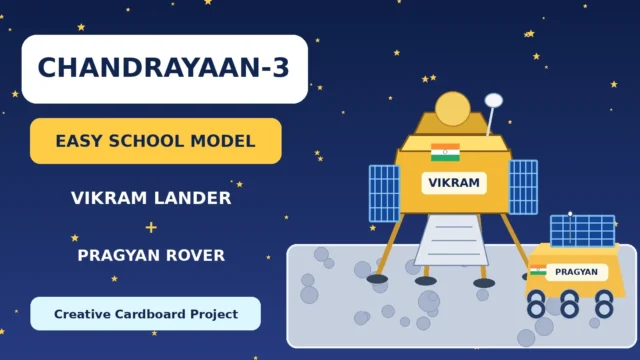
- Chandrayaan-3 Model for School Projects: 6 Pictures
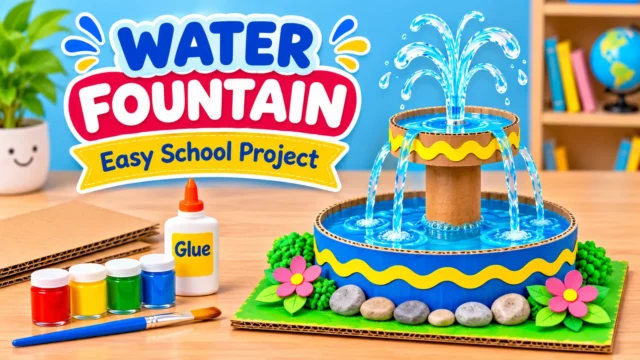
- Water Fountain School Project: 6 Pictures and Steps









Share Your Opinion
Comments are closed on this post.