Legal disclaimer
This article provides general legal information about India, reviewed on 9 October 2026. Ask an advocate to examine ownership, the family tree, applicable personal law and state land rules. It is not advice to conceal a co-owner’s interest or obtain property without lawful authority.
A share and the entire property are different
Whether ancestral or family property can be sold without every person’s consent depends on its legal character and the seller’s authority. Separately owned property, ordinary co-ownership and Hindu coparcenary property require different assessment. A person may have a lawful transferable interest without having authority to sell the entire property.
Not every family member is a present owner. Equally, the relative who manages the land is not necessarily its sole owner. Statements that everyone must always sign, or that one family member can always sell, are both unreliable. Identify the actual rights before deciding whose consent or authority is required.
Mutation, registration and actual partition are also distinct questions. A revenue entry in one person’s name does not extinguish another person’s established title. Transferring an undivided interest does not invariably give the buyer exclusive possession of a particular selected parcel. The transaction must accurately describe what the seller can lawfully convey.
Establish the ownership history first
Collect the original acquisition deed, previous transfers, death certificates, family tree, wills, gifts, releases and earlier partition records. Survey numbers and local revenue records help identify the land. A current revenue entry alone is not a conclusive answer to a disputed ownership chain. Check the documents that explain how the asset was acquired.
If a living father exclusively owns separate property, children’s expectation of future inheritance is different from present co-ownership. An already existing coparcenary interest is another question. Do not confuse a prospective heir with a person who already owns a share. The distinction can change whether consent is necessary for the proposed transaction.
After a death, the sons are not automatically the only heirs. Under the applicable Hindu succession framework, a widow, daughter, mother and relevant other Class I heirs or branches may have interests. A valid will or another personal law can change the result. Prepare the complete family tree rather than omitting inconvenient relatives. [1]
What an ordinary co-owner can transfer
Section 44 of the Transfer of Property Act provides a framework for a legally competent co-owner transferring their share or interest. Subject to the relevant conditions and liabilities, the buyer acquires rights connected with that interest and may enforce partition. The provision does not allow the seller to transfer another owner’s share merely by claiming the whole property. [2]
Without an actual partition, promising an undisputed, specifically bounded portion can create problems. A half undivided interest and a chosen half of a field are not necessarily the same thing. Examine any existing lawful division, possession arrangement and local land restrictions before representing what the purchaser will receive.
Section 44 also contains a particular restriction concerning a share in an undivided family dwelling house acquired by a person outside the family. Such a transferee is not thereby entitled to joint possession or common enjoyment under that provision. Do not extend this specific rule indiscriminately to every type of property. Agricultural fragmentation and tenancy restrictions require separate checks.
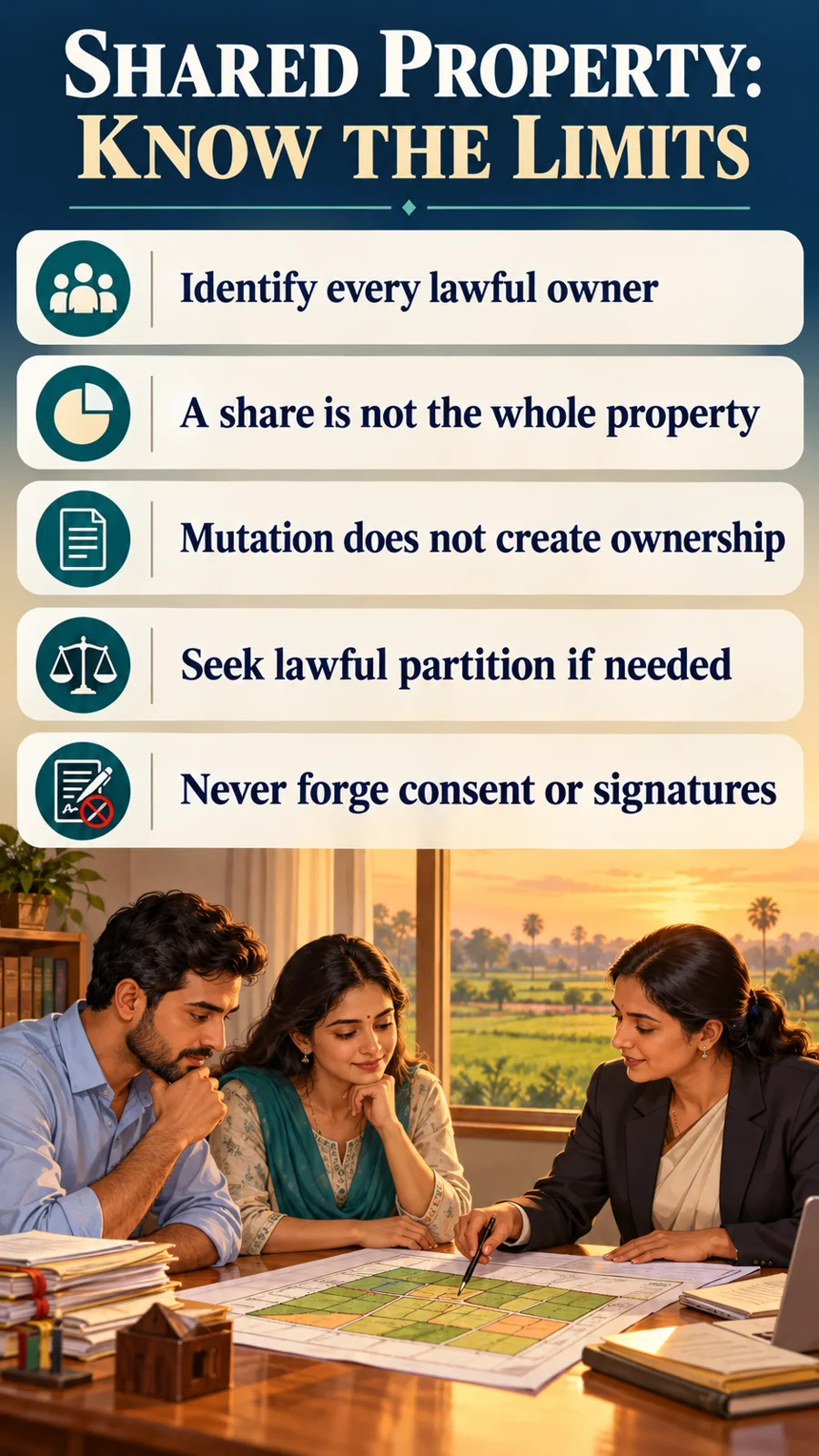
FACT: Mutation does not create exclusive ownership of an entire jointly owned property. A lawful transfer of one person’s share does not automatically extinguish another co-owner’s rights.
Coparcenary property and the Karta’s powers
Section 6 of the Hindu Succession Act makes a daughter’s equal rights important in the relevant Mitakshara coparcenary framework. Agreement between brothers does not automatically defeat her existing interest. Equally, property received from a grandfather is not necessarily continuing coparcenary property; the method of acquisition and earlier partition history matter. [1]
A Karta’s recognised alienations may be assessed under rules concerning legal necessity, benefit of the estate or indispensable duties. Consequently, unanimous signatures are not the complete explanation for every joint-family transaction. However, simply calling the seller the Karta does not create unlimited power to dispose of family property at will.
The relevant necessity, authority and evidence require examination. A recital about family expenses does not guarantee that a transaction binds everybody. Buyers should verify the authority and applicable restrictions. Do not apply ordinary co-ownership rules to every coparcenary sale or gift without checking the distinct legal framework.
Record a genuine agreed partition properly
A real family settlement should identify the affected interests, land, shares and necessary consent. Naming only brothers does not solve the problem if other owners have rights. Consent must be genuine and informed. Blank signatures, pressure and incomplete descriptions can create disputes instead of producing a secure title arrangement.
Registration consequences depend partly on whether the document itself creates or extinguishes rights or genuinely records an earlier completed arrangement. Section 17 of the Registration Act and applicable stamp law require assessment. Labelling a document an unregistered memorandum does not automatically remove a registration obligation. Its actual function and contents matter. [3]
Registration also does not cure forged signatures or absence of ownership. Check the instrument’s legal effect, execution and authority. Fees and stamp duties vary with the state and document type. A single percentage from an internet post is not a dependable cost estimate for every partition or transfer.
When agreement is not possible
A person can seek partition of their actual share or another appropriate remedy before the competent court or authority. Agricultural land and state revenue legislation can affect jurisdiction. The nature of the property, title dispute and relief sought determine the correct route. Get local advice before assuming that every case belongs in the same forum.
Identify all necessary parties and properties accurately. Explain the basis of the claimed share and provide the genuine earlier documents. Establishing shares and physically dividing the land may occur at different stages. Filing a partition claim does not immediately make the applicant the sole owner of the entire property.
Where a disputed sale, construction or change of possession is genuinely threatened, ask about an injunction or other interim protection. Approval is not automatic; rights, urgency and the other relevant legal conditions need examination. Comply with an actual court restraint even if another family member disagrees with it.
What the Supreme Court decisions explain
Ramdas v. Sitabai, (2009) 7 SCC 444 is relevant to the distinction between purchasing an undivided interest and demanding specific possession before partition. The official order dated 16 September 2009 in Gajara Vishnu Gosavi v. Prakash Nanasaheb Kamble discusses that principle and statutory agricultural-fragmentation restrictions. [4]
Jitendra Singh v. State of Madhya Pradesh, 2021 SCC OnLine SC 802 reiterated that mutation has a fiscal purpose and does not confer title. The official judgment in P. Kishore Kumar v. Vittal K. Patkar, 2023 INSC 1009 also cites this principle. Revenue administration should not be mistaken for a conclusive determination of every co-owner’s rights. [5]
These authorities do not mean that every transfer is invalid or that a court case is always necessary. The documents, legally transferable interest and statutory limits determine the assessment. A landmark case name cannot establish missing ownership facts. Connect the relevant principle with the actual transaction and property history.
Responding to a disputed entry or transaction
If a mutation appears incorrect, obtain the certified record and order date promptly. A revenue objection or appeal and a remedy for disputed title may be different processes, with their own deadlines. Applying to a local revenue official does not necessarily resolve every litigation or limitation issue. Identify the required proceeding in time.
Do not use forged consent, signatures attributed to a deceased person or a false affidavit. Check the scope and validity of any genuine power of attorney; it does not always transfer ownership itself. Buyers and family claimants should obtain original records and independent title advice instead of relying only on the person managing the land.
Frequently asked questions
Can I seek partition without my brothers agreeing?
In appropriate circumstances, you can ask the competent forum to recognise and divide your actual share. Establish the rights and applicable law first.
Can one brother sell the entire jointly owned property?
He has no general authority to sell another owner’s share. His own transferable interest and any lawful special authority are separate questions.
Are the brothers’ signatures always enough?
No, if a sister, mother or another person has affected rights. Identify every actual owner and necessary party.
Does mutation remove the need to establish title?
No. Mutation and ownership are different; title requires its lawful basis and relevant documents.
Does buying half the share give me the selected half of a field?
Not necessarily. An undivided interest, actual partition and entitlement to possession require separate assessment.
Advice
Verify the ownership chain and complete family tree. Distinguish your share from the whole property. Use an appropriate instrument for a genuine agreement, or seek advice about lawful partition and other relief where agreement fails. Never hide another owner, interest or signature to obtain exclusive title.
Related reading: How to remove name from false FIR: Section 482 CrPC quashing petition in High Court explained · What happens if you ignore court summons? Bailable vs non-bailable warrants and legal consequences
Official sources and judgments
[1] India Code — Hindu Succession Act, 1956, Sections 6, 8–10 and Class I Schedule: https://www.indiacode.nic.in/indiacode/handle/123456789/1713?view_type=browse
[2] India Code — Transfer of Property Act, 1882, Section 44: https://www.indiacode.nic.in/bitstream/123456789/14648/1/tpa.pdf
[3] India Code — Registration Act, 1908, Section 17: https://www.indiacode.nic.in/bitstream/123456789/2190/5/A1908-16.pdf
[4] Supreme Court — Gajara Vishnu Gosavi v. Prakash Nanasaheb Kamble, 16 September 2009, discussing Ramdas v. Sitabai: https://api.sci.gov.in/jonew/bosir/orderpdf/950726.pdf
[5] Supreme Court — P. Kishore Kumar v. Vittal K. Patkar, 2023 INSC 1009, discussing Jitendra Singh: https://api.sci.gov.in/supremecourt/2011/10304/10304_2011_5_1501_48291_Judgement_20-Nov-2023.pdf
Detailed legal disclaimer
This educational article does not endorse forged consent, false ownership records, forced signatures or concealment of another co-owner’s interest. Personal law, state legislation, documents and individual facts require assessment. No partition, transfer, mutation or platform-policy approval is guaranteed. This disclaimer does not remove legal duties or another person’s rights.