Legal disclaimer
This article explains general Indian law for educational purposes, reviewed on 9 October 2026. It is not individual legal advice. An advocate should examine the cheque, notice, service record, complaint and court orders before advising on your case.
A bounced cheque does not mean immediate imprisonment
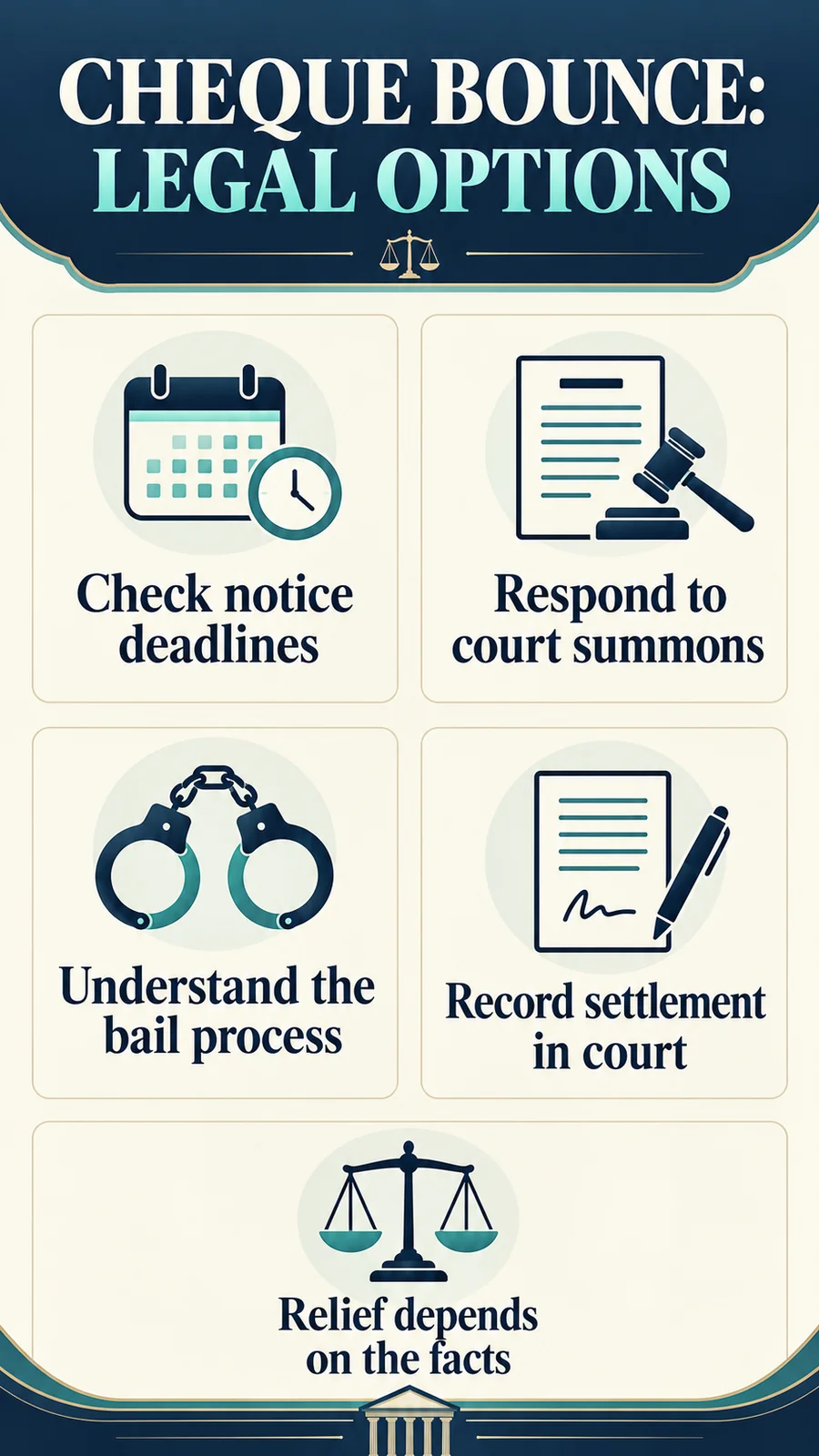
A bank’s return memo is not a conviction or an arrest warrant. Section 138 of the Negotiable Instruments Act, 1881 creates an offence where its legal requirements are met, followed by the appropriate complaint and court process. Ignoring a notice or summons is not a defense. Lawful options include responding promptly, seeking bail where required, presenting a genuine defense and exploring a properly recorded settlement.
If the offence is proved, Section 138 permits imprisonment up to two years, a fine up to twice the cheque amount, or both. These are statutory limits, not the punishment automatically imposed whenever a cheque is returned. Bail during proceedings, acquittal after trial, compounding by settlement and suspension of a sentence after conviction are different matters. Each requires its own legal basis and, where necessary, a court order. [1]
FACT: Neither a payment promise nor a private settlement message automatically closes a pending cheque-bounce prosecution. Obtain the appropriate court order and preserve payment proof.
Check whether Section 138 applies
The cheque must relate to a legally enforceable debt or liability, wholly or partly, and the statutory conditions must be satisfied. The complaint must connect the cheque to the accused’s account and the relevant obligation. Where a company is involved, Section 141 raises additional questions about the company and the persons responsible. Signing authority or a job title should not be treated as sufficient for every person’s liability.
The reason recorded by the bank also needs legal assessment. Stop-payment instructions, an account closure or a signature-related return are not universal escape routes; some such dishonours can attract Section 138 when the requirements are met. Likewise, calling a cheque a “security cheque” does not automatically defeat a complaint if an enforceable liability existed when it became payable. Explain the actual transaction rather than rely on labels.
Understand the main time limits
Presentment must occur within the legally relevant validity period. RBI directions ordinarily limit cheque validity to three months from the instrument’s date. After receiving bank information about dishonour, the payee must issue the statutory written demand within thirty days. The drawer has fifteen days after receipt of that notice to make the required payment. A timely full payment within that statutory window can prevent the cause of action for that dishonour from arising. [1][2]
If payment is not made, Section 142 generally requires the complaint within one month of the cause of action arising. A court may condone a delayed complaint where sufficient cause is shown. Notice service, deemed service, holidays and calculation of dates can be legally significant. Do not substitute “thirty days” for “one month” or calculate deadlines from a recovery caller’s informal message without examining the statutory documents.
What to do when a legal notice arrives
Keep the notice, envelope, tracking information and the date it reached you. Compare the cheque number, amount, bank, alleged debt and transactions against your records. Give your advocate the loan agreement, invoices, receipts and return memo. If payment is due and possible, obtain advice about paying the proper recipient within the statutory time and documenting it. Use verifiable payment channels and retain acknowledgement.
If the demand is disputed, a truthful and timely reply can set out your position. A reply is not a substitute for payment where payment is legally due, and silence is not a substitute for a defense. Do not fabricate receipts, alter cheque copies or pretend that an address never belonged to you. If you learn of proceedings without receiving a notice personally, seek advice; avoiding delivery does not guarantee that service will be treated as invalid.
Bail and attendance during the case
A prosecution solely under Section 138 is ordinarily treated as a bailable offence. On appearance before the competent court, your advocate can help comply with the applicable bail process, bond requirements and dates. Bail protects liberty during proceedings; it does not remove the debt or establish innocence. Local procedure and any additional offences alleged must be considered rather than assuming that every connected case has identical bail rules.
If a summons was missed, find out whether the court has issued a warrant and seek the appropriate relief promptly. A warrant resulting from non-appearance is different from automatic arrest because the bank returned a cheque. Ask for exemption from personal appearance when legally available and justified, but do not assume it has been granted. Keep a case calendar and verify orders through the court or eCourts record.
Build a genuine, evidence-based defense
Potential issues include repayment already made, the absence of the alleged enforceable liability, a mismatch between the cheque amount and the liability, or a legally significant defect in the complaint’s requirements. These are matters to investigate against the facts, not ready-made excuses. Statements about lost cheques, misuse or disputed signatures must be truthful and supported where possible by contemporaneous records and lawful evidence.
Sections 118 and 139 contain presumptions relevant to cheque cases. A bare denial is usually insufficient. Rangappa v. Sri Mohan, (2010) 11 SCC 441, is an important authority on the rebuttable presumption. Basalingappa v. Mudibasappa, decided on 9 April 2019, explains the probable-defense standard and the use of the complainant’s own material. A defense may therefore depend on documents and cross-examination rather than an invented alternative story. [3]
Interim compensation is a separate issue
Section 143A permits the court, in the circumstances specified by the provision, to order interim compensation not exceeding twenty per cent of the cheque amount. That is not an automatic twenty-per-cent bill in every complaint. In Rakesh Ranjan Shrivastava v. State of Jharkhand, 2024 INSC 205, the Supreme Court explained that this power is discretionary and requires consideration of relevant factors. Ask your advocate to examine the order, applicable date and reasons. [4]
An appeal after conviction is different. Section 148 concerns an appellate deposit and its relationship to fine or compensation, including a statutory minimum of twenty per cent when the deposit is directed. Do not confuse it with Section 143A or assume that paying either amount closes the case. The exact order, payment deadline, possible relief and the effect of subsequent acquittal should be checked under the applicable provision.
Settlement and compounding
Section 147 makes offences under the Act compoundable. A genuine settlement can be explored with the complainant and placed before the court through the proper procedure. Set out the amount, instalments, dates, payment method, treatment of costs and steps for disposal of the case. Avoid relying on a vague promise that a recovery representative will “manage the court” after taking cash. Verify the representative’s authority and the recipient account.
Compounding requires appropriate legal and judicial steps; a defendant cannot compel every complainant to accept a discount. Applicable costs and conditions can depend on the stage and current judicial directions. Obtain a copy of the disposal or compounding order. If instalments fail, the consequences depend on the recorded terms and orders, so negotiate only a schedule you can realistically perform.
If a conviction has already occurred
Obtain the judgment and sentence order immediately and ask about the available appeal, limitation period, suspension of sentence and bail during appeal. Filing an appeal alone should not be assumed to suspend imprisonment or monetary directions. A later settlement also needs to be dealt with through the court. Do not leave these steps until the date on which custody or payment becomes due.
Keep separate records of the original debt, compensation, deposits and settlement payments. The same amount should not be accidentally paid twice because different proceedings were discussed informally. At the same time, do not unilaterally deduct amounts without legal clarity. An advocate can ask the relevant court to account for payments and explain what obligations remain after the order.
Frequently asked questions
Will police arrest me the day the cheque bounces?
A bank return alone is not an arrest order. A court case, non-appearance warrant or additional criminal allegations can change the position.
Does “security cheque” automatically protect me?
No. The actual liability and circumstances when the cheque became payable must be examined.
Can I stop payment to avoid Section 138?
Stop payment is not a blanket defense. A complaint can still succeed where its legal requirements are met.
Does bail mean the case is over?
No. Bail concerns liberty during proceedings. The trial or lawful disposal process remains.
Can settlement prevent imprisonment?
A properly completed and judicially recorded resolution can provide relief as permitted by law. No result is guaranteed by merely proposing settlement.
Advice for your next step
Act early, preserve records, attend court as directed and assess both the merits and an affordable settlement. The safest lawful strategy is based on the actual transaction and timely procedural compliance. If a warrant or conviction already exists, treat that order as an immediate legal task rather than assume the original notice-stage advice still applies.
Related reading: How to reduce maintenance amount in court: Legitimate grounds to challenge interim alimony · What happens if personal loan is not paid in India? Defaulter rights, civil recovery, and RBI rules
Official sources and judgments
[1] India Code — Negotiable Instruments Act, 1881, Sections 118, 138–143A, 147 and 148: https://www.indiacode.nic.in/handle/123456789/13092?locale=hi
[2] RBI — cheque validity directions: https://www.rbi.org.in/commonman/Upload/English/Notification/PDFs/CVC041111.pdf
[3] Supreme Court — Basalingappa v. Mudibasappa, (2019) 5 SCC 418, including discussion of Rangappa: https://api.sci.gov.in/supremecourt/2018/36832/36832_2018_Judgement_09-Apr-2019.pdf
[4] Supreme Court — Rakesh Ranjan Shrivastava v. State of Jharkhand, 2024 INSC 205: https://api.sci.gov.in/supremecourt/2023/7859/7859_2023_8_1502_51462_Judgement_15-Mar-2024.pdf
Detailed legal disclaimer
This educational content does not encourage unpaid debts, false defenses, evasion of service or disregard of court orders. Law and procedure must be applied to the individual facts and may change. No bail, acquittal, settlement discount, platform-policy approval or immunity from liability is guaranteed. Consult an advocate before acting. This disclaimer does not override legal duties or another person’s rights.