Avoiding a physical visit is different from avoiding a decree
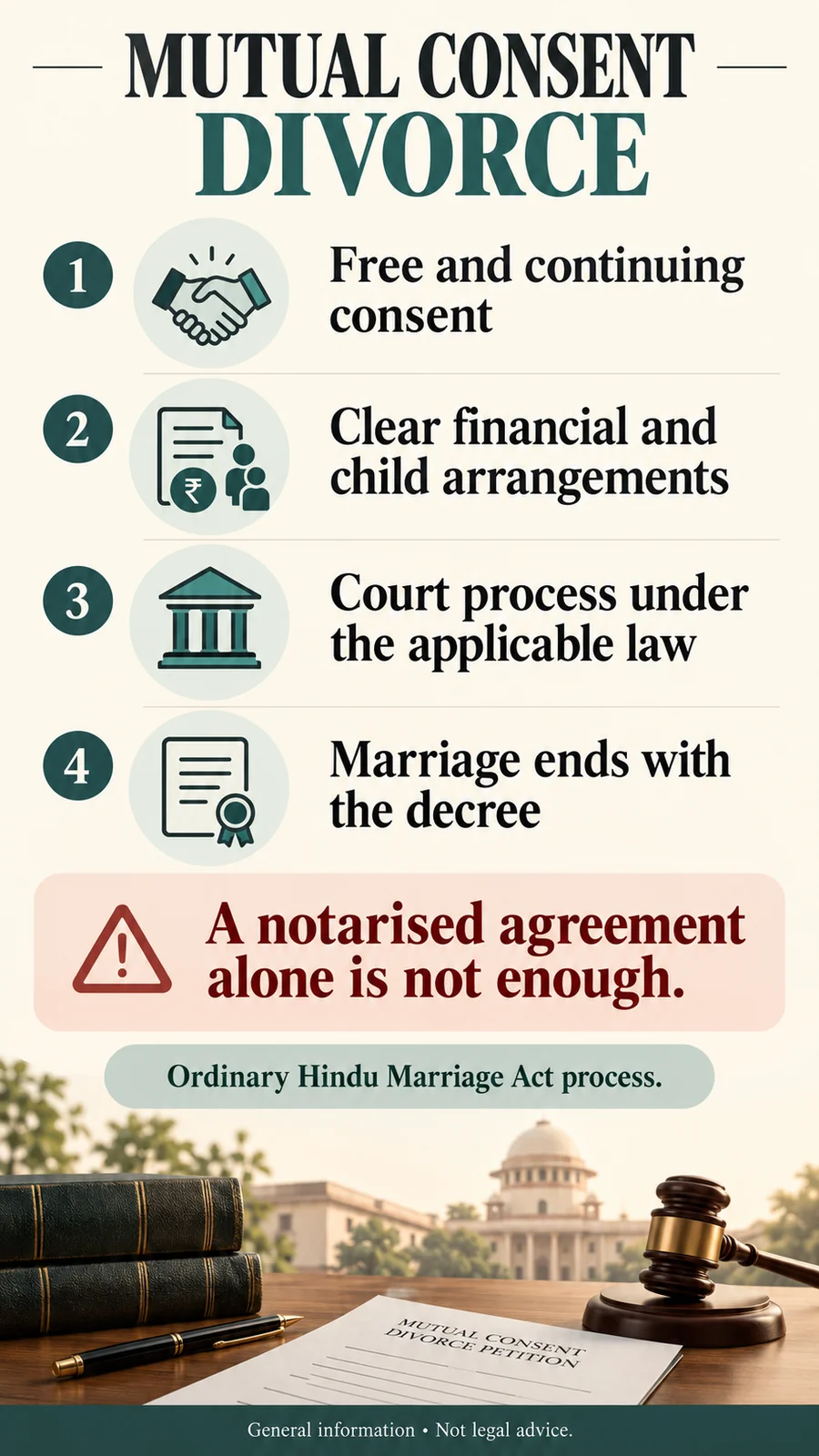
If both spouses want to separate, can a signed agreement or notarised document complete the divorce? For ordinary mutual-consent divorce under the Hindu Marriage Act, the answer is no: a court decree is required. Permission for video participation or exemption from personal attendance may help in particular circumstances, but does not remove the judicial process. Other marriage laws require their own assessment.
Legal disclaimer: This article provides general legal information, not personal advice. Ask a qualified advocate to identify your marriage law and review the documents before taking a step.
“Online divorce,” “notary divorce” and “mutual agreement” are often used as though they describe the same thing. They do not. Agreement can reduce the issues in dispute, but it does not necessarily produce the legal effect of ending a marriage. Understand what the service offered actually completes, and what remains for the court.
Identify the marriage law first
Section 13B of the Hindu Marriage Act provides for a joint petition seeking divorce by mutual consent. Its basic conditions include living separately for a year or more, inability to live together and agreement that the marriage should be dissolved. The legal meaning of living separately must be assessed against the actual circumstances. [1]
The Special Marriage Act and other marriage laws can involve different provisions and requirements. Do not choose the statute solely from a religious label or a single line in a registration document. Give your advocate the available marriage records and explain how the marriage was solemnised or registered.
This article principally explains the ordinary Hindu Marriage Act court procedure. A claim involving a legally recognised custom or another personal-law form of dissolution needs separate examination. Neither “every Indian divorce requires precisely this process” nor “notarisation works for everybody” is a reliable general statement.
Before comparing prices or timelines, establish which process you need. Ask whether the quoted service covers preparation, filing, both motions, court appearances and obtaining the decree. An inexpensive package that only supplies draft papers is not the same as completing a divorce.
How the ordinary mutual-consent process works
The spouses first discuss the practical terms: financial support, property or belongings, children and pending disputes. Once terms are genuinely agreed, a joint petition and settlement can be prepared. Filing takes place before the competent Family Court or other court with jurisdiction. Local document and filing requirements should be checked.
The court considers the parties' statements and consent at the first stage. The second motion follows the applicable timing and procedure. If ongoing consent and the legal requirements are satisfied, a decree can be granted. Filing the petition does not itself end the marriage. [1]
Review names, dates, the separation history and details of children before filing. An inaccurate date or a missing term can create unnecessary correction work and further disagreement. Do not sign papers simply because both people want to finish quickly.
The agreement should be practical enough to implement. State the amount, due date, method of payment and any connection with a procedural stage. Identify belongings to be returned and the agreed arrangements for doing so. A vague promise to decide everything later defeats much of the purpose of agreeing terms first.
Can the six-month cooling-off period be waived?
Section 13B(2) provides for the ordinary six-month interval after the first motion and an eighteen-month outer limit for the motion in its terms. In Amardeep Singh v. Harveen Kaur, decided on 12 September 2017, the Supreme Court held that the six-month interval can be waived by the court in appropriate cases. Waiver is not automatic. [1][2]
The reality of the settlement, attempts at reconciliation and whether further waiting serves a useful purpose are relevant considerations. A joint preference for speed is not a promise that waiver will be granted. Have the application assessed against the facts and relevant later decisions.
Do not confuse waiver of the second-motion interval with a general waiver of Section 13B(1)'s separate-living condition. Section 14's restriction concerning petitions within the first year of marriage is another distinct issue. Calling all of these “the waiting period” can lead to incorrect advice about eligibility.
FACT: Waiver can shorten a judicial process. It does not make a private agreement or notarised paper a substitute for the decree in ordinary Section 13B divorce.
Video participation and exemption from attendance
A spouse overseas, unwell or facing a genuine difficulty attending can ask about an appropriate application. The court may consider video participation or another permitted arrangement, taking identity and voluntary consent into account. Amardeep Singh discusses video conferencing and representation in suitable circumstances. [2]
This should not be offered as a guaranteed service in every court. Check local rules, the assigned court's directions and the records needed to explain the difficulty. A website's promise of completing everything from home cannot replace judicial permission.
If participating remotely, prepare reliable connectivity, a quiet place and the required identification and papers. Follow the court's instructions about who must be present. An overseas participant may need additional document authentication; ask about the actual requirement before paying for a particular certificate or service.
Remote participation still involves a hearing and questions. If personal attendance has been ordered, do not assume that logging into a video link excuses absence. Seek permission in advance rather than creating an avoidable procedural problem on the hearing date.
Settle financial terms, children and pending proceedings clearly
Record agreed support, arrears, belongings or stridhan, property terms and the payment schedule. Keep divorce and any existing maintenance order separate when analysing their effect. Ask how an existing order is to be modified or disposed of rather than assuming the settlement automatically changes it.
For children, address residence, education and medical expenses, contact and visits. A child's interests cannot simply be treated as a bargain between adults. The court's assessment remains important, and changes in circumstances may require later consideration of child-related arrangements.
List each FIR or pending proceeding accurately. The sentence “all cases are settled” does not automatically end every case. Withdrawal, disposal or quashing may require a proper application before the relevant court, depending on the proceeding and governing law.
Prepare available marriage proof, identification, addresses, children's details, financial records and case numbers. If a document is missing, ask about accepted alternatives. Do not respond to a filing difficulty by using a false address or fabricated certificate.
Advice: protect voluntary consent and check the final decree
Each spouse should have time to read and understand the terms. Pressure, threats or a signature obtained without understanding can undermine genuine consent. In the ordinary Section 13B process, consent must continue until the decree; an initial agreement does not guarantee divorce if a spouse later withdraws consent. [3]
Shilpa Sailesh v. Varun Sreenivasan, decided on 1 May 2023, explains the Supreme Court's exceptional Article 142 powers. It does not give a Family Court the same constitutional power, or create a routine direct Article 32 route for seeking divorce. Distinguish this exceptional judicial jurisdiction from the ordinary procedure. [3]
Ask your advocate what remains to be completed at each stage. Keep records of payments and returned belongings. After the decree, obtain the proper copy and check compliance with its terms. Before remarriage, obtain advice about finality and any relevant appeal question rather than relying on a message that the case is “done.”
If cost is a difficulty, inquire about legal-aid eligibility with the District Legal Services Authority. Be cautious of anyone who sells an instant result without identifying the marriage law, the competent court or what document will actually establish dissolution.
FAQ
Can a notarised agreement complete ordinary Hindu mutual-consent divorce?
No. The ordinary process requires a decree. A claimed legally recognised customary arrangement requires separate advice and proof.
Is waiver of six months guaranteed when both spouses agree?
No. The facts, settlement and court's assessment determine whether waiver is appropriate. Consent to seek waiver is not a grant of waiver.
Can a spouse abroad participate through video?
It may be possible with permission and under applicable court rules. Arrange it in advance instead of assuming it will be available.
Can consent be withdrawn before the decree?
Continuing consent is important in ordinary mutual-consent proceedings. If consent changes, obtain separate advice about further options and the settlement's effect.
Does the divorce automatically end cruelty or maintenance proceedings?
No. Each pending proceeding and order requires appropriate legal treatment. Identify the court steps needed for every matter.
Related reading and sources
Related reading: How to avoid paying maintenance to wife legally: Grounds for refusal and court exceptions · How to save yourself from false 498A case: Supreme Court guidelines and anticipatory bail process
[1] Hindu Marriage Act 1955, particularly Sections 13B, 14 and 15: https://www.indiacode.nic.in/handle/123456789/1560
[2] Amardeep Singh v. Harveen Kaur, 12 September 2017, (2017) 8 SCC 746: https://api.sci.gov.in/supremecourt/2017/22782/22782_2017_Judgement_12-Sep-2017.pdf
[3] Shilpa Sailesh v. Varun Sreenivasan, 1 May 2023, 2023 INSC 468: https://api.sci.gov.in/supremecourt/2014/26304/26304_2014_2_1501_44203_Judgement_01-May-2023.pdf
Detailed legal disclaimer: This article explains general procedures and does not determine the legal status of an individual marriage. Requirements vary with the marriage law, facts and local court rules. Do not treat a private settlement as a final divorce without proper legal review. Obtain advice about documents, payments, children, finality and remarriage from a qualified advocate before acting.