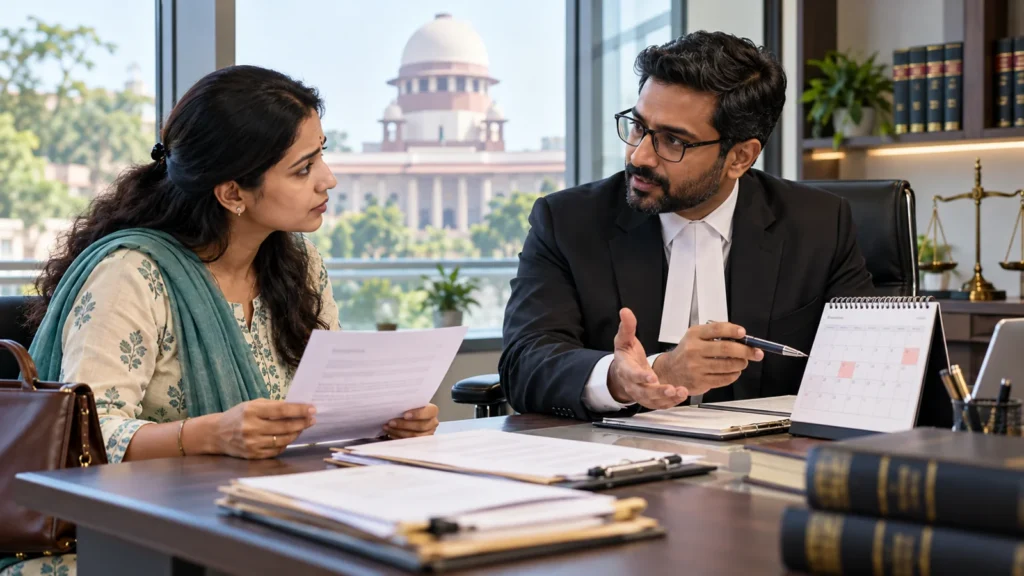
Legal disclaimer
This article provides general Indian legal and financial information, reviewed on 9 October 2026. It is not individual advice. Consult an advocate about notices or proceedings and ask the issuer to explain your agreement, statement and repayment options.
Unpaid bills and criminal allegations are different
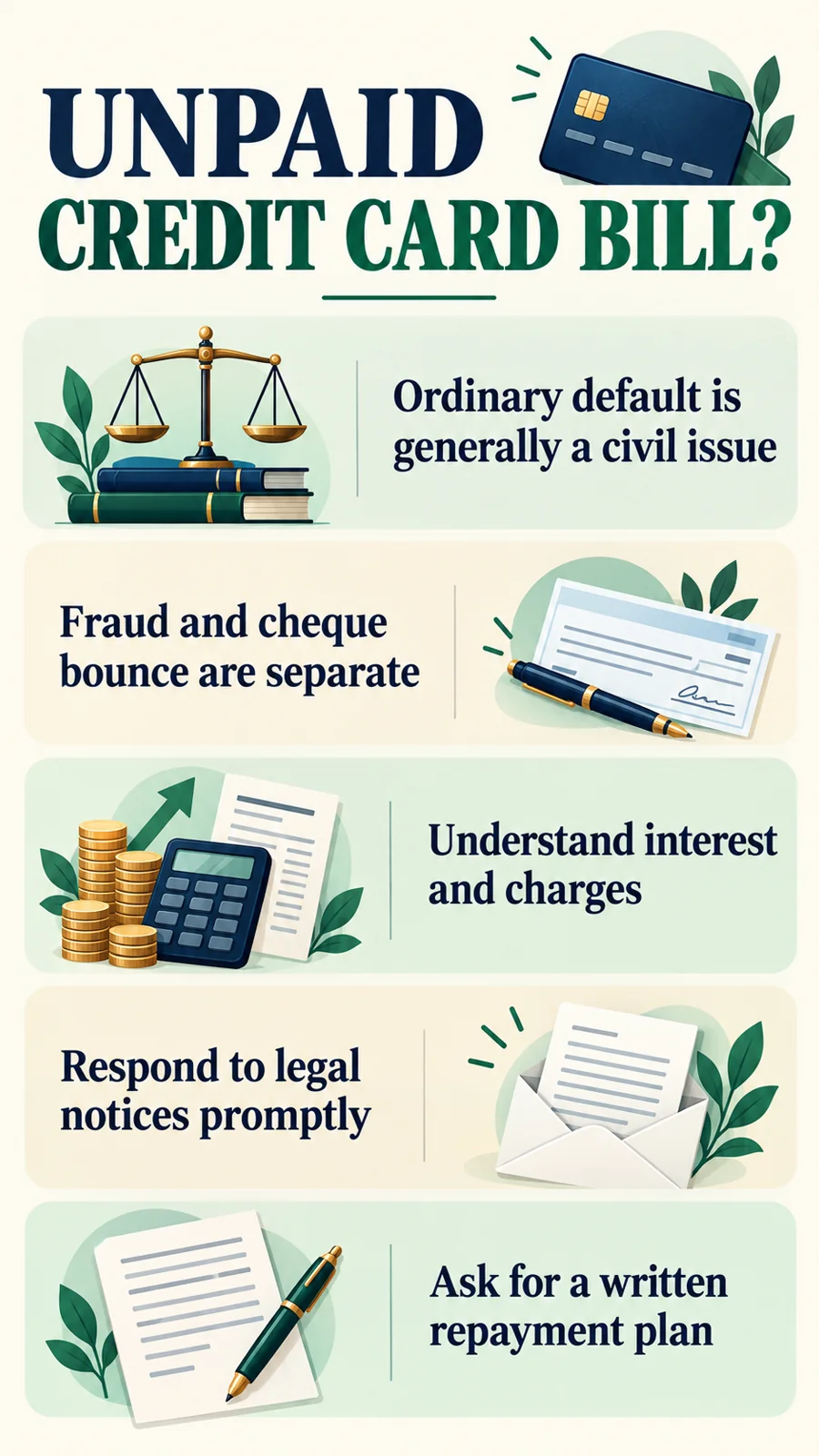
Ordinary inability to pay a credit card bill is generally a civil recovery issue. It does not automatically establish cheating or authorise a collection agent to arrest the cardholder. However, a transaction involving fraud, forged documents, a dishonoured repayment cheque or judicial orders can raise separate issues. A caller’s threat of a police case is not itself proof that one exists.
An issuer can pursue legally available recovery. An unsecured card balance is still a debt; lack of agreed collateral does not mean that a bank can never sue. Conversely, every unpaid balance should not be labelled a criminal offence. Identify the amount, reason for non-payment, documents and process actually started. Verify genuine police or court communications and obtain advice rather than ignore them.
FACT: Paying the Minimum Amount Due does not clear the full bill. Interest and the loss of the interest-free period can remain relevant to the unpaid balance.
Total due versus minimum due
The Total Amount Due represents the statement’s full payable amount. The Minimum Amount Due is the minimum payment requested under the applicable cycle and terms. Paying only that amount leaves a balance outstanding and can lengthen repayment substantially. Do not treat a small minimum payment as evidence that the remaining debt is inexpensive or that next month’s purchases will remain interest-free.
RBI’s Commercial Banks Credit Cards and Debit Cards Directions, 2025, updated on 1 October 2026, require clear information about minimum-payment consequences and finance-charge calculations. An outstanding balance from the previous bill affects the interest-free credit period. Retail purchases, cash advances and conversion to instalments can have different conditions. Read the actual terms rather than use a generic online percentage. [1]
Interest, late fees and the three-day rule
Check the statement and Most Important Terms and Conditions, or MITC, for APR, finance charges, late fees, taxes and the calculation method. Ask the issuer to explain how payments, refunds and reversals were credited. A bill can contain legitimate charges and errors at the same time; reconcile the entries instead of accepting or rejecting the entire figure without examining it.
The RBI directions restrict covered past-due reporting and related penal charges to accounts that remain past due for more than three days. The days past due and charges are nevertheless calculated from the statement’s payment due date. This is not a universal three-day interest-free extension. Ordinary finance charges, payment processing and the interest-free-period conditions need separate attention. [1]
When criminal law may become relevant
BNS Section 318 addresses cheating, with requirements involving deception and dishonest inducement. Taking a facility honestly and later losing income differs from obtaining it through an initial dishonest scheme. Forged identity or salary records and other genuine fraud allegations can change the position. Non-payment alone does not establish every required element of cheating, but a civil claim does not prevent investigation of a real offence. [2]
For earlier conduct, the IPC and transitional rules may remain relevant. Hridaya Ranjan Prasad Verma v. State of Bihar, (2000) 4 SCC 168 is an important authority on breach of contract versus cheating. The Supreme Court discussed the initial-intention principle again in Raju Krishna Shedbalkar v. State of Karnataka, in its order of 2 February 2024. These authorities require a factual assessment, rather than guarantee dismissal of every card-related allegation. [3]
A dishonoured repayment cheque is a separate matter
A cheque issued towards card dues can attract Section 138 of the Negotiable Instruments Act if the requirements are met. Its demand notice, service, payment window and complaint filing rules must be examined. A balance statement and a cheque prosecution are not the same proceeding. An electronic mandate failure may also need assessment under its relevant law and circumstances.
Do not issue an unaffordable cheque merely to end a difficult recovery call. Preserve statutory notices and their delivery records and obtain prompt advice. Negotiating instalments with the issuer does not automatically suspend a notice deadline. Where a criminal proceeding already exists, understand what lawful steps and court orders are needed to record any settlement and dispose of the matter.
The issuer’s civil recovery options
Depending on the agreement and law, a lender may pursue a civil suit, arbitration or another available process. If the claim contains incorrect payments or charges, raise a documented objection through the correct procedure. Distinguish a bank demand from court summons. An arbitration notice also deserves attention; ignoring it because it did not arrive from a court can be a costly mistake.
After a valid decree or enforceable award, execution and legal exemptions become separate questions. An agent does not acquire a general private power to seize belongings because a card bill is unpaid. Equally, “unsecured” does not mean recovery after adjudication is impossible. If an order exists, obtain it and ask an advocate about compliance, challenge or interim relief as applicable.
Credit information reporting
Late payments, outstanding balances and settlements can affect later credit assessment. There is no fixed number of score points lost by every borrower. The current RBI card directions require prior intimation under the issuer’s approved default-reporting procedure. Do not assume that older references to a universal seven-day notice are the current rule for every card account. [1]
Where a reported cardholder later settles dues, the directions provide for updating the status with the credit information company within thirty days. An update does not mean erasing truthful history or representing a discounted settlement as full repayment. Check the report for accuracy and submit payment records where correction is needed. The directions also contain safeguards relating to disputed information; assess their application to the actual grievance.
Recovery threats and harassment
Issuers and agents must comply with applicable recovery-conduct requirements. RBI directions prohibit intimidation, humiliation and intrusion into family privacy. Verify the caller and agency through the issuer’s official channel. Preserve messages, dates and the incident details. Do not share passwords, PINs or OTPs or pay an unverified personal account because someone threatens immediate arrest. [1][4]
Send a written conduct complaint to the issuer’s grievance officer. Violence or criminal intimidation can require police assistance through a separate route. A complaint does not itself suspend valid dues. You can object to abusive conduct while making an honest repayment proposal. Clear separation of the issues helps the lender investigate harassment without confusing it with a request to cancel the debt.
Wrong bills and unauthorised transactions
Report an unauthorised transaction promptly through the issuer’s official channel and ask about blocking the card or other protective action. A transaction dispute, payment default and chargeback have different processes. Applicable customer-liability rules and reporting time limits require assessment. Merely withholding payment does not establish that a dispute has been registered or decided in your favour.
Retain the statement, merchant details and complaint reference. Ask how undisputed dues should be treated while the particular charge is investigated. Do not label every transaction fraudulent because one entry is unfamiliar. A cybercrime or police complaint may be appropriate depending on the facts. Be wary of an unverified person asking for remote access, OTPs or a fee to “reverse” the transaction.
Instalments, restructuring and settlement
Ask the issuer about a repayment plan that fits your actual budget. For EMI conversion, compare interest, fees, taxes, prepayment conditions and total payable, not just the next monthly amount. Eligibility and approval depend on the issuer and product. A hardship request is not an automatic payment holiday, and an informal collection discussion may not change the contract.
A settlement may involve the lender accepting less than the claimed dues, but neither approval nor a percentage discount is guaranteed. Obtain authorised written terms identifying the account, amount, dates, remaining liability and closure conditions. A collection agent’s message alone may not establish approval. Settlement can have different credit implications from full repayment; request acknowledgement and accurate reporting after payment.
The current RBI complaint route
Complain to the issuer first and retain proof. Where the entity and service fall within coverage and the grievance concerns an eligible deficiency in service, RBI CMS may be available. The Integrated Ombudsman Scheme, 2026 applies from 1 July 2026. Consider escalation after no response within thirty days or a longer applicable response period, or dissatisfaction with the reply, subject to the remaining conditions. [5]
The scheme generally requires filing within ninety days from expiry of that response period or the entity’s last communication, whichever is later. The same grievance pending or decided in another specified forum can affect maintainability. Refusal of a commercial discount is not automatically a service deficiency. Do not miss court or arbitration deadlines while waiting for an Ombudsman complaint to be assessed.
Frequently asked questions
Does paying minimum due stop all interest?
No. The outstanding balance, interest-free-period conditions and issuer’s terms still matter.
Can a collection agent send police simply because I missed a bill?
An agent has no arrest power. Genuine police action needs a lawful basis and should be independently verified and addressed.
Does closing the card cancel the balance?
A closure request does not replace repayment. Ask about outstanding dues and the applicable closure conditions.
Will settlement immediately repair my score?
No fixed result is guaranteed. Accurate status updates and the complete payment history are separate issues.
Can I ignore a legal notice?
Do not do so. Identify the notice type, required response and deadline with appropriate advice.
Advice
Stop adding unaffordable spending, reconcile the statement and prepare a realistic budget. Contact the issuer early and preserve notices. Keep valid dues, disputed transactions and harassment distinct. Check every promise of a smaller payment or case closure against authorised written terms and any necessary court process. Honest records and timely action are the basis for a workable solution.
Related reading: How to deal with bank recovery agents legally: RBI harassment guidelines and filing police complaint · How to settle loan with bank for less amount: One-Time Settlement (OTS) procedure and credit impact
Official sources and judgment
[1] RBI — Commercial Banks Credit Cards and Debit Cards Directions, 2025, updated 1 October 2026, paragraphs 23, 35–39: https://rbidocs.rbi.org.in/rdocs/notification/PDFs/155MD.PDF
[2] Ministry of Home Affairs — BNS, Section 318: https://www.mha.gov.in/sites/default/files/2024-04/250883_english_01042024.pdf
[3] Supreme Court — Raju Krishna Shedbalkar v. State of Karnataka, 2 February 2024, discussing Hridaya Ranjan: https://api.sci.gov.in/supremecourt/2021/19002/19002_2021_17_36_50030_Order_02-Feb-2024.pdf
[4] RBI — Commercial Banks Responsible Business Conduct Directions, paragraph 445: https://rbidocs.rbi.org.in/rdocs/notification/PDFs/170MD.PDF
[5] RBI — Integrated Ombudsman Scheme, 2026: https://www.rbi.org.in/Scripts/BS_PressReleaseDisplay.aspx?prid=62052 ; complaints: https://cms.rbi.org.in
Detailed legal disclaimer
This educational article does not encourage deliberate default, fraud, false documents, asset concealment or disregard of judicial orders. Consequences depend on the facts, contract and current rules. No waiver, settlement, credit-score improvement, immunity from police action or platform-policy approval is guaranteed. Seek individual advice before acting. This disclaimer does not remove contractual or statutory obligations.