Madhya Pradesh Foundation Day 2026: Formation, Nagpur and Bhopal Explained
Why is Bhopal the capital of Madhya Pradesh if older general knowledge books mention Nagpur? The answer lies in the difference between the old Madhya Pradesh and the state reorganised in 1956. This guide explains the formation story, the key dates and common exam mistakes, followed by an original short speech for a school assembly.
When is Madhya Pradesh Foundation Day in 2026?
Madhya Pradesh Foundation Day is observed on 1 November. The reorganised state came into existence on 1 November 1956. On 1 November 2026, 70 years will have elapsed since that formation. The occasion is an opportunity to learn how different regions became part of a shared state.
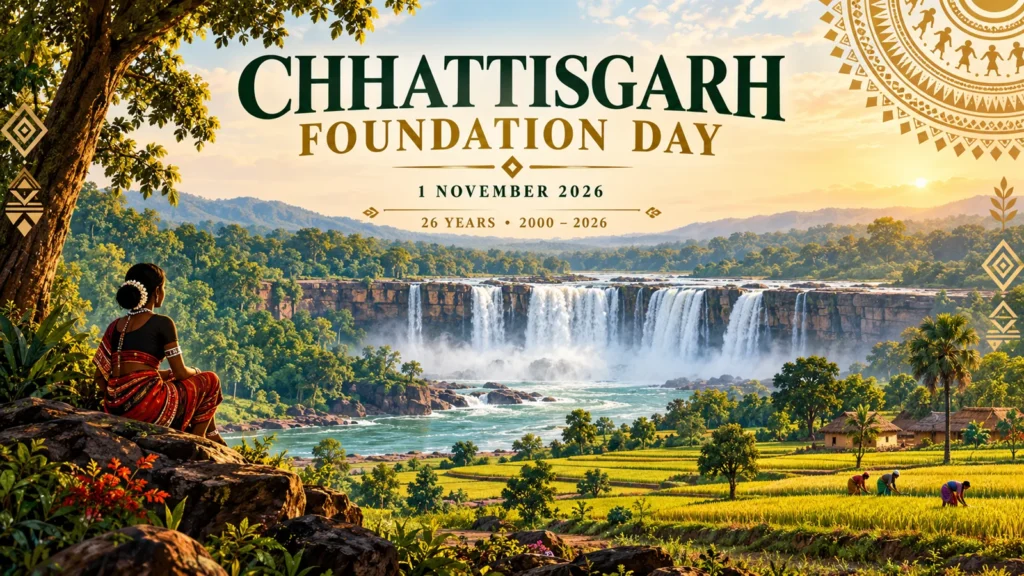
The boundaries of the state formed in 1956 were different from today’s boundaries. The territory that became Chhattisgarh was then part of Madhya Pradesh. Chhattisgarh became a separate state on 1 November 2000. A map of present-day MP should therefore never be labelled as a map of the 1956 state.
How was Madhya Pradesh formed?
After independence, central India contained several administrative units. The old Madhya Pradesh included Mahakoshal and Chhattisgarh areas. Madhya Bharat, Vindhya Pradesh and Bhopal were separate units. State reorganisation brought much of these territories into a new Madhya Pradesh.
Section 9 of the States Reorganisation Act, 1956 provided for the new state. Some districts of the old Madhya Pradesh went to the then Bombay State. Most of Madhya Bharat, along with Vindhya Pradesh, Bhopal and the Sironj subdivision of Rajasthan, entered the new MP. Saying that four complete states were simply joined together misses the boundary adjustments.
| Historical name | What to remember |
|---|---|
| Old Madhya Pradesh | A pre-1956 state with Nagpur as its capital. |
| Madhya Bharat | A separate state before reorganisation. |
| Vindhya Pradesh | Became part of the reorganised MP. |
| Bhopal State | A separate administrative state after merger with India; joined the new MP in 1956. |
What was the capital of MP before 1956?
Nagpur was the capital of the old Madhya Pradesh. This answer applies to that particular state. It is not an answer to a question about the capital of Madhya Bharat or another neighbouring unit. Read the exact historical name in an examination question before answering.
During reorganisation, Nagpur and the relevant Marathi-speaking districts became part of the then Bombay State. They later became part of Maharashtra. Bhopal became the capital of the reorganised Madhya Pradesh. Nagpur is not a city in present-day MP.
How did Bhopal become the capital?
The Union government took over the administration of Bhopal on 1 June 1949 following the merger agreement. Bhopal subsequently existed as a separate Part C state. It joined the new Madhya Pradesh in the 1956 reorganisation, and Bhopal city became the capital.
These are two different milestones: merger with India in 1949 and becoming the capital of reorganised MP in 1956. Popular stories that attribute the decision entirely to a single condition or individual should not be presented as established history without original documents. The clear exam fact is the connection between the 1956 reorganisation and Bhopal’s capital status.
Quick facts for school assemblies and MP examinations
- Foundation Day: 1 November.
- Formation date of reorganised MP: 1 November 1956.
- Capital of the old MP: Nagpur.
- Capital of reorganised MP: Bhopal.
- Administrative merger milestone for Bhopal: 1 June 1949.
- Chhattisgarh became a separate state: 1 November 2000.
Mahakoshal, Malwa, Bundelkhand, Baghelkhand and Nimar help explain the state’s regional diversity. Historical and cultural regions are not interchangeable with current administrative divisions. Students preparing for MPPSC, MP Police or Patwari examinations should keep those categories separate in their notes.
A short Foundation Day speech and greeting
Respected Principal, teachers and my dear friends, warm wishes to everyone on Madhya Pradesh Foundation Day. On 1 November 1956, the reorganised state of Madhya Pradesh came into existence. In 2026, we mark 70 years since that event. Our state brings together different languages, traditions, landscapes and historical experiences. Its identity includes the culture of the Narmada, the work of villages and towns, and the knowledge of its many communities. Today, let us learn our history with care and contribute to a better future. We can begin with education, equal respect, cleanliness and care for nature. A strong state grows when all its people have opportunities to learn and participate. Thank you.
This is an original sample, not a quotation from a historical leader. Add your school’s name or a verified local example. An original greeting to share is: “Celebrating the diversity, shared history and future of Madhya Pradesh. Happy Foundation Day.”
Advice and frequently asked questions
For an assembly activity, ask each child to introduce one river, local art form or historical place from their district. Label every historical map with its year. Check departmental announcements before claiming that a particular public event, competition or holiday has been declared for 2026.
Does Madhya Pradesh complete 70 years in 2026?
Yes. Seventy years from the formation on 1 November 1956 are completed on 1 November 2026.
Did Bhopal become MP’s capital in 1949?
No. The 1949 milestone concerns Bhopal’s administrative merger with India. The capital milestone is 1956.
Were Madhya Bharat and Madhya Pradesh the same state?
No. They were different units before the 1956 reorganisation.
Was Chhattisgarh separated in 1956?
No. Chhattisgarh became a separate state on 1 November 2000.
Is this an official MPPSC study note?
No. It is an educational explanation. Use the official syllabus and original records for examination preparation.
Editorial note: This article combines historical explanation with an original educational speech. It does not announce a government event or holiday for 2026.
Sources and further reading
- Prime Minister’s Office: MP formation date
- Madhya Pradesh Legislative Assembly: history
- Bhopal district administration: merger and history
- MP Pollution Control Board: state background
Also read for school assemblies
Children’s Day speeches and anchoring
Related reading: Constitution Day: Preamble meanings and school speeches
Related reading: Dr Harisingh Gour and the history of Sagar University
Related reading: Chhattisgarh Foundation Day: formation from MP
Related reading: Veer Durgadas Rathore and the Ujjain cenotaph