 Vista
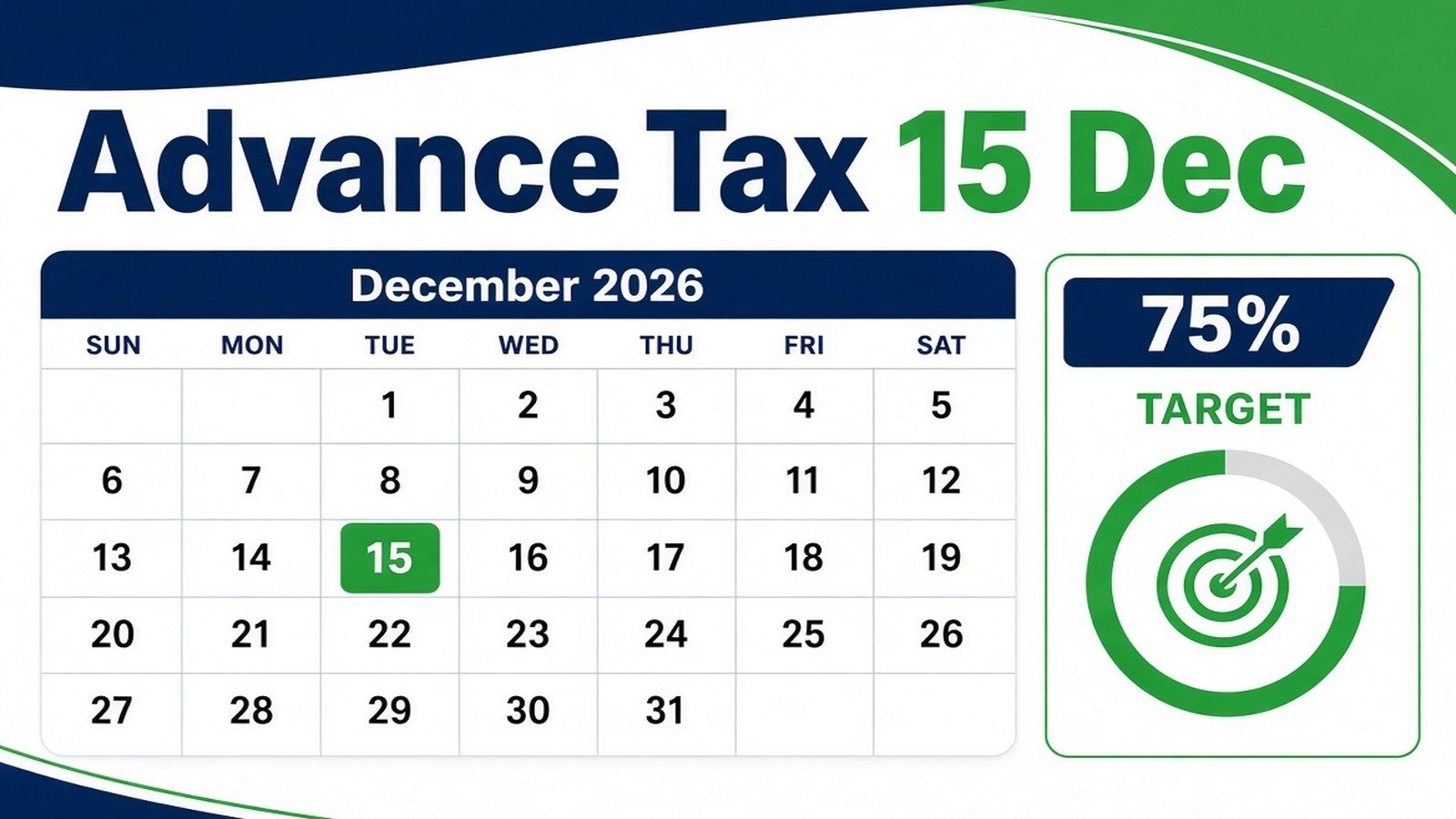
Advance Tax December 15, 2026: for the regular instalment schedule, your cumulative payment should reach 75% of estimated annual advance-tax liability. The correct new-law flow uses Income-tax Act, 2025, Tax Year 2026–27 and ITNS 280N Advance Tax minor head 100, subject to eligibility and exceptions.
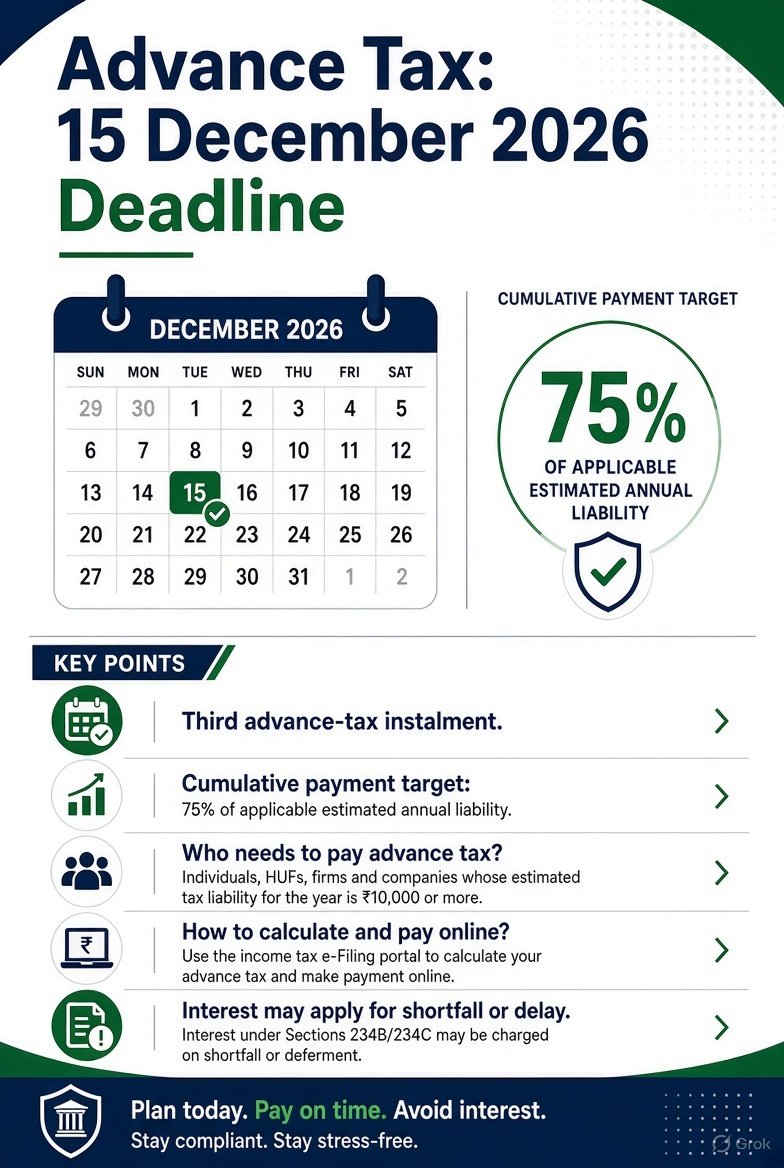
Updated 22 November 2026 | Tax Year 2026–27
Advance tax 15 December 2026: third instalment and the direct answer
Tuesday, 15 December 2026, is the third regular advance-tax instalment due date for Tax Year 2026–27, covering income earned from April 1, 2026 to March 31, 2027. Under Section 408 of the Income-tax Act, 2025, people and businesses following the standard quarterly schedule must have paid at least 75% of their estimated annual advance-tax liability in total by that date. It does not mean everyone must pay a fresh 75% in December.
Advance tax is income tax paid during the year instead of waiting for the income-tax return to be filed. Its amount depends on estimated taxable income, the applicable tax computation, eligible tax credits, and payments already deposited in June and September. The Income Tax Department’s official FAQs confirm that Tax Year 2026–27 is governed by the new Income-tax Act, 2025, whereas payments for old Assessment Year 2026–27 follow the previous Act where applicable.
This guide is for readers planning their December payment, particularly freelancers, consultants, landlords, investors, shop owners and salaried people with substantial income not fully covered by TDS. It explains the 75% calculation, exceptions, ITNS 280N challan, e-Pay Tax steps, interest and common mistakes.
Advance-tax instalment calendar: 15%, 45%, 75%, 100%
Section 408 sets four cumulative milestones for the standard instalment schedule: 15 June—at least 15%; 15 September—at least 45%; 15 December—at least 75%; and 15 March—100% of estimated advance tax. The percentages are cumulative, with amounts already paid deducted when finding the next instalment. For Tax Year 2026–27, the four dates are 15 June 2026, 15 September 2026, 15 December 2026 and 15 March 2027.
A common incorrect calculation is 15% in June plus 45% in September plus 75% in December. That would add up to 135% before March and misread the statute. Instead, if an estimated total advance tax is ₹1 lakh, the required cumulative amounts would be ₹15,000, ₹45,000, ₹75,000 and ₹1,00,000 respectively. The additional payments needed are whatever brings the account to those totals.
These dates relate to advance tax on income of the ongoing year; they are not deadlines for filing all tax returns or paying a previous year’s assessment demand. A one-instalment exception for qualifying presumptive-tax businesses is explained separately below.
Who must pay advance tax? The ₹10,000 threshold
The department confirms that under Section 404 of the Income-tax Act, 2025, advance tax applies if the amount of tax payable during the year, computed under the relevant advance-tax provisions, is ₹10,000 or more. This is a tax-liability threshold, not an income threshold of ₹10,000. Someone might have income substantially above that figure but little further advance tax due because adequate TDS has already been collected.
People who may owe advance tax include self-employed professionals, consultants, business owners, freelancers, landlords with taxable rental income, investors with taxable capital gains and salaried individuals who have income not adequately covered by payroll tax deduction. For a salaried taxpayer, employer TDS may be sufficient; no separate advance-tax payment is necessarily required. Companies and other entities must apply their own liability computation.
A resident individual aged 60 or above who has no income from business or profession generally has a statutory advance-tax exception under the continuing policy framework. However, residency, age, and income source must all be checked; it is not a blanket waiver for every person receiving a pension. Complex accounts and tax credits may warrant a qualified tax adviser’s review.
How to estimate annual tax after TDS and credits
Begin with a realistic estimate of total income for April 2026–March 2027. Include relevant salary, business or professional profits, interest, rent and taxable investment income. Then account for the applicable tax regime, deductions and exemptions that you are legally eligible to claim, surcharge if relevant and health-and-education cess as applicable. The goal is to estimate the full-year tax, not merely multiply income by a headline slab rate.
Next subtract eligible Tax Deducted at Source (TDS) or other relevant tax credits already expected to cover the liability. The Income Tax Act’s advance-tax formula and the portal FAQs make this computation more specific; review available credit statements and supporting records. If the amount remaining reaches ₹10,000, the advance-tax obligation may apply unless an exemption covers the taxpayer.
Income earned late in the year can alter the estimate. The law contains particular rules for capital gains and some income that is difficult to predict in earlier quarters. An investor who sold shares in November should review the relevant statutory relief instead of assuming interest automatically applies to June for an unforeseeable gain.
75% calculation example: annual liability ₹1.2 lakh
Suppose the taxpayer estimates total annual tax of ₹1,80,000 and expects ₹60,000 of eligible TDS, giving a net advance-tax estimate of ₹1,20,000. Under the standard timetable, the cumulative amount required by 15 December is 75% × ₹1,20,000 = ₹90,000. If ₹54,000 of advance tax was paid across the June and September instalments, the additional amount needed by December 15 is ₹36,000.
The same illustration shows the final March milestone: 100% of ₹1,20,000 equals ₹1,20,000. If the estimate remains unchanged and total advance tax paid by December is ₹90,000, the balance to meet the March 15 target is ₹30,000. The taxpayer should recalculate if actual income, TDS or credits change before March.
The example is deliberately simple. It does not determine which items count as tax credit, how to assess capital gains, whether a presumptive scheme applies or the legal tolerance for instalment interest. Use it to understand cumulative payment, not as an exact tax bill without reviewing personal figures.
The special March-only rule for presumptive taxation
Income Tax Department guidance identifies a different schedule for taxpayers whose qualifying business income is taxed under the presumptive taxation scheme in Section 58 of the new Act. Under Section 408(2), the eligible taxpayer may pay the entire advance-tax amount in a single instalment by 15 March of the relevant financial year. For Tax Year 2026–27, that date is 15 March 2027.
This is not a waiver of income tax or a universal rule for every freelancer. A business or professional must verify whether its income, turnover, records and chosen presumptive-tax provision actually meet the requirements. The law and FAQs refer to specific presumptive categories, so the taxpayer’s exact eligibility matters.
If a taxpayer has a mix of presumptive and non-presumptive income or other complicated circumstances, the advance-tax computation may need individual attention. Do not use the March-only exception simply because the business is small or because a previous year used a different return form.
Income-tax Act, 2025 and ITNS 280N: why 2026 payment is different
A crucial transition-year trap is selecting the wrong law or year on the tax portal. For income from FY 2026–27, the portal instructs taxpayers to select Income-tax Act, 2025 and Tax Year 2026–27. By contrast, self-assessment tax for older Assessment Year 2026–27, linked to FY 2025–26 income, falls under the former Act. The payment date alone does not decide which law applies; the income period does.
The new Act uses ITNS 280N for general income-tax payments including advance tax. The Income Tax Department lists minor head 100 for Advance Tax and 300 for Self-Assessment Tax. Companies generally use major head 0020; non-company income tax uses 0021. Use the official portal selection appropriate to the PAN and taxpayer category rather than guessing a code from an old image.
Using the self-assessment minor head or old tax year for a December advance-tax instalment can create a tax-credit mismatch or require later correction procedures. Before confirming the challan, verify the PAN, tax year, applicable Act, payment type and amount carefully.
How to pay advance tax online using e-Pay Tax and ITNS 280N
Visit the official Income Tax e-Filing portal at incometax.gov.in and sign in with the account’s authorised credentials. From the dashboard open e-File → e-Pay Tax → select Income-tax Act, 2025 → New Payment. Choose the appropriate Income Tax or Corporation Tax tile. Confirm Tax Year 2026–27, Advance Tax (minor head 100), and the payment amount or tax breakdown shown by the portal.
The system generates a Challan Reference Number (CRN). Choose a supported method such as net banking, debit card, payment gateway, UPI where available, NEFT/RTGS or eligible bank-counter facilities. The available routes depend on the taxpayer type and authorised bank. Follow the on-screen instructions; do not assume every card, bank or payment channel has the same fee or eligibility.
After the payment is processed successfully, download the challan receipt under e-Pay Tax → Payment History. Check the paid status, Challan Identification Number (CIN), BSR code, payment date and serial number. A generated but unpaid CRN is not proof that the tax reached the government. Keep the receipt and reconcile it with your later tax statement.
Paying without login, UPI and failed challan transactions
The Income Tax portal also documents a pre-login e-Pay Tax route. It uses PAN, mobile number and OTP verification before allowing the user to choose the applicable Act and payment details. Some options require a logged-in account; use the official guide relevant to your case. Payment gateways may support UPI, cards or net banking and may display transaction charges that vary by provider.
A CRN can expire if not used within its validity period, and a generated challan cannot simply be edited after issue. If a payment fails, first check Payment History and the bank debit before immediately paying again, because duplicate payments can create unnecessary administrative work. Never share a portal OTP, password or full financial credentials with somebody offering to ‘fix’ the challan through WhatsApp.
If the wrong Act, tax year or minor head was selected, do not assume an instant refund button exists. The official FAQ says e-Filing portal reversal of an erroneously paid amount is not generally available. Follow the relevant correction, tax-credit or Assessing Officer procedure after checking the details.
Interest for late advance tax: Sections 424 and 425
The new Act preserves the substance of advance-tax interest rules while renumbering the sections. The Income Tax Department identifies Section 424 as the successor to old Section 234B (default or serious underpayment of advance tax) and Section 425 as the successor to Section 234C (deferment of individual instalments). The official FAQs describe 1% per month or part for the relevant Section 424 period and specific 1% or 3% charges under Section 425 according to its statutory table.
The amount is not necessarily a flat fine payable by everyone on December 16. Relevant calculations depend on the shortfall, the instalment concerned, later payments, income type and exceptions in the law. Some capital gains or other unforeseeable income can have special treatment when the related instalment is paid promptly at the permitted next date. Exact interest should be computed on the full facts, not by applying an arbitrary 3% to the entire annual income.
To reduce avoidable interest, recalculate the estimate and pay the applicable cumulative shortfall by December 15, then repeat the check before March 15. If you discover a mistake, an accountant can help analyse the consequences under the correct Tax Year rather than relying on outdated old-section references.
What if I missed June or September advance-tax instalments?
Missing or underpaying an earlier instalment does not make a December payment pointless. The December target remains a cumulative 75% for standard-schedule taxpayers, and catching up can reduce further unpaid amounts. However, a later payment does not automatically erase interest that already accrued for missing an earlier statutory milestone. The treatment depends on Section 425 and the nature of the income.
For example, if the annual advance-tax estimate is ₹80,000 but nothing was paid earlier, the December cumulative target would be ₹60,000. Paying ₹60,000 by December 15 can satisfy that current cumulative threshold on the estimate, but it may not eliminate interest consequences associated with June and September. It also leaves a further ₹20,000 to reach the full March milestone, assuming the estimate remains correct.
Tax laws distinguish a payment schedule from the final income-tax return. A person who missed an instalment should review actual liability, ensure that the challan is correctly credited and consult a qualified professional for unusual income or interest calculations rather than abandon the process.
Practical checklist for freelancers, salaried earners and investors
Freelancers and consultants should estimate income from completed and expected projects, account for eligible expenses or presumptive-tax rules where applicable, and check whether clients already deducted TDS. Salaried people should review employer TDS and then add taxable bank interest, rent, side-business income and relevant investment income. Investors should consider taxable capital gains, but use the statutory exceptions for income that arose unpredictably.
Before clicking Pay, confirm Tax Year 2026–27, Income-tax Act, 2025, ITNS 280N, Advance Tax minor head 100, the correct PAN and the resulting balance after prior instalments. Save a PDF receipt and record its BSR/CIN reference. Review the next milestone—15 March 2027—if you are on the regular schedule.
Likely questions after this deadline include ‘advance tax 15 December 2026 75 percent calculator’, ‘ITNS 280N minor head 100’, ‘Income Tax Act 2025 section 408 due date’, ‘advance tax wrong Tax Year correction’, and ‘Section 425 interest December instalment’. They are suggested search intents, not claimed actual Google search volumes.
Advance Tax December 2026 FAQs
What percentage of advance tax is due by December 15, 2026?
At least 75% of the estimated annual advance-tax liability must be paid cumulatively under the standard schedule, after considering earlier instalments.
Does everyone need to pay 75% again in December?
No. Deduct advance tax already paid toward the 75% cumulative target.
Which tax year and Income Tax Act apply to December 2026?
Select Income-tax Act, 2025 and Tax Year 2026–27 for income from April 2026 to March 2027.
Which challan and minor head should be selected?
ITNS 280N and Advance Tax minor head 100, with the appropriate major head and PAN.
Is the December instalment compulsory for presumptive taxpayers?
Qualifying Section 58 presumptive-tax taxpayers may pay the full amount in a single instalment by March 15, 2027, under Section 408(2).
What happens if I pay less advance tax?
Interest under Sections 424 and/or 425 may apply according to the particular shortfall, dates and statutory exceptions; consult the official rules.
Conclusion and official income-tax sources
Check both the 75% cumulative target and the payment metadata before confirming. Use personal tax records and qualified advice where income or credits are complex.
- Income Tax Department – Official Tax Payments FAQ (Income-tax Act, 2025, sections 404, 424, 425)
- Income-tax Act, 2025 – Section 408 (advance-tax instalments and due dates)
- Income Tax Department – ITNS 280N challan FAQs and minor head 100
- Income Tax Department – PAN-login challan creation guide
- Income Tax Department – e-Pay Tax service and payment history
- Income Tax Department – e-Pay Tax general questions and accepted payment modes
Disclaimer: General tax education, not personalised legal or chartered-accountant advice. Verify current statutory provisions and your individual income and credits.






















Share Your Opinion
Comments are closed on this post.