 Vista
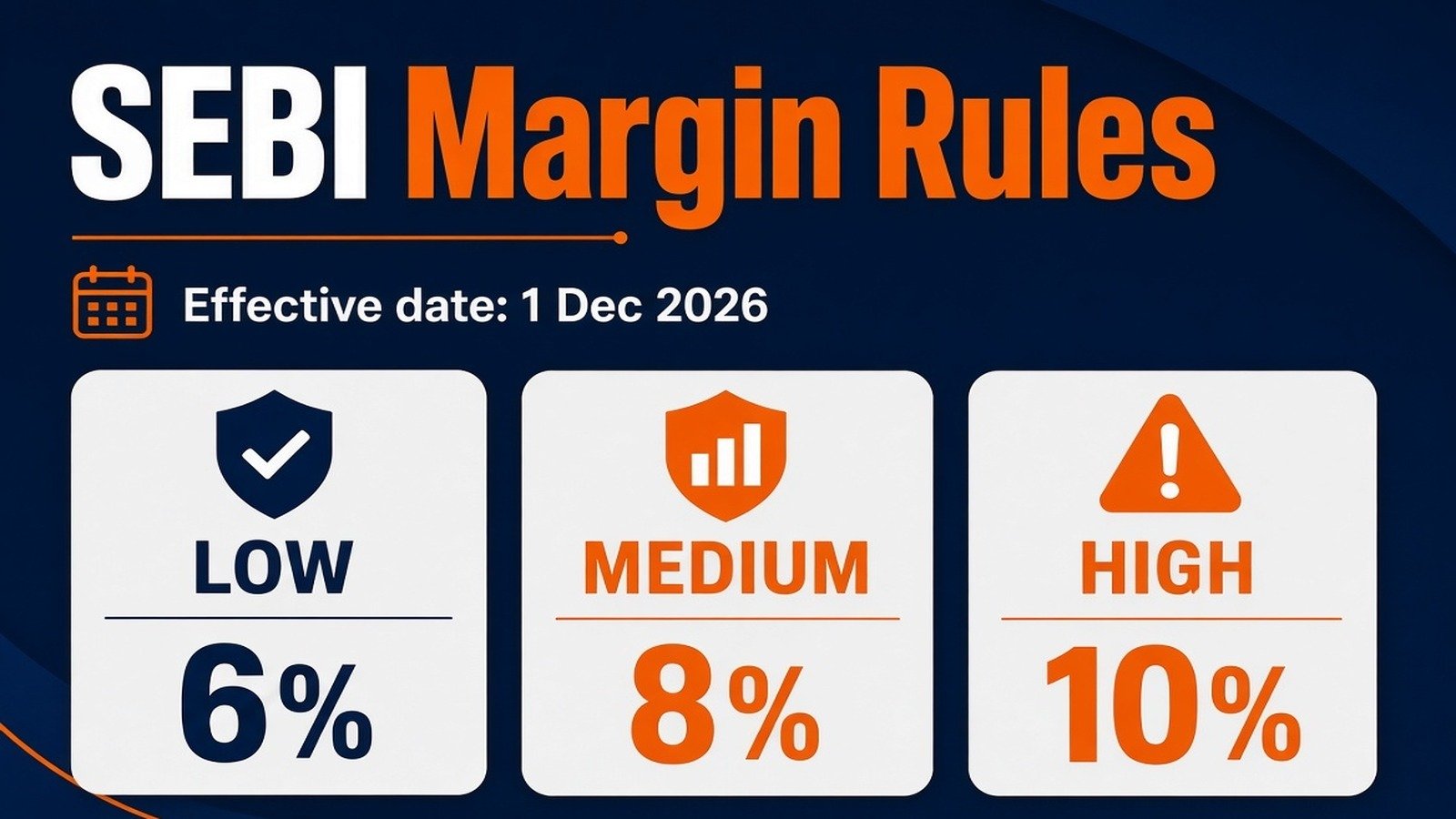
SEBI Commodity Margin Rules December 2026: From December 1, the minimum initial margin for agricultural and non-agricultural commodity derivatives is aligned at 6% (low volatility), 8% (medium) and 10% (high), with 2/2/3-day minimum MPOR. These are regulatory floors, not guaranteed broker margin quotations.
Updated: November 22, 2026 | Effective from December 1, 2026
SEBI commodity margin rules 2026: the direct answer
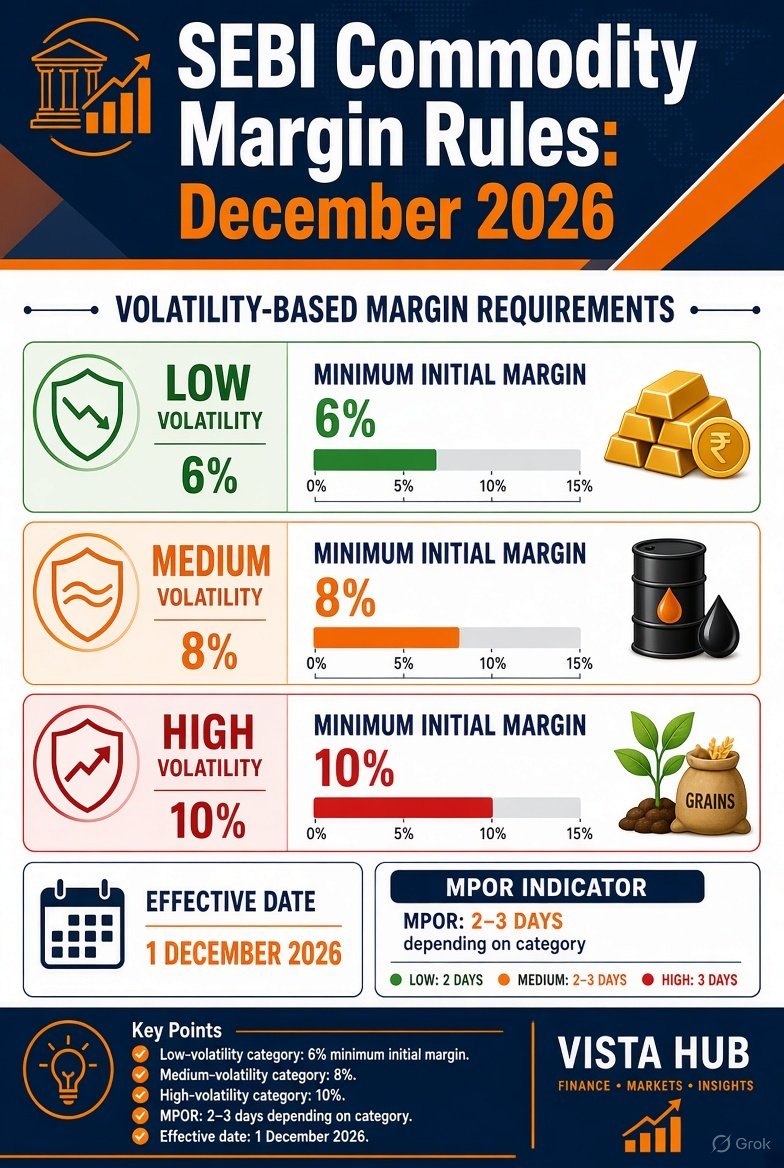
On 17 November 2026, the Securities and Exchange Board of India (SEBI) issued a circular revising minimum initial-margin floors and the minimum Margin Period of Risk (MPOR) in exchange-traded commodity derivatives. Starting 1 December 2026, both agricultural (agri) and non-agricultural commodity contracts use the same minimum margin according to volatility category: 6% for low, 8% for medium and 10% for high. The respective minimum MPOR values are two, two and three days.
The regulatory change is not a promise that every trader’s broker margin will fall to exactly 6%, 8% or 10%. It establishes minimum floors to be implemented by recognised clearing corporations. Actual exchange, clearing-member and broker requirements may be higher because margin methodology includes additional risk elements. The circular itself gives a future effective date and applies for one year from its issue date, with a possibility of extension by another SEBI circular.
The official SEBI circular dated November 17: what changed?
The official document carries circular number HO/47/16/14(3)2026-MRD-POD1/I/25885/2026 and the subject ‘Review of Margin Framework for Commodity Derivatives Segment’. It revises paragraph 9.1.3.I.a(iv) of Chapter 9 in SEBI’s commodity derivatives master circular dated August 4, 2023. The revision followed industry representations and recommendations from a working group reviewing agricultural commodity-derivatives rules and the Risk Management Review Committee.
SEBI’s table gives the same minimum initial-margin percentages for agri and non-agri commodities within each volatility bucket. That alignment is the central regulatory development. Earlier, agricultural derivatives faced higher prescribed minimum floors in the corresponding low, medium and high categories. The revision is meant to reduce that disparity without removing margin-based safeguards. Trading members must still follow applicable clearing-corporation instructions.
New 6%, 8%, 10% margin chart: low, medium and high volatility
The circular’s minimum initial margin table is straightforward. Low volatility: 6% agri and 6% non-agri, with minimum MPOR of two days for both. Medium volatility: 8% and 8%, with minimum MPOR of two days. High volatility: 10% and 10%, with minimum MPOR of three days. Volatility category is not merely a trader’s personal opinion that one commodity ‘feels safe’. It is determined within the framework used by the exchange and clearing corporation.
This is the new regulatory floor rather than a real-time quote for any specific gold, silver, crude oil, natural gas or agricultural contract. Commodity futures and options may also attract other components including risk-based SPAN parameters, short option minimum margin where applicable, additional margin or broker buffers. Before entering a position, consult the current contract-wise margin report, not an infographic alone.
How agricultural commodity margins change from the earlier framework
In the immediately preceding framework, agriculture-related minimum initial margin floors for low, medium and high volatility were broadly 8%, 10% and 12% respectively. Under the December 1 alignment they become 6%, 8% and 10%. That means an across-category reduction of two percentage points in the regulatory agricultural minimum, not a universal two percent reduction in the final amount every trader pays.
For example, suppose an agri futures contract has a notional value of ₹1,00,000 and is classified in a low-volatility category. The previous 8% floor would be ₹8,000; the new 6% floor is ₹6,000. This hypothetical ₹2,000 difference illustrates only the SEBI floor. The actual upfront broker requirement can remain above ₹6,000. It also assumes the contract remains in the same category, which must be checked against current exchange notices.
The revised minimum MPOR also aligns agricultural risk assumptions with the corresponding non-agri category. That does not mean harvest risks, delivery, rainfall or weather events vanish. Clearing and exchanges can still impose protections when volatility, concentration or liquidity conditions require them.
What does Minimum Initial Margin (IM) mean?
A futures contract represents a much larger notional value than the cash deposited by a trader. Minimum Initial Margin is the required risk deposit intended to cushion adverse price movements and help protect the clearing system against default. For instance, at a 10% regulatory minimum on a hypothetical ₹2,00,000 contract, the basic minimum IM is ₹20,000 before any additional charges or margins.
The percentage is applied to a contract-value calculation prescribed by the relevant clearing infrastructure. It is not a fee taken away as profit, interest paid to the exchange or a loss limit. When a position is closed, margin treatment depends on realised profit or loss, outstanding obligations, settlement and the broker’s rules. If prices move sharply, the user may be asked for extra funds even after initially meeting the required amount.
A smaller floor increases the potential leverage associated with a contract, so retail traders need to treat lower margins as a risk-management issue, not free purchasing power. High leverage can magnify losses quickly. Never infer from a 6% initial-margin requirement that the maximum loss is 6%.
MPOR explained: why two days or three days matter
MPOR stands for Margin Period of Risk. In a derivatives-clearing context, it approximates the time risk managers need to account for exposure following a default, including close-out or replacement of a position under stressed market conditions. The regulatory parameter can influence how clearing systems quantify price shocks and determine margin; it is not a permission slip to hold a position for only that many days.
Under the new December framework, minimum MPOR is two days in the low- and medium-volatility groups and three days in the high-volatility group, the same for agri and non-agri commodities. A low-volatility category is not risk-free; two days simply reflects the prescribed minimum parameter. A trader can keep a contract position longer if contract rules allow and must keep meeting applicable margins every trading day.
If an investor sees ‘MPOR 2’ in a circular, it should not be confused with a T+2 settlement promise or an obligation to square off after forty-eight hours. Actual trading sessions, holiday calendars and delivery requirements are separate from the risk-model horizon.
SEBI December 1 start date and one-year validity: timeline
The SEBI circular was issued on Tuesday, November 17, 2026. It specifies that the new rules come into force on Tuesday, December 1, 2026. It also says the circular is applicable for one year from the date of issuance, with an option for SEBI to extend that period through a separate circular. The issue date and effective date are therefore not interchangeable.
For traders reading this article on November 22, 2026, the revised minima are upcoming, rather than already in force. Brokers and exchanges may communicate updated risk files, contract tables and capital requirements before the effective date. An operational transition can include exchange communications and platform changes, so traders should verify the live requirement shown by their broker once the rule begins.
If you read the guide after 2026, check subsequent SEBI or clearing-corporation notices to confirm whether the one-year period has been extended, superseded or replaced. A circular issued in November is not a guarantee that rates remain the same indefinitely.
Which commodities are affected: gold, crude oil and agricultural futures
The change is written for recognised clearing corporations that operate a commodity derivatives segment. It is not a special margin discount only for gold or only for agricultural crops. The two key axes in SEBI’s new table are agri versus non-agri and low/medium/high volatility. Categories and contract-wise implementation are determined by the relevant clearing ecosystem, not by an article title.
Precious metals, energy contracts and agricultural derivatives can all have different price-volatility characteristics, liquidity and margin add-ons. Gold and crude oil should not be placed in the same category by assumption, and one commodity can have a different risk profile in the future. Before buying or selling, consult the current MCX, NCDEX, NSE or other relevant exchange and clearing corporation’s own margin files.
For a trader checking ‘SEBI new margin for gold 2026’ or ‘crude oil margin after December 1’, the correct answer requires the current contract-specific applicable margin and volatility bucket. The generic regulatory table alone cannot give a reliable number of rupees for an individual lot.
Margin calculator examples: ₹1 lakh and ₹5 lakh contracts
For learning purposes, take a hypothetical contract notional value of ₹1,00,000. The regulatory base floors would be ₹6,000 for low volatility, ₹8,000 for medium and ₹10,000 for high. For a hypothetical ₹5,00,000 value, the corresponding base floor calculations are ₹30,000, ₹40,000 and ₹50,000. These are simple multiplication examples and nothing more.
Actual order margins may not equal these values. A broker could ask for additional risk cover, contract-specific variation, exposure margins or event-based limits. A position involving options can have very different risk from a plain long futures contract, while selling options may demand additional upfront margin. Some positions also involve delivery-period charges.
A responsible comparison looks at the whole required funds figure on the order screen, the worst-case price moves that the trader can afford, and the maintenance or top-up requirements. One cannot use the 6% base floor to promise that a ₹1 lakh futures trade is always executable with ₹6,000 cash.
Will the 2026 SEBI change increase leverage for retail traders?
When a minimum margin floor is reduced while contract notional stays constant, the mathematical leverage implied by that floor goes up: a 6% margin corresponds to roughly 16.7 times notional-to-margin, while 8% corresponds to 12.5 times and 10% to 10 times. These ratios are not broker-authorised leverage offers. They simply illustrate why relying only on the minimum percentage can understate risk.
Actual market access depends on collateral eligibility, client agreements, broker RMS controls, exchange and clearing corporation rules and any daily volatility-driven recalibration. A steep adverse move or gap after a holiday can cause losses exceeding the initial margin deposit. Professional risk management uses position sizing, liquidity checks and predefined exit plans in addition to regulatory deposits.
Investors should avoid headlines claiming that SEBI has ‘made commodity trading 40% cheaper for everyone’. The scheme does not eliminate exchange transaction costs, taxes or the price risk in underlying commodities. It changes minimum margin assumptions in a specified derivatives segment.
How do MPOR and other SPAN or additional margins interact?
Many derivatives brokers show a composite funds requirement on the trading screen. It can incorporate SPAN/risk-array calculations, minimum initial-margin floors, short-option minimum margin, delivery or exposure-related safeguards and special additional margins during volatility events. The SEBI circular changes a specific minimum component in the wider risk-management framework.
Suppose the minimum is ₹8,000 but the clearing system’s current risk calculation requires ₹11,000. A trader generally cannot insist on opening the position with ₹8,000 solely because a chart said ‘medium volatility = 8%’. Conversely, if a regulator reduces the floor, the overall requirement might fall only when that floor was the binding component. Whether it becomes cheaper depends on the actual margin methodology on the day.
This is why a change in a published regulatory floor does not translate into a guaranteed reduction in every broker’s app. If figures differ between a broker’s calculator and an old article, check the current exchange-clearing RPF or margin file, not a cropped social media table.
What should MCX and NCDEX traders do before December 1?
Check the exchange and clearing-corporation circular applicable to your contracts. Identify whether the underlying is agricultural or non-agricultural and review the assigned volatility bucket. Read your broker’s announcements for the new December margin methodology, especially if you hold open positions through the transition.
Next, inspect the live margin calculator for the specific lot size, side of trade, delivery status and product type. Keep a cash buffer rather than deploying every available rupee because a new 6% or 8% figure appears in a chart. Review stop-loss and overnight risk policies, keeping in mind that orders may gap through a desired exit price.
Lastly, if a platform posts a surprising increase rather than a decrease, check whether volatility category, SPAN, delivery or additional risk charges changed. A regulatory reduction in one parameter and an increase in another can occur together. For disputes, ask the broker for the exact exchange or clearing-corporation calculation used.
Future search questions: new SEBI commodity margin December 2026
Likely follow-up queries include ‘SEBI commodity margin 1 December circular PDF’, ‘MCX gold margin from December 2026’, ‘NCDEX agri margin 6 percent’, ‘SEBI MPOR 2 day versus 3 day’, ‘initial margin 6 8 10 chart’, ‘SEBI commodity margin calculator’ and ‘why broker margin did not fall after SEBI change’. These are useful anticipated search intents, not measured search volumes.
To answer a specific question later, a reader needs the exchange, underlying commodity, active contract, expiry, position type, volatility class and date. Without these details, a fixed rupee margin quote is speculation. The official circular is authoritative for the minimum floors, while the current clearing-corporation file governs actionable contract parameters.
SEBI Commodity Margin FAQs
What is the new SEBI margin for commodity derivatives from December 1, 2026?
Minimum initial-margin floors are 6% for low-volatility, 8% for medium-volatility and 10% for high-volatility contracts for both agri and non-agri categories.
Does every MCX or NCDEX contract require only 6%?
No. The percentage depends on the assigned volatility category, and actual exchange or broker risk margins may be higher.
What is MPOR under the December 2026 circular?
Minimum MPOR is two days for low and medium volatility, and three days for high volatility, for agri and non-agri.
When was the SEBI circular issued?
November 17, 2026; its stated effective date is December 1, 2026.
How long is the new margin framework valid?
The circular says one year from its issue date, subject to extension by a separate SEBI circular.
Does lower initial margin mean losses cannot exceed 6%?
No. Margin is a risk deposit, not a stop-loss or maximum loss guarantee. Leveraged losses can exceed the initial deposit.
Conclusion and original SEBI circular
The new 6/8/10% values are regulatory minimums—not full position margins. Always check contract-specific exchange risk files and broker requirements before entering derivatives positions.
- SEBI Official Circular, November 17, 2026 (PDF)
- SEBI Circulars — Review of Margin Framework (2026)
- SEBI Master Circular for Commodity Derivatives, August 4, 2023 (PDF)
Disclaimer: Educational and regulatory information, not trading or investment advice. Derivatives are high risk and losses can exceed initial margin.
























Share Your Opinion
Comments are closed on this post.