 Vista
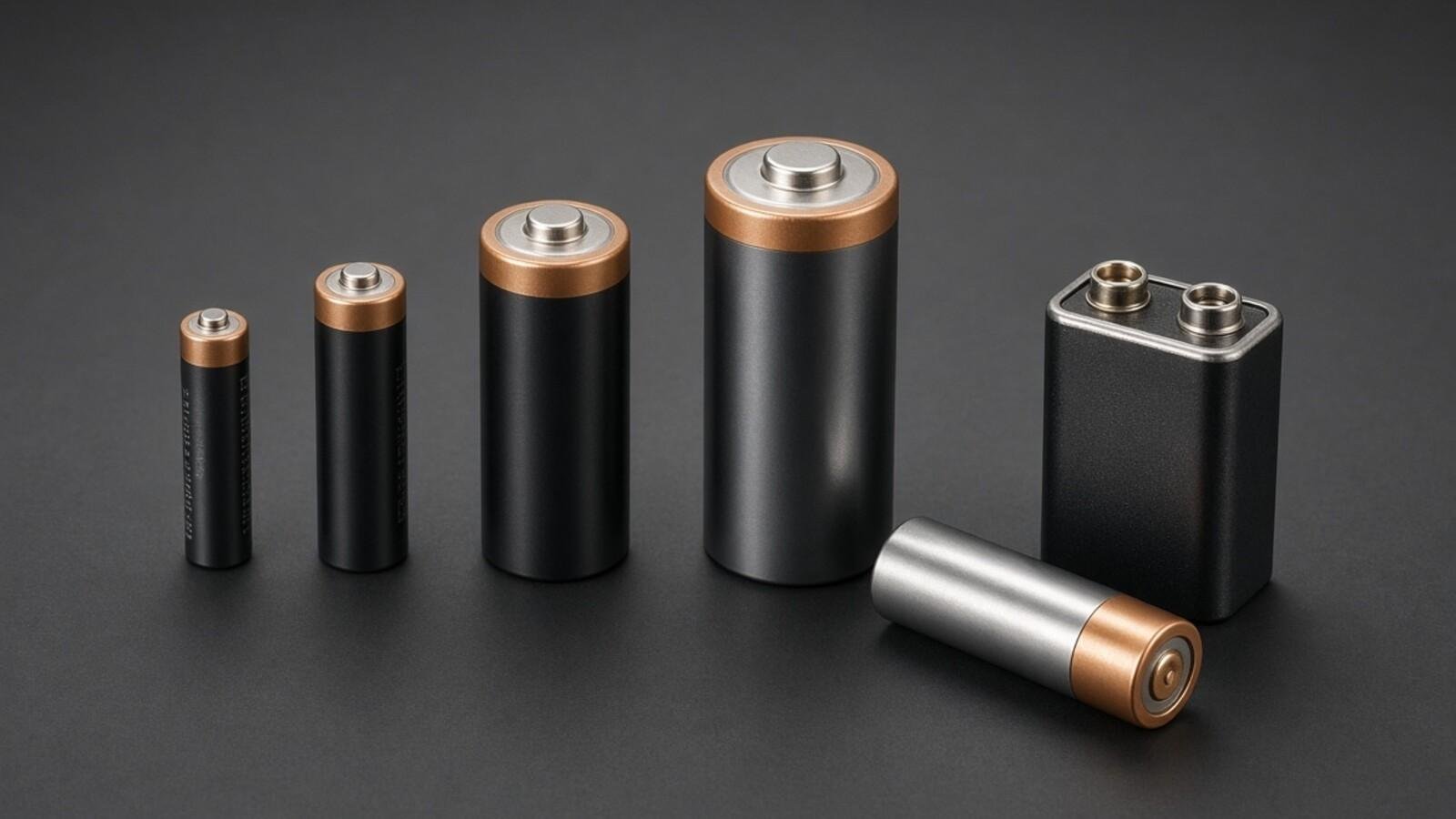
Quick answer: AA, AAA, C, D, rectangular 9V, 18650 and CR2032 batteries have different shapes, voltages, chemistries and safe uses. An AA alkaline cell is commonly nominal 1.5 V, whereas an AA NiMH rechargeable is around 1.2 V; a rechargeable 18650 lithium-ion cell is typically about 3.6–3.7 V and a CR2032 coin cell is 3 V primary lithium. Matching physical size does not guarantee electrical interchangeability.
Updated: 21 November 2026.
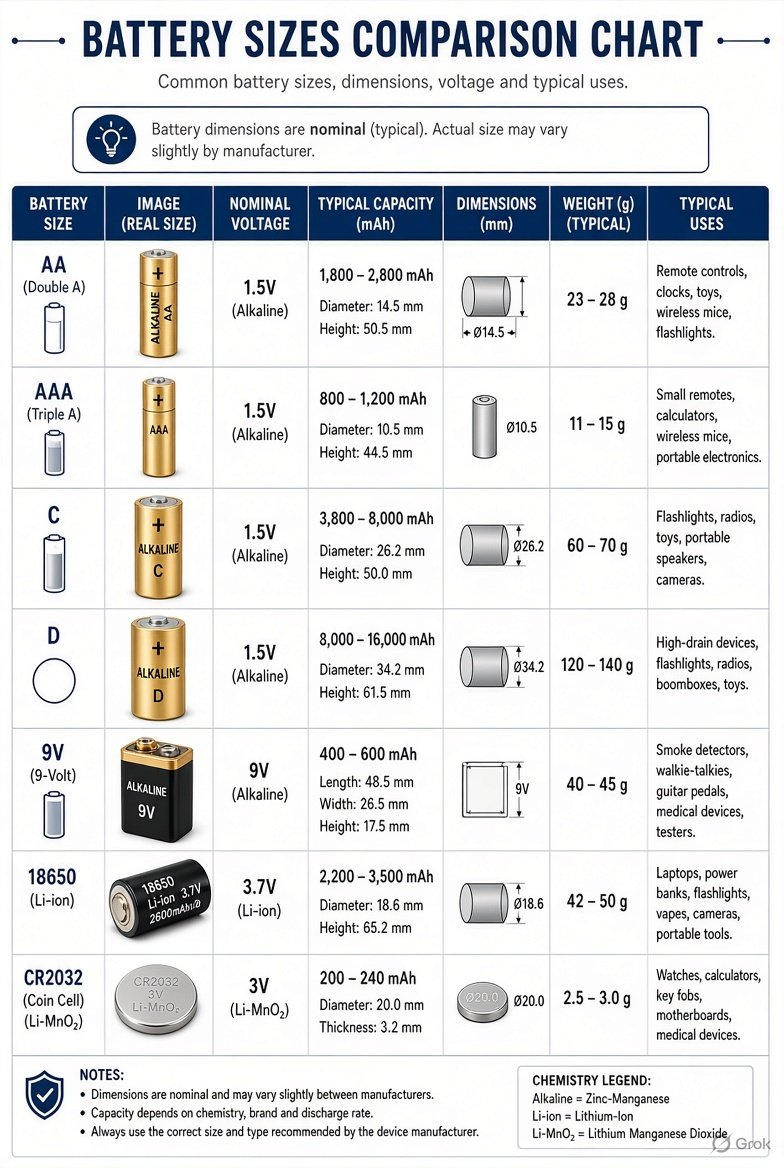
Battery size and voltage comparison table
| Battery | Typical dimensions | Common nominal voltage | Typical use |
|---|---|---|---|
| AAA | ≈10.5 × 44.5 mm | Alkaline ≈1.5 V; NiMH ≈1.2 V | Remote controls, small electronics |
| AA | ≈14.5 × 50.5 mm | Alkaline ≈1.5 V; NiMH ≈1.2 V | Toys, flashlights, controls |
| C | ≈26.2 × 50 mm | Alkaline ≈1.5 V (typical) | Larger portable devices |
| D | ≈34.2 × 61.5 mm | Alkaline ≈1.5 V (typical) | Lanterns, large devices |
| 9V rectangular | ≈26.5 × 17.5 × 48.5 mm | Alkaline ≈9 V; rechargeable variants differ | Smoke alarms and meters, if approved |
| 18650 lithium-ion | Nominal class ≈18 × 65 mm | Typically ≈3.6–3.7 V rechargeable | Manufacturer-designed battery packs |
| CR2032 coin | 20 × 3.2 mm | 3 V primary lithium | Remotes, scales, sensors |
Dimensions are approximate nominal form factors; product construction and terminals can vary.
Battery sizes versus battery chemistry: two different questions
A battery-size designation mostly helps identify its physical format and terminal arrangement, while chemistry affects nominal voltage, charging behaviour, temperature limits and permitted applications. An alkaline AA and a NiMH AA can fit the same compartment but have different voltage profiles. A lithium-ion cell may resemble an AA-sized cylinder yet deliver far higher voltage. Therefore a chart must never suggest that a battery with roughly matching dimensions is automatically a safe replacement.
Before purchasing, check the equipment’s original battery compartment, user manual, chemistry designation, voltage and polarity. Read the full label of any rechargeable product. Some common rechargeable technologies use special chargers; charging an alkaline or non-rechargeable primary lithium cell in an incompatible charger can create serious hazards. The device manufacturer is the correct authority for supported replacements. Size charts are best used for identification, not overriding a device’s specifications.
AAA and AA battery dimensions and uses
AAA is a slender cylindrical battery of roughly 10.5 mm diameter and 44.5 mm length. AA is wider and longer at approximately 14.5 mm by 50.5 mm. Both formats are popular in consumer devices, but they cannot fit interchangeably without a specifically approved adapter or device design. A remote control designed for AAA cells should not be modified to take AA simply because both use 1.5 V alkaline chemistry.
Size standards have tolerances, so measured batteries from different brands may vary a little. Raised positive terminals and spring contacts can affect fit. The actual mass and available capacity also depend on chemistry. A larger AA cell often stores more energy than a comparable AAA product of the same chemistry, but the real runtime depends on load, temperature and device efficiency. Avoid giving one fixed mAh value for every AA or AAA; manufacturer datasheets provide the relevant information.
C and D batteries: larger cylinders, not always more volts
C-size cells are commonly around 26.2 mm in diameter and 50 mm in length, while D cells are approximately 34.2 mm in diameter and 61.5 mm long. Many disposable alkaline versions still provide about 1.5 V nominally. Their larger physical volume often suits devices requiring more stored energy or longer operating time, such as lanterns and some large portable products. The benefit is not a universal increase in nominal voltage.
A C-to-D size spacer may be offered for certain rechargeable batteries, but a spacer does not upgrade the cell’s capacity or make an incompatible charger or device safe. A manufacturer-approved adapter and correct terminal contact are essential. Long-running loads may expose small cells to greater stress when placed in larger cases, so choose the intended battery type for the application. If a torch says D batteries, consult its instructions instead of assuming a D-shaped dummy shell over an AA cell will behave identically.
Rectangular 9V batteries: terminals and internal construction
The familiar rectangular 9V format is different from a cylindrical 1.5 V cell. It has two snap terminals and is commonly used in some smoke detectors, measurement instruments and specialized electronics where the manufacturer specifies it. Alkaline 9V batteries are often described as 9 V nominal, while rechargeable products sold in a similar housing can have a different internal chemistry and nominal output. The exact physical size and terminal arrangement must match the equipment.
Never assume that all 9V rechargeable batteries give exactly the same voltage, and never replace a safety-critical detector battery with an unapproved chemistry. Smoke-alarm manufacturers may require a specific battery type to ensure correct low-battery warnings and runtime. Also protect both 9V terminals from contact with conductive items: keys or coins can bridge the snaps and produce short-circuit heating. Keep spare 9V batteries in suitable packaging rather than loose in a toolbox.
18650 lithium-ion: size class, voltage and protected cells
The name 18650 is commonly associated with a cylindrical cell approximately 18 mm in diameter and 65 mm long. Typical rechargeable lithium-ion versions have a nominal voltage around 3.6–3.7 V and are charged according to their specific chemistry and approved electronics. A protected cell can be longer than the nominal 65 mm class, and cells differ in discharge capability, terminals and protection features. The label alone does not prove suitability.
The US Consumer Product Safety Commission warns against buying or using loose 18650 lithium-ion cells separated from battery packs. Such cells can short-circuit, overheat, go into thermal runaway or cause fires if they are used or carried improperly. Choose manufacturer-designed battery packs and approved equipment rather than salvaging cells, carrying loose cells in pockets or improvising battery holders. Do not suggest that a 3.7 V 18650 can substitute for a 1.5 V AA simply because both are cylindrical.
CR2032 coin cells: 20 mm diameter, 3.2 mm thickness
The CR2032 is a primary, non-rechargeable lithium coin cell. Panasonic lists a nominal 3 V and 20.0 mm diameter, with the familiar nominal 3.2 mm thickness reflected in its designation. These cells are used in various small electronics such as sensors, scales or remote accessories, subject to device specifications. Other coin cells can be similar in diameter while differing in thickness, chemistry or voltage.
The biggest safety concern is ingestion by children. A swallowed coin or button cell can cause severe internal injury, sometimes before obvious symptoms appear. Store cells securely and keep battery compartments closed. If ingestion is suspected, seek emergency medical attention immediately and follow local emergency or poison-centre guidance; do not wait for symptoms. The exact product and local rules matter, so do not treat a convenient CR2032 photo as evidence that another coin-cell size will fit safely.
Why voltage and polarity prevent simple substitutions
Nominal voltage describes typical electrical potential in a defined operating range, not a fixed reading at every moment. An alkaline AA cell may start above its nominal value and gradually decline under load; NiMH behaves differently. Series-connected cells add voltage, while a device using parallel or specialty arrangements has different requirements. Using an unsuitable high-voltage cell risks damaging electronics or creating heat and fire hazards.
Polarity matters as much as size. The positive end and negative end must align with the device’s markings. Never use metal foil, loose springs or improvised spacers to force a battery to fit. A charger designed for one chemistry may overcharge another. Do not mix old and new cells or different chemistries in an ordinary multi-cell device unless the manufacturer specifically permits it. For rechargeable packs, use the approved charger and protection circuit.
Cross-reference codes, capacities and choosing replacements
Battery packages may use common alternative size codes such as LR6 for an alkaline AA or LR03 for alkaline AAA, but codes and availability vary by standards and chemistry. A CR2032 is not a rechargeable LIR2032 merely because they resemble each other. An 18650 protected pack and an unprotected industrial cell can require different mechanical and electrical designs. Cross-reference tables should always be checked against manufacturer specifications rather than treated as permission for arbitrary substitutions.
Claims such as ‘all AAA cells have 1200 mAh’ or ‘all 18650 cells have 9900 mAh’ are unreliable without valid test conditions and reputable manufacturer data. Capacity depends on chemistry, discharge current, cutoff voltage, temperature and the stated rating method. For shopping, first match the exact device type, then compare certified product options and recommended performance. If you cannot verify a battery listing, choose a trustworthy supplier rather than a misleading high-capacity advertisement.
Safe storage, recycling and chart accuracy checklist
Store batteries in their protective packaging or appropriate cases, away from children, metal objects, moisture and excessive heat. Do not crush, puncture, recharge primary cells, short terminals or throw lithium cells into fire. If a cell is swollen, damaged, unusually hot or leaking, follow manufacturer and local hazardous-waste guidance rather than using it. Dispose of used batteries through an authorised battery collection or recycling system as required locally.
An image-comparison chart can show relative silhouettes, but its scale may not be truly 1:1. The reliable specifications are the written dimensions and device instructions. Pay attention to 9V snap terminals, the much higher voltage of 18650 lithium-ion, and the swallow hazard of CR2032 coins. If the artwork appears to label a lithium cell as 1.5 V or a CR2032 as rechargeable, the label is wrong and the article’s verified text should take precedence until the image is corrected.
Frequently asked questions
Are AA and AAA the same voltage?
Many alkaline versions are both about 1.5 V nominal, despite their different physical sizes.
Can an 18650 replace an AA battery?
No, not as a simple swap: typical lithium-ion 18650 voltage is around 3.6–3.7 V and use requires suitable device design.
Is CR2032 rechargeable?
A conventional CR2032 is a 3 V primary lithium cell and is not rechargeable.
Does a D-size alkaline battery provide more voltage than an AA?
Usually no: both typically have about 1.5 V nominal output, though size and available energy differ.
Can button battery ingestion wait until symptoms appear?
No. Suspected swallowing requires immediate emergency medical care.
Conclusion
Size is only one battery attribute. Voltage, chemistry, terminal design, charging safety and the device’s exact specifications are equally important.
Sources
- Energizer — Battery comparison and sizes
- Panasonic — NiMH versus alkaline voltages
- Panasonic — CR2032 specifications
- US CPSC — Warning on loose 18650 lithium-ion cells
- Health Canada — Coin battery ingestion risk
Battery safety: mismatched cells, shorts and accidental coin-cell ingestion can cause serious injury.




















Share Your Opinion
Comments are closed on this post.