 Vista

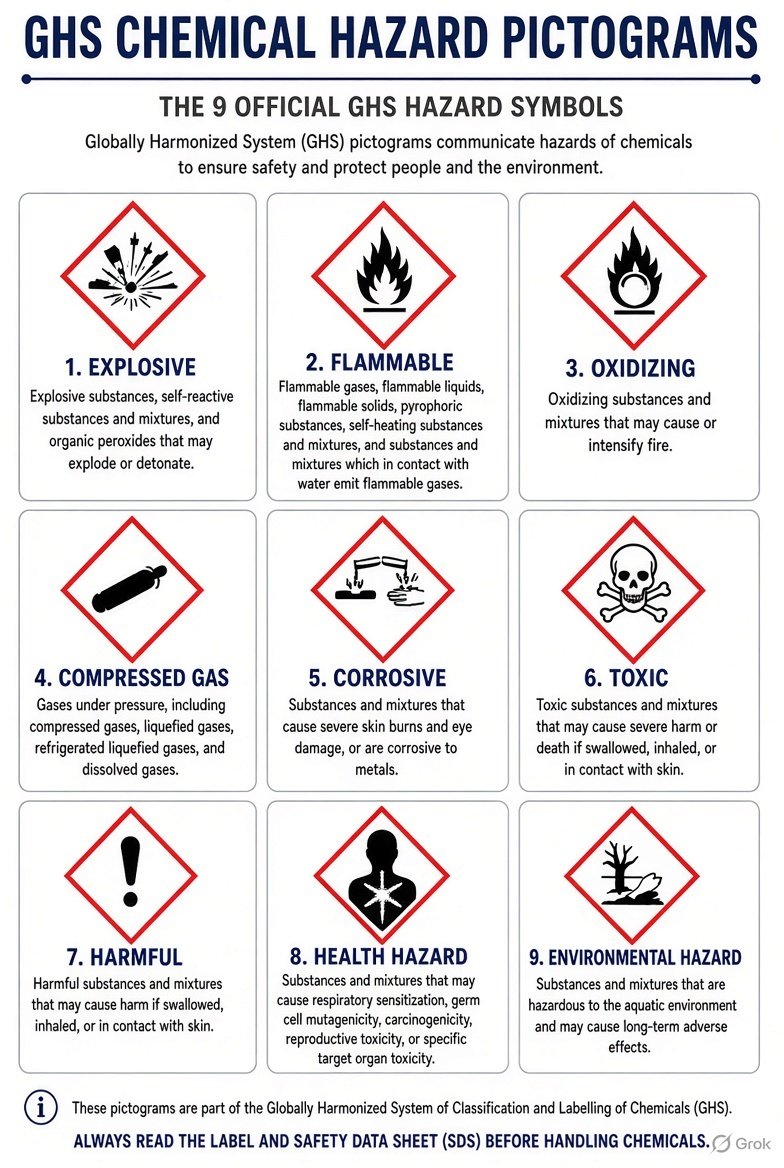
Quick answer: The Globally Harmonized System (GHS) uses nine red-diamond hazard pictograms to communicate categories of chemical danger: exploding bomb, flame, flame over circle, gas cylinder, corrosion, skull and crossbones, exclamation mark, health hazard and environment. A pictogram identifies a class of concern, not the complete safe-handling instructions for an unknown chemical. Read the product label and Safety Data Sheet (SDS) before using any hazardous material.
Updated: 21 November 2026.
All nine GHS pictograms at a glance
| Code | Pictogram | Typical meaning |
|---|---|---|
| GHS01 | Exploding bomb | Explosive hazards |
| GHS02 | Flame | Flammable and related fire hazards |
| GHS03 | Flame over circle | Oxidizers |
| GHS04 | Gas cylinder | Gases under pressure |
| GHS05 | Corrosion | Skin/eye damage; metal corrosion |
| GHS06 | Skull and crossbones | Acute toxicity, severe categories |
| GHS07 | Exclamation mark | Irritation, certain sensitization/toxicity |
| GHS08 | Health hazard | Certain serious/chronic health risks |
| GHS09 | Environment | Aquatic environmental hazards |
What makes a GHS pictogram official?
A GHS pictogram is a particular black graphic on a white background inside a red diamond-shaped border. The shape is a square turned onto a point, not a random warning triangle. The United Nations Economic Commission for Europe publishes the GHS framework, with its eleventh revised edition issued in 2025. Individual jurisdictions decide how the model requirements are implemented. That means the exact required content and workplace obligations can vary by country and chemical application.
An empty red diamond is not an acceptable hazard pictogram. A decorative black skull in a circle is also not the GHS06 graphic just because its message seems alarming. Labels may include signal words, hazard statements, precautionary statements, supplier information and product identifiers. Those items work alongside the pictograms and cannot all be compressed into a single icon. When preparing school posters, draw the nine recognised symbols accurately and distinguish official artwork from an AI illustration that might distort the internal graphics.
GHS01 Exploding Bomb and GHS02 Flame
GHS01, the exploding bomb, is used for certain explosive and related physical hazard classifications. The precise use depends on hazard class and category; it does not mean every object can explode from a gentle touch. GHS02, the flame, is associated with relevant flammable gases, liquids, solids and certain self-reactive or other fire-related hazards. A flame symbol warns about ignition and fire behaviour, not the exact temperature at which the substance burns.
Do not decide how to transport, mix or store an unidentified chemical solely from the symbol. An oxidizer nearby, incompatible materials and poor ventilation can change the risks. Many laboratory and industrial incidents happen because a person overlooks details beyond the pictogram. Read the official SDS Sections 2, 7 and 10 for hazard identification, handling/storage and stability/reactivity information. For a spill or fire, follow workplace emergency procedures and call trained responders; a poster cannot select a universally safe extinguisher.
GHS03 Flame over Circle and GHS04 Gas Cylinder
GHS03 shows a flame over a circle and is used for oxidizing substances in applicable classifications. Oxidizers can support or intensify a fire, even when the oxidizer itself is not a normal combustible fuel. GHS04 shows a gas cylinder for gases under pressure. A compressed, liquefied or refrigerated gas can cause pressure, rupture or very cold exposure hazards depending on the product. These symbols should not be confused with ordinary kitchen icons.
A common error is to treat GHS03 as just another copy of the flammable flame. Fire intensification from oxidizers is a distinct hazard. A cylinder label also does not tell you whether the contents are toxic, flammable, inert or oxygen-displacing; additional pictograms and text may apply. Gas cylinders should be handled using trained procedures with suitable storage, securement and compatible regulators. Do not open unknown valves or attempt improvised repairs based on an internet graphic.
GHS05 Corrosion and GHS06 Skull and Crossbones
The corrosion pictogram shows liquid affecting a hand and metal. It communicates certain serious skin corrosion or eye damage hazards and may indicate corrosivity to metals under applicable classifications. GHS06 skull and crossbones is associated with higher-severity acute toxicity categories where exposure can cause serious harm. Neither graphic is an invitation to test a substance’s strength by touching, sniffing or diluting it without protection.
Not every corrosive product behaves the same way on every surface, and not every product bearing a skull is unsafe at the same exposure route or dose. The hazard statements tell you whether contact, inhalation or swallowing is relevant. Never taste, smell intentionally or mix unknown chemicals for identification. If exposure occurs, follow the current label and SDS first-aid steps and seek medical help or poison-center advice as appropriate. Chemical gloves and goggles have product-specific compatibility limits; an icon alone cannot choose the right protective material.
GHS07 Exclamation Mark and GHS08 Health Hazard silhouette
The exclamation-mark pictogram often communicates less severe acute toxicity categories, skin or eye irritation, skin sensitization or certain other listed hazards. GHS08 is the person silhouette with a star-like mark on the chest, used for important longer-term or serious health hazards such as certain carcinogenicity, reproductive toxicity, respiratory sensitization, specific target-organ toxicity or aspiration hazards, depending on classification. These two pictograms are distinct despite both involving health.
GHS08 does not mean that every labelled substance causes cancer; the individual hazard class and statement determine the meaning. Likewise, the exclamation mark does not always imply a harmless mild irritant. Do not substitute one pictogram for another from memory, and be aware that precedence rules sometimes affect which pictograms appear together. For workplace decisions, review the substance-specific SDS Section 2 and exposure-control information in Section 8 instead of diagnosing risk from the picture alone.
GHS09 Environment: aquatic toxicity and the US OSHA exception
The environmental symbol shows a dead tree and fish. It is used for specified hazards to aquatic environments, including some acute or chronic aquatic toxicity classifications. It is part of the full set of nine GHS pictograms. However, the US OSHA Hazard Communication Standard generally mandates eight of the nine; the environmental pictogram is not mandatory within OSHA’s workplace hazard jurisdiction because environmental hazards fall outside that agency’s scope. This difference is often missed in simplified safety quizzes.
The fact that GHS09 may not be required on a particular US OSHA workplace label does not mean that disposal into a drain is safe. Environmental protection, chemical waste and transport requirements can come from other applicable laws. For a school chart covering the global GHS system, show all nine pictograms with the relevant qualification. For formal US compliance, check OSHA’s latest standard and applicable environmental agencies. Regional implementation in India or elsewhere should not be guessed from a US poster.
GHS labels versus transport diamonds and safety signs
A red-framed GHS diamond on a chemical container is not the same coding system as the coloured transport placards used for dangerous goods shipments. Transport labels may use particular hazard classes, numbers and colour schemes; GHS supply labels use the standardized workplace or consumer chemical hazard pictograms. ISO safety signs such as a yellow warning triangle also serve a different purpose. An infographic mixing these systems without headers can confuse a reader attempting to identify a package.
When moving chemicals from a supplier package into another authorised container, workplace labelling requirements may apply. Do not invent a ‘safe’ substitute label using a generic skull emoji. The original product identifier, SDS access and site procedures should guide the label. If a chart’s graphic has changed proportions, check it against UNECE’s official pictogram page. Safety artwork deserves more accuracy than decorative illustrations because workers may recognise an emergency hazard from a tiny image.
SDS, H-statements and a practical chemical-safety checklist
Start by identifying the chemical product and its exact concentration or mixture. Then find the SDS from the manufacturer or authorised supplier. Section 2 provides hazard classification, pictograms and statements; Section 4 covers first aid, Section 5 firefighting, Section 6 accidental release, Section 7 handling and storage, Section 8 exposure control and protective equipment, and Section 10 chemical stability. Other sections cover transport, disposal and ecological context. SDS availability and exact structure depend on jurisdiction.
Before using a new product, review compatibility, ventilation, spill response, eye protection and safe disposal under trained procedures. Keep chemicals in properly labelled containers and never use drinks bottles for hazardous substances. For a classroom exercise, use printed pictograms and harmless demonstration materials rather than actual corrosives or flammables. A well-designed GHS chart should promote recognition and the habit of checking hazard statements—not provide instructions to mix hazardous substances or make unsupported claims about a chemical’s toxicity.
Frequently asked questions
How many GHS hazard pictograms are there?
Nine in the full UN GHS set, GHS01 through GHS09.
Why does OSHA often say eight pictograms?
The environmental pictogram is not mandatory under the US OSHA workplace hazard-communication rule.
What does the GHS08 health-hazard silhouette mean?
Several serious or longer-term health hazard classifications may use it; read the individual hazard statements.
Are GHS diamond labels the same as transport placards?
No. Transport dangerous-goods labels use separate conventions and rules.
Is a pictogram enough to handle a chemical safely?
No. Read the current label, SDS and appropriate workplace safety procedures.
Conclusion
GHS pictograms provide an important first alert, but safe handling, exposure control and disposal depend on full product information and the applicable local rules.
Sources
- UNECE — GHS Rev.11 (2025)
- UNECE — Official GHS Labels
- US OSHA — Hazard Communication Pictograms FAQ
- US OSHA — Hazard Communication Appendix C
Safety: do not mix unknown chemicals or handle spills without suitable training and procedures.


















Share Your Opinion
Comments are closed on this post.