 Vista
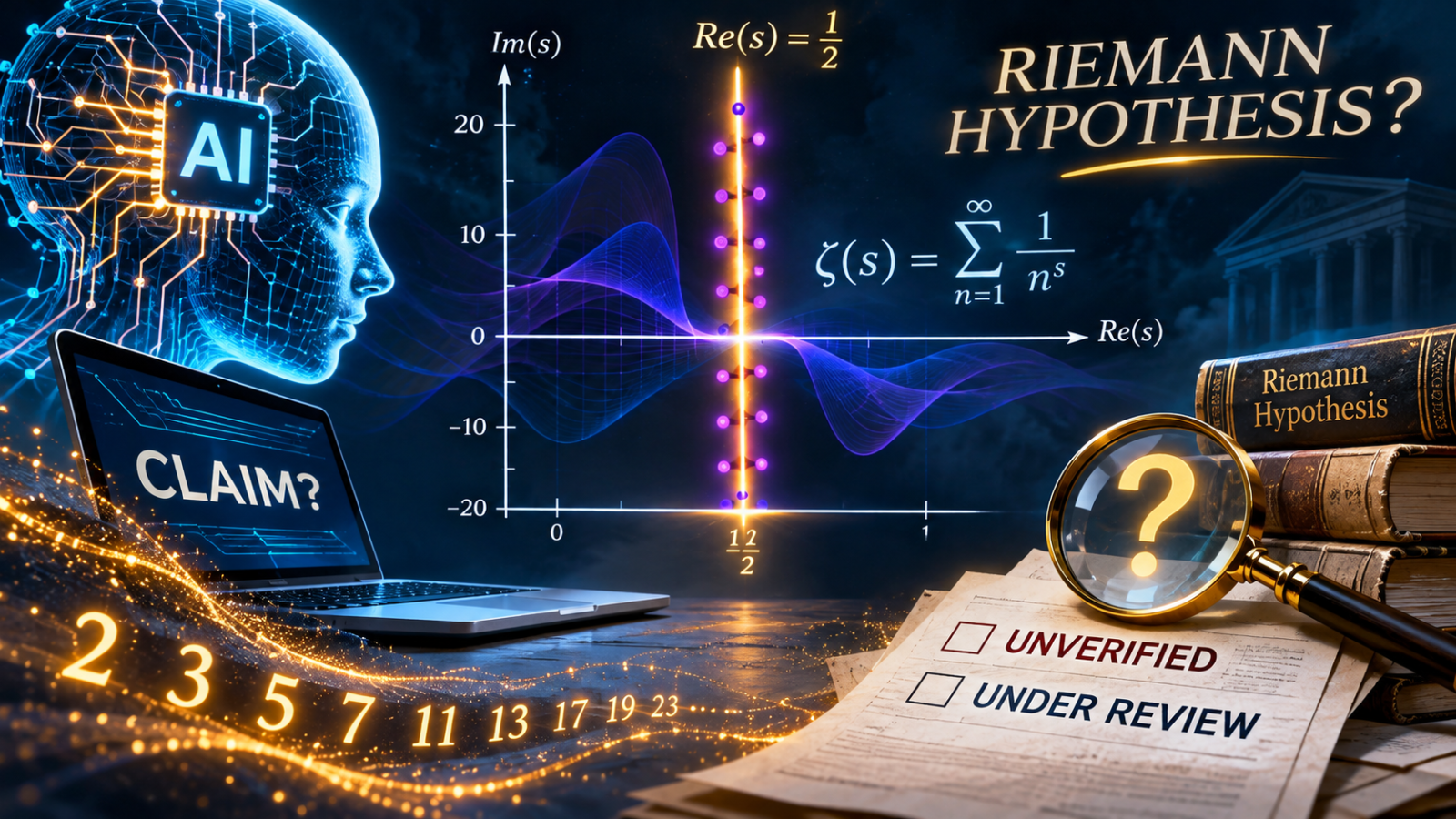
Has Claude solved the Riemann Hypothesis? Not in the sense of an independently accepted mathematical discovery. On 20 November 2026, Anthropic mathematician Levent Alpöge said he believed that work with the AI system Claude had produced a proof of the 167-year-old Riemann Hypothesis, and he also described a broader claim involving its generalized version. The announcement is significant, but a posted claim and formal code are not the same thing as an established theorem. As of this update on 21 November, outside mathematical verification and general acceptance remain pending.
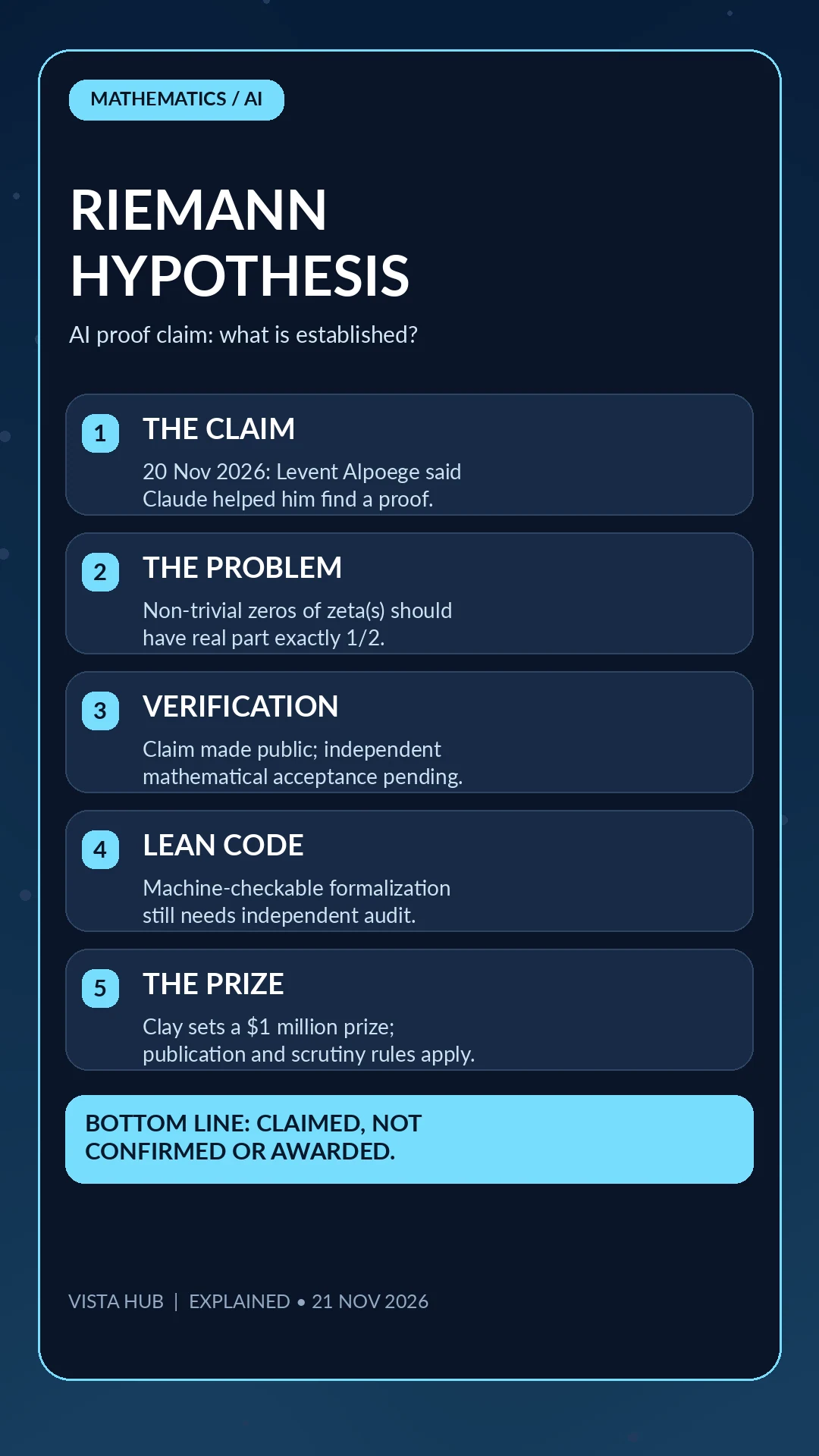
What exactly happened on 20 November 2026?
Alpöge, a mathematician working at Anthropic, publicly described research he had pursued with Claude. Major science outlets reported a short note and a substantial formalization effort written in Lean, a software-based proof assistant. Some news headlines made the event sound like mathematics had already settled the question. That is ahead of the evidence. The accurate headline is that a mathematician claims a Claude-assisted solution and has invited scrutiny.
Three events should be separated. First, someone makes a mathematical statement, for example that a certain conjecture holds. Second, someone constructs an argument that purports to show why the statement must hold. Third, mathematicians independently check every premise and deduction, resolve ambiguities, reproduce the argument and accept it as correct. The third step is the one readers should watch. A press report is evidence that the claim was made; it is not evidence that the theorem has been proved.
Riemann Hypothesis explained simply: what does it say?
The Riemann Hypothesis concerns the Riemann zeta function, usually written as ζ(s). One expression for the function is a sum involving the reciprocals of positive integers raised to a complex power, in the region where that series converges. Mathematicians extend the function beyond that region using analytic continuation. Its special values and its zeros reveal surprisingly deep information about prime numbers.
A prime number has exactly two positive divisors: 1 and itself. Examples include 2, 3, 5, 7 and 11. Prime numbers do not appear in a simple repeating pattern, but they are not completely without mathematical structure. The Prime Number Theorem provides an approximate count of how many primes lie below a very large number. The Riemann Hypothesis would substantially sharpen what we can say about the error in that approximation.
The conjecture says that every non-trivial zero of ζ(s) has real part equal to one-half. Imagine a graph of complex numbers with real and imaginary coordinates. The hypothesis says that all the relevant zeros sit on one particular vertical line: Re(s) = 1/2, known as the critical line. This does not mean every number on that line is a zero. It means every non-trivial zero lies there.
Why have mathematicians struggled with it since 1859?
Bernhard Riemann stated the hypothesis in 1859. Testing individual zeros is possible, and an enormous number have been checked, but an infinite mathematical assertion cannot generally be established by checking any finite list. You need a logically complete argument that rules out every possible counterexample, including ones beyond the reach of computers. That distinction between a trillion successful checks and a proof is central to this story.
The conjecture touches analytic number theory, the behaviour of L-functions and methods used to understand the distribution of prime numbers. Dozens of important conditional results take the form ‘if the Riemann Hypothesis is true, then…’ A correct proof would convert some conditional statements into unconditional mathematics. It would not, by itself, reveal a magic formula for every prime number, end all mathematical uncertainty or prove that today’s digital encryption is suddenly broken.
Claude Riemann Hypothesis proof: what role did AI actually play?
According to Alpöge’s account, Claude assisted with parts of the mathematical research. Large language models can propose lemmas, search for related ideas, help translate mathematics into formal notation and accelerate the repetitive work surrounding verification. They can also fabricate citations, quietly change assumptions or produce persuasive-looking gaps. That is why the role of Claude matters but does not settle the validity of the proof.
We also need to distinguish the claims of the researcher from corporate statements. Alpöge works for Anthropic, but that alone does not mean that Anthropic has formally certified the proposed solution or that an independent review board has endorsed it. The model’s name makes the story accessible to a general audience; the decisive question remains whether the mathematics stands on its own when checked by other experts.
Is the claimed Lean proof verified? Three checks that matter
Check one: does the formal statement express the actual theorem? A computer can confirm a logically valid derivation of a weaker or differently worded statement without settling the Riemann Hypothesis. The assumptions, imported lemmas and definition of the goal must be inspected carefully. In particular, ‘Lean accepted the file’ is not automatically equivalent to ‘the world’s mathematicians have accepted the Riemann Hypothesis as solved.’
Check two: can independent researchers reproduce the result? Researchers need the exact code, compatible software versions and a documented way to rebuild the output. They should verify that no unchecked assertions, placeholder shortcuts or unintended axioms slipped into the proof environment. A public repository can be a useful starting point, but what counts is scrutiny from independent qualified experts.
Check three: can the argument be explained and evaluated mathematically? Even a valid machine-checked proof of the right statement should be examined for its mathematical content. Researchers want a comprehensible account of the central new ideas and a precise map of dependencies. That is how the field determines what has actually been established and which techniques can be reused elsewhere.
Claude Riemann Hypothesis proof verified: what would count as confirmation?
Real confirmation would involve a publicly available complete proof, independent technical and mathematical examination, resolution of any reported objections and broad acceptance by specialists. Formal proof assistants may make some stages quicker or more auditable, but they do not replace the need to understand exactly what is being certified. Readers should expect careful, sometimes slow verification rather than a single dramatic social-media announcement.
It is also possible for a claimed breakthrough to be revised. A researcher may correct a gap, narrow the claim, introduce a new hypothesis or withdraw an argument. That would not make AI useless for mathematics. A system can help generate valuable lemmas and new research directions even when its largest claim does not survive review. Scientific progress and headline validation are not the same thing.
What is the Generalized Riemann Hypothesis?
The Generalized Riemann Hypothesis, abbreviated GRH, extends the central claim to a family of mathematical functions, especially Dirichlet L-functions. It is related to questions about how primes are distributed in different arithmetic progressions. Reporting about Alpöge’s work indicates that he claims a proof beyond the original hypothesis as well. That is a stronger assertion, not an independently validated extension.
People searching ‘Riemann Hypothesis vs Generalized Riemann Hypothesis’ should remember that proving a generalized form would typically entail results about the original one, but the scope depends on the exact mathematical definitions. Independent reviewers must inspect precisely which function classes are covered. A headline cannot answer that technical question on its own.
Does solving the Riemann Hypothesis earn the million Clay Prize?
The Clay Mathematics Institute has offered a prize of US$1 million for a correct resolution of each Millennium Prize Problem. But a public assertion, a viral post or an AI model output does not immediately trigger payment. Under the Institute’s published rules, a proposed solution must appear in a qualifying outlet, at least two years must pass after that publication, and the solution must gain general acceptance in the worldwide mathematical community before the Institute considers the award.
Clay still describes the Riemann Hypothesis as unsolved in its official problem listing at the time of this update. If a solution ultimately passes all conditions, it could become one of the most important events in modern mathematics. Until then, statements that Claude or Alpöge has ‘won the million dollars’ are premature.
What happens next for Claude, Anthropic and mathematics?
Watch for independent expert write-ups that analyze the published material, reproducible formal builds, precise statements of the hypotheses used and a clear account of any objections. Serious follow-up reporting should identify who checked the mathematics and what they actually confirmed. Avoid screenshots that merely show a terminal message or a social-media account saying ‘proof completed.’ A software status screen is only a tiny part of the evidence.
If verification succeeds, the event will open fascinating questions about how researchers collaborate with AI. If it does not, it may still tell us something useful about the strengths and limitations of current systems in advanced mathematics. Readers benefit from following evidence and dates rather than picking a side in a race between people and machines.
FAQ: Riemann Hypothesis and Claude AI
Has the Riemann Hypothesis been solved in 2026?
A proof has been claimed in November 2026, but independent mathematical acceptance has not been established as of 21 November. The claim should not be described as a confirmed solution.
Who is Levent Alpöge?
Levent Alpöge is a mathematician at Anthropic who publicly reported working with Claude on the proposed Riemann Hypothesis proof. His professional affiliation does not by itself validate the mathematical argument.
Can Claude AI prove advanced mathematics?
AI can assist in research, suggest arguments and work with formal proof tools. Whether any particular proof is correct depends on the complete mathematical details and independent verification, not on the identity of the assistant.
Is the Lean code itself enough to settle the problem?
No. Reviewers must confirm the formalized theorem matches the original conjecture and that every assumption and proof dependency is valid. Reproducibility and independent mathematical scrutiny are essential.
Will the Riemann Hypothesis proof change cryptography?
A genuine proof would be profoundly important to number theory. It does not automatically imply that modern cryptographic systems have been broken, and there is no verified basis for that sensational claim.
Has anyone received the Clay million prize?
There is no basis to say the reward has been awarded for this claim. The Clay Institute has strict publication, elapsed-time and general-acceptance conditions.
Bottom line: the exciting news is a Claude-assisted proof claim, not a certified end to a 167-year-old mathematical problem. Follow independent evidence before updating the status from ‘unverified’ to ‘proved.’
Original sources and further reading
Clay Mathematics Institute: official Riemann Hypothesis statement; Clay Millennium Prize rules; AFP report, 20 November 2026; Nature news coverage.
Editorial note: Updated 21 November 2026. This article reports a researcher’s claim, not a certified mathematical result. New peer reviews or corrections may change the assessment.

















Share Your Opinion
Comments are closed on this post.