 Vista
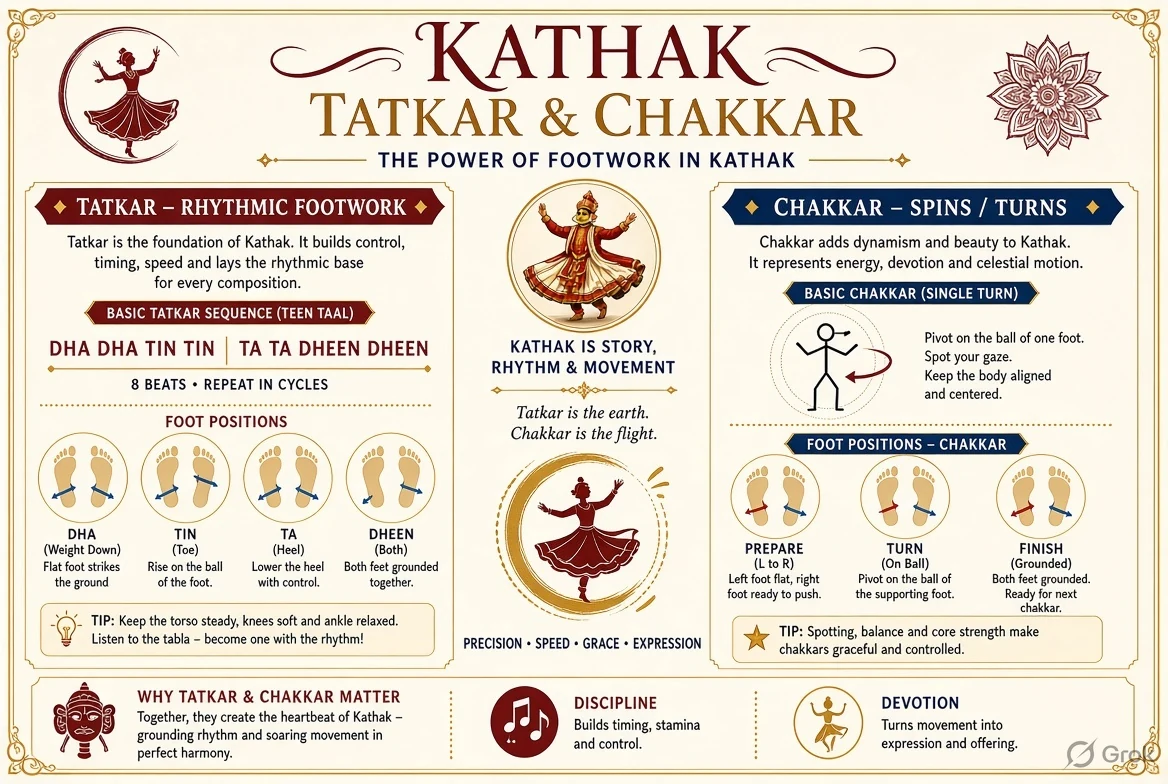
Direct answer: Kathak Tatkar is rhythmic footwork organised by musical bols and beats; Chakkar is a controlled turn or spin. A familiar beginner phrase is Ta Thei Thei Tat, Aa Thei Thei Tat. These four picture charts explain foot position, spoken syllables, balance and 16-beat Teentaal without claiming every Kathak gharana uses one identical technique.
Updated 21 November 2026. Illustrative training references, not a substitute for a qualified teacher.
Kathak Tatkar and Chakkar footwork: four visual charts

What is Tatkar in Kathak dance?
Tatkar is the structured rhythmic footwork of Kathak, a classical dance tradition of northern India. The dancer makes controlled contacts with the floor in relation to spoken syllables, musical beats and the chosen taal. The sound of the feet, often supported by ghungroo bells, becomes part of the musical texture rather than merely a means of moving from one side of the stage to another. The Government of India’s CCRT Kathak booklet identifies Tatkar as a distinctive feature of the form, alongside the turning movement known as Chakkar.
A quick screenshot can show foot placement, but it cannot convey weight transfer, attack, sound and the precise relationship to the beat. That is why a Kathak Tatkar chart is useful as a memory guide, not a complete technical lesson. This article compares foot positions, a familiar spoken-bol phrase, Chakkar alignment and rhythmic patterns. The four images are illustrations designed for explanation rather than motion-capture recordings of a specific Kathak gharana or teacher.
Ta Thei Thei Tat: understanding the basic spoken bols
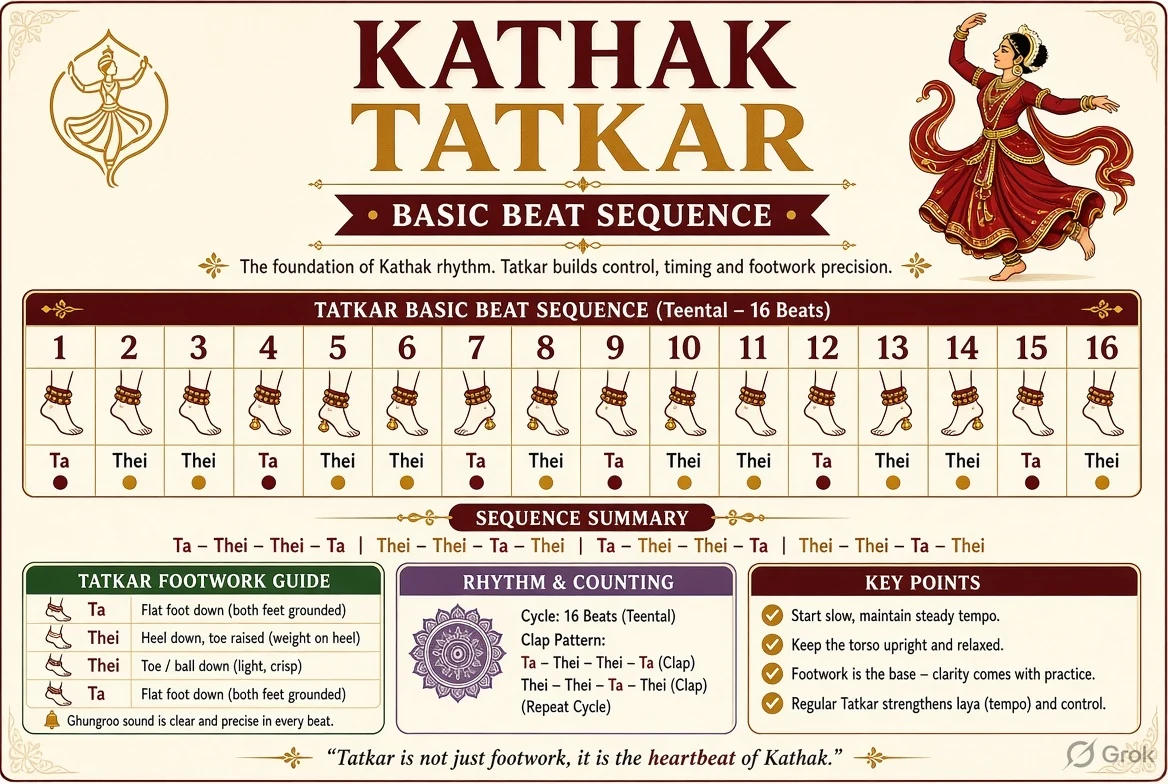
One well-known beginner sequence is spoken as Ta Thei Thei Tat, Aa Thei Thei Tat, with spelling and pronunciation variations such as tha, thae, thai depending on teaching convention. Teachers associate syllables with carefully organised foot movements and changes of weight. A student learns to recite the pattern before attempting faster movement. The syllables are part of a rhythmic teaching system; reading them like ordinary English words will not reveal exactly which foot strikes the floor on each count.
Some beginner worksheets divide these sounds into groups of four, but the actual foot placement and timing are demonstrated by the instructor. The chart provides a visual reference to the common bol sequence, not a claim that every school uses one identical foot-to-syllable mapping. When studying with a teacher, write down the version being taught and practise it at a comfortable laya before changing speed. The same phrase can be developed into progressively more demanding rhythmic exercises once the basic weight transfer is stable.
Foot position, heel contact and weight transfer
Kathak foot position diagrams often show where the feet start and how the dancer changes weight between them. Real Tatkar depends on the quality of contact with the floor, the natural support of the ankles and knees, and the clarity of the accompanying sound. Beginner instructions may mention heel and forefoot actions, but the details of a particular strike vary across phrases and teaching lineages. A drawn foot symbol cannot certify that a student’s posture is correct or safe.
Good practice begins on a suitable non-slip surface, with the body balanced and knees able to move comfortably. Overstriking a hard floor or forcing unusually loud impacts can make movement harsh and may cause discomfort. The teacher may correct heel alignment, hip position or the rhythm of weight transfer. Watch how the torso stays organised while the feet perform repeated strokes. If an image shows an exaggerated ankle turn, do not copy it mechanically; confirm the movement through a qualified instructor.
What is Chakkar? Spins in classical Kathak
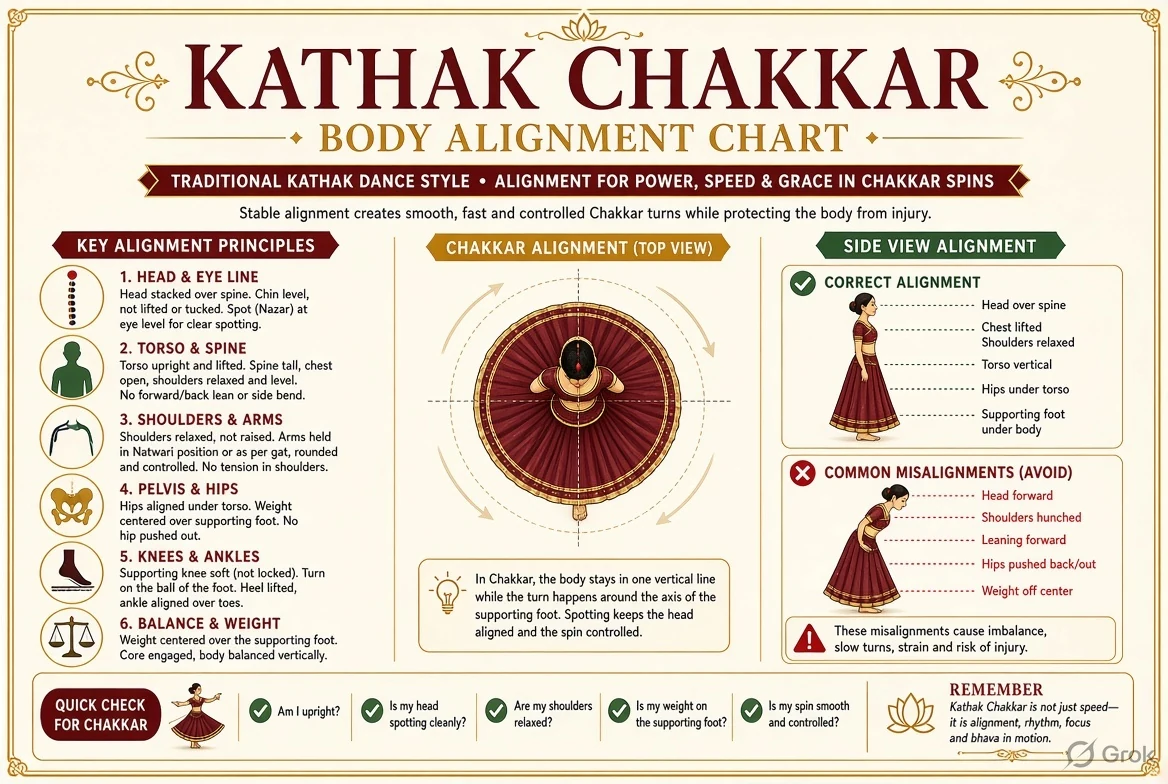
Chakkar refers to spinning or turning, another widely recognised feature of Kathak. A controlled Chakkar is not defined only by how many revolutions a performer can do. The dancer manages vertical alignment, the axis of rotation, arms, centre of gravity and where the gaze returns. Beautiful turns can be taken at different speeds within the music. A spinning performer may complete a sequence and arrive at the musical sam, the first beat of the cycle, with dramatic precision.
Our Chakkar alignment chart introduces the idea of an upright axis and balanced positioning. It should not be followed as a standalone physical training protocol. Dizziness, unstable balance and crowded spaces make rapid turns unsafe for beginners. Start with small direction changes under supervision and stop if you feel dizzy. The ability to repeat fast spins comes from gradual training rather than an online challenge to perform dozens of revolutions. Kathak artistry lies in musical control, not simply a high number of spins.
Tatkar versus Chakkar: rhythmic sound and circular movement
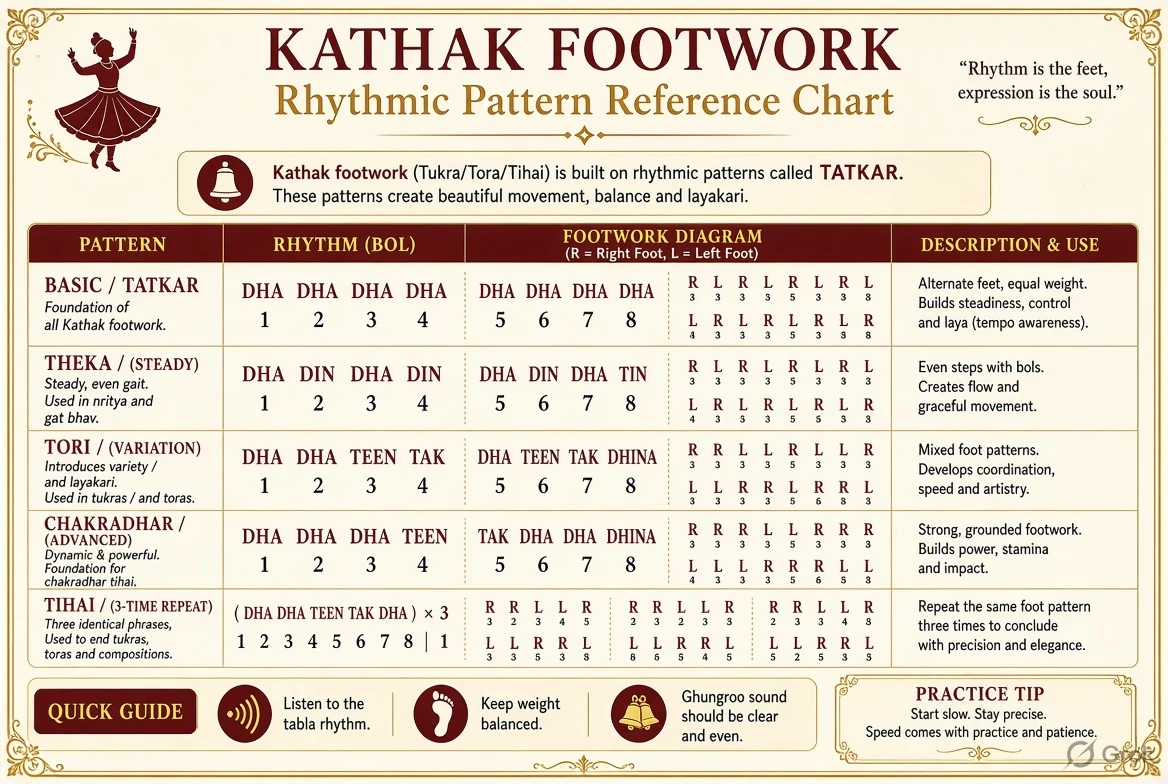
Tatkar and Chakkar are related components of Kathak but answer different technical questions. Tatkar develops musical timing through repeated foot strikes; Chakkar develops turning skill, coordination and dramatic placement within the rhythm. A solo piece can combine footwork, turns, pauses and expressive passages. That does not make every walking step Tatkar or every circular gesture a Chakkar. Teachers structure practice so the dancer learns clear sound and stable turns as separate skills before combining them.
A common beginner mistake is to focus on speed in both elements. Quick Tatkar with muddy timing is less useful than clearly executed slower footwork. Many spins with poor alignment can make a performance less musical and more physically uncomfortable. Practise one skill at a time, then check whether the ending of the movement matches the intended beat. The fourth chart helps illustrate their relationship to rhythmic patterns, but a live demonstration is the right place to learn their full movement vocabulary.
Teentaal, sixteen beats and the role of sam
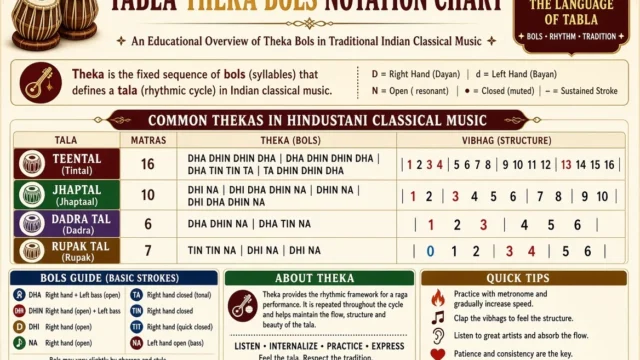
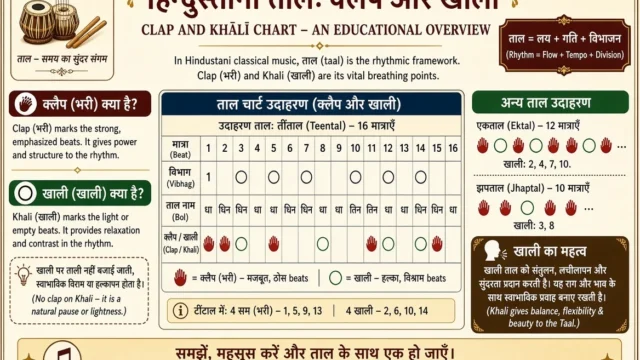
Teentaal is a widely taught 16-beat rhythmic cycle in Hindustani music and Kathak. It is often organised into four groups of four beats, with claps and a wave used to mark characteristic positions. The first beat, sam, is an important point of arrival for many danced patterns. Kathak also works with other taal structures and different tempos, so learners should not assume that every Tatkar exercise uses Teentaal or that a single chart represents all possible rhythmic groupings.
Counting and reciting can help students connect their feet to an audible pulse. Begin by marking the beat, then add the teacher’s prescribed bol sequence. Keeping timing steady is more important than immediately adding rapid accelerations. A repeated footwork phrase can be developed at different laya speeds. If a dance phrase spans several rhythmic cycles, it should be labelled accordingly rather than pretending it fits into one bar. The Teentaal chart is a basic organising aid, not a substitute for tabla instruction or live accompaniment.
Kathak gharanas and why teaching conventions vary
Kathak is associated with several historical teaching lineages or gharanas, including those linked to Lucknow, Jaipur and Banaras. Their performance and training emphases can differ, and individual teachers also develop their own methods within a lineage. Sangeet Natak Akademi’s Kathak Kendra documents the institutional teaching and performance of Kathak, while CCRT provides broad educational material for schools and cultural learners. The diversity of the tradition is a reason to avoid declaring every one-page Tatkar chart the only correct version.
Names of movements and phonetic spelling of syllables sometimes differ between Hindi, English transliteration and oral teaching. For example, Thei, Thai and Tha may be represented differently in informal digital notes. In learning situations, preserve your instructor’s phrasing and ask for the intended foot action. Online diagrams are most helpful when labelled as examples in a specific syllabus rather than treated as standardised mechanical instructions imposed on all artists.
How to practise Tatkar and Chakkar with care
For beginners, start by reciting the rhythm, then transfer it to slow footwork on a stable surface. Keep a natural bend in the knees, avoid locking them and notice whether your weight moves comfortably. Practise small sections instead of attempting long, fast repetitions before the basics are secure. If you wear ghungroo, follow your teacher’s advice about weight, fit and practice duration. The bells are a musical aid and should not hide unclear foot strikes.
For Chakkar, begin under supervision with balance and orientation. Use a clear, open floor without nearby furniture or sharp edges. Stop and rest if you feel dizzy, experience pain or cannot control your landing. Over time, connect a simple turn to a recognised beat rather than competing over speed. A video or poster can show the broad visual, but the teacher’s correction remains essential for safe technique. Record progress through musical clarity, controlled arrival and consistency, not through unverified viral spin counts.
Kathak Tatkar and Chakkar FAQs
What is Tatkar in Kathak?
Rhythmic footwork that makes clear foot sounds in relation to spoken bols and the musical beat.
What does Ta Thei Thei Tat mean?
It is a familiar spoken teaching phrase for Tatkar; exact foot actions are learned through a teacher.
What is a Kathak Chakkar?
A controlled turn or spin performed within the dance’s musical structure.
Does Tatkar always use 16-beat Teentaal?
No. Teentaal is a common teaching cycle, but Kathak works with other rhythmic cycles too.
Can I learn fast Chakkars from a diagram?
A diagram helps orientation, but gradual supervised practice is needed for balance and safety.
Conclusion: rhythm before speed
Tatkar and Chakkar reward clear rhythm, balance and controlled musical arrival. Use the diagrams to review concepts; learn the physical technique with a qualified Kathak instructor.
Training and official references
CCRT, Government of India: Kathak Dance booklet; Sangeet Natak Akademi: Kathak Kendra; CCRT: Indian classical dance cultural packages.














Share Your Opinion
Comments are closed on this post.