 Vista

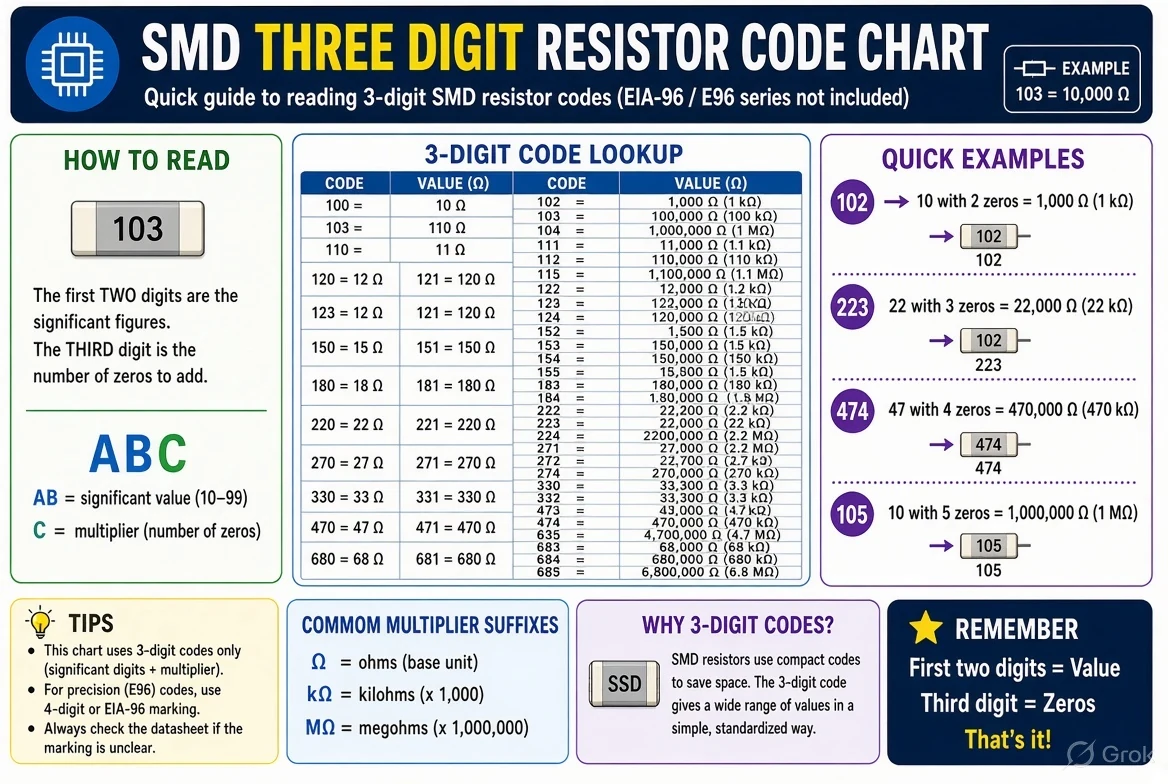
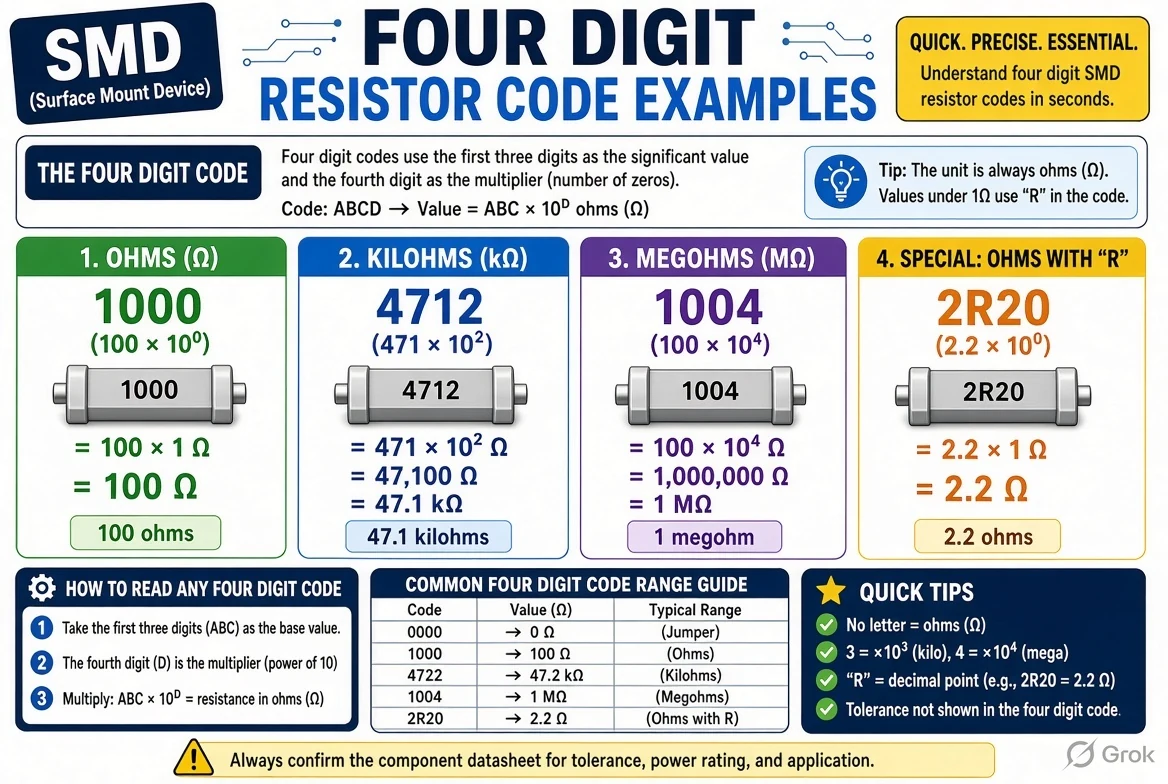
SMD resistor markings compress a resistance value into a few printed characters. A typical three-digit code uses two significant digits plus a power-of-ten multiplier: 103 means 10 × 1,000 = 10 kΩ, and 472 means 47 × 100 = 4.7 kΩ. Four-digit codes use three significant digits plus a multiplier; 4R7 uses R as a decimal point. EIA-96 uses a separate index and letter table, not the ordinary three-digit rule. These four images show the formats, worked examples and chip-package dimensions.
Updated 21 November 2026. Always confirm actual components against the manufacturer’s datasheet; this guide is for education, not an electrical safety certification.
Four visual SMD resistor reference charts

Why surface-mount resistors use codes instead of colour bands
Tiny components soldered directly to printed circuit boards often have too little room for the familiar colour bands of leaded resistors. Many chip resistors instead use numerical or alphanumeric markings. Smaller packages may carry no readable markings at all, so the printed text is a clue rather than guaranteed identification. A repairer should combine it with the bill of materials, position on the board and component datasheet.
A typical beginner search asks what 103, 472 or 4R7 means. Those can be decoded quickly once the correct marking system is identified. More advanced searches about EIA-96 require a lookup chart. Never treat a code as a complete engineering specification: tolerance, power rating, voltage, temperature coefficient and pulse behaviour are separate properties that may not be printed on the chip.
Three-digit SMD resistor code: two digits and one multiplier
For an ordinary numeric three-digit marking, take the first two digits as significant figures and the last digit as the exponent of ten in ohms. Thus 103 equals 10 × 10³, or 10,000 ohms. Code 472 equals 47 × 10², or 4,700 ohms. A commonly misread 100 means 10 × 10⁰ = 10 ohms; it does not mean 100 ohms. Marking 101 is the common 100-ohm code.
Check that you are looking at a resistor, not a capacitor or inductor, because a visually similar three-digit printed marking can use different unit conventions on different components. A numeric resistor marking does not independently prove the tolerance. Although the three-digit format is frequently associated with E24-series general-purpose resistors, manufacturer choices differ. Confirm the device family in the datasheet when tolerances matter.
Four-digit code: three significant digits before the exponent
Four numeric characters usually show three significant figures and one final base-ten multiplier. For instance, 1001 is 100 × 10¹ = 1,000 Ω, or 1 kΩ. Code 4702 is 470 × 10² = 47 kΩ. Code 1000 means 100 Ω rather than 1 kΩ. The four-digit approach is useful for finely spaced preferred values and is often seen on precision parts that have sufficient marking area.
The extra significant digit does not automatically guarantee a specific tolerance for an unidentified component. The nominal resistance can be decoded, while accuracy and thermal stability require part-number information. In real PCB repair, compare the manufacturer’s package, the printed marking and the circuit’s function. If the device is connected to other components, an in-circuit resistance reading may not equal the isolated resistor value.
R notation: how to read 4R7, R47 and low-ohm shunts
When R appears inside a resistor value code, it commonly takes the role of a decimal point. So 4R7 is 4.7 Ω, R47 is 0.47 Ω and 1R0 is 1.0 Ω. Some current-sense shunts use markings like R005 for 0.005 Ω (5 milliohms); special low-resistance schemes may vary, making manufacturer documentation particularly important.
Do not try to infer the shunt’s safe continuous current from its low resistance alone. Power is affected by both current and resistance, package design, copper layout and cooling. A low-ohm part also challenges ordinary handheld meter accuracy because probe and lead resistance may be significant. Four-wire measurement and a known good schematic can be needed in precision work.
EIA-96 markings: why 01C is not read as 01 × 10³
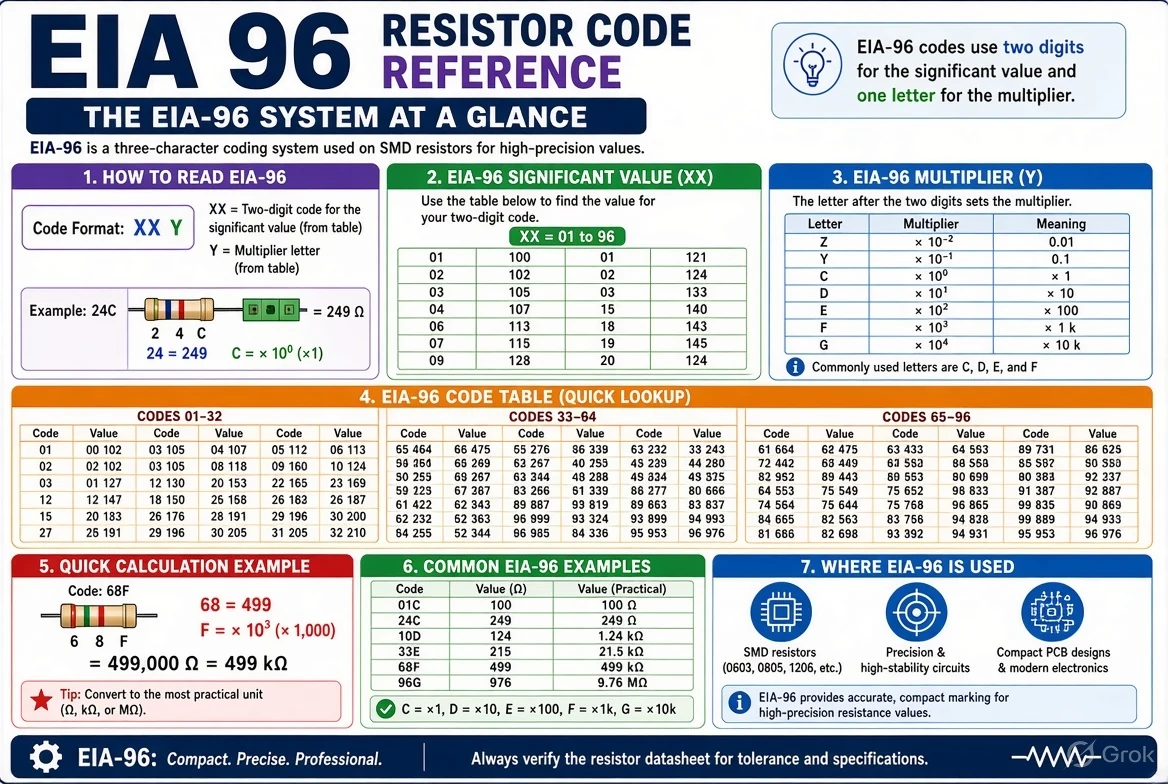
A common EIA-96 code has two digits from 01 to 96 followed by a letter. The digits represent an index into the E96 resistance-value table, not simply the first two printed significant figures. The letter determines a multiplier. For example, index 01 is base value 100 and C typically multiplies by 100, so 01C represents 10 kΩ. Index 68 corresponds to base 499; X is a multiplier of 0.1, so 68X represents 49.9 Ω.
Letter conventions, including alternative suffixes in some families, should be checked against the maker’s marking guide. If a code contains letters, first establish whether it is EIA-96, an R-decimal marking or a proprietary marking. Applying the normal three-digit formula to EIA-96 almost always produces the wrong answer. The accompanying EIA-96 chart helps identify which of the 96 base values is meant.
SMD 0402, 0603, 0805 and 1206 package sizes
Resistor sizes such as 0402, 0603, 0805 and 1206 often refer to imperial inch-based nominal dimensions: 0402 is about 1.0 × 0.5 mm, 0603 about 1.6 × 0.8 mm, 0805 about 2.0 × 1.25 mm and 1206 about 3.2 × 1.6 mm. Metric naming uses corresponding labels such as 1005, 1608, 2012 and 3216. Always check which size convention a parts catalogue is using.
Case size alone does not fix the resistor’s power rating. Different technologies and temperature ratings produce different results even at the same outline. Replacement parts need suitable resistance, tolerance, rating, physical fit and environmental conditions. Do not assume a physically larger-looking chip is an automatic drop-in upgrade if PCB pads and electrical design are different.
Safe identification and measurement workflow
Start by switching equipment off and disconnecting power. For products with exposed mains, large capacitors, battery packs or stored high voltage, stop and follow qualified-service procedures; unplugged equipment can still retain dangerous energy. Read the code under good lighting and magnification, identify the suspected component class, then use the correct numeric or EIA-96 chart. Record the board reference such as R12, where available.
A digital multimeter on resistance mode can help confirm a resistor after safe isolation, but parallel components on the board can lower an in-circuit reading. For critical work a technician may disconnect one end after following appropriate handling procedures. Never use ohms mode on a powered board. A component’s failure can be caused by an upstream fault, so merely replacing it with the visible marked value is not always a lasting repair.
Common mistakes in online code calculators
A frequent error is treating resistor code 103 like capacitor marking 103, which would lead to a completely different unit. Another is reading 100 as one hundred ohms. A third is assuming EIA-96 uses the ordinary last-digit multiplier. A fourth is confusing imperial 0603 with a metric code. Check your input format before trusting a calculator result, especially when copying characters photographed at low resolution.
Also, mark spacing may be misleading: the character 1 resembles 7 in some images, and an R may look like a damaged digit. Do not rely only on a social-media picture. Prefer a component datasheet, a manufacturer marking guide and a measurement performed under safe conditions. The right result is not just a decoded number but a confidence level appropriate for the repair or design decision.
SMD code decoder examples and calculations
| Marking | System | Calculation | Value |
|---|---|---|---|
| 100 | 3-digit | 10 × 10⁰ | 10 Ω |
| 101 | 3-digit | 10 × 10¹ | 100 Ω |
| 103 | 3-digit | 10 × 10³ | 10 kΩ |
| 472 | 3-digit | 47 × 10² | 4.7 kΩ |
| 1001 | 4-digit | 100 × 10¹ | 1 kΩ |
| 4702 | 4-digit | 470 × 10² | 47 kΩ |
| 4R7 | R decimal | 4.7 | 4.7 Ω |
| R47 | R decimal | 0.47 | 0.47 Ω |
| 01C | EIA-96 | base 100 × 100 | 10 kΩ |
| 68X | EIA-96 | base 499 × 0.1 | 49.9 Ω |
Package size quick reference
| Imperial / metric | Approx dimensions |
|---|---|
| 0402 / 1005 | 1.0 × 0.5 mm |
| 0603 / 1608 | 1.6 × 0.8 mm |
| 0805 / 2012 | 2.0 × 1.25 mm |
| 1206 / 3216 | 3.2 × 1.6 mm |
Frequently asked questions
What does 103 mean on an SMD resistor?
Usually 10 kΩ in a standard three-digit resistor marking system.
What does 472 mean?
4.7 kΩ under the common three-digit system.
Is 4R7 equal to 4.7 ohms?
Yes, in the common R-decimal notation.
What does EIA-96 code 01C mean?
In the common EIA-96 table, 10 kΩ.
Does 0603 tell the resistance?
No. It is a package size designation, not the ohmic value.
Conclusion and reference sources
SMD resistor markings compress a resistance value into a few printed characters. A typical three-digit code uses two significant digits plus a power-of-ten multiplier: 103 means 10 × 1,000 = 10 kΩ, and 472 means 47 × 100 = 4.7 kΩ. Four-digit codes use three significant digits plus a multiplier; 4R7 uses R as a decimal point. EIA-96 uses a separate index and letter table, not the ordinary three-digit rule. These four images show the formats, worked examples and chip-package dimensions.
LCSC: SMD resistor markings · Galco engineering calculator. Use manufacturer specifications when making real repairs or engineering decisions.

























Share Your Opinion
Comments are closed on this post.