 Vista
Direct answer: Fountain pen nib markings usually describe writing width, material or manufacturer. EF, F, M and B mean extra fine, fine, medium and broad; 14K/585 and 18K/750 indicate gold-alloy fineness, not nib flexibility. This illustrated fountain pen nib markings guide compares size letters, steel and gold nibs, and vintage imprints without inventing precise dates or line widths.
Updated 21 November 2026. Charts are educational illustrations, not authenticated vintage pen photographs.
Fountain pen nib markings guide: three visual charts
What do fountain pen nib markings mean?
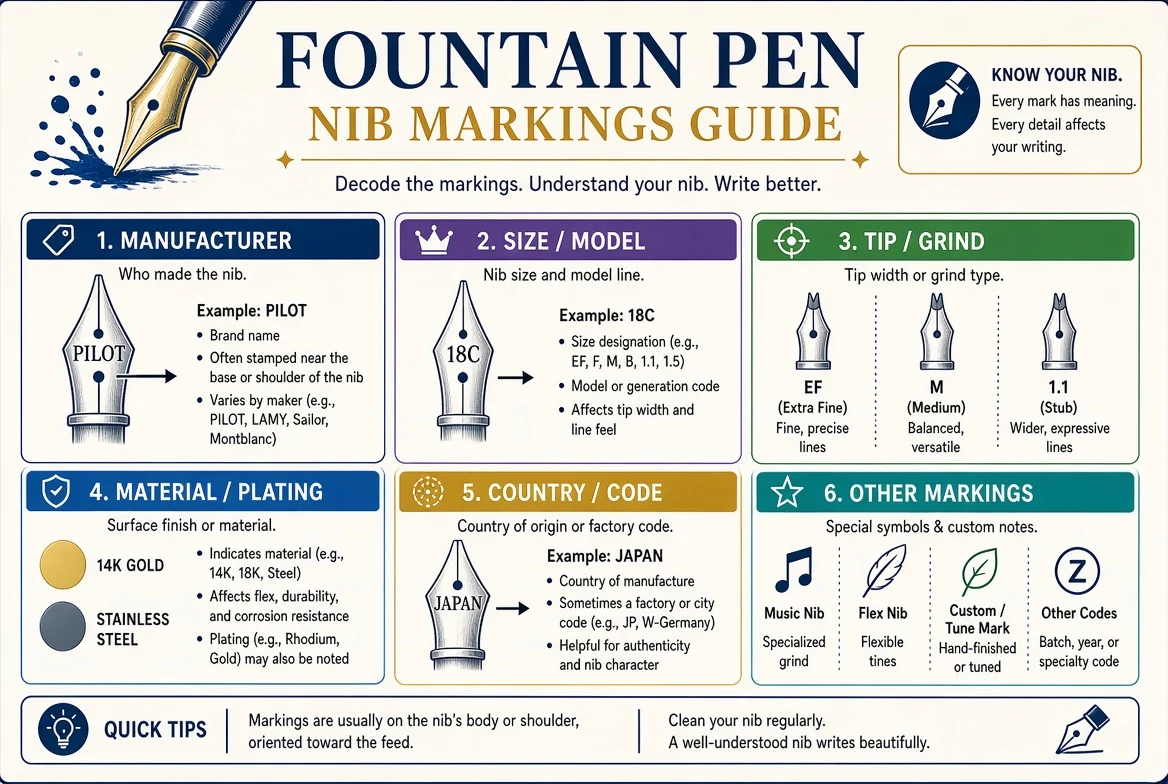
Fountain pen nib markings are letters, numbers, words and symbols stamped or engraved on the writing nib. Their purpose depends on the pen: EF, F, M or B commonly indicates the intended width of the line; 14K or 18K describes gold-alloy content; a maker logo can identify a manufacturer or supplier. Some vintage nibs also carry model names, country-of-origin labels, ornamental flourishes or flexible-writing terms. No single universal decoding chart can determine the nib’s age, authenticity and exact writing behaviour from one mark.
Start with a clear photograph of the front of the nib and its underside if accessible without disassembly. Note the visible characters, colour and location of the tipping point. Then inspect the pen’s cap, barrel, feed and filling mechanism for matching model information. The three visual diagrams in this guide separate size markings, material stamps and vintage imprints. They are educational reconstructions, not authenticated close-ups of one specific historical pen.
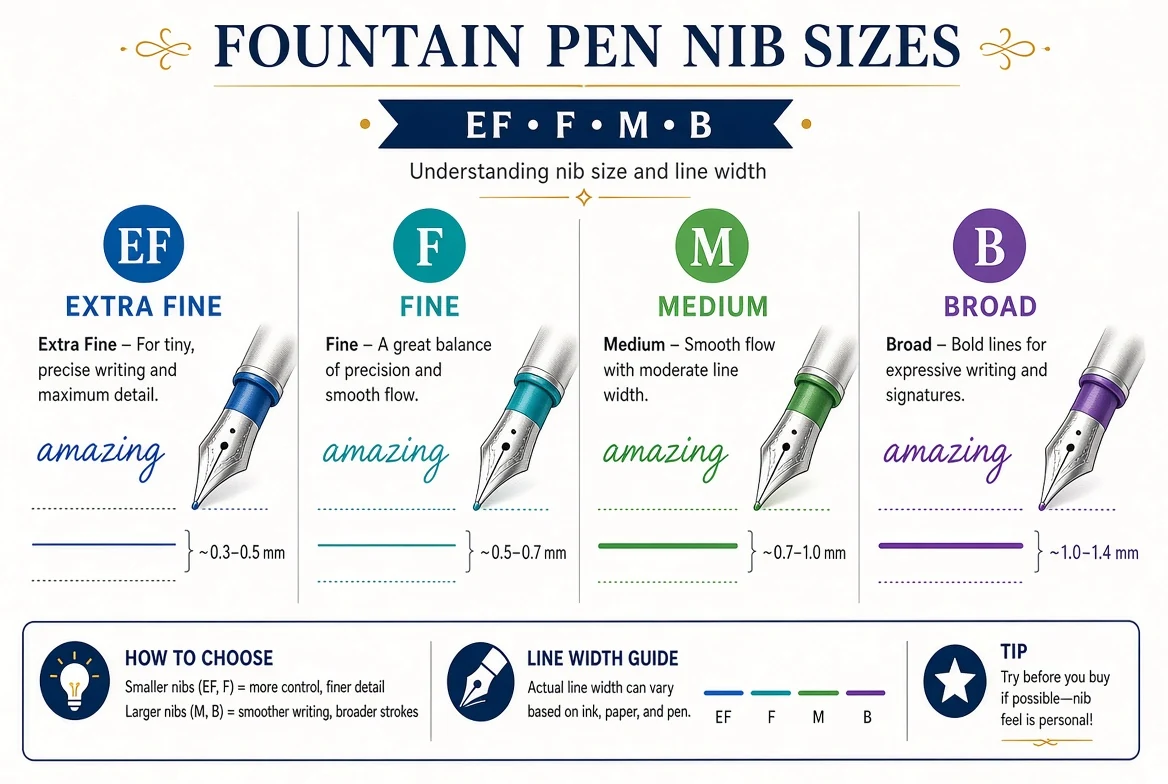
EF, F, M and B nib sizes: which writes thinner?
The most familiar fountain pen nib size chart begins with EF (extra fine), F (fine), M (medium) and B (broad). On a typical range, EF produces the narrowest line and B the widest. Other frequently used options include FM (fine-medium), BB (double broad), stub and music nibs. Pilot’s official Custom series guide demonstrates that a manufacturer may offer more than a dozen specific nib designs, including PO, FA, WA and SU, each intended for particular writing styles.
Do not assume an EF from two brands produces exactly the same width in millimetres. The actual mark depends on tip geometry, writing pressure, paper texture, ink flow, wetness and the angle at which the nib touches paper. Some Japanese EF nibs feel narrower than a European F, but even this is a tendency rather than a guaranteed numerical standard. For a purchase comparison, view writing samples made with the specific model and ink instead of reading just the letter on the nib.
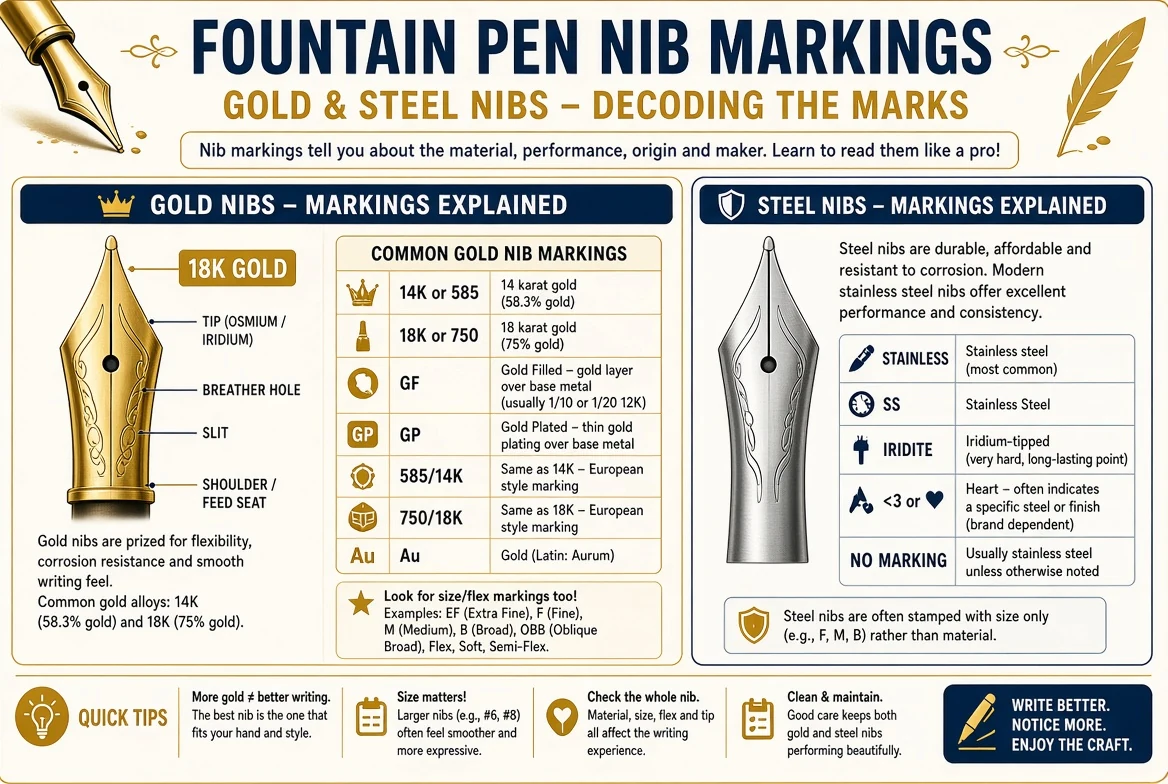
14K, 585, 18K and 750 stamps: what is gold content?
If a nib carries 14K or 585, it typically describes an alloy with approximately 58.5% gold by mass. 18K or 750 usually refers to a gold alloy containing 75% gold. These numbers are material grades; they do not say that the tip itself is pure gold. Writing tips frequently use hard tipping material because gold alone would be unsuitable for durable contact with paper. A gold-coloured steel nib should not be sold as a solid gold nib merely because its plating looks similar.
The alloy stamp also does not guarantee a softer or more flexible nib. Thickness, curvature, cut, temper and shape of the tines determine much of the writing response. Some 14K nibs are firm and some steel nibs have pleasant spring; not all gold nibs are designed for calligraphy. Vintage plated or two-tone nibs complicate visual judgement, so check a trustworthy manufacturer specification or specialist examination before making claims about solid gold content.
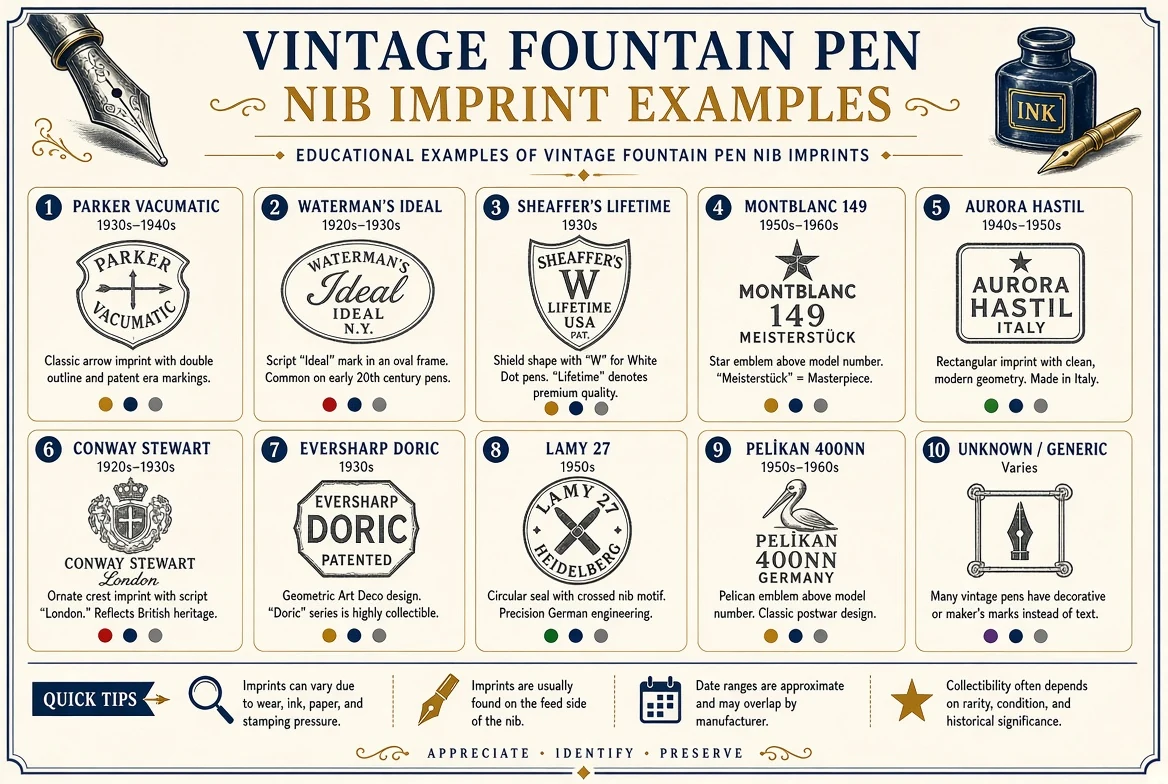
Vintage fountain pen nib imprints: brand, model and country
A vintage fountain pen nib imprint can show a historic maker’s name, a model number, an alloy designation or decorative wording. The imprint can help narrow the history of a pen when it matches its feed, barrel, clip and filling system. Yet nibs are replaceable parts, and an old barrel may contain a later replacement nib. Therefore an early-looking engraving does not automatically date every other component of the pen to that same year.
When researching an unknown imprint, transcribe every letter and symbol and search documented catalogues or manufacturer archives. Look at differences in typeface and ornament across known periods. Be careful with a number such as 5, 6 or 10: it may be a maker’s nib-size designation, model identifier or another internal code, not an official line-width measurement or production date. Similarly “Iridium Point” on a modern inexpensive nib is a marketing or historical phrase, not proof of a large quantity of that specific element in the tip.
Steel versus gold nib: which is better for daily writing?
Steel fountain pen nibs are widely used because they are durable, economical and can deliver excellent writing quality when correctly tuned. Gold nibs can provide different elasticity and corrosion resistance depending on their alloy and design, but their higher price does not prove they will write better for everyone. A well-made steel medium nib may be smoother than a poorly adjusted gold fine nib. Smoothness comes largely from tipping geometry, alignment, ink lubrication and paper interaction.
For everyday notes, check how a nib starts after a pause, whether it skips and whether its width suits your handwriting. A wet broad nib can make elegant signatures but may feather on absorbent office paper; an extra-fine nib can fit small writing but accentuate scratchiness if poorly adjusted. Choose by writing sample and use case, not the prestige of a 14K stamp alone. Always clean and maintain according to the pen’s filling mechanism rather than using aggressive liquids.
What do flex, soft, stub, architect and music nibs mean?
A flex nib is designed to produce line variation as the tines spread under appropriate pressure; however, vintage flexibility ranges greatly and applying excessive force can permanently spring or crack a nib. A “soft” nib may feel cushioned without having the line-spread capability of a true flexible nib. Stub and italic-style grinds produce directional line variation from tip shape, typically wider downstrokes and narrower cross-strokes. An architect grind usually reverses that relationship depending on writing orientation.
Pilot’s official Custom series list includes specialist nib types such as the FA and SU, showing why a general EF/F/M/B chart cannot describe every writing experience. “Music nib” is a historical functional term for wide lines and particular stroke behaviour, but different modern manufacturers implement it differently. Avoid applying flex pressure to an unknown antique nib merely because it says “14K”. Observe tine response gently and consult a competent nib specialist before attempting adjustments.
How to read the tip, tines, breather hole and feed
The nib tip is the small writing point. Most common fountain pen nibs have a slit that separates two tines, and their underside meets a feed that regulates ink delivery. Many nibs have a breather hole or decorative opening near the end of the slit, but designs vary and not every nib uses the classic round hole. These construction features affect flow and flexibility and help distinguish a fountain-pen nib from a dip nib or rollerball tip.
If a pen writes poorly, do not start by widening the slit with a knife or attempting to bend the tines. Misalignment, dry ink, poor paper, incompatible filling systems and blocked feeds can all cause skipping. Gentle cleaning with water where recommended is safer than polishing tipping material or using solvents. For an old pen with unknown materials, a qualified repair specialist is the safer option. The most useful visual identification combines the imprint with the intact nib-feed assembly.
How to choose a nib from the EF F M B picture chart
For small handwriting or narrow notebook lines, begin by trying EF or F. For an all-purpose handwritten letter, M is often a comfortable middle choice. For signatures, bold lettering or expressive shading, B or a specialised stub may be more suitable. Use the chart as a first filter, then check actual writing on the paper you plan to use. If you write in a language with dense characters or fine diacritics, a fine grade may help keep details separate.
Compare several short writing samples rather than buying by a brand’s broad reputation. Hold the pen at your natural angle, write slowly and quickly, and look for hard starts, inconsistent ink flow and scratchiness. Ink and paper can change the line substantially, so an EF on a smooth coated sheet may behave differently on ordinary recycled paper. The best size is one that produces legible writing without forcing you to change your hand position or pressure.
FAQ: fountain pen nib markings and sizes
What does EF mean on a fountain pen nib?
Extra fine, a line-width grade generally finer than F, M and B within the same maker’s system.
Does 585 on a nib mean solid 14K gold alloy?
It usually denotes 585 parts gold per thousand, but genuine material and originality still require verification.
Are Japanese fountain pen nibs always finer?
Not always. There is a common tendency, but specific models and writing conditions matter.
Is a gold nib always flexible?
No. Gold content does not independently determine nib softness or controlled line spread.
Can a nib imprint tell the exact age of my vintage pen?
Not by itself. Nibs may be replaced; compare the barrel, feed, model and documented manufacturer history.
Conclusion: match the imprint to the actual writing experience
The useful first clues are nib-size letters, gold-alloy markings and historical maker imprints, but none of them guarantees a particular smoothness, flexibility or collectible value. Identify the whole pen and test the writing on appropriate paper before making a confident judgement.
Manufacturer sources
Pilot Custom: official EF, F, FM, M, B and specialty nib types; Pilot Custom: official nib-material and size specifications; Pilot Custom: nib model history.

















Share Your Opinion
Comments are closed on this post.