 Vista
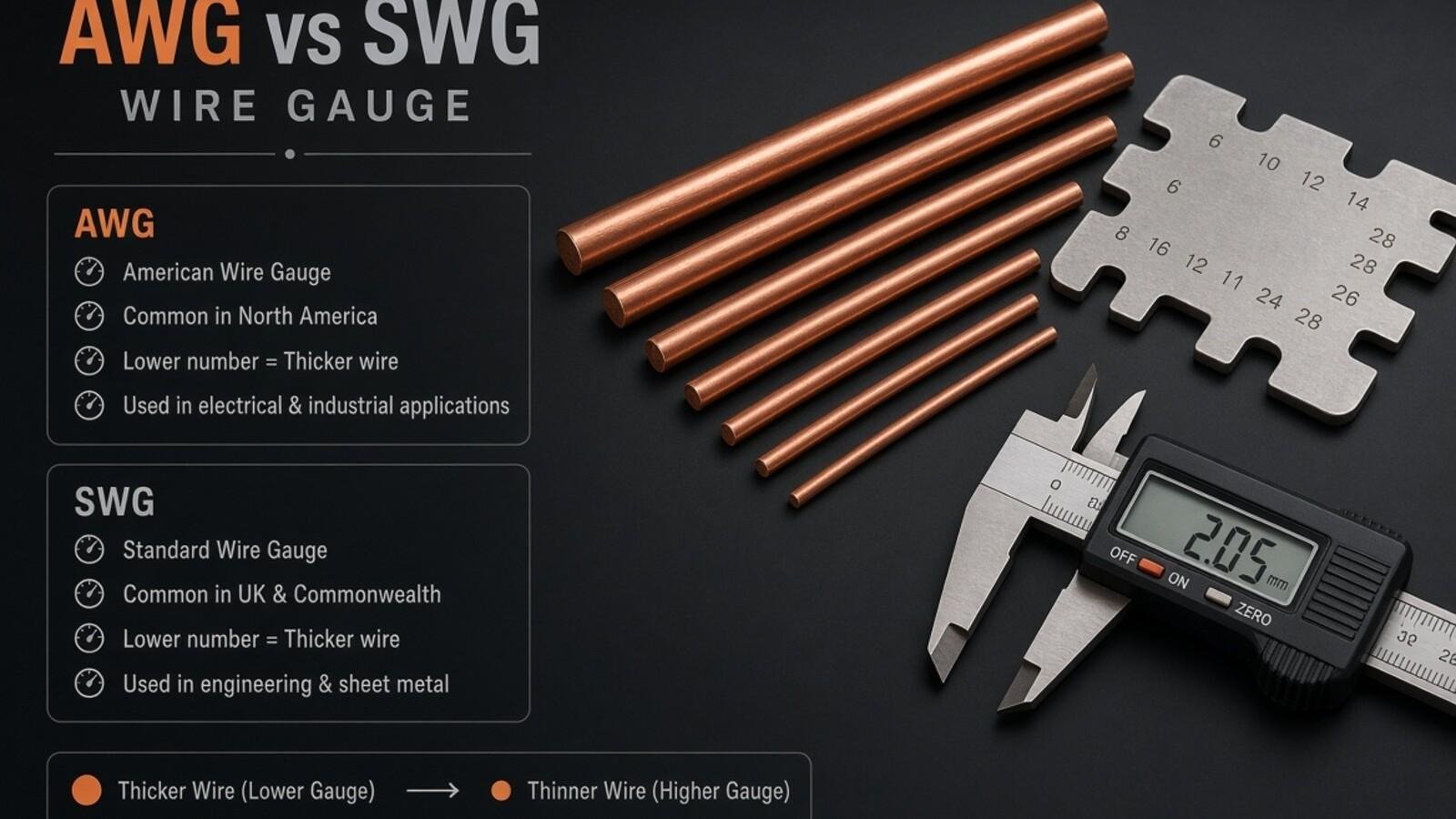
Quick answer: AWG and SWG are different diameter gauge systems, while mm² measures conductive cross-sectional area. For example, 16 AWG is approximately 1.290 mm diameter and 1.309 mm² area; 16 SWG is 1.6256 mm and 2.076 mm². The same number does not mean the same wire.
Updated: 21 November 2026. Engineering reference; not an ampacity design certificate.
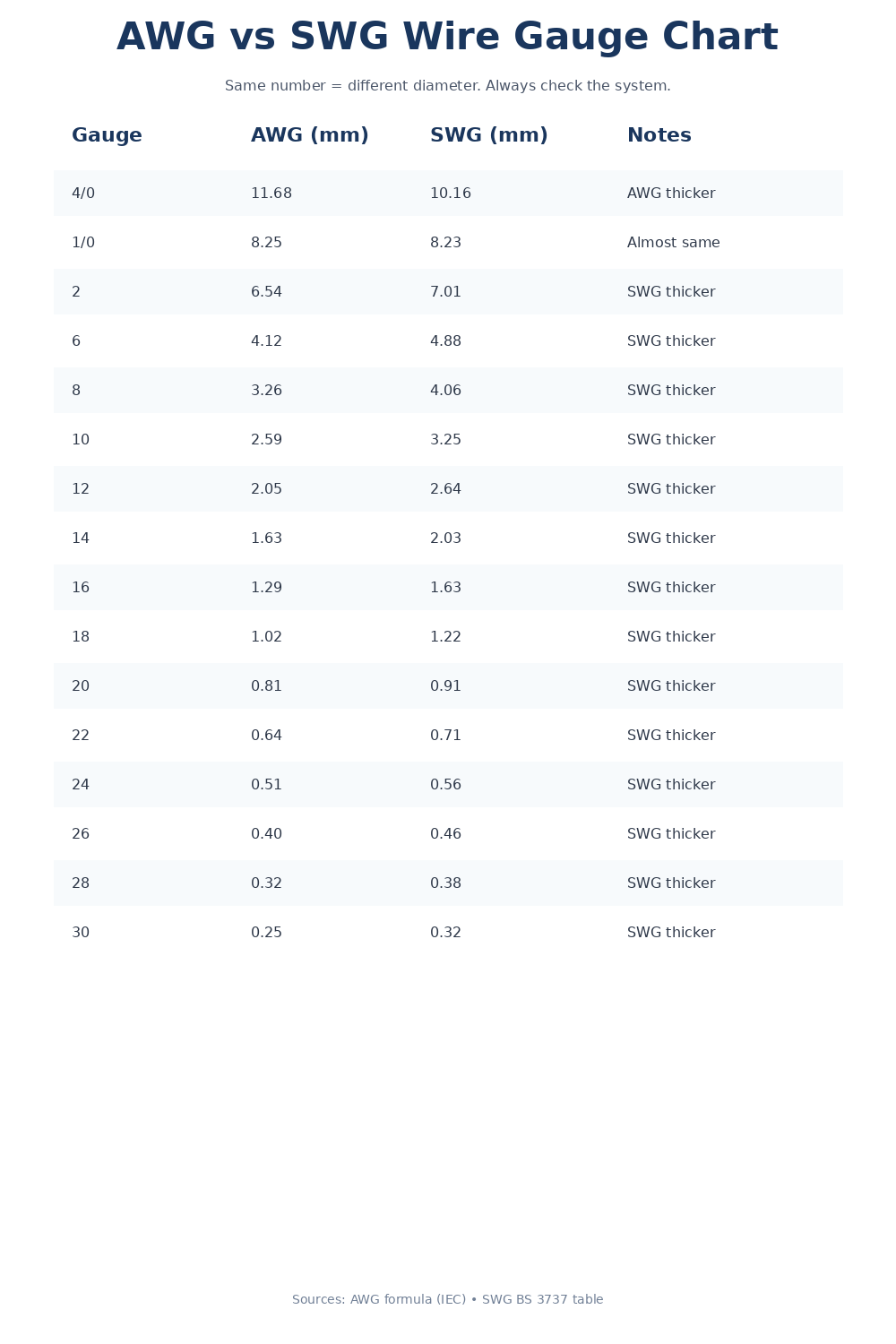
AWG, SWG and mm² sizes: verified comparison table
| Gauge | AWG diameter (mm) | SWG diameter (mm) | AWG metal area (mm²) | SWG metal area (mm²) |
|---|---|---|---|---|
| 10 | 2.588 | 3.251 | 5.261 | 8.302 |
| 12 | 2.053 | 2.642 | 3.309 | 5.481 |
| 14 | 1.628 | 2.032 | 2.081 | 3.243 |
| 16 | 1.291 | 1.626 | 1.309 | 2.075 |
| 18 | 1.024 | 1.219 | 0.823 | 1.167 |
| 20 | 0.812 | 0.914 | 0.518 | 0.657 |
| 22 | 0.644 | 0.711 | 0.326 | 0.397 |
| 24 | 0.511 | 0.559 | 0.205 | 0.245 |
| 26 | 0.405 | 0.457 | 0.129 | 0.164 |
| 28 | 0.321 | 0.376 | 0.081 | 0.111 |
| 30 | 0.255 | 0.315 | 0.051 | 0.078 |
The metal area figures are calculated from circular solid-conductor diameters and rounded to three decimal places. They are not ratings for a complete insulated cable.
AWG, SWG and mm²: three specifications that are not interchangeable
A wire gauge chart often displays AWG, SWG and mm² side by side, but they describe related rather than identical quantities. American Wire Gauge is a geometric series of bare solid conductor diameters. Standard Wire Gauge has a different set of defined British diameter values. Square millimetres is an area unit and is often printed as the nominal conductive metal area of an electrical cable. A label saying “18 gauge wire” without a standard is ambiguous, because the same numeral represents different diameters in the two systems.
The outside diameter of a finished insulated cable is another measurement entirely. Its plastic jacket, protective coatings and multi-core construction add size without increasing the conductive metal area. Even after insulation is removed, a stranded conductor can have spaces between the strands. This is why a simple caliper reading of cable outer diameter is not a dependable substitute for the manufacturer’s specification. A reliable visual reference makes the physical diameter and computed metal area clearly separate.
How American Wire Gauge (AWG) numbering works
In the standard AWG system, a larger gauge number indicates a thinner bare conductor. The common geometric formula is d(mm) = 0.127 × 92^((36−n)/39), where n is the gauge number. For example, it gives approximately 1.290 mm for 16 AWG and 0.813 mm for 20 AWG. The progression is logarithmic: moving one gauge step does not subtract a fixed number of millimetres. An occasional 4/0 size uses a separate notation for larger wire rather than being written as a standard positive integer.
AWG is often encountered in electronic wires, appliance harnesses, speaker cables, instrumentation and equipment from North America. The number alone still cannot tell a buyer whether the conductor is copper, copper-clad aluminium or another material. Insulation ratings, strand configuration and approved use are also important. If you need to match an existing machine part, confirm both the original cable marking and its manufacturer documentation instead of selecting a spool that appears to have a similar thickness.
SWG diameter tables and why 16 SWG differs from 16 AWG
British Standard Wire Gauge, often abbreviated SWG, follows defined nominal metal diameters. According to the technical comparison published by TR Fastenings, 16 SWG is 1.6256 mm in diameter, whereas 16 AWG is about 1.290 mm. The area of the former is approximately 2.076 mm² and the latter approximately 1.309 mm². They are not a matching replacement simply because both have the number 16 in their names.
SWG may appear in older engineering records, guitar strings, metalworking stock, workshop gauges and specialised products. Additional gauge systems exist for sheet materials and other industries. Before ordering, read whether the drawing says AWG, SWG or something else, and ask for an actual nominal diameter. In mechanical wire applications, alloy, finish and tensile characteristics may matter much more than electrical conductivity. Treat an unspecified ‘gauge’ in a drawing as a question to resolve, not a calculation to guess.
The AWG-to-SWG comparison table: 10–30
The table below compares the two standards at the same printed gauge numbers between 10 and 30. The AWG diameters are calculated from the standard geometric formula, while the SWG diameters follow the published lookup sequence. Each metal area is then calculated for a solid circular wire. These are rounded engineering reference values. The table deliberately does not label one column ‘equivalent gauge’ because identical gauge numbers do not represent the same diameter.
For example, the 20 AWG row gives approximately 0.813 mm diameter and about 0.518 mm² area; 20 SWG gives 0.914 mm diameter and about 0.657 mm². The size difference is not a rounding artefact. A product sold as nominal 0.5 mm² could have a different strand arrangement from a 20 AWG solid wire, so the nearest numerical area match may not be the proper replacement. Check cable construction and product certification in addition to the mathematics.
How to convert a round wire diameter to mm² area
For one ideal solid round conductor, cross-sectional area is A = πd²/4, with diameter d expressed in millimetres. A measured diameter of 2.0 mm yields about 3.142 mm². Reversing the formula gives d = √(4A/π) when the metal area is known. These equations are geometry and not a special property of copper; they apply to a circular cross-section regardless of metal, although the electrical behaviour of different metals varies.
For a stranded cable, add the areas of the actual metallic strands, or use the product’s declared nominal conductor area. A circle drawn around the bundle includes small air spaces, and sometimes the bundle has been compacted. Calculating area from its outer diameter may give the wrong value. For enamel-coated winding wire, measure the specified conductor metal diameter separately from its insulating coating. Avoid pretending that an image of bare wire specifies manufacturing tolerances or actual conductor resistance.
Why a 1.5 mm² cable does not have one universal amp rating
Ampacity depends on the conductor metal, permitted insulation operating temperature, ambient heat, cable grouping, installation method and protective devices. A cable in free air may cool differently from a similar cable hidden inside thermal insulation or bundled with many other current-carrying wires. Voltage drop and fault-protection requirements can also determine the selected size. Thus a chart claiming a single safe number of amperes for every 1.5 mm² copper cable would be misleading.
For mains wiring, refer to the applicable national electrical code and employ a qualified installer. For low-voltage projects, inspect the connector and termination rating along with wire losses; a thin cable may run unacceptably hot or cause voltage drop even at a current that appears small. A geometry table is useful for understanding the size of a metal conductor, but it does not authorise a particular fuse, breaker or circuit. Ignore sites that combine SWG, AWG and amp ratings into one universal rule without installation assumptions.
Solid, stranded, enamelled and flexible wire choices
Solid conductor diameters are straightforward to compare on a gauge table, but their mechanical properties can differ from flexible stranded cable. Motor windings often use enamel-coated magnet wire and require attention to insulation class, winding geometry, thermal behaviour and measured resistance. Electronic jumper wires may favour flexibility. The correct choice depends on whether the wire is intended to bend, carry signal current, transfer power or form a precisely wound coil.
Using an identical-looking diameter in a motor winding does not guarantee the same resistance or temperature performance. Similarly, a spool labelled 24 AWG can use different conductor constructions and jackets. For crimp connections, terminals must match the actual conductor and insulation sizes specified by the connector manufacturer. A loose or over-compressed crimp can become a reliability or heating problem. For repairs to mains-connected appliances, service manuals and trained personnel matter more than visual similarity.
Practical buying checklist and common conversion errors
Before purchasing, write the complete specification: AWG or SWG, exact nominal size, metal type, solid or stranded structure, insulation material, required temperature and voltage classification, and intended environment. If you are translating from a legacy drawing, keep both the original system and the calculated metric dimension in the record. Verify the supplier datasheet rather than trusting marketplace images, because a poorly edited comparison graphic can swap the two standards.
Watch out for three repeated mistakes: treating diameter in mm as if it were area in mm², measuring over insulation, and interpreting one gauge number as the same in every standard. A fourth is inferring safe current from cross-section alone. For teaching, combine the verified numeric table with a diagram showing bare metal diameter versus insulated cable diameter. This makes the visual genuinely useful without turning it into a misleading electrical-safety approval.
Wire gauge frequently asked questions
Is 16 AWG equivalent to 16 SWG?
No. Their diameters differ: around 1.29 mm and 1.6256 mm respectively.
What is the formula for AWG diameter?
d(mm) = 0.127 × 92^((36−n)/39), for conventional AWG gauge number n.
How do you calculate the cross-section in mm²?
For round solid wire, A=πd²/4 with d in millimetres.
Does gauge number directly tell me how many amps the wire can carry?
No. Material, insulation, wiring method, ambient heat and code requirements affect safe current.
Can a cable caliper measurement include its insulation?
Not when measuring metal diameter for area conversion. Insulation changes outside diameter.
Conclusion
Use separate AWG and SWG columns and distinguish metal diameter from area. Verify manufacturer documentation and follow applicable electrical safety standards when selecting real cables and terminations.
Sources
Safety: do not select electrical mains wiring or protective devices from this comparison chart alone.

















Share Your Opinion
Comments are closed on this post.