 Vista
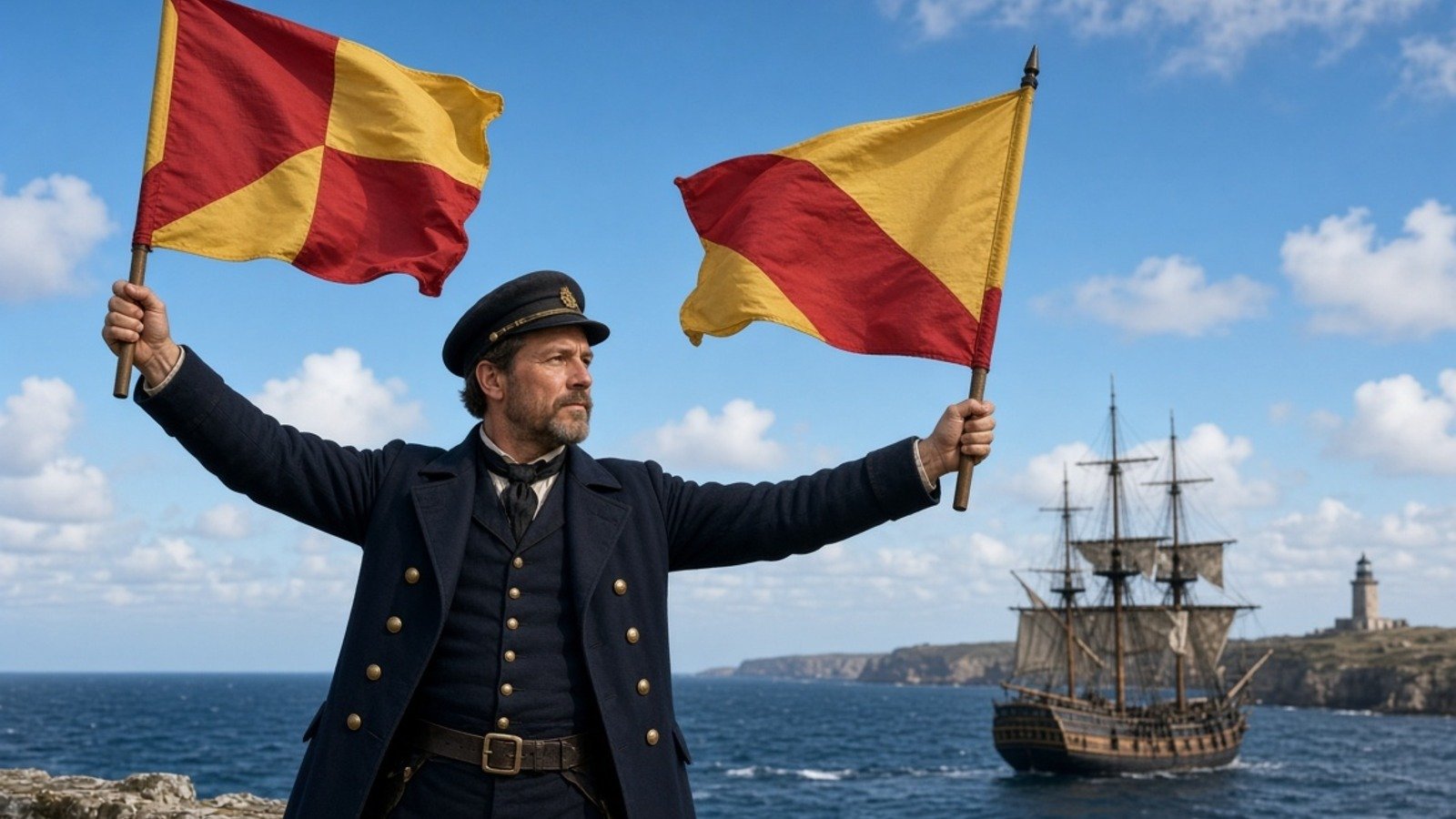
Quick answer: The semaphore flag alphabet uses two flags held at defined arm angles to signal A–Z. Each letter is a simultaneous pose, not a different coloured flag. The sender’s orientation, a clear line of sight and accurate arm positions are essential; the system is distinct from maritime ICS signal flags and Morse code.
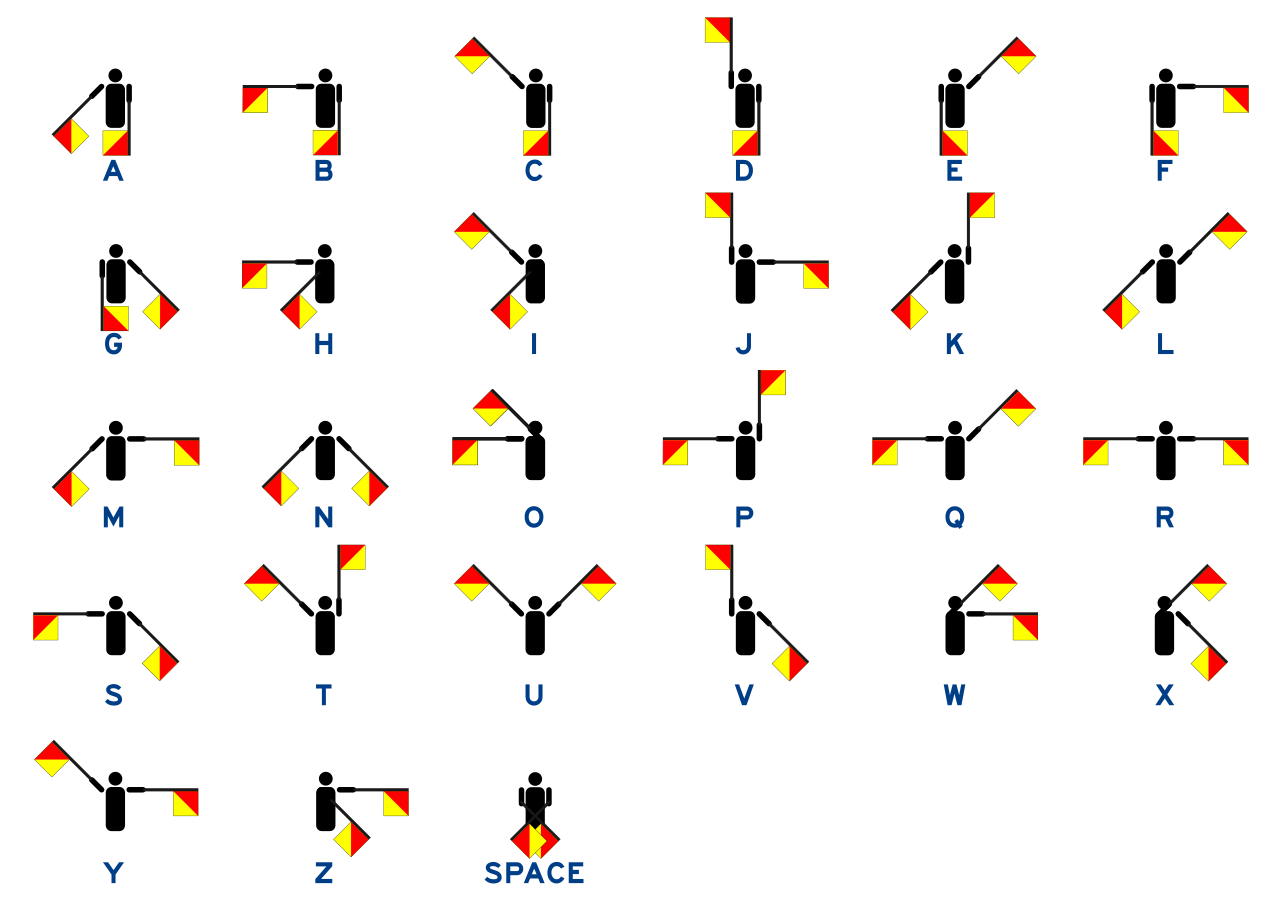
Updated 21 November 2026. This is a general educational explanation.
What is the semaphore flag alphabet?
Semaphore is a visual signalling system in which a person holds two small flags and changes their relative arm positions to represent letters or procedural signals. The message is read from the orientation of the signaller’s arms, not the unique colour pattern of each flag. A beginner’s semaphore alphabet chart normally shows an operator with two flags extended in a different combination for each Latin letter A to Z. Signal visibility, position, angle and audience viewpoint all matter.
Semaphore developed as a useful visual messaging method where people could see one another directly and needed communication without voice. It has been associated with maritime and military signalling as well as scouting and education. Unlike radio, it requires a clear line of sight and a properly trained observer. Nowadays it is often taught to demonstrate non-verbal communication, coordination and coding principles. A poster should show the positions precisely rather than replacing them with a photograph of flags hanging on a ship.
Eight directions and the logic of two arms
Imagine the signaller standing in the centre of a clock-like arrangement. Each arm can point in several clearly defined directions around the body: low diagonals, horizontal, high diagonals and vertical positions. A pair of flags forms a distinct combination. Many learner charts organise the semaphore alphabet into numbered circles or a sequence of arm positions, which can make the system seem easier to memorise. But the visual reference must also show which way the signaller faces.
A viewer looking at the signaller from the front sees left and right differently from a sender thinking in terms of their own arms. This mirror issue can reverse an instruction if a chart is poorly labelled. Always practise from a single agreed viewing perspective and compare with the approved training diagram. A diagram’s arrow or flag orientation may also be stylised; what conveys the letter is the direction of the arms. For a student practising at home, mark the sender’s left and right and avoid flipping a smartphone image while copying the positions.
Semaphore alphabet A–Z: how to learn the chart
The official semaphore alphabet contains 26 Latin-letter signals formed from pairs of positions. A recognised training reference is the US Navy’s Bluejacket’s Manual, which illustrates A–N and O–Z along with procedural signals. A basic memory strategy is to learn the early group, practise sending simple two- and three-letter words, then progressively add letters that involve overhead or crossed-body arm placements. Do not guess the meaning of a difficult letter solely from a written phrase describing the pose; the visual reference is essential.
Semaphore letters are not read by adding one raised arm to the next as a sequence of separate letters. Both arms form a single simultaneous letter position. Hold the pose long enough for the receiver to identify it, return to the appropriate rest or transition position and move to the next letter clearly. Flags can be red-and-yellow or other contrasting patterns depending on service and training context. An attractive but geometrically incorrect alphabet chart is worse than a basic verified black-and-white diagram.
Semaphore numbers and special procedure signs
Numbers may be signalled through a numeral indicator or mode according to the signalling procedure, rather than by inventing a separate unrelated twenty-seventh hand position for each digit. The Navy’s reference also illustrates special signs such as attention, error and numeral indicators. These are part of real signalling practice: a listener needs to know when a message starts, when an error is being corrected and when the sender intends a number rather than an alphabet character.
A chart showing only A–Z is useful for getting started but is incomplete for unrestricted message transmission. When writing a longer message, the operator should follow the specific training code’s conventions for spaces, corrections and acknowledgement. Do not assume that every scouting exercise, naval manual and historical signalling method uses identical procedural sequences. If the purpose is a school project, state which system you are teaching and show the exact source for procedural signs instead of adding guessed icons.
How to send and receive a semaphore word
Start with a clearly visible sender position and two flags held so the receiver can see their orientation. Agree on the distance and a simple message. Practise a short word such as SEA or MAP with a verified alphabet diagram. The sender should pause long enough for each two-arm pattern to be recognised, and the receiver should write down the letters before confirming the word. If a signal is not clear, repeat it using the agreed correction procedure rather than improvising a movement.
Wind can distort the flags, people can block the line of sight and intense sun glare can reduce visibility. Check for these problems before assuming the recipient has made a mistake. Beginners sometimes move a single flag while leaving the other hanging or rotate their whole body accidentally, causing the appearance of a different position. Practise slowly at first and use feedback. A person receiving the message should stand in a sensible viewing position and avoid looking directly into the sun behind the sender. Team exercises are best conducted in a safe open area.
Semaphore versus maritime ICS flags
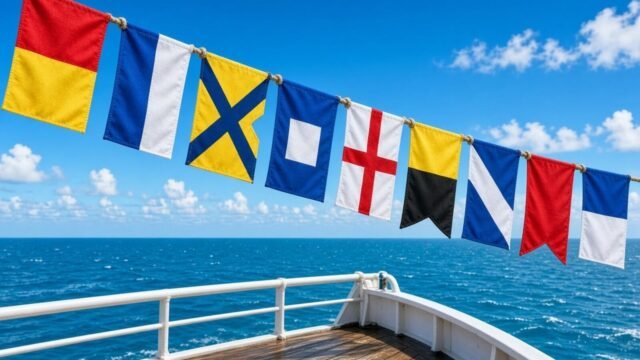
A common image-search mistake is treating semaphore flags and International Code of Signals (ICS) flags as the same system. Maritime ICS alphabet flags are individually coloured and patterned for distinct letters; when hoisted, many also carry defined standalone meanings. In semaphore, the two handheld flags can share the same design, while the arms’ relative positions encode letters. The physical flags are a visual aid for seeing the arm directions. Their colours do not mean a separate A or B by themselves.
Consequently, a nautical flag chart with twenty-six different coloured rectangles is not an accurate semaphore alphabet chart. A row of semaphore silhouettes without the correct arm positions is also not useful. If the student’s question is “What does the Oscar ship signal flag mean?”, the relevant reference is the ICS. If the question is “How do I show O using two flags?”, the semaphore reference is appropriate. Keep these two resources separate in article headings, file names and alt descriptions to prevent confusion for learners and Google Images users.
Semaphore versus Morse code and modern communications
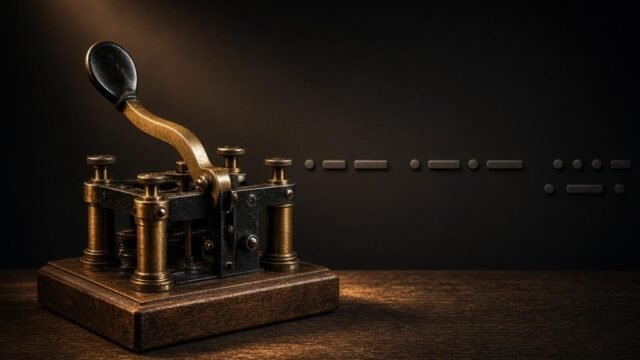
Morse code represents characters with a timed sequence of dots and dashes, delivered by sound, light or another signal. Semaphore represents characters through simultaneous arm-and-flag positions. Morse therefore requires timing recognition of sequential elements, while semaphore relies on visual recognition of a pose. Radio, digital messaging and satellite systems are widely used today, but studying the older methods helps explain information encoding and the importance of agreed rules.
Semaphore can be a fun method for teaching teamwork and attention. It should not, however, be presented as a reliable substitute for current marine emergency communications or navigation safety. Maritime officers follow approved communication systems, emergency procedures and legal requirements. Even historically, visual flag signals were limited by distance, weather and obstruction. Explaining those limitations makes the lesson more informative than claiming that two flags alone can replace a modern radio network.
Chart accuracy checklist and classroom activities
When choosing a printable semaphore flag alphabet chart, confirm that every letter from A to Z appears once. Compare challenging silhouettes against an authoritative manual; do not trust an AI image merely because it includes the right number of human figures. Check that directions are not mirrored, flag shapes are visible and special signs are clearly separated from alphabet letters. A letter’s printed name cannot rescue an incorrect arm pose, so accuracy of geometry is the main requirement.
For a classroom exercise, have learners build two simple flags from safe lightweight material. Practise A–E first with a verified model, then take turns as sender and receiver. Record which positions are easily confused and improve the visibility of the poses. More advanced learners can create a small word challenge with clear start, acknowledgment and error correction. Never use a school diagram to issue operational ship signals. If sharing the picture online, provide a short text explanation beside it and credit the source manual used for verification.
Frequently asked semaphore questions
What is the semaphore alphabet?
A set of Latin-letter signals represented by the positions of two flags held by one sender.
Does the colour of each semaphore flag indicate its letter?
No. The letter is conveyed by the relative positions of the two arms and flags.
Are semaphore flags the same as nautical signal flags?
No. The ICS uses distinctive individual flag designs; semaphore uses two held flags to create different arm positions.
Can semaphore send numbers?
Yes, under the applicable signalling procedure using a numeral indicator or mode; use its verified reference.
Can I learn semaphore from any AI-generated A–Z chart?
Check each pose against an authoritative manual first; mirrored or invented arm positions can teach the wrong alphabet.
Conclusion
Semaphore is a useful demonstration of visual coding through two-arm positions. Use a reliable official diagram, practise with one consistent viewpoint and keep protocol signs separate from the alphabet. In real maritime use, follow approved modern communication and safety procedures.
Authoritative sources
- US Navy — The Bluejacket’s Manual, semaphore figures A–Z
- US Naval History — Phonetic alphabet and flags
- IMO — International Code of Signals (different flag system)
The supplied image is illustrative. An incorrect AI-drawn flag position must not be used to teach an official signal; confirm visually with the linked manual.








Share Your Opinion
Comments are closed on this post.