 Vista

Metric screw threads normally express pitch as the distance between neighbouring thread crests in millimetres, while UNC and UNF unified inch-series threads identify their pitch by threads per inch (TPI). An M6 × 1 bolt has a nominal 6 mm diameter and 1.0 mm pitch. A 1/4-20 UNC bolt has a nominal quarter-inch major diameter and 20 threads per inch, giving a pitch of 25.4 ÷ 20 = 1.27 mm. The finer 1/4-28 UNF example has 28 TPI, about 0.907 mm pitch. These four visual charts explain the designations and why similar-looking bolts should not be forced into the wrong nut.
Updated 21 November 2026. Mechanical reference only; verify required tolerance class, mating series and service specifications for actual fasteners.
Metric and imperial thread pitch chart visuals


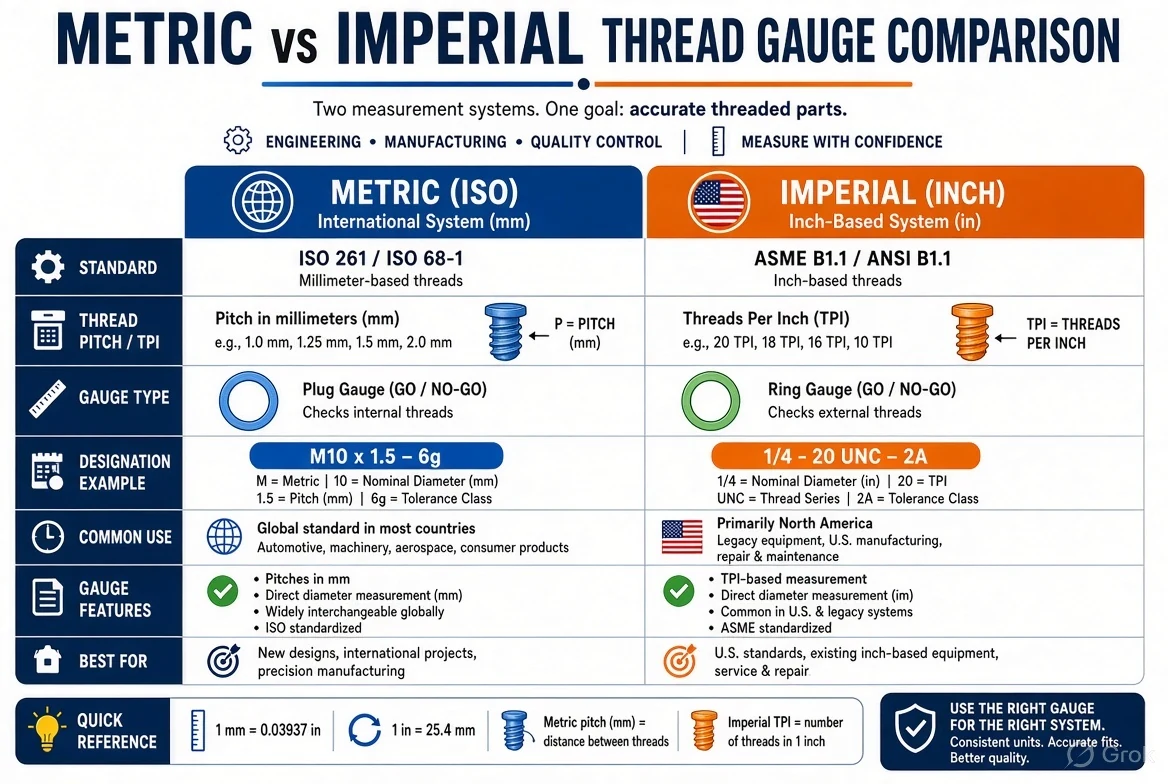
Thread pitch, diameter and TPI: three measurements to keep separate
An external screw thread is defined by several dimensions, including the nominal major diameter and the spacing of its repeated thread form. Pitch means distance from one thread crest to the next along the screw axis. For an ordinary single-start thread, the axial advance after one revolution corresponds to its pitch; multi-start thread designs can differ. For a metric fastener, the notation M8 × 1.25 states the nominal 8 mm diameter and 1.25 mm pitch.
Unified National Coarse (UNC) and Unified National Fine (UNF) denote common inch-based screw thread series. A designation such as 1/4-20 UNC states a nominal diameter of one quarter inch and 20 threads per inch. Thread pitch is not the length of the bolt and TPI is not how many complete threads are visible on a short piece. Two bolts can have a similar overall appearance but different pitch and diameter, so both dimensions must be verified.
Metric coarse threads: M3, M4, M5, M6, M8, M10 and M12
Common ISO metric coarse sizes include M3 × 0.5, M4 × 0.7, M5 × 0.8, M6 × 1.0, M8 × 1.25, M10 × 1.5 and M12 × 1.75. The first number is the nominal major diameter in millimetres, followed by the pitch. On standard drawings, a coarse designation may omit the pitch where the specification makes it unambiguous, for example ‘M8’ often denotes the usual M8 × 1.25 coarse series.
Metric fine alternatives are also common in specific assemblies. For example, M8 × 1.0 is finer than M8 × 1.25, and M10 × 1.25 is finer than M10 × 1.5. They may appear in machinery, vehicle components and specialised fittings. Even when two metric bolts have the same outside diameter, a different pitch means they are not normal mating substitutes. Check drawing notes, tolerance classes and load requirements, not just whether the screw turns once or twice.
UNC coarse thread examples: 1/4-20, 5/16-18 and 3/8-16
Common UNC fasteners include 1/4-20 UNC, 5/16-18 UNC and 3/8-16 UNC. The value before the dash is nominal major diameter in inches; the number after the dash is threads per inch. A 1/4-20 screw has 20 threads per 25.4 mm of axial length, so the pitch is about 1.27 mm. This family is frequently encountered in general machinery, fixtures and inch-system hardware.
The exact appearance of thread crests depends on pitch, tolerance, wear and manufacturing method. Do not identify a UNC thread from photo proportions alone. Also, inch bolt diameters need converting to millimetres to compare candidates accurately: 1/4 inch equals 6.35 mm, so a 1/4-inch major diameter is not the same nominal size as an M6 screw. A tap or die with the wrong thread standard can permanently damage a part.
UNF fine threads: 1/4-28, 5/16-24 and 3/8-24
For similar outside diameters, the UNF series uses a higher threads-per-inch count than UNC. Common examples are 1/4-28, 5/16-24 and 3/8-24 UNF. Since pitch is 25.4 divided by TPI, 1/4-28 gives approximately 0.907 mm between adjacent crests. By contrast, 1/4-20 UNC is about 1.27 mm. The higher TPI produces a finer thread spacing, though bolt suitability still depends on material, grade and joint design.
A fine thread may be chosen for particular adjustment or fastening requirements, but it is not automatically stronger or safer in every application. The right series depends on engagement length, material, loads, locking arrangements and engineering standards. If a part was specified as 1/4-28, substituting 1/4-20 because it shares the nominal diameter is wrong. The thread will not mate correctly and forcing it may destroy an expensive tapped hole.
TPI to millimetres conversion formula and practical examples
For a single-start thread, the relation is pitch in millimetres = 25.4 ÷ TPI. Conversely, TPI = 25.4 ÷ pitch(mm). Thus 20 TPI gives 1.27 mm, 28 TPI gives about 0.907 mm and 16 TPI gives 1.5875 mm. This conversion describes spacing only; it does not turn an inch-series thread into a metric-standard thread. Profile details, nominal diameter and tolerance may still differ.
The misleading cases are important. M6 × 1.0 is about 25.4 TPI if you convert its pitch numerically, but it is not an inch screw. Similarly, M8 × 1.25 works out to about 20.32 TPI and should not be mistaken for a 5/16-20 fastener just because a rough gauge seems nearby. Thread series need the correct nominal diameter and defined geometry. Use conversion to compare spacings, not to approve mating compatibility.
How to identify unknown screw threads with a pitch gauge
Start with a clean, safely isolated bolt or nut. Measure the outside diameter of an external thread with callipers, allowing for coating and wear. Next use a metric or inch pitch-gauge leaf that matches the crests and roots over several turns. A leaf that appears to fit only one gap but progressively drifts across later crests is probably incorrect. For internal threads, suitable calibrated plug gauges or manufacturer documentation may be more reliable than visual estimation.
Record both candidate diameter and pitch. For example, approximately 6 mm and 1 mm suggests M6 × 1, whereas approximately 6.35 mm and 20 TPI suggests 1/4-20 UNC. If you only have a ruler, counting threads over a longer measured distance can provide a preliminary clue, but small pitch differences are hard to resolve accurately. For production or safety-critical inspection, use calibrated thread gauges and applicable acceptance standards.
Four infographic charts: metric, UNC, UNF and gauge comparison
The first chart lists commonly used metric pitches for M-series fasteners. The second and third charts cover UNC and UNF designations, showing how threads per inch varies by nominal inch diameter. The fourth compares a metric pitch gauge with an imperial TPI gauge and highlights why one scale cannot be used as an automatic replacement for the other. Read each heading carefully: the labels describe different measurement systems.
A good workshop notebook has columns for diameter, series, pitch or TPI, tolerance class and the piece of equipment being repaired. Avoid mixing metric and inch fasteners in one unlabelled storage bin. If you buy a screw based only on ‘M8-ish’ or ‘quarter inch-ish’, the result can strip a thread or prevent correct clamping. The images are quick-reference aids; a verified standard or machine drawing should control your final part selection.
Important limitations: pipe threads, left-hand threads and repair safety
UNC, UNF and ISO metric M-series screws are not the same as the BSP or NPT pipe-thread systems used in many fluid and pressure connections. Pipe threads involve their own designations and in some cases taper; a generic fastener pitch chart cannot tell you how to replace a gas, water or high-pressure fitting. Left-hand threads also exist and require their own identification. Do not assume a normal right-hand screw or nut is safe just because the diameter is similar.
Automotive steering, brakes, suspension, pressure vessels, lifting devices and other high-consequence assemblies require exactly specified fastener grades, tightening procedures and fit. If the original part is stripped or damaged, do not blindly re-tap it into a convenient nearby size. Use the manufacturer’s service requirements or a competent machinist. Thread standards specify geometry, but safe design also depends on materials, torque, lubrication and joint loading.
Metric, UNC and UNF size reference tables
| Thread designation | Nominal major diameter | Pitch |
|---|---|---|
| M3 × 0.5 | 3 mm | 0.50 mm |
| M4 × 0.7 | 4 mm | 0.70 mm |
| M5 × 0.8 | 5 mm | 0.80 mm |
| M6 × 1 | 6 mm | 1.00 mm |
| M8 × 1.25 | 8 mm | 1.25 mm |
| M10 × 1.5 | 10 mm | 1.50 mm |
| M12 × 1.75 | 12 mm | 1.75 mm |
| 1/4-20 UNC | 0.25 in / 6.35 mm | 20 TPI / 1.27 mm |
| 1/4-28 UNF | 0.25 in / 6.35 mm | 28 TPI / 0.907 mm |
| 5/16-18 UNC | 0.3125 in / 7.94 mm | 18 TPI / 1.411 mm |
| 5/16-24 UNF | 0.3125 in / 7.94 mm | 24 TPI / 1.058 mm |
| 3/8-16 UNC | 0.375 in / 9.53 mm | 16 TPI / 1.5875 mm |
| 3/8-24 UNF | 0.375 in / 9.53 mm | 24 TPI / 1.058 mm |
Frequently asked questions
What is the pitch of M6?
The common M6 coarse pitch is 1.0 mm, often written M6 × 1.0.
What is the normal pitch of M8 and M10?
M8 coarse is commonly 1.25 mm; M10 coarse is commonly 1.5 mm.
What does 1/4-20 UNC mean?
Nominal 1/4 inch diameter with 20 threads per inch in the Unified Coarse series.
What does 1/4-28 UNF mean?
Nominal 1/4 inch diameter with 28 threads per inch in the Unified Fine series.
How do I convert TPI to millimetres?
Divide 25.4 by threads per inch; this converts spacing, not thread-standard compatibility.
Can M6 and 1/4-20 bolts be interchanged?
No. Their nominal diameters and pitches are different; use the specified mating standard.
Conclusion and sources
The correct thread is identified by its standard, diameter, pitch, tolerance and mating function together. A visually close alternative is not automatically interchangeable.
- Thread pitch and TPI reference examples
- Fastener thread identification and metric/coarse/fine chart
- Thread callout explanation and size tables


















Share Your Opinion
Comments are closed on this post.