 Vista

Direct answer: A Tabla Theka is a repeating pattern of drum bols that expresses a taal. Common examples include Teentaal 16 matras, Dadra 6, Keherwa 8 and Ektaal 12. The charts show familiar bol sequences and beat-group notation, explaining why one theka may have several accepted performance variations.
Updated 21 November 2026. Basic teaching notation; school and gharana versions may differ.
Tabla Theka Bols: four notation charts with matras


What is a Tabla Theka, and how is it different from a Taal?
A tabla theka is a recurring pattern of spoken or played drum syllables, called bols, used to express and identify a taal in Hindustani music. The taal is the underlying cycle of counted beats or matras, while the theka is a characteristic way of articulating that structure on percussion. This distinction matters: musicians can vary or elaborate the bols while remaining within the same cycle. Understanding both the mathematics and the sound makes a notation chart more useful than memorising a bare string of syllables.
Academic music sources such as Pustakalaya describe a taal in terms of matras, vibhags, tali, khali and theka. Our four charts compare the familiar 16-beat Teentaal, six-beat Dadra, eight-beat Keherwa and 12-beat Ektaal, followed by a division comparison. The examples are intended for beginner recognition. Tabla schools, accompaniment styles and concert situations can use different pronunciation, strokes and variations, so an online diagram should not claim that one printed sequence is the only acceptable performance version.
Teentaal Theka: the 16-matra Dha Dhin Dhin Dha pattern
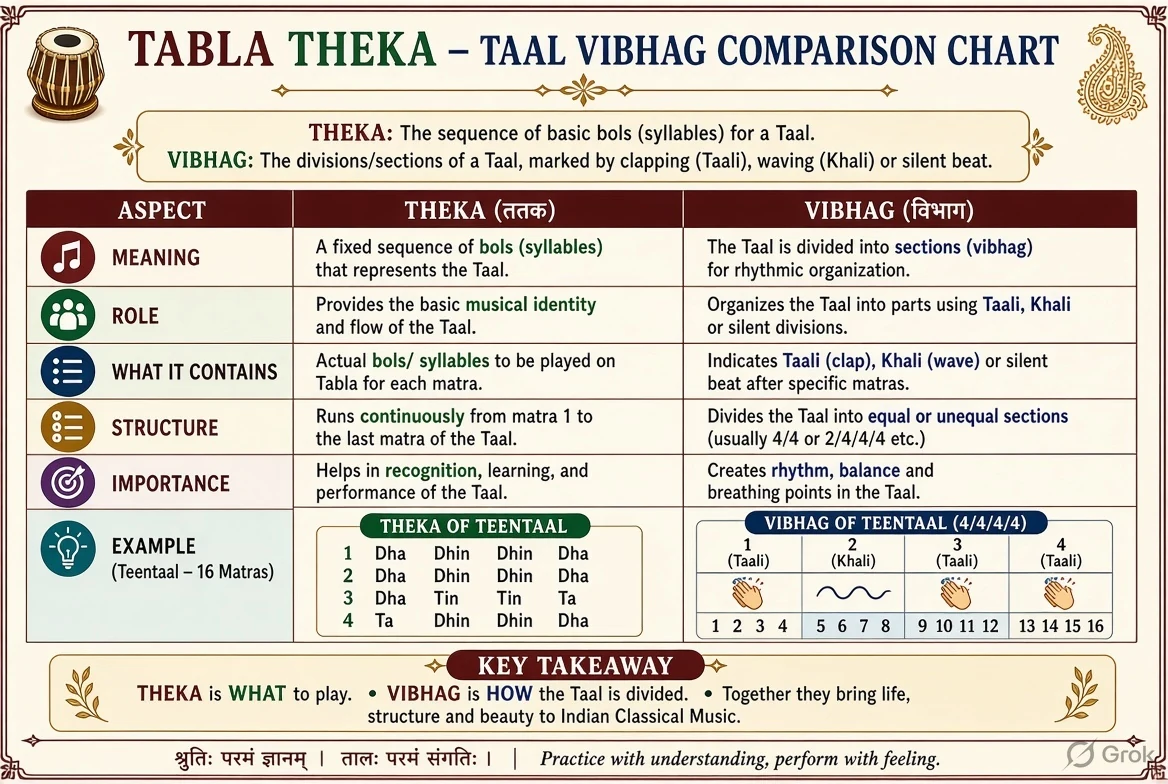
The widely taught Teentaal Theka contains 16 matras divided into 4+4+4+4. A common sequence is Dha Dhin Dhin Dha | Dha Dhin Dhin Dha | Dha Tin Tin Ta | Ta Dhin Dhin Dha. The first matra is sam, the claps mark beats 1, 5 and 13, and khali starts at beat 9. The common vibhag symbols are X 2 0 3. These markers help students see why the third group differs in its musical character despite having the same number of counted beats.
Speak all sixteen beats at a steady slow pace before trying to play. Do not skip the khali group or shorten the last division just because the first bols repeat. A table with vertical bars makes the vibhag boundaries clearer, while a recording demonstrates the tonal difference between paired drums. When preparing for a particular examination, use the theka variant prescribed by that syllabus. Our first chart is a legible reference to one common pattern; a teacher may add variations or different stroke techniques without abandoning Teentaal.
Dadra Theka: six beats, two groups of three
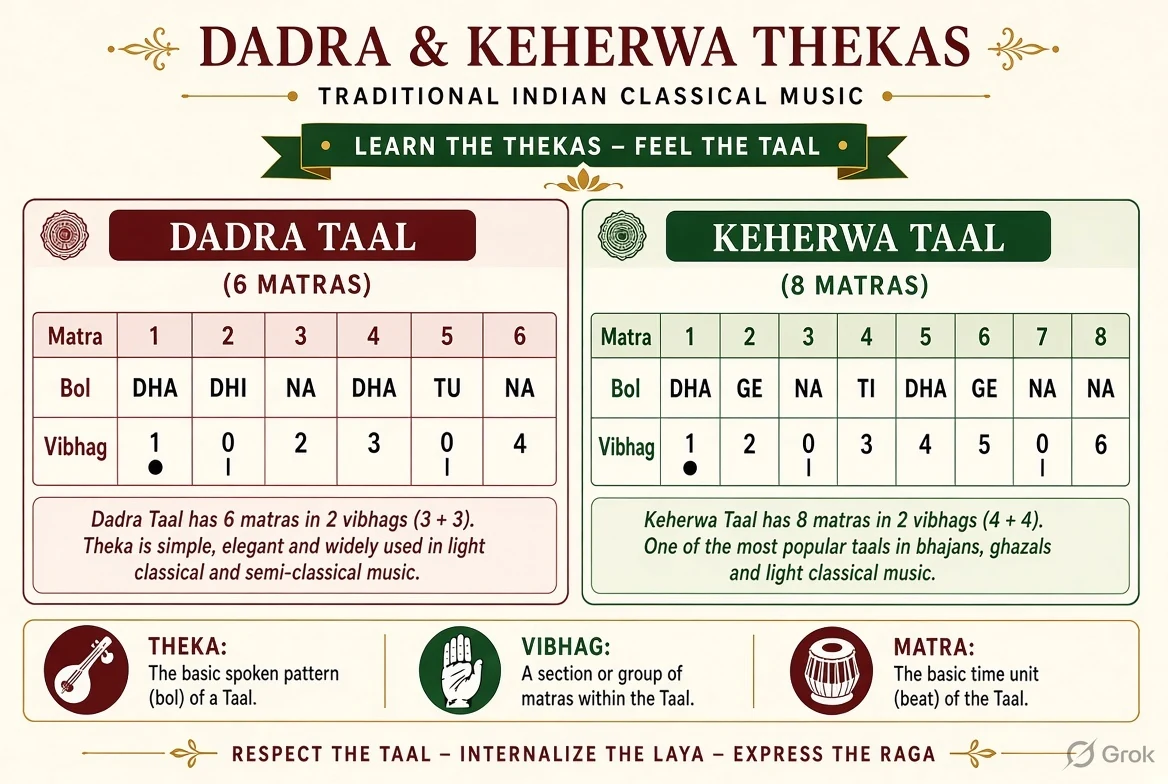
Dadra Taal commonly has six matras divided as 3+3. A familiar beginner theka can be spoken as Dha Dhi Na | Dha Tu Na, though variants such as Dha Dhin Na and other syllable choices are also taught. The first group begins with sam and the second commonly carries a khali mark. This does not mean the second three matras are silent: the drummer still keeps the beat with appropriate strokes.
For listening practice, count 1-2-3 and 4-5-6 while hearing the repeated theka. The strong return to one helps identify the cycle even when the singer uses flexible phrasing. Dadra appears in lighter classical, devotional and popular contexts, but a genre label alone cannot guarantee one identical six-beat accompaniment. Teachers may show laggi or other embellishments, which decorate the flow while the underlying cycle remains recognisable. Our second chart places Dadra next to Keherwa so students can compare the different lengths and avoid combining their bols accidentally.
Keherwa Theka: eight beats and popular accompaniment
Keherwa or Kaharwa Taal is widely taught as an eight-matra cycle in groups of 4+4. One commonly cited beginner pattern is Dha Ge Na Ti | Na Ka Dhi Na, but spellings and bol choices vary, including alternatives in folk and light-music settings. Sam is on the first beat and the second group commonly begins with a khali marker at beat five. The simple grouping can make it an approachable entry point for beginners.
Listen for the eight-beat return while keeping your hands clapping or waving at the vibhag positions. A tabla artist can introduce variations, syncopation or a faster laggi without making the cycle cease to be Keherwa. Consequently, an online “one true Keherwa bols” statement is too strict. Some arrangements may feel different from the textbook pattern because the musical genre calls for a different accent. The useful skill is to recognise the cycle and its general theka character, not to memorise one keyboard-style code and reject every live performance variation.
Ektaal Theka: twelve matras in six two-beat groups
Ektaal consists of 12 matras commonly divided into six vibhags of two beats each: 2+2+2+2+2+2. A frequently taught hand-symbol sequence is X 0 2 0 3 4, giving claps at the beginnings of the first, third, fifth and sixth divisions, with waves at the second and fourth divisions. A common theka is represented as Dhin Dhin | DhaGe Tirakita | Tu Na | Kat Ta | DhaGe Tirakita | Dhi Na. Some written bols contain several spoken syllables within one counted matra, so the number of syllable fragments is not the same as the number of beats.
Ektaal is especially important in vocal accompaniment, including some slow khayal settings. At slow laya, each matra can feel spacious, and singers may build long phrases across the twelve-beat avartan. Compare the teacher’s actual stroke positions to the chart rather than trying to force every individual phonetic syllable into its own beat. The third visual provides the overall framework; for advanced notation and technique, a trained tabla instructor should confirm the precise variant taught.
Bol, Matra, Vibhag and Avartan in tabla notation
A bol is a spoken representation of a percussion sound or combination of sounds, such as Dha, Dhin, Tin, Na, Ge or Ta. A matra is a counted beat in the cycle. A vibhag groups several matras, while an avartan is one full return through the taal. These terms are related but not interchangeable. For example, the bol Tirakita contains multiple spoken elements; depending on the context, those elements can be fitted into a rhythmic subdivision rather than treated as several separate matras.
In a simple chart, write the total matras, the vibhag divisions and the theka with bars. Place the clap or wave symbols at the correct section starts. Beginners sometimes assume every written space corresponds to a beat, which causes errors when compound bols are present. Reading the count aloud while listening to the theka is a stronger technique. Our fourth visual aligns the names of common taals with their group structures, making it easier to compare a 16-beat and a 12-beat pattern without mixing the notation conventions.
Sam, Tali, Khali: how the theka shows the cycle
Sam is the opening beat and an important point of arrival in the rhythmic cycle. Tali is a clapped group marker, while khali marks a section using a wave. The distinction is not simply about stopping the drum: a khali vibhag generally remains musically active but may have a different tonal quality or pattern of strokes. In Teentaal, the khali starts at matra 9; in Dadra, commonly at 4; and in Keherwa, at 5.
The theka helps performers hear those divisions. A student can count a full avartan while speaking the bols, placing clap and wave signs over the correct groups. If the hand gesture changes but the count continues, the student is understanding khali correctly. If the music seems to begin the cycle again too early, check whether any matras were omitted from the group. It is also useful to practise resolving a short spoken phrase on sam, which builds the ear for how a singer or instrumentalist uses the percussion framework.
Notation practice: slow counting before complex variations
To practise tabla theka notation, choose one taal and write its matra count at the top. Then group the beats using bars and put the bol sequence under them. Recite at a comfortable steady tempo, tapping or clapping each beat, and identify sam without looking at the page. Once the learner understands the complete loop, variations can be introduced through a teacher. The objective is not simply to speak faster; clear rhythmic organisation matters more than speed.
Tabla stroke technique should be taught carefully, because the hands produce different tones on the dayan and bayan. A printed bol does not show finger pressure, hand position or safe movement. If practising physically, keep wrists comfortable and stop when a stroke causes pain. Check the teacher’s pronunciation of Dha, Dhin, Ge and other combinations. Different gharanas can articulate related patterns differently, and that diversity is a reason to label study examples rather than presenting one chart as the final description of all tabla music.
Tabla theka and bols FAQs
What is the difference between a taal and a theka?
Taal is the rhythmic beat cycle; theka is its characteristic repeated percussion bol pattern.
What is the common Teentaal theka?
Dha Dhin Dhin Dha | Dha Dhin Dhin Dha | Dha Tin Tin Ta | Ta Dhin Dhin Dha.
How many matras do Dadra and Keherwa have?
Dadra usually has six and Keherwa eight matras.
How many beats are in Ektaal?
Twelve, commonly divided into six vibhags of two each.
Does Khali mean that the tabla becomes silent?
No. It marks a lighter or waved section while rhythmic counting continues.
Conclusion: count first, then play bols
Theka notation is useful only when bol sound, matra count and vibhag divisions are understood together. Learn the basic loop before moving into variations.
References for theka and bols
Pustakalaya: Tala, Theka and Rhythm; Naadabrahma: Taal Theka Library; Meend: Matras and Theka examples; Tanpura Online: Tabla Taal Chart.



Share Your Opinion
Comments are closed on this post.