 Vista

Direct answer: Mohiniyattam mudras are expressive hand gestures from Kerala’s classical dance tradition, associated especially with the Hastalakshana Deepika. Its Lasya style emphasises flowing and graceful movement. These three visual references show gestures, posture and selected names while explaining why expressions and a teacher’s corrections are essential.
Updated 21 November 2026. Illustrative diagrams, not authentic photographs of dance training.
Mohiniyattam hand mudras and Lasya: three visual charts
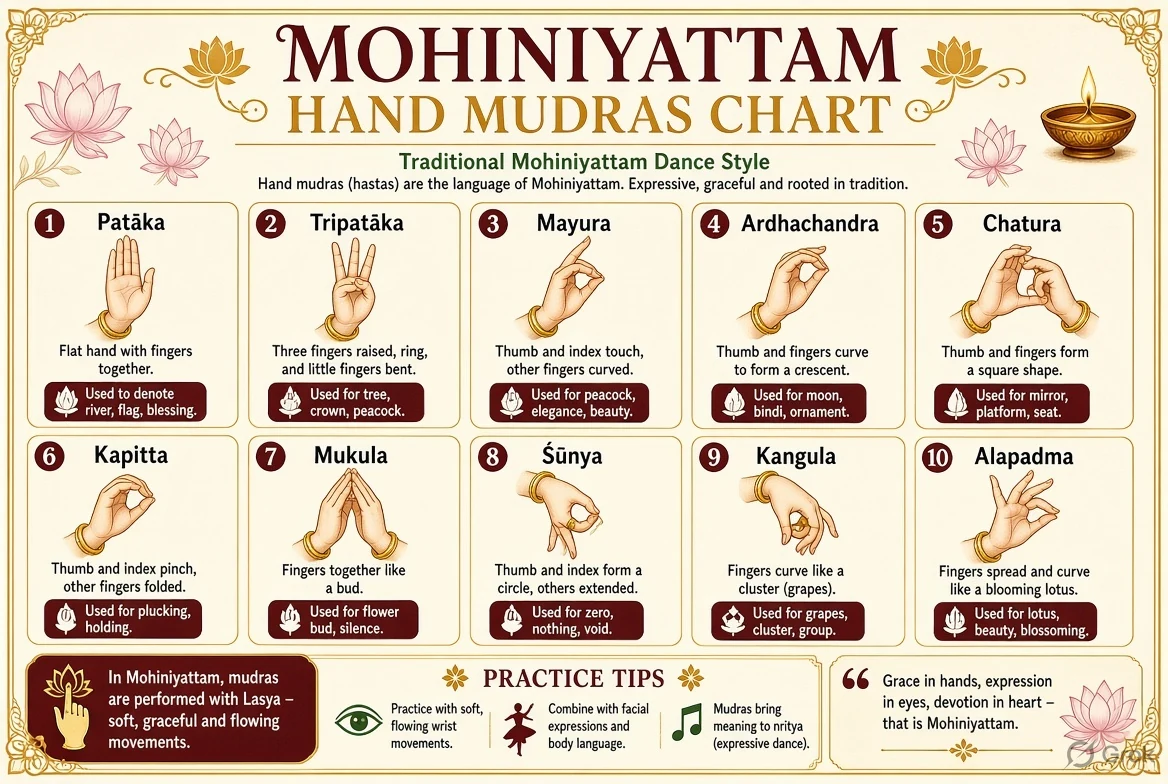


Mohiniyattam and its distinctive Lasya movement
Mohiniyattam, also spelled Mohiniattam, is a classical dance form associated with Kerala. It is particularly known for measured, flowing movement, controlled swaying of the torso, curved pathways and expressive use of eyes and hands. The descriptive term Lasya commonly refers to the gentle and graceful quality emphasised in the style. Kerala Tourism describes Mohiniyattam as an iconic Lasya dance, with circular movement and subtle gestures contributing to its recognisable performance language.
That description should not be mistaken for a rule that the form has no energetic passages or that every pose can be judged from a still photograph. Musical timing, transitions and narrative make a difference. The dancer’s physical control gives apparently soft movements their clarity. For a reader looking up “Mohiniyattam Lasya posture images,” the most useful question is how the torso, hands and gaze work together, rather than how far a beginner can bend to copy one silhouette. The illustrations here identify a few major visual ideas but are not a substitute for live instruction.
Hastalakshana Deepika and the hand gesture system
Many Kerala classical performance traditions draw on the Hastalakshana Deepika for describing hand gestures, and Mohiniyattam teaching has a particularly important connection with this text. Cultural documentation by Sahapedia also notes older gramya and other gesture traditions, so it would be simplistic to say that every historically used hand movement is contained in one school chart. A frequently taught Hastalakshana Deepika framework includes 24 basic hand signs, but counting and usage conventions should be tied to the specific textbook and guru being cited.
A named gesture is only part of the expressive language. The same finger arrangement can take different meanings when it moves, faces another direction or is paired with a second hand. Textual descriptions give names and rules, whereas a performance gives those shapes context. Our first poster illustrates the category of hand mudras for searchers learning the visual vocabulary. It does not claim to reproduce all gestures perfectly or certify every illustrated finger placement for examinations. Students should compare it with the demonstration used in their own training programme.
Reading a Mohiniyattam mudra chart responsibly
A good Mohiniyattam mudras chart identifies what can be observed: finger positions, thumb placement, palm direction and whether the gesture uses one hand or both. But a flat vector image often obscures the angle between the fingers and palm. An illustration can also be simplified to remain readable on a phone. The resulting image may be useful for revision without being sufficient for a beginner to reproduce exact technical detail. For that reason, a gesture-name poster should be treated as a memory prompt.
Before publishing a labelled diagram, verify the specific names in the dancer’s tradition. Do not randomly copy a Bharatanatyam list and call it the complete Mohiniyattam system, even though some classical dances share hand vocabulary. Sahapedia explicitly discusses the Kerala gestural sources. When a chart gives a specific viniyoga or application, the source and performance context matter. If an online image provides one English meaning for every mudra and promises that no meaning ever changes, it is teaching an oversimplified method rather than explaining expressive dance.
Lasya posture: torso, shoulders and flowing pathways
The distinctive Mohiniyattam Lasya posture is best observed as a controlled moving relationship among the feet, knees, hips, torso, shoulders and head. Gentle side-to-side or circular pathways may be used without making the dancer’s upper body rigid. Arms frame and continue the curves, and the eyes guide interpretation. Kerala Tourism’s descriptions and profiles of Kalamandalam artists stress the rhythmic softness of the movement while showing that technique requires training and coordination.
For a beginner, the goal is not to create a large spinal curve at any cost. A photograph that looks elegantly bent may conceal the weight transfer used to arrive there. Under a qualified teacher, work on comfortable balance and a gradual movement range. Avoid abrupt twisting, extreme knee positions or locked joints. The second visual illustrates a broadly graceful line but cannot predict what stance is safe for each person’s body. If an exercise is painful or causes dizziness, stop and seek an appropriate adjustment from the instructor.
How gaze, face and hand gesture create Abhinaya
Abhinaya is expressive communication in dance. In Mohiniyattam, the hands may suggest a person, action, emotion or object, while the facial expression and gaze make the intended meaning clear. A still picture of an extended palm does not disclose which lyric is being interpreted. A dancer can use the same underlying shape in distinct contexts by changing motion, direction and expression. A useful educational article therefore separates the technical gesture name from the meaning produced in a particular performance.
When analysing a genuine performance recording, observe the dancer before and after the gesture. Listen for the text being sung and note changes of gaze or posture. If a gesture seems to mean “flower” in one moment, check whether it later serves another dramatic purpose. In a classroom, a teacher can use short musical phrases to demonstrate contextual meaning more reliably than an English-only icon list. Our third chart presents a compact reference to gesture names, not a complete interpretation of every story performed through this style.
Historical development and Kerala Kalamandalam
Mohiniyattam has evolved through artists, institutional teaching and changing performance environments. Kerala Tourism documents influential figures, including Kalamandalam Sathyabhama, who contributed to the refinement and wider recognition of its performance language. Sahapedia discusses transformations associated with institutions such as Kerala Kalamandalam as well as older practices. That history is important because a current classroom syllabus cannot be presented as an unaltered manual from every earlier century.
Contemporary dancers continue to explore repertoire, music, stage presentation and new expressive concerns while preserving elements taught by their gurus. It is possible to respect this art as a classical tradition without pretending that there has never been debate or change in gesture usage. When describing a historical performance photograph, attribute it to an artist and date if verifiable. When describing a newly created visual, state that it is an educational illustration rather than an authentic performance or a documentary reconstruction of an old Kerala dance school.
Mohiniyattam costume, music and the complete stage picture
Audiences may recognise Mohiniyattam through its traditional off-white costume with gold-toned borders, restrained adornment and characteristic hairstyle. But costume alone does not establish the dance style, especially in school shows or modern photographic shoots. Movement, music, repertoire and body language are stronger evidence for identifying a genuine performance. The connection with Kerala’s musical and theatrical traditions contributes to the overall artistic experience.
Stage items may combine pure-dance elements and expressive storytelling. A viewer researching mudras should therefore ask whether the photographed hands occur during rhythmic movement or a lyric-based dramatic section. Kerala Tourism notes related gesture conventions in Kathakali and Kutiyattam, but their body language and presentation are not identical to Mohiniyattam. A poster showing only a woman in a white-and-gold costume cannot supply a complete mudra lesson. Correct image captions describe the visible detail and name the dance only when supported by the source.
Mohiniyattam vs Bharatanatyam and Kathakali
Each Indian classical dance tradition has its own performance vocabulary. Bharatanatyam, associated with Tamil Nadu, includes distinctive adavus, postures and hastas, while Mohiniyattam gives special prominence to Lasya and the fluid movement pattern. Kathakali also originates in Kerala, but its highly theatrical presentation, elaborate costumes and dramatic movement system are different. They may share some gesture terminology without using it in precisely the same way throughout a performance.
For search users, the common question “Are Mohiniyattam mudras the same as Bharatanatyam mudras?” deserves a careful answer: there are relationships between traditions, but a teacher’s text, applications and style-specific execution matter. Copying a diagram from another dance with a new label risks misleading students. Compare reliable demonstrations from both forms. Use a specific image name such as “Kerala Mohiniyattam Lasya body posture illustration” when that is actually what the picture shows.
Mohiniyattam mudras and Lasya FAQs
What are Mohiniyattam hand gestures called?
They are commonly called mudras or hastas and are used within an expressive dance language.
Which hand-gesture text is important in Mohiniyattam?
Hastalakshana Deepika is an important Kerala reference, alongside other historical practices.
What is Lasya in Mohiniyattam?
The graceful, flowing quality of movement and expression associated with the style.
Do all Mohiniyattam mudras have one fixed English meaning?
No. Applications depend on gesture direction, motion, expression and the performed story.
Can a beginner learn accurate postures using only a poster?
A poster supports recognition; safe physical technique and applications need qualified teaching.
Conclusion: a mudra needs context
The chart helps recognise hand shapes and Lasya lines, but the meaning of a gesture emerges in movement, music and abhinaya. Treat dance diagrams as a study aid, not a performance certificate.
Research and training references
Kerala Tourism: Mohiniyattam; Sahapedia: Traditions in Mohiniyattam and Hastalakshana Deepika; Kerala Tourism: Kalamandalam Sathyabhama; Kerala 365: Mohiniyattam Lasya.













Share Your Opinion
Comments are closed on this post.