 Vista
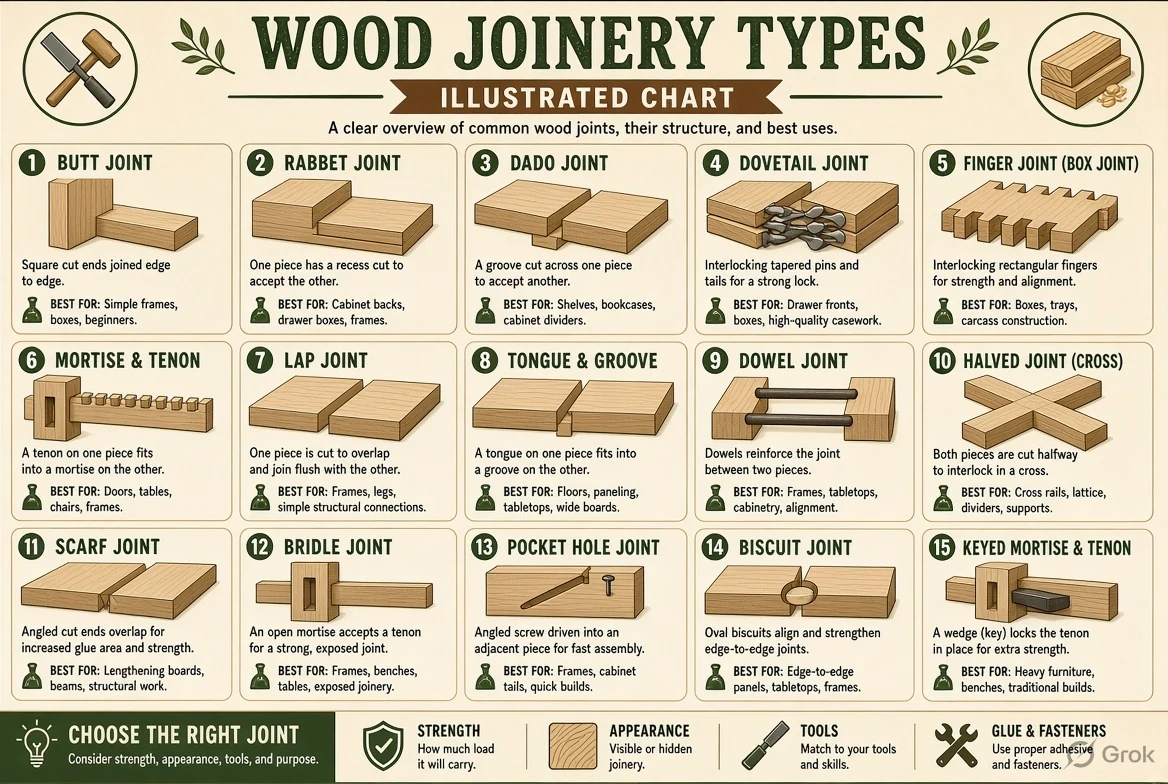
Wood joinery describes the shaped connections that hold two pieces of wood together. A dovetail uses angled tails and pins to resist pulling apart; a mortise-and-tenon joint inserts a projecting tenon into a matching hole; a half-lap removes material from overlapping pieces; a bridle joint is an open-sided tenon-and-slot arrangement; and a box joint uses interlocking straight fingers. None is universally the strongest choice for every job. Four detailed visual comparisons show how the joints differ, what their geometry accomplishes and where a beginner can practise each one safely.
Updated 21 November 2026. Joint illustrations are educational, not certified load-bearing construction drawings.
Wood joinery visual comparison gallery

Why do woodworkers use different joints?
Furniture and wooden structures face several kinds of load, including tension, shear, bending and racking. A connection that works well at a drawer corner may not be ideal for a chair rail or frame. Joinery controls how two pieces contact one another, whether long-grain glue surfaces meet, and how the connection resists movement. The grain orientation and strength of the wood are as important as the appealing shape of a finished joint.
There is a temptation to rank every joint on a single strongest-to-weakest list. That usually hides the conditions that make a comparison meaningful. A carefully fitted and suitably glued half-lap can perform well in its intended frame, while a poorly cut dovetail can fail despite looking impressive. Evaluate load direction, stock thickness, wood movement, tool availability, accuracy and whether the joint will be visible. Use the charts as a decision guide, not a substitute for design.
Dovetail joints: through, half-blind and sliding varieties
Traditional dovetail joinery uses trapezoid-shaped tails and corresponding pins. The geometry provides mechanical resistance to parts being pulled straight apart across the joint. Through dovetails expose both tails and pins at the outside corner and are often used in decorative boxes and solid-wood casework. Half-blind dovetails conceal the joint on one face, commonly used where drawer-front appearance matters. Sliding dovetails connect one board edge or tail-like projection into a matching groove.
Accurate layout is essential: mismatched slopes or uneven baseline depths can produce gaps and reduce glue contact. The angle of a dovetail is not a universal fixed number. Hardwood, softwood, hand-cut style and jig geometry influence the chosen layout. Before cutting a real drawer, practise on scraps from the same material. Learn to distinguish the characteristic dovetail silhouette from a box joint’s square interlocking fingers.
Mortise and tenon: the familiar frame joint
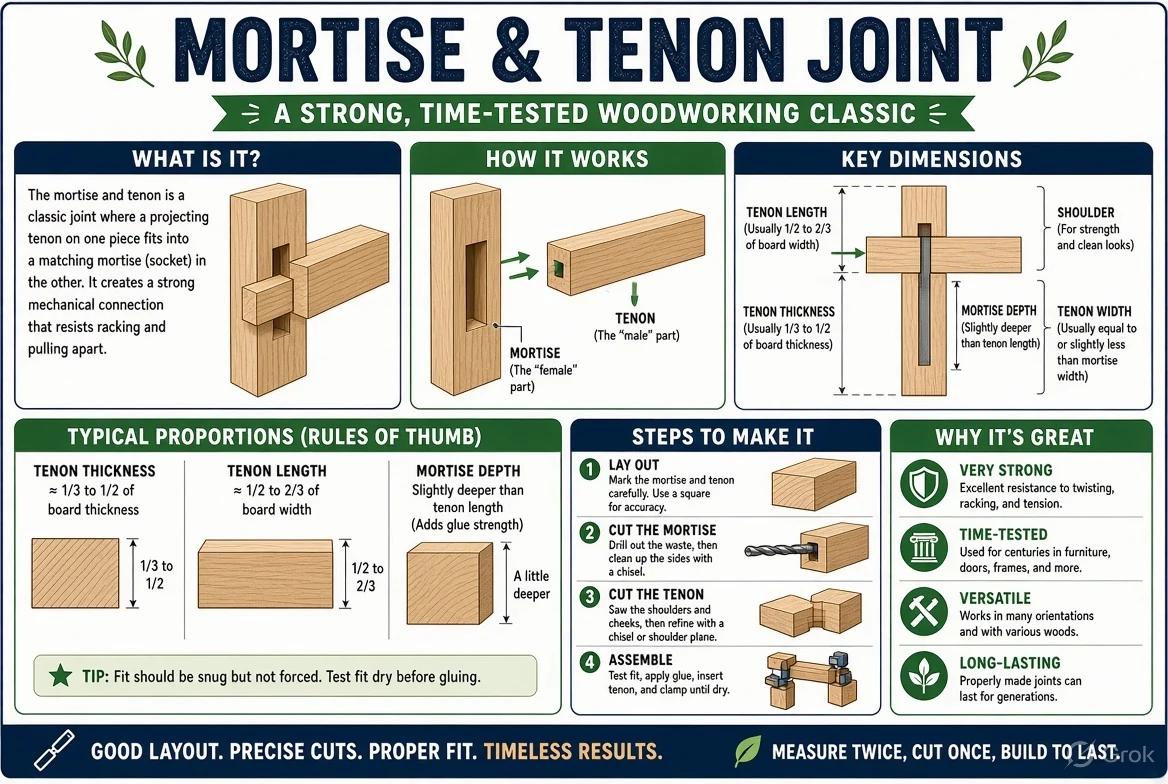
In a mortise-and-tenon connection, one member has a projecting tongue called the tenon, and the mating member contains a mortise cavity. The shoulders of the tenon can help locate the joint and resist movement under load. This layout is common in tables, chairs, doors and frame construction. Variants include blind, through, haunched, wedged and other application-specific versions. No single shoulder or tenon size works for all stock thicknesses.
A widely taught rule of thumb makes a tenon thickness around one-third of the stock thickness, but it is only an initial proportion; dimensions change with species, loads and the size of the joint. WOOD Magazine discusses sizing as a tradeoff rather than a rigid recipe. Aim for snug, not hammer-forced, fit. Dry-assemble before glue, check the frame for square, and verify that tenon shoulders contact appropriately without overstressing thin walls.
Half-lap joints: simple overlapping geometry
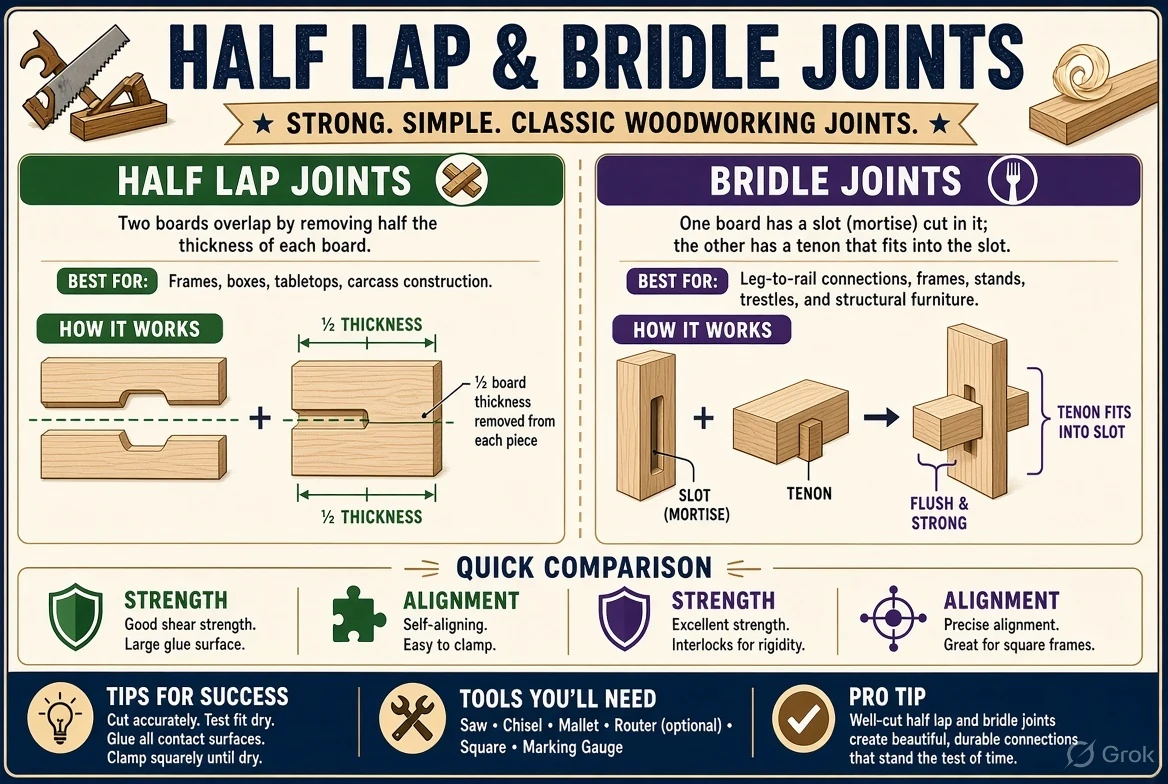
A half-lap normally reduces two intersecting members to roughly half their thickness over the overlap so their faces finish flush. The resulting broad contact area makes the joint useful for some frames, supports and workshop fixtures. Variations include end laps, T-laps, cross laps and mitred laps. Because removing material reduces each member locally, size and load direction still matter. A half-lap is not automatically safe for a structural beam.
Beginners can practise marking a consistent depth and cutting a flat shoulder with hand tools before using faster machines. Check the overlap after dry fitting: if one half is thicker, the frame will twist or the surfaces will stand proud. Glue a sample only after the pieces meet cleanly. WOOD Magazine’s half-lap examples show how small inaccuracies create visible steps and why test cuts are valuable before committing project stock.
Bridle joint: an open-ended mortise-and-tenon relative
A bridle joint resembles an open mortise or slot that receives a corresponding tongue across the end or edge of a member. Its exposed surfaces make it relatively straightforward to inspect during fitting, which is useful in selected frame corners and light joinery. Corner bridles, T-bridles and related configurations are not identical: each changes which faces bear load and where end grain is exposed. The specific application should dictate the shape.
Cut parallel cheeks and shoulders carefully. A joint that is loose may rack; one that is excessively tight can split a thin wall. Clamping pressure should close the joint rather than distort the frame. Bridle joints often display their construction, so clean lines can be part of a project’s visual design. This also means accuracy matters: a saw mark or out-of-square cut can remain obvious after finishing.
Box joints and finger joints: when are they different?
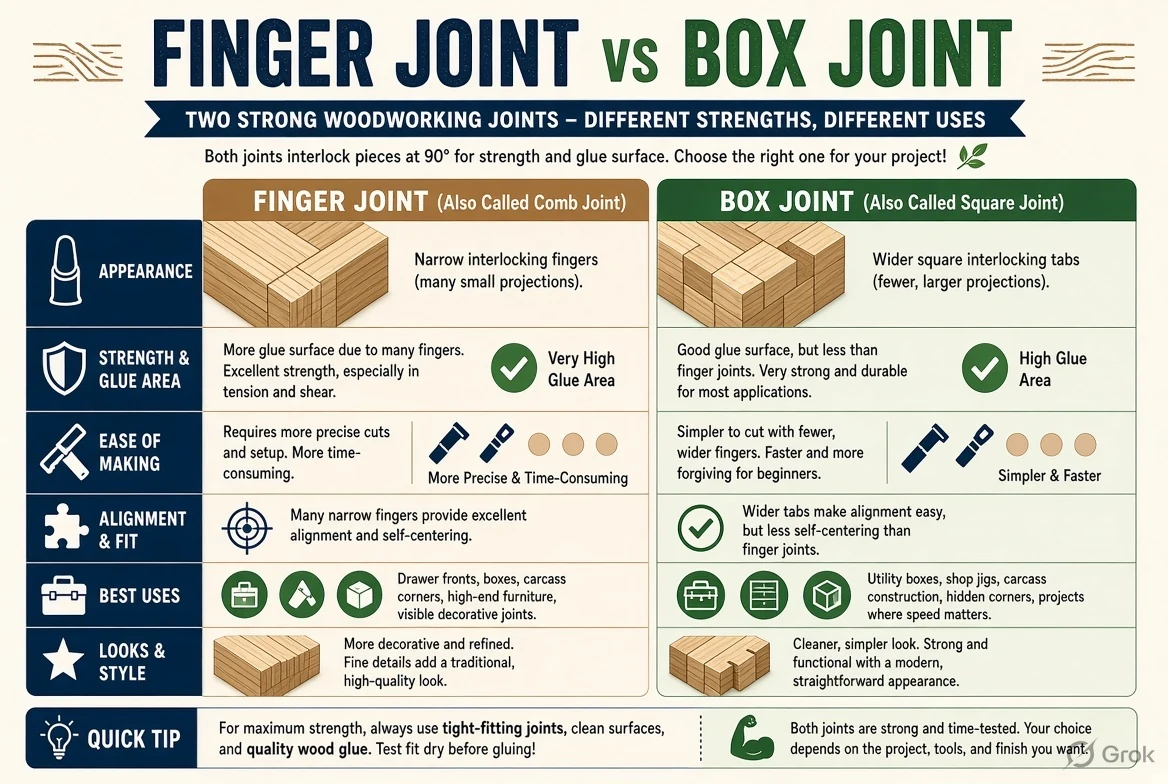
Box joints use straight, often regularly spaced fingers on two boards, producing a corner with many interlocking glue faces. They are common in wooden boxes and some drawers. The term ‘finger joint’ is also used for this style of square-finger corner joinery, but in other contexts it can describe small end-to-end scarf-like teeth used to join lengths of timber or manufacture engineered stock. Check the context before treating the two terms as always identical.
Unlike dovetails, simple box-joint fingers do not themselves create angled mechanical resistance to pulling apart. Their success typically depends on well-cut contact surfaces and suitable adhesive, plus the orientation of the joint and loads. A jig can help produce regular spacing. Finger width is not the sole determinant of strength. Material type, glue choice, fit and exposure conditions influence the result.
Which wood joint is best for a table, drawer or picture frame?
A table leg-to-rail connection commonly invites mortise-and-tenon or a properly engineered alternative because it must resist racking and bending. A decorative drawer may use dovetails or suitably made box joints. A simple workshop frame might use half-laps where broad overlap and a straightforward cut are valuable. A light picture frame may employ mitres with reinforcement or other appropriate joinery. The selection is based on load and construction, not a single universally superior joint name.
If making chairs, stairs, railings, overhead fixtures or load-bearing furniture, use proven designs rather than experimenting with an untested attractive joint. Wood movement in solid timber also matters, especially with large panels and seasonal humidity changes. Do not glue a wide panel in a configuration that restrains natural cross-grain movement without an appropriate design. Ask an experienced woodworker or qualified designer when the finished piece supports people or substantial weight.
Four joinery diagrams and a beginner practice sequence
Our first visual compares dovetail patterns, followed by mortise-and-tenon anatomy. The third figure explains half-lap and bridle layouts, while the fourth contrasts finger/box-joint forms. Look for the direction of the wood grain, the surfaces actually in contact and the cuts that remove supporting material. These simplified illustrations help learn joint names, but they are not cut lists, strength calculations or machine-safety instructions.
For a practical notebook, begin with a 90-degree half-lap scrap project. Then make a small box-joint corner and compare its fit with a hand-cut dovetail sample. Follow with a mortise-and-tenon practice piece, dry-fitting before glue. Inspect each test: are faces flush, shoulders square, glue gaps controlled and fibres undamaged? Use appropriate eye and hearing protection, dust extraction, clamps and blade guards for your particular tools. Never hold small stock dangerously close to a moving cutter.
Wood joints: quick project reference
| Joint | Main geometry | Example project |
|---|---|---|
| Dovetail | Angled tails and pins | Box and drawer corners |
| Mortise and tenon | Tenon inside corresponding cavity | Tables, doors and frames |
| Half lap | Reduced-depth overlapping faces | Some wooden frames |
| Bridle | Open slot and tongue | Selected corner frames |
| Box joint | Straight interlocking fingers | Box corners |
Frequently asked questions
What is the difference between a dovetail and box joint?
Dovetails use angled tails and pins; box joints use straight square fingers and usually rely heavily on glue and fit.
What is a mortise and tenon joint used for?
It is common in furniture and frame assemblies such as tables, chairs and doors.
Is a half-lap always the strongest joint?
No. Its strength depends on stock, geometry, adhesive and the loading situation.
Are finger joints and box joints identical?
Sometimes the names overlap for box corners, but ‘finger joint’ can also mean end-to-end length joints.
Can a beginner cut a bridle joint by hand?
Yes, with proper marking, safe hand tools and practice on scrap stock.
Do diagrams tell me how much weight a joint can hold?
No. The complete design, material and testing determine load capacity.
Conclusion and specialist references
A wood joint should be selected to match the real load, board geometry, available tools and assembly technique. The chart is most useful alongside careful practice and correct woodworking safety procedures.
- WOOD Magazine comprehensive joinery guides
- WOOD Magazine mortise and tenon sizing
- WOOD Magazine half-lap joint techniques
- Lee Valley basics of cutting woodworking joints












Share Your Opinion
Comments are closed on this post.