 Vista
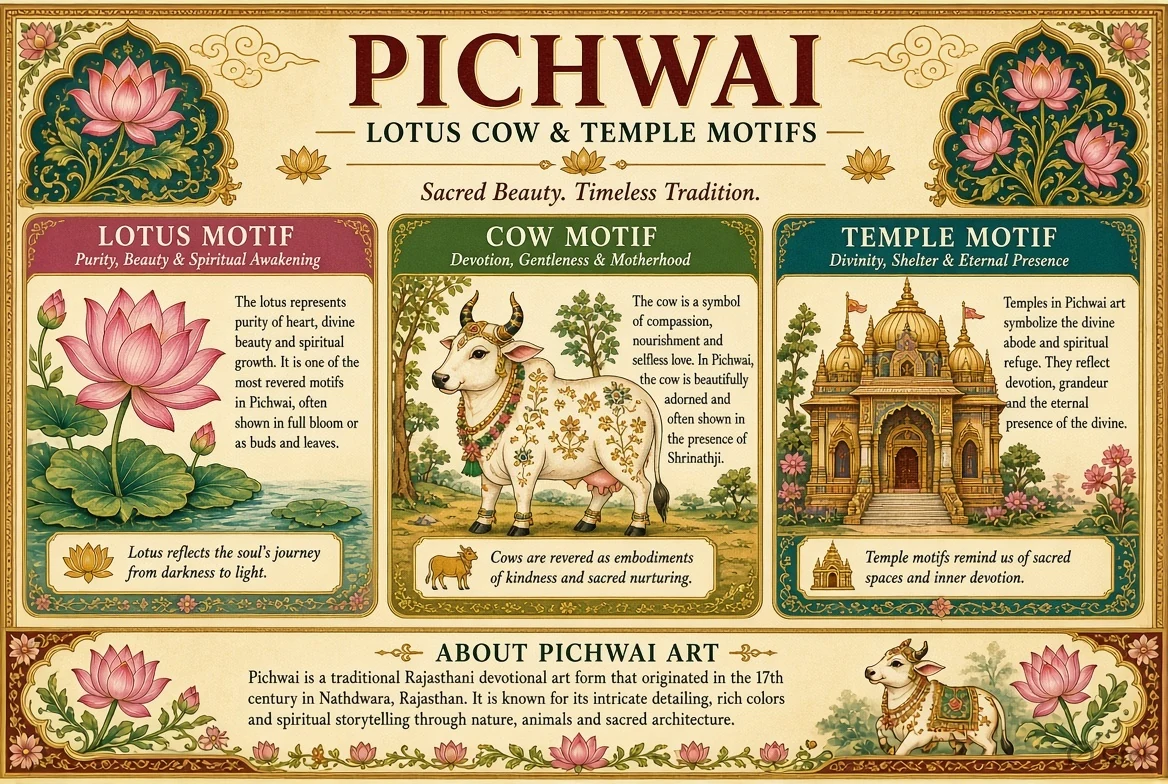
Direct answer: Pichwai painting motifs include Shrinathji, lotus ponds, cows and calves, temple borders and seasonal settings. The Nathdwara tradition developed around painted cloth displayed behind the deity; a modern cow-and-lotus illustration is not automatically a historic temple hanging. These four charts compare the forms and meanings with proper artistic context.
Updated 21 November 2026. Charts are illustrative, not verified photographs of an original temple Pichwai.
Pichwai lotus cow and temple motifs: four visual reference charts



What is Pichwai painting and why is Shrinathji central?
Pichwai or Pichhwai painting is a painted-textile tradition closely associated with the Shrinathji temple at Nathdwara, Rajasthan. The painted cloth was historically displayed behind the image of Shrinathji, a form of Krishna particularly important to the Pushtimarg tradition. The word is connected with a cloth hanging at the back of the deity. Such works help establish the setting for worship and seasonal observances. This history explains why an original Pichwai is not simply a modern image with a lotus and cow placed near a Krishna figure.
Scholarship documented by Impart and Google Arts & Culture describes the Nathdwara school as a living artistic practice shaped by temple patronage, workshops and changes in taste. Paintings may include Shrinathji, cows, lotus ponds, peacocks, gopis, ornamental borders and festival imagery. A scene’s emphasis can depend on the occasion or patron. Our illustrations are subject-identification references rather than photographs of authenticated temple hangings. When researching a genuine work, consider its material, maker, size, period and ritual purpose before assigning a date.
Pichwai lotus motifs: ponds, petals and summer scenes
Pichwai lotus flower motifs are among the most visually searchable elements of Nathdwara paintings. Lotus flowers can surround the central deity, form a continuous pond setting or occupy a decorative border. Some paintings prominently present pink lotus blooms with green leaves and water, providing a cool visual atmosphere. Museum and craft references note that lotus-pond imagery can be associated with seasonal settings, particularly summer, but not every artwork with a lotus can automatically be dated to a given month or festival.
A lotus shape is best described in relation to the complete painting. Is it under the feet of Shrinathji, behind the figure, arranged as a border or repeated across a water scene? Each position changes the composition. A generic Pichwai lotus pattern chart can teach rounded petals, layered leaves and background repetition, but it cannot certify the religious meaning of an unlabelled antique. In image ALT text, use the visible subject rather than saying that every lotus guarantees prosperity or that a digital picture came from the temple.
Cows and calves in Shrinathji Pichwai iconography
Pichwai cow and calf motifs are closely connected with Krishna’s pastoral identity and the devotional world depicted around Shrinathji. White or patterned cows may fill the background or stand in ordered groups around the central figure. In some works they help create a sense of Vrindavan and the life of Krishna, while other paintings concentrate on the beauty of the animals themselves. The specific placement and colour choices can depend on the painter and the devotional setting.
A painting containing a cow is not necessarily a Pichwai, and a cow placed beside an anonymous deity cannot establish Nathdwara provenance. The comparison image in this guide introduces cows and calves as recognisable motifs, but its educational drawing is not an authentic temple icon. For a genuine textile, consult a catalogue and check whether Shrinathji is the central figure, what the accompanying animals represent in that composition and whether the piece is a historic hanging or a newer collector-oriented artwork.
Borders and temple decoration in Pichwai art
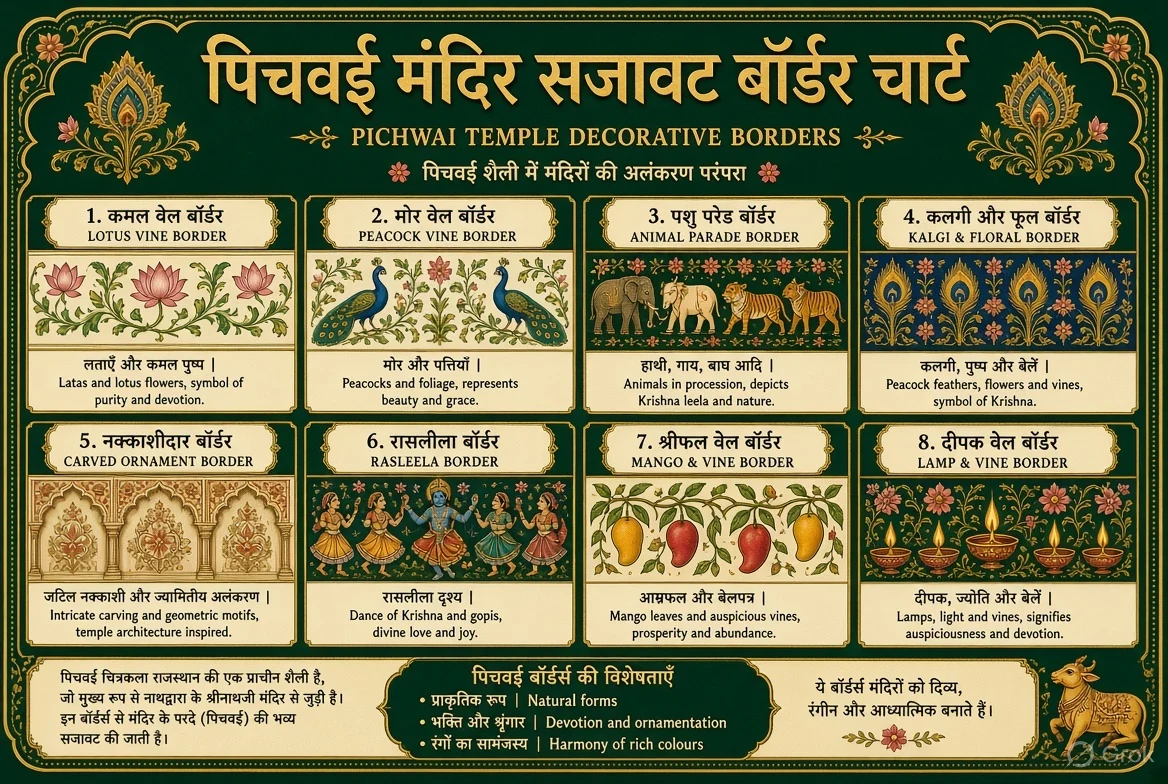
Large Pichwai textile borders can include floral vines, lotus chains, repeated decorative units and fine outlines. Their function is not just to decorate the edge: a border establishes a clear frame for Shrinathji and can support the visual atmosphere associated with the season or festival. Some painters use multiple border bands and small details that echo the central scene. What looks like a simple frame in a thumbnail can be an important part of the overall painted structure.
Study the corner transitions and the proportion of the central image to the surrounding decoration. If a border is too dominant, it may distract from the icon; if it is too narrow, the whole cloth can feel visually unfinished. Different historic workshops and later artists made different aesthetic choices. An educational Pichwai border exercise can explore these principles without copying a living painter’s entire composition. Label diagrams as modern references and identify original textile photographs as such when credible documentation is available.
Monsoon, lotus ponds and Sharad Purnima: seasonal Pichwai
Seasonal Pichwai paintings can reflect changes in temple adornment. Sources on Nathdwara visual culture describe monsoon themes featuring peacocks, lotus-pond scenes for warm weather and full-moon imagery for Sharad Purnima. These examples show how the environment of devotion can be presented through flowers, clouds, animals and colour. Yet a single decorative peacock does not prove that a textile was produced during monsoon or commissioned for a particular historical festival.
Look at the full context, including Shrinathji’s attire, accompanying decorations and the museum or maker’s title. The Smithsonian’s National Museum of Asian Art has investigated historic Pichwai materials, demonstrating that actual pigments and textile construction can reveal information beyond what a smartphone photograph shows. Our seasonal comparison graphic helps readers recognise common visual settings but cannot substitute for a specific museum attribution. Avoid captioning all blue-coloured Pichwai backgrounds as a named ritual without supporting evidence.
Materials, pigments and careful identification of originals
Historic Pichwai works often use prepared cloth, controlled drawing and mineral or organic pigments. Some examples incorporate precious metal detail or other costly materials. The Smithsonian National Museum of Asian Art’s conservation work demonstrates that analysing pigment and support can reveal artistic experimentation and complicated histories. Such evidence is stronger than the common internet claim that every authentic Pichwai must contain an identical fixed list of naturally extracted colours.
Modern producers also make Pichwai-style paintings on paper or canvas, prints and digital patterns for homes and commercial interiors. These are different product categories. If purchasing an expensive work, ask whether it is hand-painted, a reproduction or a digitally printed decoration, and request information on the artist, condition and provenance. Do not try to test pigment on an old cloth using water or solvents; doing so can irreversibly damage it. A professional conservator should inspect valuable or fragile historic textiles.
How Nathdwara painting changed across generations
It can be tempting to portray Pichwai as one completely unchanged form from centuries ago. Google Arts & Culture notes that Nathdwara artists developed distinctive idioms and creatively adapted their work across the nineteenth and twentieth centuries, responding to new media, patronage and public demand. Workshops maintained devotional subjects while experimenting with visual presentation. This history is part of the tradition’s strength, not a reason to dismiss newer paintings as inherently inauthentic.
Artisans and collectors also use the term Pichwai in contemporary markets more broadly. A modern decorative cow-and-lotus picture may be inspired by the visual tradition without having the same purpose as a cloth hung behind Shrinathji. Accurate descriptions should say whether a work is a temple hanging, a workshop painting, an inspired illustration or a printed reproduction. That distinction helps users find trustworthy visuals and supports original artists instead of uncredited digital copying.
Pichwai versus Pithora, Madhubani and other Indian arts
Several regional traditions feature cows, flowers, trees and devotional themes. Pichwai is distinguished by its Nathdwara–Shrinathji temple-hanging context. Pithora is associated with Rathwa community ritual wall paintings and prominent horses. Madhubani or Mithila painting is linked to its own regional drawing traditions and dense decorative fills. Kalamkari is an Andhra-associated textile drawing and block-printing tradition. Recognising the material and iconographic setting is more reliable than identifying an art form by one animal or flower.
A peacock and lotus alone cannot establish authorship or origin. When publishing a Pichwai image chart, avoid applying the keywords “Rathwa ritual horses” to a Nathdwara textile or passing a digital Krishna picture off as a historical temple artifact. More specific terms—Shrinathji Pichwai lotus, cow-and-calf iconography, temple hanging border—answer the reader’s actual question. Classification works best when supported by a museum catalogue, a named maker or a credible regional history.
Pichwai lotus and cow motifs FAQs
What does Pichwai mean?
The term is associated with a painted cloth displayed behind Shrinathji in Nathdwara worship.
Why are cows common in Pichwai?
They relate to Krishna’s pastoral world and may form part of a Shrinathji devotional setting.
Does every Pichwai show a lotus pond?
No. Subjects and decoration can change with season, festival and painting context.
Can a printed canvas be called an original Pichwai?
It should be clearly described as a reproduction or Pichwai-inspired print, not handmade original cloth painting.
How do I identify an antique Nathdwara Pichwai?
Compare iconography, textile support, pigments, maker history and credible catalogues; an image alone is insufficient.
Conclusion: read the full temple image
Pichwai motifs make sense in the full Shrinathji textile and its devotional season. Attribute the maker and distinguish historic temple hangings from new decorative illustrations.
Research sources
Impart: Pichhwai and Nathdwara; Google Arts & Culture: Living Pichwai tradition; Smithsonian: Identifying the Pichwai Painter’s Palette; Gaatha: Pichwai Art of Nathdwara.





















Share Your Opinion
Comments are closed on this post.