 Vista
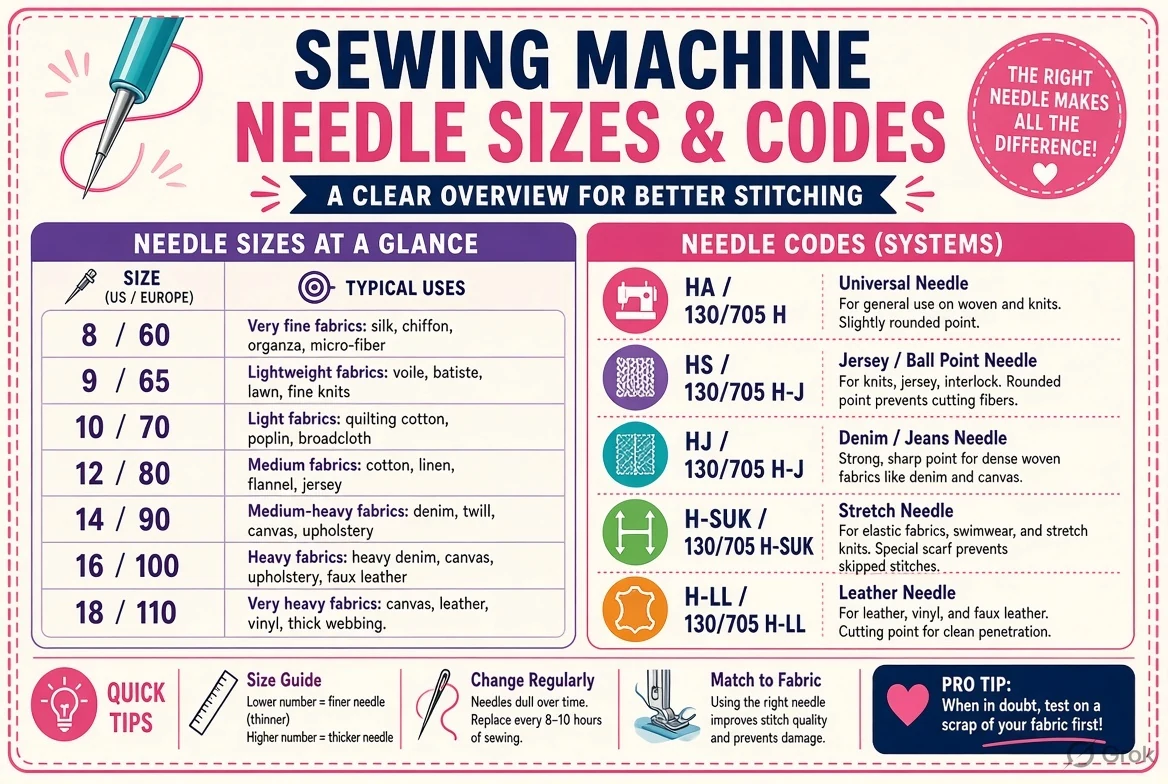
Sewing machine needles are identified by both a size and a needle system or type. A label such as 80/12 contains a metric number and an approximate American size for the needle blade; the 130/705 H system identifies a widely used flat-shank household-machine needle family. Needle type matters too: universal, jersey/ballpoint, stretch, jeans, Microtex and leather needles have different points or constructions. Our four diagrams compare needle sizes, common types, system markings and fabric suitability so you can check the right needle before sewing.
Updated 21 November 2026. Refer to your machine manual and the needle manufacturer’s latest guide before choosing an exact needle.
Needle size and fabric identification diagrams

What does 80/12 mean on a sewing machine needle?
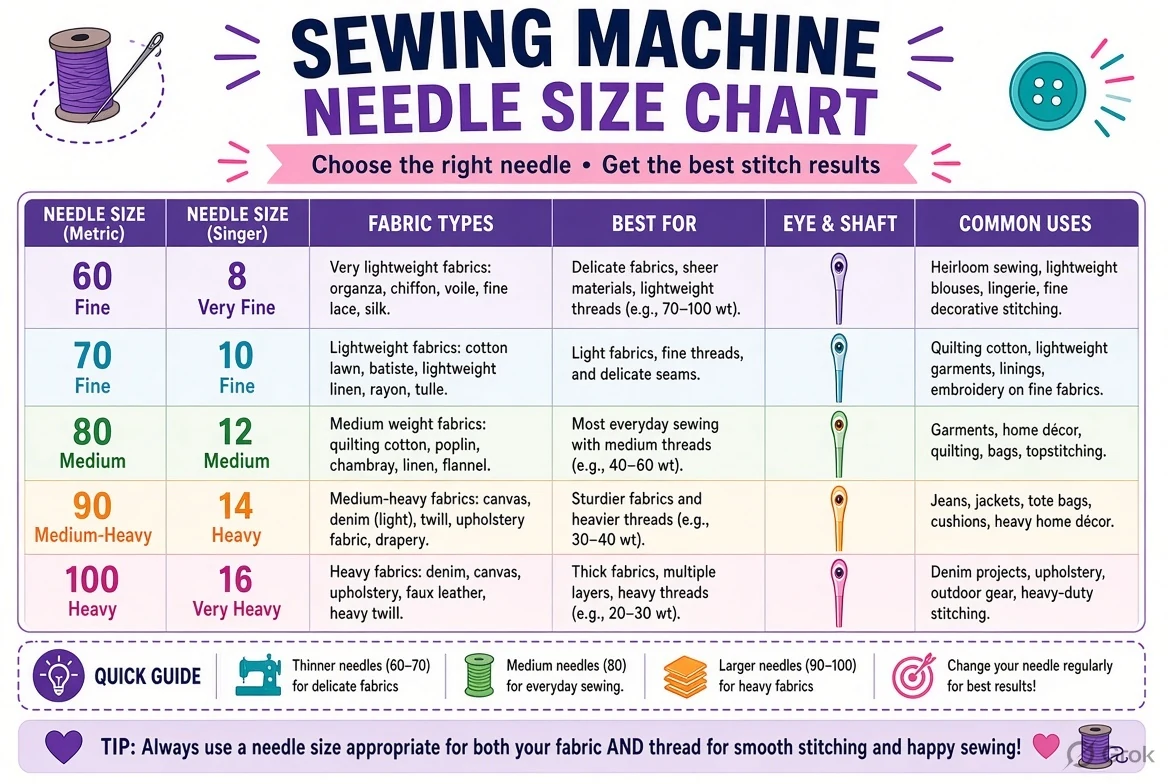
Most household needle packs show two related size systems. The first number, such as 70, 80, 90 or 100, is a metric size commonly understood as the blade diameter in hundredths of a millimetre. In that scheme size 80 corresponds to around 0.80 mm nominal needle diameter. The number after the slash, such as 12 in 80/12, is a corresponding US-style size designation. These pairs let sewists recognise roughly how fine or sturdy a standard needle is.
Typical combinations include 60/8, 70/10, 80/12, 90/14, 100/16 and 110/18. Higher numbers usually mean thicker needles, but choosing the biggest one is not automatically safer or better. A needle that is too thick can leave unwanted holes in delicate fabric, while one that is too fine can bend or break on thick seams. Fabric structure and thread size are important considerations alongside thickness.
Needle system 130/705 H: what the flat shank tells you
The 130/705 H family is a very common household sewing-machine needle system, often associated with a shank that is flat on one side for consistent orientation. You may also see commercial equivalents or related labels such as 15×1 in catalogues, but the machine manual should control the final system choice. Many industrial and specialty machines require entirely different needle systems even when the needle sizes sound similar.
The system number and blade size answer different questions. 130/705 H identifies the overall needle system and mounting requirements, while 80/12 describes size. Add a type designation, for example a stretch or jersey variant, and the packet tells you more about how the needle point and scarf are designed. Never assume every household needle fits a serger, embroidery-only unit or industrial lockstitch machine without the model’s guidance.
Universal needle versus jersey or ballpoint needle
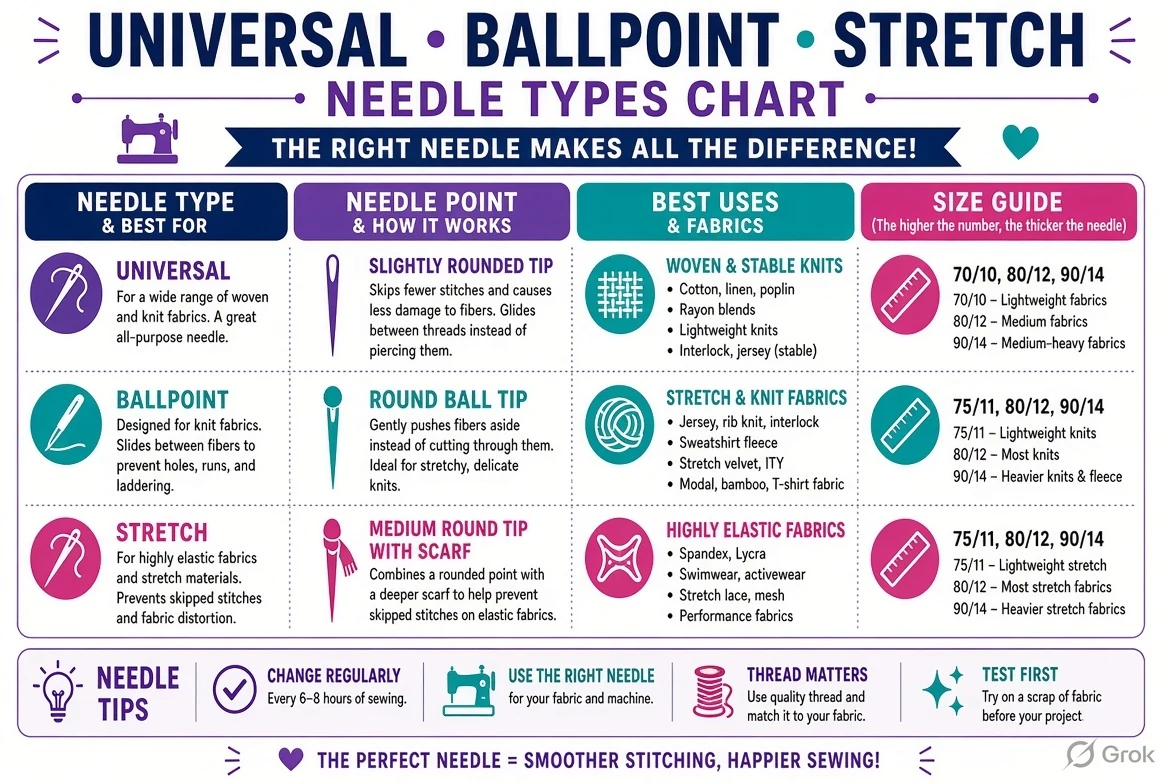
A universal needle has a slightly rounded point designed for many stable woven fabrics and certain routine sewing tasks. It is commonly found in starter packs because a general-purpose needle handles uncomplicated seams on cotton shirting and similar fabrics. A jersey or ballpoint needle has a more rounded point intended to slip between yarn loops of knits rather than cut through them unnecessarily. The exact point geometry varies by product family.
If your knit fabric develops small holes along a seam, switching from an unsuitable point to a suitable jersey/ballpoint needle may help. But needle size, speed, seam stretch and material quality can contribute as well. Not every knit wants the same needle: a soft cotton jersey and a very elastic sports fabric can behave differently. Test one or two needle types and inspect the stitched sample before cutting the final garment.
Stretch needles: why elastic knits may skip stitches
Stretch needles are often designed with a point and scarf arrangement better suited to highly elastic fabrics. They can improve stitch formation where a universal or basic ballpoint needle has frequent skipped stitches, for example on stretch jersey, swimwear fabrics or some synthetic blends. The exact product differs across manufacturers, so use the needle maker’s specific fabric recommendations rather than treating all stretch needles as identical.
A needle change is often the first test, but not the only one. Re-thread the machine, use a suitable elastic or stretch stitch, consider the selected thread and stabilise the seam if needed. If the needle pulls the fabric down into the needle plate, the problem might relate to foot pressure, stitch plate or material handling. Carefully change one variable at a time, so you can tell what actually solved skipped stitches.
Jeans, Microtex, leather, embroidery and topstitch needles
Jeans or denim needles are engineered for tightly woven or dense fabrics and may have reinforced construction. Microtex needles have sharper, precision-oriented points that are useful in certain tightly woven or fine synthetic fabrics. Leather needles often have cutting points designed for suitable non-woven leather applications; that cutting action is normally inappropriate for ordinary knitted fabric. Embroidery and topstitch needles may alter eye shape and construction to work with specialised threads.
The correct selection is not a contest over which needle looks sharpest. A leather needle can permanently cut fibres where a rounded jersey point would be safer, and a heavy denim needle may damage silk or lightweight fabric. Even within ‘denim’ and ‘leather’, thickness and surface finish vary greatly. Follow the fabric maker and needle maker’s recommendations, use test scraps and check for damaged yarns or enlarged stitch holes.
Fabric compatibility chart: a practical starting point
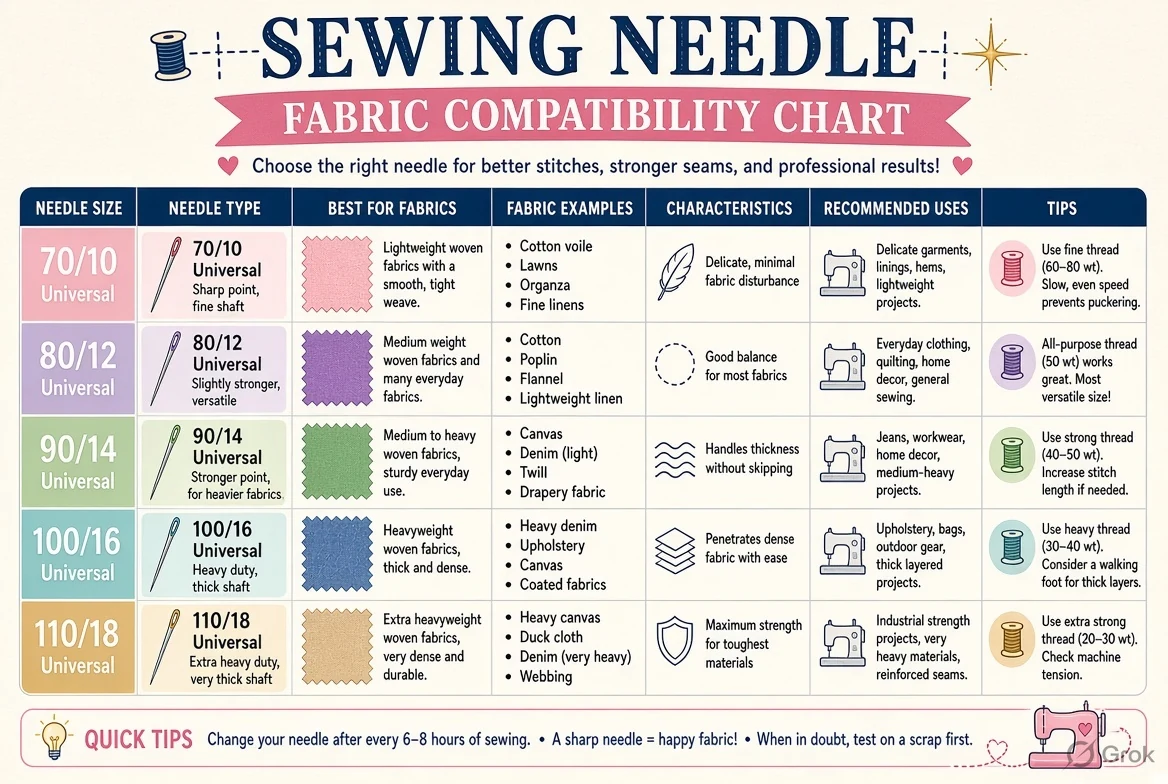
A light, tightly woven voile may suit a fine universal or Microtex needle such as 60/8 or 70/10, depending on thread. Many ordinary cotton wovens work with 70/10 or 80/12 universal needles. Medium-weight blends and fabrics can call for 80/12 or 90/14. Thick denim seams often need a jeans-type needle in an appropriate stronger size, such as 90/14 or 100/16. Elastic knit garments may call for jersey or stretch point designs rather than changing size alone.
These are starting examples, not mandatory universal combinations. A thick elastic fabric still needs an appropriate point and enough needle strength; a delicate stretch knit might benefit from a finer stretch needle. Machine capacity matters. Do not force layers through a motor that struggles, and never try to hand-push thick fabric close to a moving needle. The accompanying fabric chart should be used with your machine’s allowed needle-size range.
How to read needle labels and colour bands
Needle packets usually state system, size and purpose. Some brands also mark the upper part of the needle with colour bands that encode needle type and size. SCHMETZ, for example, publishes needle guidance and colour-code material, but users must follow the specific maker’s chart rather than memorising a colour as a universal standard. A blue band on one product line should not be assumed to mean exactly the same thing everywhere.
If the original packaging has been discarded, inspect an unidentified needle carefully, but do not use it in a machine until its system and condition are known. Slightly bent, blunt or burred needles can cause thread shredding, skipped stitches and damaged fabric. A fresh needle of known type is often less costly than repairing torn cloth. Keep new needles organised with packets or marked cases.
Needle replacement, installation and troubleshooting
Switch off the machine, raise the needle to its highest position and follow the machine manual for releasing and installing the needle. The flat shank must face the intended direction for that machine, and the needle should be inserted fully into the clamp and secured properly. A loosely seated needle can shift or strike the plate. After changing it, rotate the handwheel slowly to verify clear movement before sewing at speed.
Needles gradually wear during use and can be damaged by striking pins, the presser foot or needle plate. If you hear clicking, see fuzzy or skipped stitches, or notice snagged fabric, stop and inspect the needle and threading. Frequent bending or breakage can point to the wrong size, incorrect foot, fabric forcing or alignment trouble. Replace the needle with an appropriate intact one and seek machine servicing when the fault persists.
Sewing needle size and fabric quick-reference table
| EU/US | Nominal blade diameter | Example suitable projects* |
|---|---|---|
| 60/8 | 0.60 mm | Very fine fabric, with appropriate point and thread |
| 70/10 | 0.70 mm | Lightweight woven |
| 80/12 | 0.80 mm | Ordinary woven / medium projects |
| 90/14 | 0.90 mm | Medium-heavy woven, denim depending on construction |
| 100/16 | 1.00 mm | Heavy fabrics with appropriate jeans needle |
| 110/18 | 1.10 mm | Some heavy tasks within machine’s rating |
*Illustrative starting points; choose fabric-specific needle point, thread and machine capacity.
Frequently asked questions
Is 80/12 a common sewing machine needle size?
Yes, it is a widely used medium household-needle size, but the best choice depends on fabric, thread and machine.
What does 130/705 H mean?
A commonly used flat-shank household sewing needle system, not a fabric-weight measurement.
Which needle should I use for jersey fabric?
A suitable jersey/ballpoint or stretch needle depending on knit elasticity and the maker’s recommendations.
What is the difference between 90/14 and 100/16?
100/16 is a thicker needle size than 90/14 in the common metric/US numbering pairs.
Do industrial machines use 130/705 H?
Many industrial machines use different systems; consult the exact model manual.
Can I keep using a bent needle?
No. Replace damaged needles to avoid breakage, fabric damage or machine collision.
Conclusion and references
Needle size, needle type and needle system are three separate checks. Start from fabric behaviour and the sewing-machine manual, then select a fresh, correctly installed needle.
- SCHMETZ official household needle guide
- SCHMETZ official product information
- SCHMETZ needle type reference



Share Your Opinion
Comments are closed on this post.