 Vista

Direct answer: Pithora painting motifs are part of a living ritual wall-art practice especially associated with the Rathwa of Gujarat and related communities. The most visible forms are colourful horses, riders, animals and village scenes, whose roles depend on community narratives rather than one universal symbol dictionary. Four illustrated reference charts explain what can be identified reliably.
Updated 21 November 2026. These visuals are educational representations, not authenticated photographs of a specific household ritual.
Pithora painting motifs: four illustrated charts

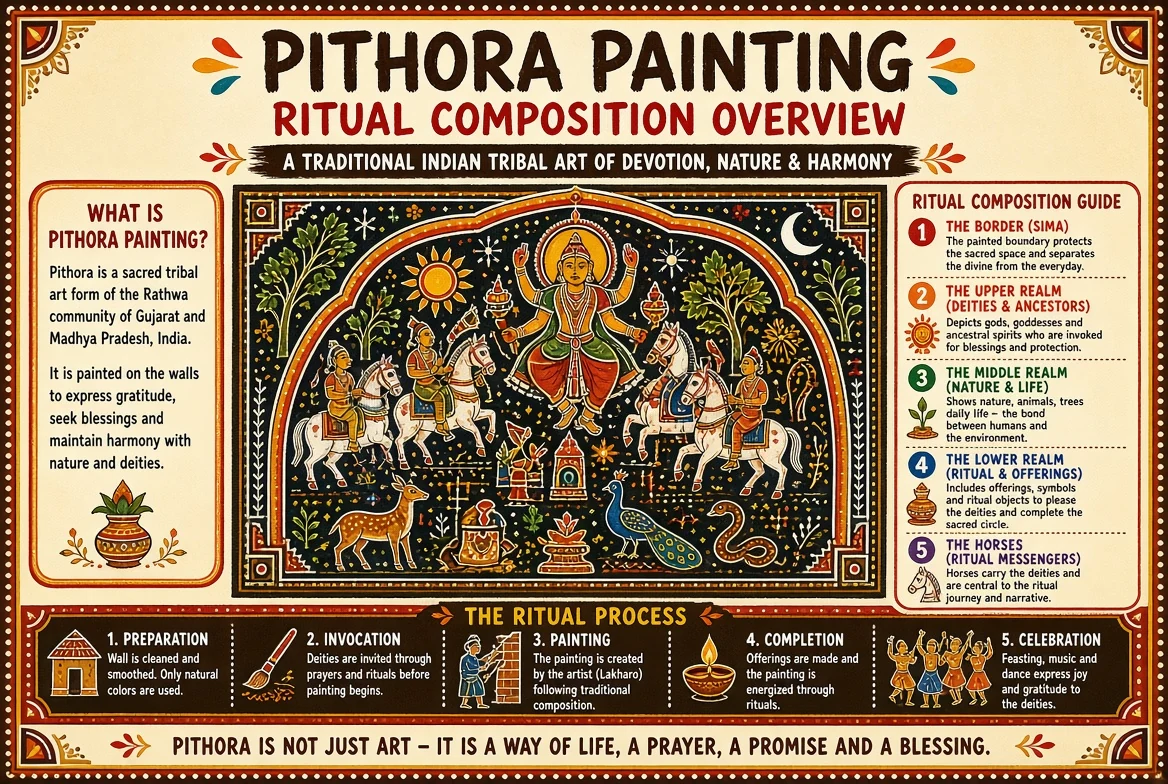

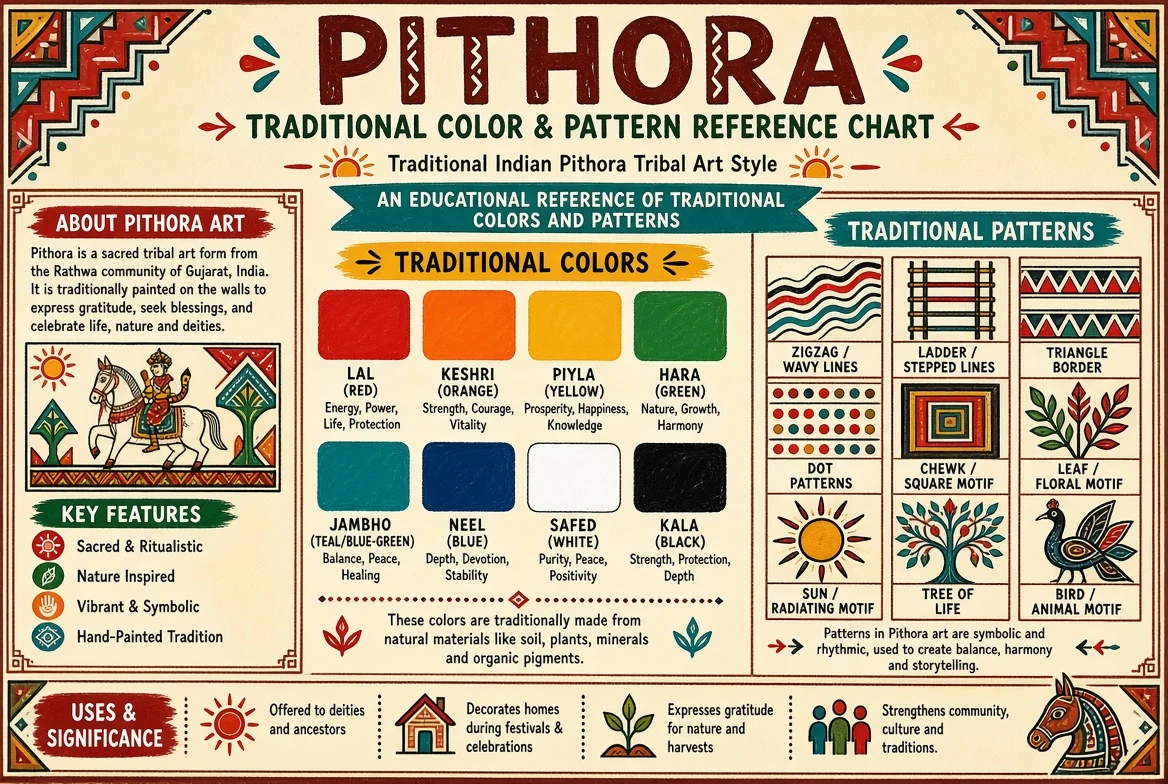
Pithora painting: a living Rathwa ritual tradition
Pithora painting is a ritual wall-painting practice associated with Rathwa communities of eastern Gujarat, with related traditions among Bhil and Bhilala communities in western Madhya Pradesh. It is widely recognised for colourful horses and riders, along with animals, people and scenes from lived experience. In many traditional settings, the mural is created within a household ritual involving Baba Pithora rather than simply being a framed illustration bought for interior decoration. Government and cultural research sources describe the painting as both a visual narrative and a performed social practice.
The distinction matters when searching for Pithora painting motifs and meanings. An isolated horse in an online graphic cannot be decoded reliably without knowing where it appears in the complete composition, which community made it and which story or ritual was being represented. Modern artists may also create Pithora-inspired art for galleries and craft markets. Those expressions should not be confused with a ritually commissioned domestic mural. The four diagrams on this page introduce recognizable forms; they are not a reproduction of a specific sacred painting.
Why horses dominate a Pithora mural
Pithora horse figures form a prominent visual element, often painted with riders and arranged as part of a wider symbolic group. Documentation from Sahapedia and the Ministry of Tribal Affairs discusses how particular horses can correspond to named characters in ritual narratives. However, there are variations in the number of horses and the details of who appears in a particular painting. For instance, Sahapedia distinguishes a smaller Ardho Pithora arrangement from fuller compositions. A generic caption such as “every Pithora painting contains exactly seven horses” would hide those variations.
Some descriptions connect the mural with the marriage of Pithora and Pithori or with other local deities and associated figures. Rather than assigning an invented universal “horse equals wealth” meaning, identify the horse within the source artwork when a practitioner or scholar gives a documented interpretation. Our first visual chart illustrates the structural role of mounted horses but does not give each drawn horse an official identity. This makes the reference useful without presenting a modern illustrative pattern as a ritual map.
The ritual roles of Lakhara, Badva and the householder
Traditional accounts refer to lakhara as the painters or ritual specialists who paint or “write” the Pithora, and a badva/badwa as a ritual specialist or priest who helps guide and interpret the work. The household also plays an active part in preparing for the occasion. Cultural records describe painting as an event shaped by relationships, vows, gratitude and community practice rather than an individual hobbyist’s decorative session. These roles explain why simply copying a composition from an image search does not recreate its cultural function.
The Impart overview stresses that the reading by the ritual specialist gives the painted arrangement meaning and sanctity in its community setting. Different communities and occasions can have their own conventions; it would be inaccurate to prescribe one authoritative ritual procedure for all readers. If you encounter a genuine Pithora mural, ask about the maker, household and local tradition before publishing a detailed “symbol dictionary.” For a school project, study the motifs respectfully and clearly label the activity as inspired art, not an authentic ceremonial commission.
Horses, elephants, birds, trees and village-life scenes
Beyond horses, Pithora painting motifs can include elephants, birds, cattle, snakes, trees, farming, people, houses and activities reflecting village life. The Ministry of Tribal Affairs’ ADI Kalakar entry documents a wide range of named and everyday elements within a Pithora painting, illustrating the richness of the composition. A peacock is not automatically a generic auspicious emblem in every mural, and an elephant may have a character-specific position in one community account. The arrangement is part of the meaning.
When looking at a chart, first distinguish the subject’s physical form from a claimed translation. A drawing of an animal can be identified confidently as an elephant without knowing the exact role that elephant has in the represented ritual. This distinction is especially important for English SEO pages, which sometimes present every folk-art animal as a one-word charm for love or prosperity. A responsible description explains what the reader can see and where the historical interpretation comes from.
Composition, wall surface and use of colour
Pithora murals are traditionally associated with carefully prepared domestic wall surfaces and vivid painted figures. The colours help separate horses, riders, plants and events in a large composition that may span a substantial area. Artists can use brushes and different natural or contemporary materials depending on the region and context. The official Incredible India feature discusses the practice of Lakhara painters using brushes made from bamboo shoots or local twigs in traditional accounts. Yet material descriptions vary, and modern portable versions may use paper or canvas.
The fourth diagram shows colour relationships and repeated motifs as a visual study, not a compulsory palette. There is no need to declare that every sacred horse must always be a particular colour without a community-specific source. Nor should a basic craft exercise advertise itself as a genuine consecrated Pithora simply because it imitates the colours. The artistic qualities of a contemporary rendition can be appreciated while keeping the cultural distinction visible to readers.
Full Pithora and Ardho Pithora: why versions differ
Researchers of Rathwa Pithora traditions describe different scales or types of mural, including the term Ardho Pithora, commonly translated as half Pithora. These differences can relate to ritual circumstances and the number or placement of figures. A brief visual chart cannot fully capture how a particular household decides on or conducts an event. Online tutorials that demand one exact count of horses or one universal wall layout oversimplify a complex living practice.
For anyone planning to identify a historical Pithora painting, the correct question is not merely “how many horses are drawn?” It is also “which community made this, for what occasion, and how was it interpreted?” A modern decorative painting may legitimately borrow the broad look of the style while omitting ritual components. Use clear labels such as “Pithora-inspired educational illustration” in that case. Respectful attribution makes a visual article more informative than an uncredited template pretending to be a complete ceremonial guide.
Pithora art vs Warli, Gond and Madhubani painting
These Indian visual traditions have their own histories and are not interchangeable labels. Pithora is especially associated with the Rathwa ritual mural and its groups of painted horses. Warli painting from Maharashtra is famous for geometric people and tarpa dance scenes. Modern Gond painting often uses patterned animals, trees and dot-line textures; Madhubani or Mithila painting often has dense decorative borders, linework and distinct local styles. Such comparisons help beginners navigate visual searches but cannot replace maker attribution.
Some museums collect works from several of these traditions, and contemporary artists may explore new media, colours or subjects. A single horse or tree may appear in multiple art forms. Do not classify it as Pithora based only on the object shown: check composition, treatment, locality and source. When naming photographs and image ALT text, “Rathwa Pithora horse figures” is more precise than the vague “Indian tribal secret symbols.” It directs searchers to the correct community and reduces misinformation about regional heritage.
How to study Pithora motifs without copying ritual art
Begin with a properly attributed published mural or museum record and identify which features you can see: the horses, their riders, other animals, the layout and the relationship to the wall. Keep notes about the cultural source. A student drawing exercise could practise bold horse silhouettes and grouped movement, but should not claim to recreate a household ceremony or assign specific spiritual powers to its elements. If using someone else’s photograph or contemporary artwork, respect image rights and cite the creator.
Artists and communities should remain central when their visual forms are used commercially. Ask permission where appropriate, seek original work from artisans and distinguish an artist-made craft from a mass-produced imitation. Do not present AI-style illustrations as a documentary photograph from a real Rathwa ritual. The best informative poster makes the reader curious about the tradition and provides accurate references rather than encouraging superficial copying of a sacred household event.
Pithora painting FAQs
Where does Pithora painting come from?
It is strongly associated with the Rathwa of eastern Gujarat, with related Bhil and Bhilala traditions in western Madhya Pradesh.
Why are there so many horses in Pithora art?
Horses and riders are central to many ritual narratives, but identities and arrangements depend on the specific tradition.
Who are the Lakhara and Badva?
Traditional accounts describe painters known as Lakhara and a ritual interpreter or specialist called Badva or Badwa.
Does every Pithora painting use an identical number of horses?
No. Fuller and smaller arrangements, including Ardho Pithora, are documented.
Can Pithora motifs be used in school art?
They can be studied respectfully, with clear labels for contemporary educational illustrations and proper cultural attribution.
Conclusion: understand the mural in context
Pithora is a living community practice, not a generic secret-symbol pack. Appreciate its horses and rich visual compositions while respecting the artists and ritual knowledge that give the images meaning.
Sources and community references
Sahapedia: Pithora of the Rathvas; Impart: Pithora ritual wall painting; Ministry of Tribal Affairs: ADI Kalakar Pithora; Incredible India: Pithora painting.




















Share Your Opinion
Comments are closed on this post.