 Vista
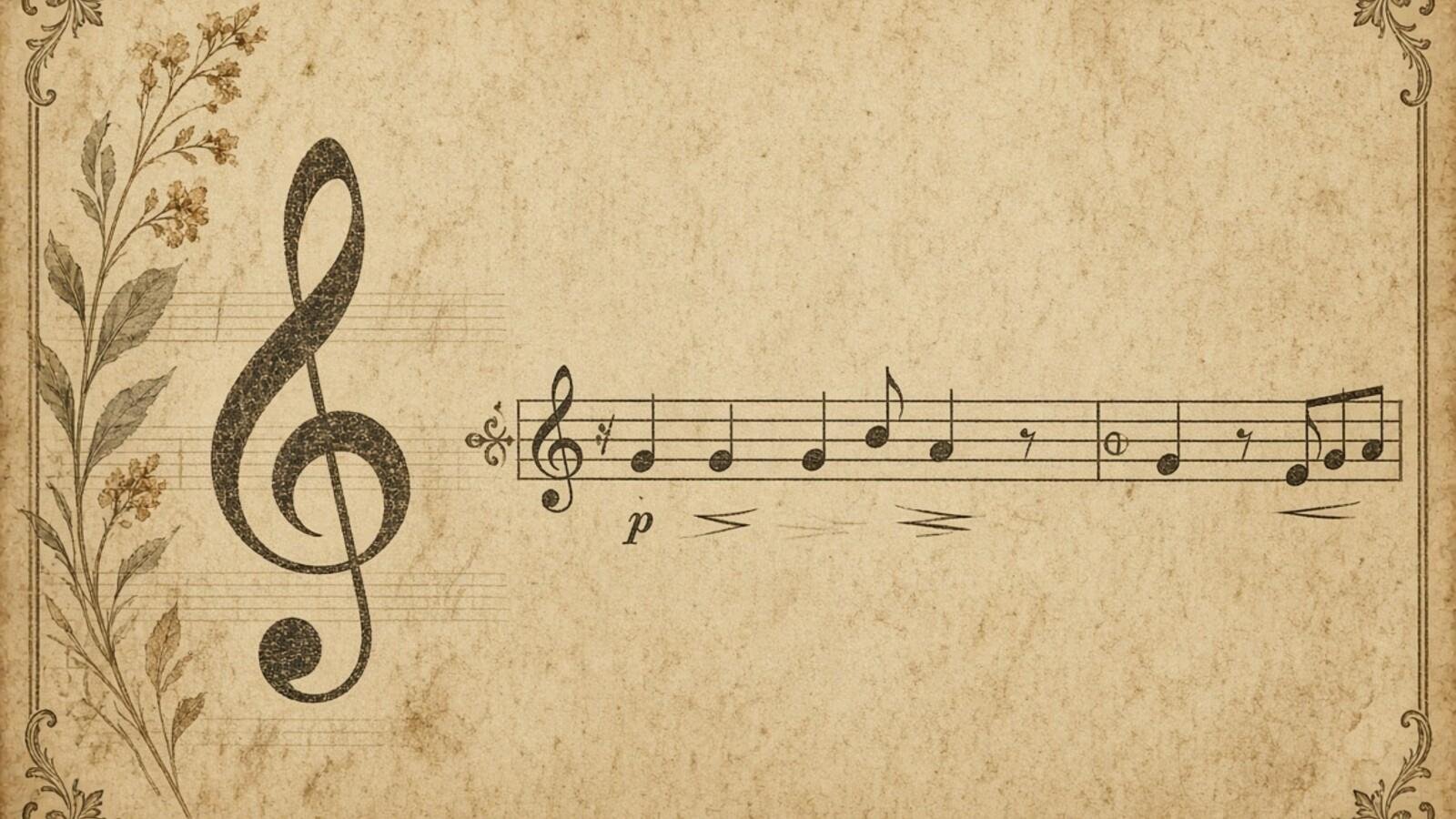
Quick answer: Music notation symbols explain three things: which pitch to play (staff and clef), how long to play or stay silent (notes, rests and rhythm), and how to perform the sound (dynamics and articulation). A quarter note is one conventional unit, a half note two, a whole note four, and the corresponding rests indicate proportional silence. The specific beat depends on the meter and tempo.
Updated: 21 November 2026.
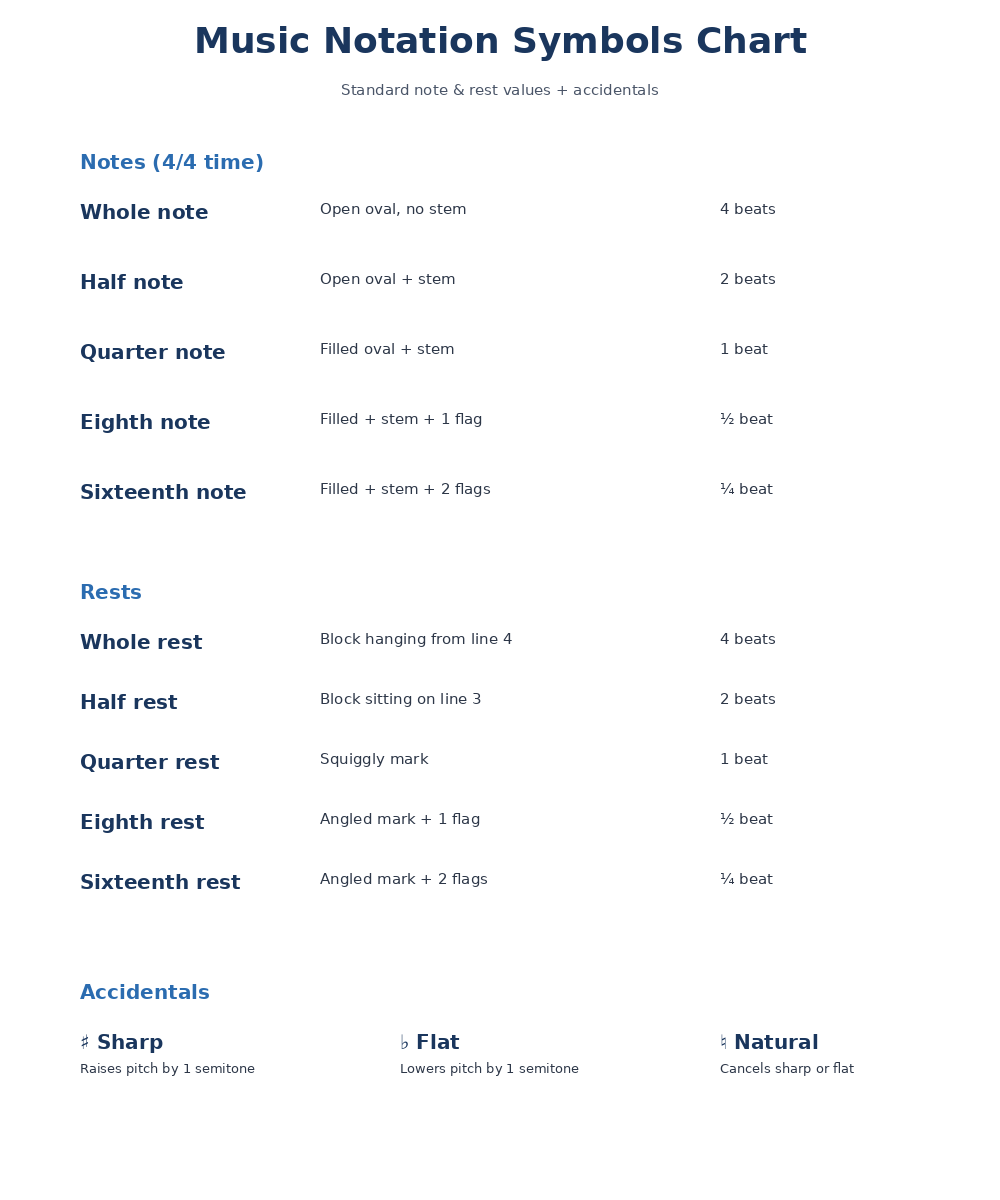
Music notes and rests: US and British names, relative durations
| US note name | UK note name | Relative duration | Rest | Rest duration |
|---|---|---|---|---|
| Whole note | Semibreve | 4 quarter-note units | Whole rest | 4 units |
| Half note | Minim | 2 units | Half rest | 2 units |
| Quarter note | Crotchet | 1 unit | Quarter rest | 1 unit |
| Eighth note | Quaver | 1/2 unit | Eighth rest | 1/2 unit |
| Sixteenth note | Semiquaver | 1/4 unit | Sixteenth rest | 1/4 unit |
| Thirty-second note | Demisemiquaver | 1/8 unit | Thirty-second rest | 1/8 unit |
Music staff, bar lines and the five-line system
Most Western staff notation places pitches on five horizontal lines and the spaces between them. Clefs establish a reference so the height of a note corresponds to a pitch name. Extra ledger lines extend the staff above or below for pitches outside its normal range. Bar lines divide the music into measures, while double bar lines or repeat symbols can show larger structural boundaries. The staff provides a coordinated visual language, but performers must also interpret rhythm, dynamics and expression markings.
The stem of a note may point up or down based on its position and engraving conventions; stem direction alone does not change pitch or rhythmic value. A line that joins note stems into a beam helps group shorter notes rhythmically. When reading a picture, distinguish a notehead from a rest and make sure the note sits clearly on a line or in a space. A generated chart that shifts a notehead half a staff-space can accidentally teach the wrong pitch. Professional printed notation relies on consistent spacing and correct symbol shapes.
Treble clef and bass clef: which pitches do they name?
The treble or G clef curls around the second staff line from the bottom to show G. In treble clef the lines from bottom to top are E, G, B, D and F, and the spaces are F, A, C and E. Bass or F clef uses two dots that surround its fourth line, identifying F. The bass-clef lines are G, B, D, F and A, with spaces A, C, E and G. These are reference patterns for common modern staff notation.
Middle C may be shown on a ledger line below the treble staff or above the bass staff. The same written location without a clef could have a different pitch, so learning note names requires reading the clef first. The alto and tenor C clefs identify middle C on different lines, and percussion clefs or tablature use other conventions. A beginner’s chart featuring only G and F clefs should not imply that all instruments are notated identically. Some instruments transpose as well, meaning the sounding pitch may differ from the written pitch.
Whole, half, quarter, eighth and sixteenth note values
A whole note or semibreve is commonly represented by an open oval without a stem. A half note or minim has an open notehead with a stem. A quarter note or crotchet has a filled notehead with a stem. An eighth note or quaver adds a flag or is beamed with another note; a sixteenth note or semiquaver has two flags or beams. These forms represent ratios of durations rather than fixed numbers of seconds.
Under the conventional quarter-note beat reference, a whole note has four quarter-note units, a half note two, a quarter one, an eighth one-half and a sixteenth one-quarter. But time signatures and tempo determine how beats are organised, and the beat unit may be a dotted note or another duration. Therefore saying a whole note always means exactly four beats in every musical context is too broad. A chart should explicitly say it is presenting proportional values, not a universal metronome timing.
Whole rest, half rest and smaller silence symbols
Rests indicate measured silence rather than sounds. Their duration relationships correspond to note values: whole rest, half rest, quarter rest, eighth rest and so forth. A traditional whole rest hangs below a staff line, while the half rest sits above a staff line, often remembered by their opposite placements. The quarter rest has a distinctive zigzag form, and smaller rests display added hooks for shorter values.
Be careful when an image generator draws the whole rest and half rest with the same vertical placement, because that can teach an incorrect symbol. A full-measure rest may also use conventional notation that depends on time signature and context, so a single visual symbol can have a particular functional role in a complete score. Practice matching each note to its relative rest without confusing silence duration with pitch. The chart’s written note-and-rest table offers a quick way to verify timing.
Time signatures: 4/4, 3/4, 6/8 and compound meter
A time signature appears near the beginning of the staff after the clef and key signature. In a simple example such as 4/4, measures contain the equivalent of four quarter-note units and are often counted as four beats. In 3/4, three quarter-note units form a measure, frequently grouped in threes. In 6/8, six eighth-note units are written but are often felt as two compound beats, each divided into three eighths.
The top number and bottom number do not tell the whole performance story without rhythm and musical style. In compound meter the prominent beat may be the dotted quarter rather than the eighth note. A beginner should tap the main beat while reading different note lengths and grouping patterns. Do not claim that all 6/8 music must be fast or that 3/4 always sounds like a waltz. Real scores use accents, note groupings and tempo indications to clarify musical flow.
Dots, ties, slurs, tuplets and fermatas
A dot immediately following a note or rest increases its duration by half of its original value. A dotted half note is therefore worth three quarter-note units in conventional proportional counting. A tie is a curved line joining two notes of the same pitch, combining their durations into one sustained sound. A slur is a curved line that groups different pitches for connected phrasing rather than adding their numerical durations.
Triplets and other tuplets fit a designated number of equal notes into a duration normally occupied by another grouping, usually marked with a numeral. A fermata indicates that a note or rest may be prolonged according to musical context and performance decision. These symbols are not interchangeable even if curved lines or dots appear similar. When generating educational graphics, put each mark in the correct relationship to its notehead, staff and neighbouring note.
Sharps, flats, naturals and key signatures
A sharp raises a note by a semitone and a flat lowers it by a semitone in the common chromatic context. A natural sign cancels the applicable alteration under the notation rules. A key signature places sharps or flats after the clef and normally indicates a tonal collection used across the music. Accidentals placed next to individual notes can modify pitch within the measure according to the governing convention.
Do not mistake the flat sign for a lowercase b used as casual text or the natural symbol for a decorative hash. Their actual graphical placement and vertical relation to notes matter. Double sharps and double flats also exist, although they are beyond the simplest beginner chart. In transposing-instrument music the written note name and concert pitch can differ; students should learn the specific instrument’s notation rather than assuming a single staff chart fits every orchestral part.
Dynamics and articulation: p, f, crescendo and staccato
Dynamics tell performers about relative intensity. The common p means piano (soft), f means forte (loud), mp is mezzo-piano and mf mezzo-forte, while pp and ff indicate relative extremes. A crescendo hairpin opens to suggest growing loudness, and a decrescendo hairpin closes to suggest reducing it. These marks are expressive instructions, not electrical measurements of decibels.
Articulation marks such as staccato dots and accents affect how notes are performed. A staccato dot is usually placed above or below a notehead, not immediately to its right as a rhythmic augmentation dot would be. A tenuto line, accent wedge and fermata each communicate something different. Musical style, instrument and conductor or performer decisions also influence interpretation. The distinction between two kinds of dot is particularly important in a visual chart intended for beginners.
Repeat signs, tempo markings and a practice method
Repeat bar lines use dots and heavy/light vertical lines to show which passage is repeated. A first and second ending can provide different routes through a repeated passage. Tempo indications may use words such as Allegro or Andante and metronome markings that specify a rhythmic unit and beats per minute. The tempo describes how quickly the musical pulse proceeds; the durations of whole, half and quarter notes remain proportional even when the piece speeds up.
To practice, start with a treble clef staff and name a handful of notes. Next clap a quarter-note pulse and read pairs of note and rest values without worrying about pitch. Then add a dotted half, a tied pair and a 6/8 rhythm. Finally use pp, mf, crescendo and staccato to change performance. Check every printed symbol with a reliable music-theory resource; AI diagrams can omit stems, draw incorrect rest hooks or confuse a time signature with a key signature.
Frequently asked music notation questions
What are the five staff lines called in treble clef?
Bottom to top: E, G, B, D and F.
What is the difference between a quarter rest and a quarter note?
Both use the same relative duration; the note sounds, while the rest marks silence.
Does a dotted note add a full beat?
No. A dot adds half the original note or rest value, whatever that value is.
What does 6/8 mean in music?
Six eighth-note units per measure, usually grouped as two compound beats.
Does a staccato dot increase duration?
No. A staccato dot is an articulation mark; a dot to the right of a note is a rhythmic augmentation dot.
What do p and f mean on sheet music?
p means piano (soft); f means forte (loud), both relative dynamic instructions.
Conclusion
Learn a symbol’s function before memorising its appearance. Clefs, notes, rests, meter, accidentals and expressive markings work together, and a clear text table can check whether a visual sheet has drawn them correctly. Keep the note-and-rest values proportional and practise reading complete measures.
Sources
- Texas A&M Open Textbook — Notes, Rests and Clefs
- Open University — Introduction to Music Theory
- MuseScore — Common Music Symbols






















Share Your Opinion
Comments are closed on this post.