 Vista
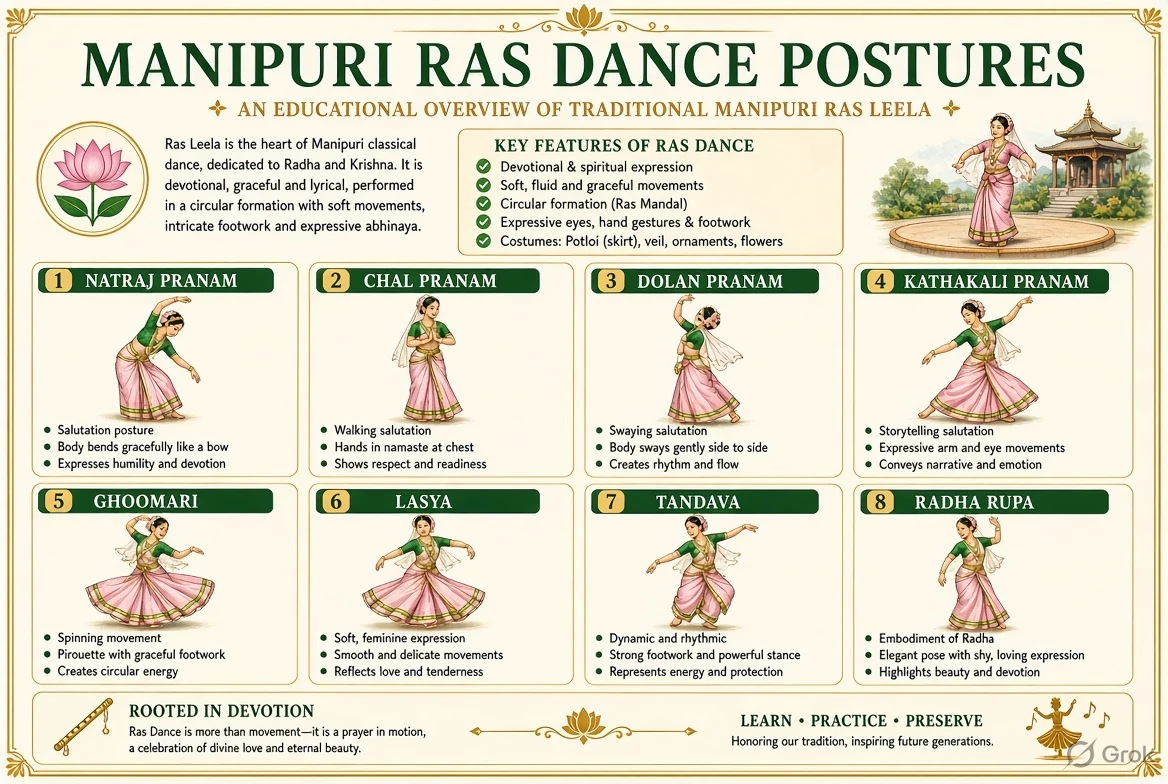
Direct answer: Manipuri Ras Dance is a devotional dance-drama repertoire of Manipur with Radha, Krishna and the gopis, characterised by flowing postures, hand gestures and circular group movement. These three visual references describe the appearance and context without equating every Manipuri dance with Ras Leela.
Updated 21 November 2026. Visuals are educational illustrations, not documentary photographs of a specific Ras ceremony.
Manipuri Ras dance postures: three illustrated references
What is Manipuri Ras Dance and where does it come from?
Manipuri Ras Dance, or Ras Leela in the Manipuri classical tradition, is a dance-drama expression closely linked with the devotional stories of Radha, Krishna and the gopis. It is one part of a wider and diverse performance heritage of Manipur, a state in northeastern India. The Ras repertoire is celebrated for rhythmic grace, circular ensemble movement, delicate hand gestures and carefully shaped body lines. Its meaning is inseparable from music, the performed story, the tradition’s ceremonial setting and the dancers’ skills.
The Government of India’s CCRT educational material calls Ras Leela an important repertoire of Manipuri classical dance, while Sangeet Natak Akademi supports the Jawaharlal Nehru Manipur Dance Academy, which teaches Manipuri dance and music. These institutions provide a useful foundation for checking popular internet captions. The three diagrams below focus on hand gestures, basic postures and movement relationships. They are educational illustrations—not photographs of a specific Ras ceremony, and not exact movement notation for every lineage.
Radha, Krishna and the dramatic centre of Ras Leela
Ras Leela is rooted in Vaishnava devotional expression, particularly themes involving the relationships of Krishna, Radha and the gopis. Different staged or ceremonial versions may focus on particular episodes, moods and seasonal or religious occasions. A performance could highlight love, separation, devotion or shared celebration through dance and music rather than conventional spoken dialogue. The story also shapes the movement pathways among the principal characters and the group.
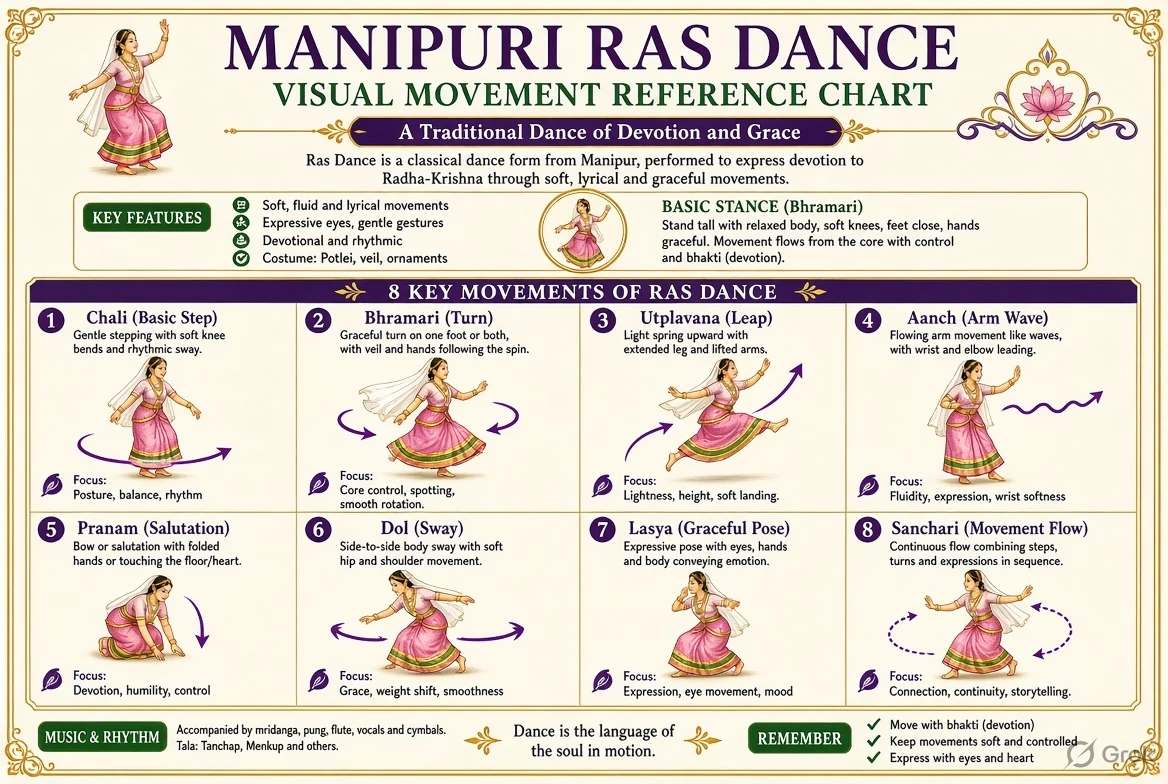
It is not reliable to assign a fixed story to every image showing a dancer in the traditional cylindrical skirt. Different pieces may share costumes and movement vocabulary, and a still photograph may not reveal the narrative moment. To interpret an authentic scene, look for the performance title, organisers and information from the performers or academy. Our movement diagram simply illustrates possible spatial relationships among Krishna, Radha and an ensemble. It does not recreate the complete stage plan of a named sacred Ras performance.
Manipuri hand gestures in the Ras tradition
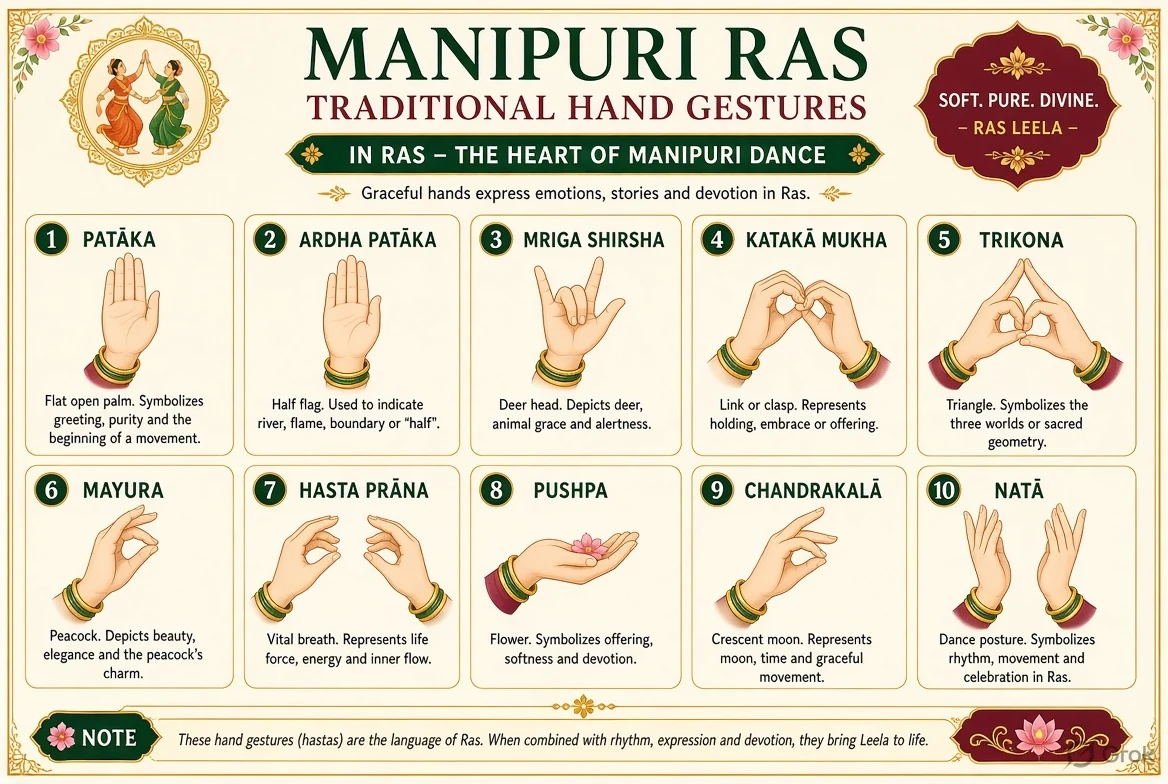
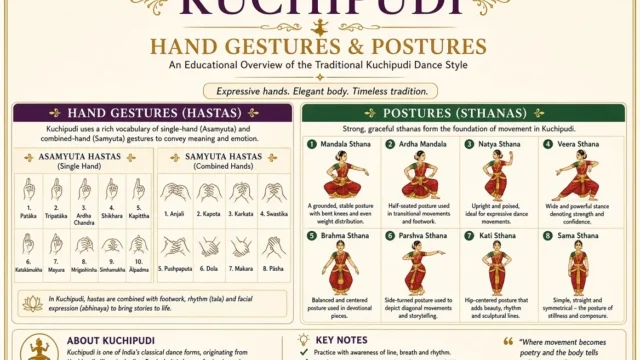
Manipuri Ras hand gestures support the telling of devotional narratives and the communication of emotion. As in other classical dance forms, hand shapes only become meaningful in relation to gaze, body movement, costume, musical structure and the role being portrayed. The fingers may appear soft and carefully controlled rather than strongly outlined in a simplified poster. Some gesture terminology overlaps with broader Indian performance theory, but the specific presentation in Manipuri Ras should be understood through its own teaching context.
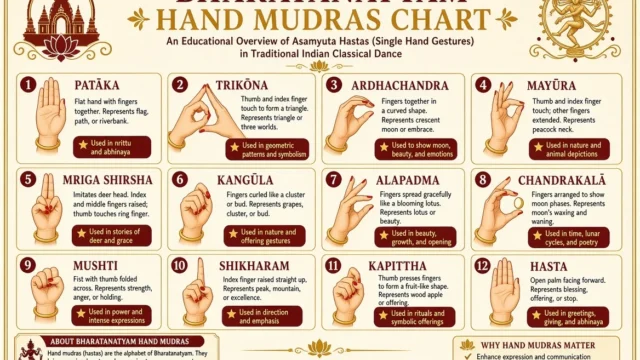
Our first chart introduces recognisable hand and arm relationships without claiming to list an authoritative set of every Manipuri mudra. A static picture may conceal the thumb or a turning wrist, so it should not be used alone to judge a student’s technique. Consult an instructor or an academy’s published teaching materials for any specific names. Avoid taking an online Bharatanatyam mudra dictionary and merely changing its title to Manipuri Ras. That practice ignores differences in choreography and can spread mistakes to examination preparation.
Why Manipuri postures look flowing and rounded
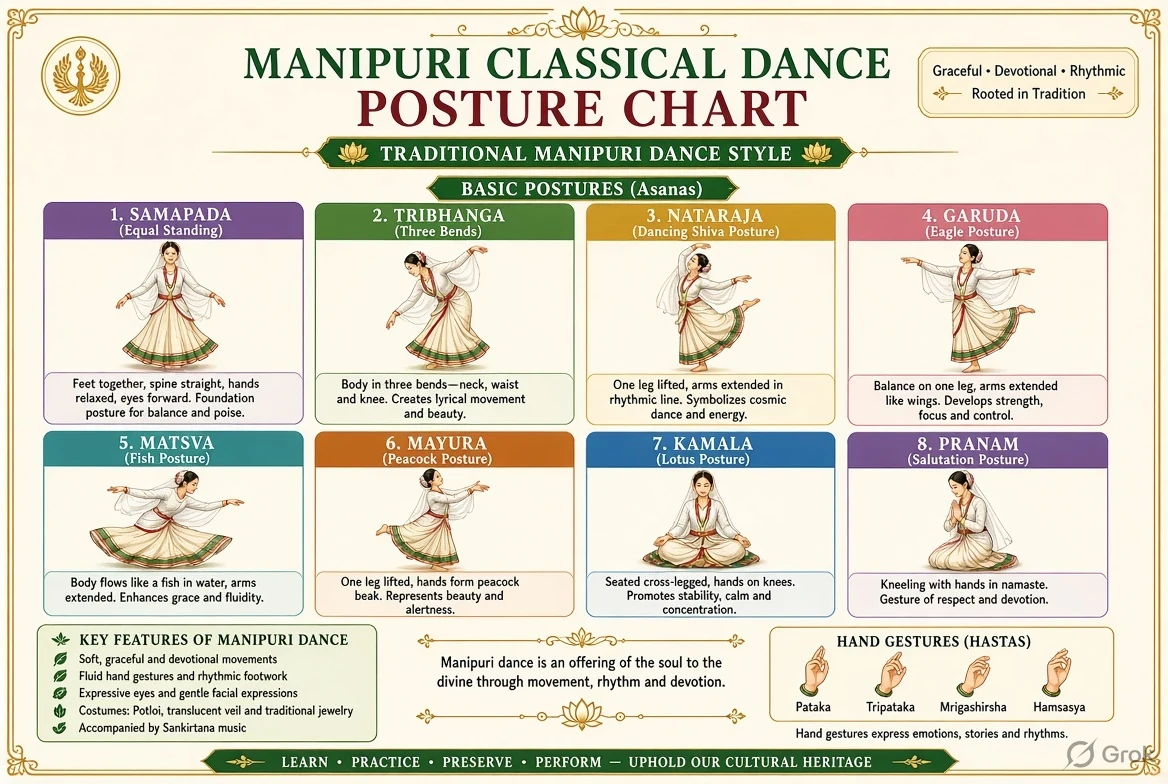
The Manipuri classical dance posture is often described through flowing lines, controlled torso movement and elegant arms. Much of the Ras repertoire creates a sense of sustained, circular or softly connected motion. An illustration may show curved arm positions and a stable upper body, but the actual technique comes from movement across time. The dancer must coordinate posture with the music and the other performers while maintaining balance and dramatic intent.
A beginner copying a single attractive silhouette can misunderstand the way the body enters and leaves a position. The apparent softness of the movement is not evidence that it requires little training. Knees, ankles, shoulders and spine all contribute to balance. Our second reference is designed to explain the broad look of a posture, not impose a required spinal bend or arm angle on all students. Real technique should be learnt through graded practice with a qualified Manipuri dance teacher.
Circular movements and relationships in group Ras
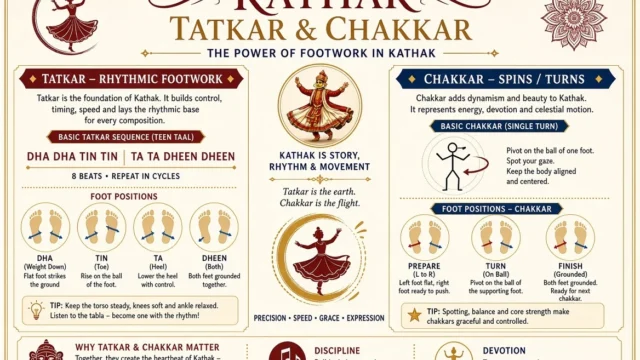
A frequently searched feature of Manipuri Ras movement is the circular group formation. Performers may use curved trajectories, alternating directions or carefully placed arrangements around important characters. These spatial designs contribute to the devotional story and allow musical phrases to unfold visually. Group choreography cannot be reconstructed accurately from one still image because timing and the direction of each dancer matter just as much as where their feet are placed.
When viewing a reliable performance video, watch how the dancers maintain distance, where changes of direction occur and how the centre of attention moves from one character to another. The third diagram illustrates circulation and ensemble spacing for study. It is not a mandatory stage arrangement. A small educational rehearsal may need fewer performers or a different stage shape, while a ritual production can follow specialised conventions. Attribute the troupe and choreography if reproducing real photographs or explaining a specific production.
Costume, Kumil and jewellery: context, not an identity test
The Ras tradition is often recognised through its elaborate attire. The structured cylindrical skirt commonly known as a Kumil is one striking feature of some female roles, along with decorative textiles, head adornment and ornaments. Costume helps create a distinctive visual language and supports the theatrical presentation. Yet not every Manipuri dance uses the same costume, and the presence of a cylindrical skirt alone cannot confirm whether an image shows a particular Ras episode.
Clothing can vary with roles, tradition, workshop and performance setting. A modern school performance may use simplified dress without claiming to reproduce a historical sacred ceremony. When labelling images, distinguish a photographed performer from an illustration of costume elements. A digital reconstruction may be helpful for teaching recognisable shapes but should not be attributed to a living artist or a precise festival without evidence. The best search reference includes information from the event organisers or credible catalogues rather than relying only on colour and clothing.
Ras, Pung Cholom and Lai Haraoba are not interchangeable
The broader cultural landscape of Manipur includes more than Ras Leela. Pung Cholom combines drumming and movement and is a striking part of the region’s performance repertoire. Lai Haraoba is another distinctive local ritual and cultural tradition with its own forms and history. Each has separate purposes and techniques; readers should not label every energetic Manipuri group dance a Ras Leela. The Jawaharlal Nehru Manipur Dance Academy teaches or supports related regional arts alongside Manipuri classical dance.
Internet image results sometimes combine these forms because they share a geographic origin. To identify the work correctly, examine the musical instrument, movements, attire, occasion and event name. A drummer performing complex jumps is not necessarily depicting Radha and Krishna, just as a group in Ras costumes is not a drumming exhibition. Distinguishing these traditions helps readers find accurate information and gives cultural practitioners the credit they deserve.
Safe beginner study and the value of live performance
To begin studying Manipuri Ras posture, focus on recognising the arrangement of head, shoulders, arms and feet in several reliable examples. Watch transitions rather than trying to hold a picture-perfect bend. If practising movement, do so under supervision on a stable floor with enough space for the arms and other performers. Maintain comfortable joint movement and rest when you feel pain or dizziness. Choreographed turns and group formations need progressive rehearsal to avoid collisions.
A video from a recognised dance academy or documented stage performance can add details that still diagrams omit: rhythm, tempo, gaze, changes in formation and the relationship between characters. Avoid treating a brief online clip as the whole ritual or style. Take notes on the name of the piece and the troupe. Use charts to help remember what to observe, but do not offer them as a complete substitute for an instructor’s corrections or an authentic contextual explanation.
Manipuri Ras Dance FAQs
What is Manipuri Ras Leela?
It is a devotional dance-drama repertoire of Manipuri classical dance focused on Radha, Krishna and related narratives.
Is every Manipuri dance a Ras Leela?
No. The region has other forms, including Pung Cholom and Lai Haraoba traditions.
Why does Manipuri Ras use circular movement?
Curved ensemble formations can support the rhythm, group relationships and devotional storytelling.
What is Kumil in Manipuri Ras?
It is the distinctive structured cylindrical skirt seen in certain female roles.
Can a poster teach complete Manipuri Ras hand gestures?
No. It supports visual identification, while accurate technique and narrative use require teacher guidance.
Conclusion: see movement, not just a costume
Manipuri Ras is a musical and dramatic practice, not just a costume silhouette. Use movement references carefully and credit the dancers, music and cultural setting.
Official cultural and training sources
Sangeet Natak Akademi: Jawaharlal Nehru Manipur Dance Academy; CCRT: Ras (Manipuri Dance) performance resource; CCRT: Manipuri Dance cultural package; Sangeet Natak Akademi: Intangible Cultural Heritage.







Share Your Opinion
Comments are closed on this post.