 Vista

Direct answer: Warli art symbols and human figures usually use circles, joined triangles, simple lines and geometric patterns to depict people, trees, houses, animals and communal Tarpa dance. The art belongs to a living Indigenous tradition in Maharashtra. Its motifs are not a universal fixed “symbol dictionary”. These four illustrated charts show the two-triangle human figure, dance circle, village scenes and repeating borders.
Updated 21 November 2026. Educational illustrations; not copies of a specified community artist’s original painting.
Warli art symbols chart: human figures, Tarpa dance and village motifs

Warli art symbols and human figures: where the tradition comes from
Warli painting is a living artistic tradition associated with the Warli communities of Maharashtra’s northern Sahyadri region. Many familiar examples show pale, often white figures against a reddish-earth background, created using simple combinations of circles, triangles and lines. The imagery commonly presents people, animals, trees, houses, farming and community celebrations. Warli art is not a universal alphabet whose triangle or circle always corresponds to one fixed English word. Images belong to social stories and, in some settings, ritual and domestic contexts.
The Government of India’s March 2026 cultural feature describes the visual language as circles, triangles and squares, often made with white pigment derived from rice paste, and specifically mentions the Tarpa dance. That official description is a useful starting point but not a reason to claim every Warli artist paints exactly the same subjects. Contemporary painters adapt scale, material, composition and colour. The four diagrams here are educational illustrations for identifying the characteristic construction of figures and patterns, not copies of any named artist’s original work.
Warli human figure drawing: two triangles and a circle
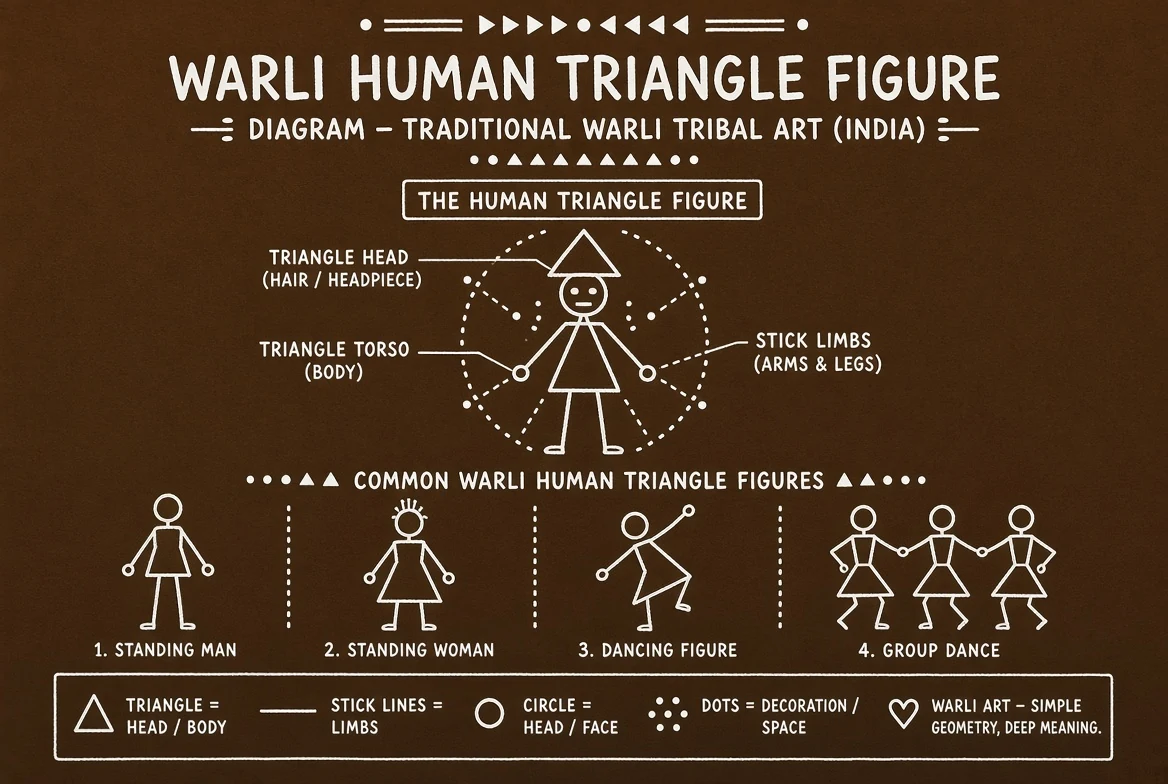
The familiar Warli human figure uses a small circle for the head, two triangles meeting at their tips for the torso and pelvis, and simple lines for arms and legs. This highly economical construction gives a person a sense of action without detailed facial features. When the arm and leg lines are angled, the figure can look as though it is walking, carrying a basket or dancing. Traditional and contemporary artists vary the proportions; the basic geometry is an introduction, not an immutable rule.
To draw a beginner’s figure, create the head circle, place one triangle below it and connect the second triangle at the narrow centre. Add a short neck if the design uses one, then position limbs to express movement. The repeated shape can be arranged into families or processions while remaining readable. Some educational pages attach rigid male or female labels to every specific triangle width; such simplifications can overlook the diversity of actual works. Interpret the figure’s activity from the complete scene rather than assigning identity from one tiny geometric detail.
Tarpa dance circle: what the spiral of people shows
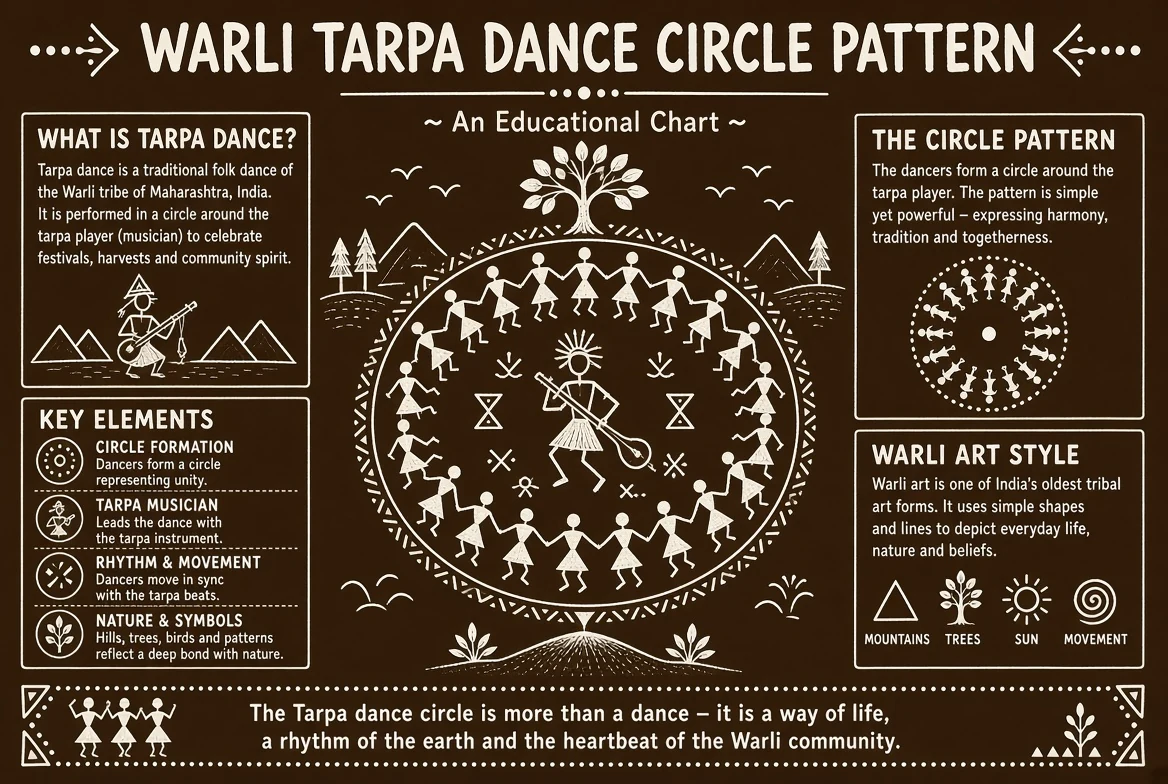
A Warli Tarpa dance painting often centres on a musician playing the tarpa, a wind instrument, while dancers form a curved line, circle or spiral. The image expresses collective movement and communal festivity. The direction and arrangement of the dancers can be used artistically to create rhythm, just as the repeated human figures give the composition a visual beat. The specific event, ritual and participants depend on the context of the artwork and the Warli community represented.
The Tarpa dance is not simply a random decorative ring invented for commercial posters. Government tribal-culture repositories document the dance and its instrument. When explaining a Warli dance image, distinguish the musician from dancers, and observe how their bodies connect through arms or repeated movement. A modern circle diagram may teach layout, but it should not be called an authenticated historical ritual painting unless the exact creator, community and setting are known.
House, tree, animal and sun motifs in Warli painting
Warli art symbols often show ordinary village life alongside images of nature: a house with a roof, people gathering, cattle or birds, trees, farming tools and a sun or moon. These motifs make an image narratively understandable even with simple geometric lines. A tree can anchor a scene, while a house may provide a location for people and activities. The overall story may involve work, harvest, celebration, marriage or a local narrative, rather than a single code in which every animal represents the same abstract virtue.
A searchable image chart should label these shapes without inventing mythic powers. For example, “Warli tree motif with people and animals” is more accurate than “this tree always guarantees wealth.” Even a square can hold different compositional or ritual significance depending on context. Traditional ritual paintings include more than the schoolbook stick-figure style, and their social functions deserve careful distinction from contemporary tourist-market scenes. Where a named artist explains a painting, their account should take priority over generic internet captions.
Warli repeating border patterns: triangles, lines and frames
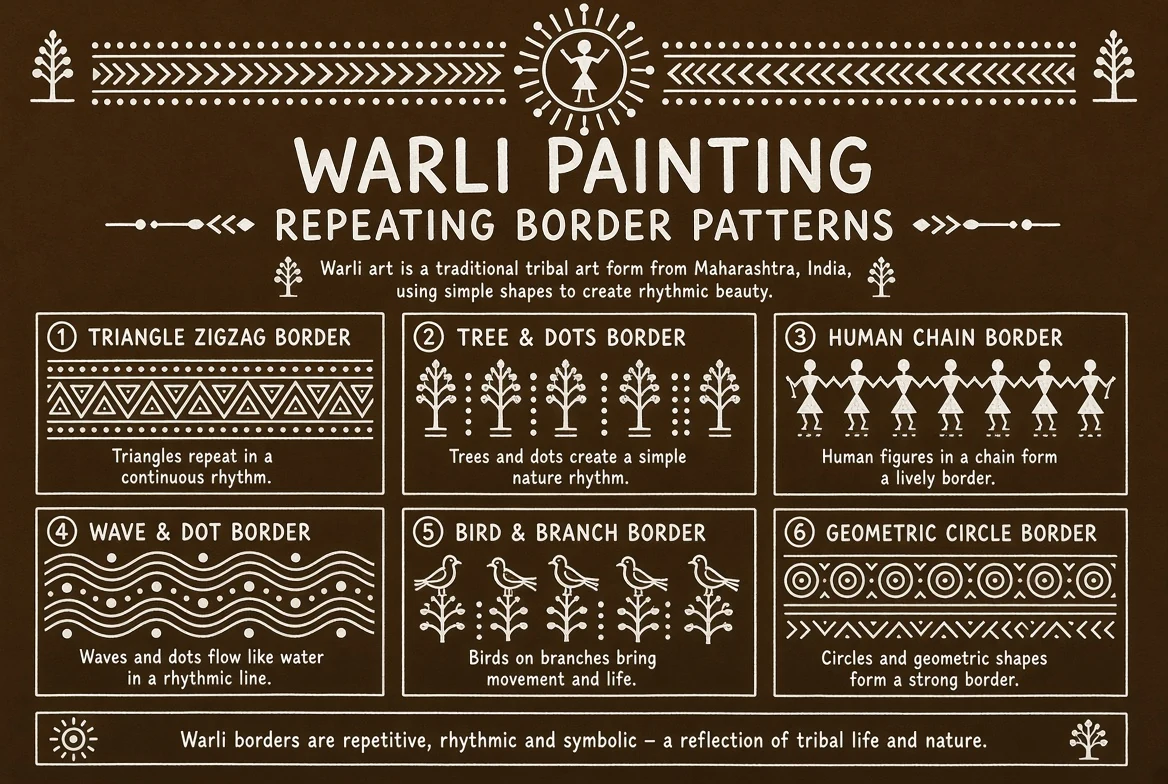
Warli border designs can use repeated triangles, zigzags, paired lines, small figures and other simple geometric units to frame a scene. A narrow repeating border lets the main narrative remain clear and lends visual continuity to a wall, school poster or craft project. Start with a consistent baseline and repeat the same unit at equal intervals. If you are wrapping a border around corners, plan the join so the rhythm does not stop abruptly or crowd the edge.
Not every zigzag is uniquely Warli, because geometric repetition appears in many artistic cultures. The surrounding human figures, local subject matter and artist attribution contribute to an informed identification. A modern paper craft inspired by Warli should be labelled as such rather than passed off as a centuries-old original. When sharing patterns online, avoid reproducing a living artist’s complete composition without permission. An educational diagram should demonstrate how the visual units are constructed and how borders support a larger scene.
Rice-paste white paintings and modern materials
Traditional accounts of Warli painting describe white pigment made from rice flour or rice paste applied against an earthy, mud-toned surface. This high contrast makes silhouettes and dance lines stand out. The palette is one of the most immediately recognisable features of the art in school displays. However, contemporary Warli artists also create work on paper, cloth, canvas and other materials, using paints suited to new settings. A colourful contemporary painting can still engage with the tradition, so authenticity should not be reduced to one pigment recipe.
For an art-class activity, a dark brown sheet and non-toxic white paint can communicate the strong light-and-dark arrangement without pretending to recreate a particular household ritual. Describe the exercise as “Warli-inspired drawing” if it is made by a learner. An authentic, culturally situated ritual painting may follow practices and permissions not captured by a craft tutorial. The gap between the learning exercise and the community-based practice should be made clear in the lesson.
Warli art vs Gond art: a useful visual comparison
Warli and Gond paintings are frequently grouped as Indian tribal art, yet they have distinct cultural settings and compositional traditions. The familiar Warli style uses small geometric human figures, communal dance scenes and simplified village subjects, historically associated with Maharashtra. Contemporary Pardhan Gond painting, well known from central India, often builds colourful animal and tree silhouettes from dense dots, dashes and fine lines. These descriptions help beginners identify common examples but do not exhaust either living practice.
A fish with elaborate coloured dots is not automatically a Warli symbol, and a two-triangle dance procession should not be labelled Gond merely because both are Indigenous Indian traditions. Correctly naming the art helps readers find original creators and community context. The most responsible image description also tells whether a picture is an illustration, a student exercise or a work by a named artist. Mixing names in image filenames and ALT text can mislead search audiences as well as misrepresent heritage.
How to draw a Warli village scene step by step
Begin with the central story, not a decorative page full of unrelated figures. Choose a village activity such as farming, musicians playing tarpa or a group gathering beside a tree. Sketch an earth-coloured background. Draw one person from a circle, two joined triangles and straight limbs; then adapt limb angles to depict work or dancing. Add a tree and small house using similarly simple shapes, keeping enough space between subjects so the action remains understandable.
Next decide whether a border improves the composition. Use a repeat of triangles or zigzags around the scene rather than crowding the dancers. Practice with a limited white-on-brown palette before adding more colours. If drawing for a cultural project, cite the Warli tradition and give credit to any reference artist. This educational method teaches a visual language; it is not a claim to reproduce a protected ceremonial image or an excuse to copy an artist’s original canvas without permission.
FAQs: Warli painting symbols and Tarpa dance
How is a Warli human figure drawn?
Commonly with a circular head, two triangles meeting at the centre and line-like limbs.
What is the Tarpa dance in Warli art?
A community dance often depicted around a musician playing the tarpa wind instrument.
What colours are traditionally associated with Warli painting?
White rice-paste pigment against an earthy wall or mud-toned background, though modern media vary.
Is Warli painting the same as Gond art?
No. They are distinct traditions with different histories and common visual approaches.
Do Warli symbols all have one fixed secret meaning?
No. Scenes and motifs gain significance from their maker and social or ritual context.
Conclusion: the scene matters more than a symbol label
Warli painting’s familiar geometry offers an accessible introduction, but the tradition is richer than a handful of symbols. Learn the human-figure structure and Tarpa dance composition while acknowledging cultural context, contemporary artists and the difference between inspired exercises and original works.
Sources and cultural references
Government of India PIB: Warli Painting — A Living Link to Ancient Traditions (March 2026); Government tribal-culture repository: Tarpa Dance in Warli art; Indian Folk Art Gallery: Warli geometry and Tarpa imagery; Indian Institute of Crafts and Design: regional craft traditions.


















Share Your Opinion
Comments are closed on this post.