 Vista
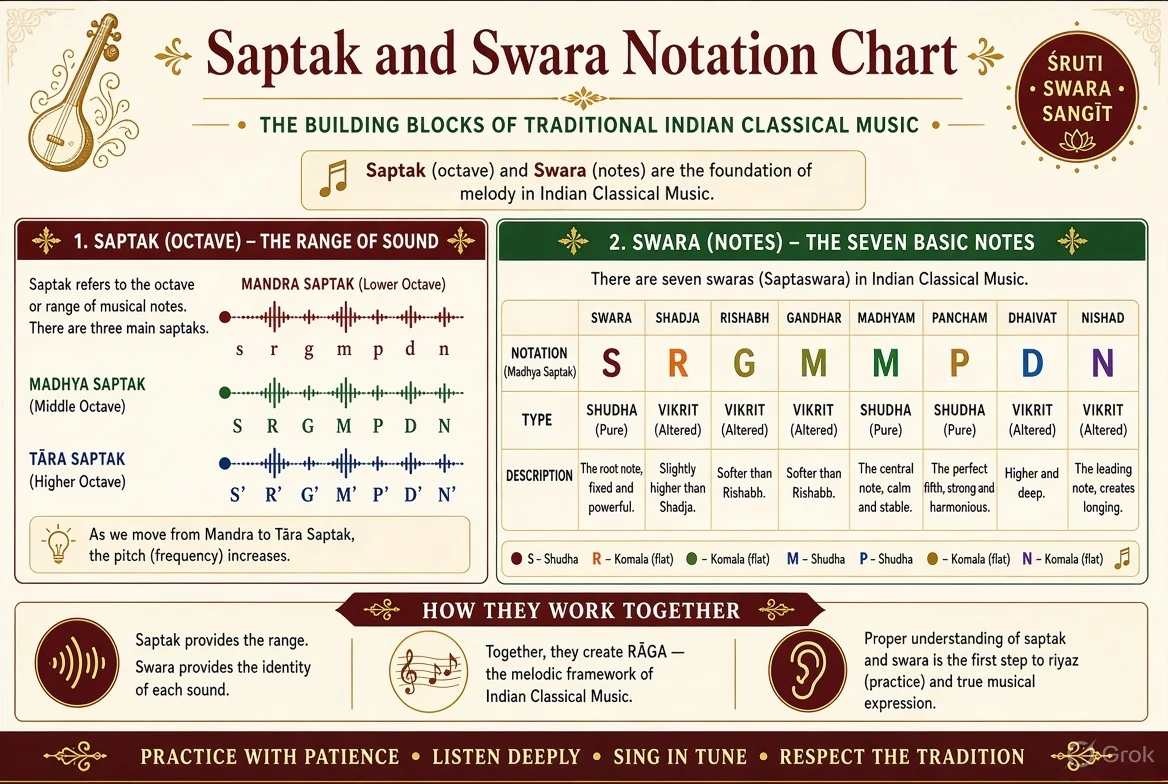
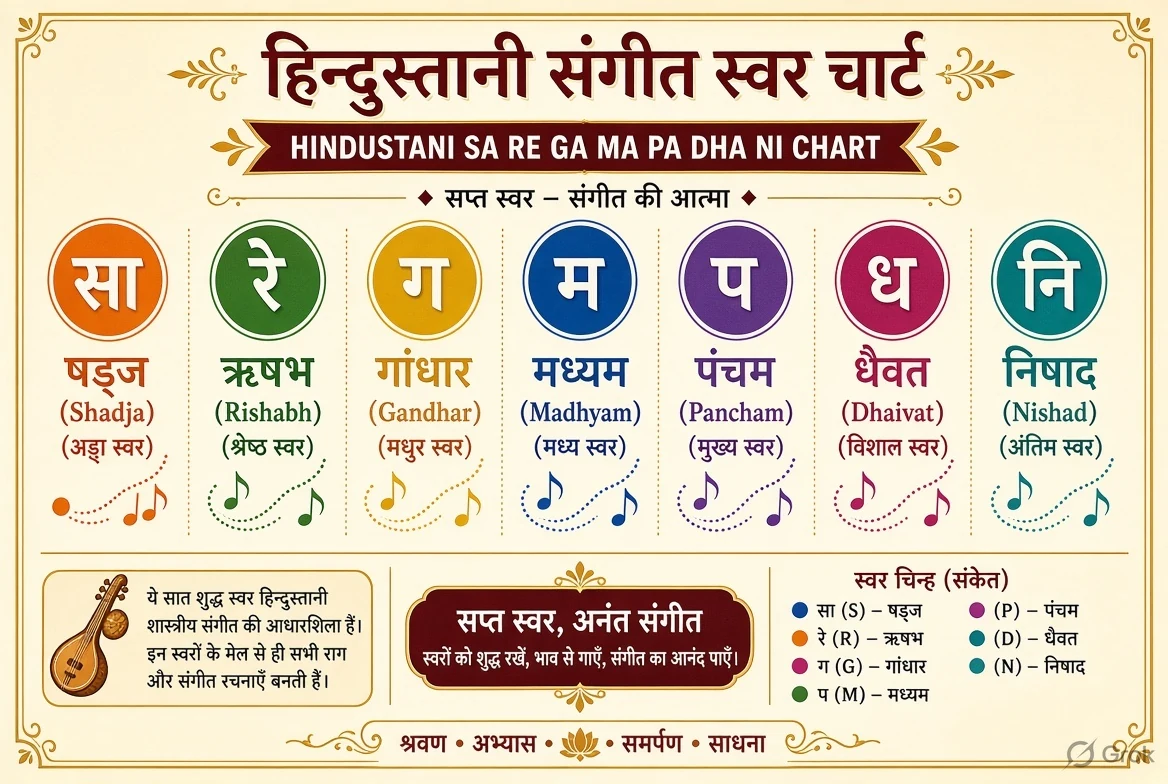
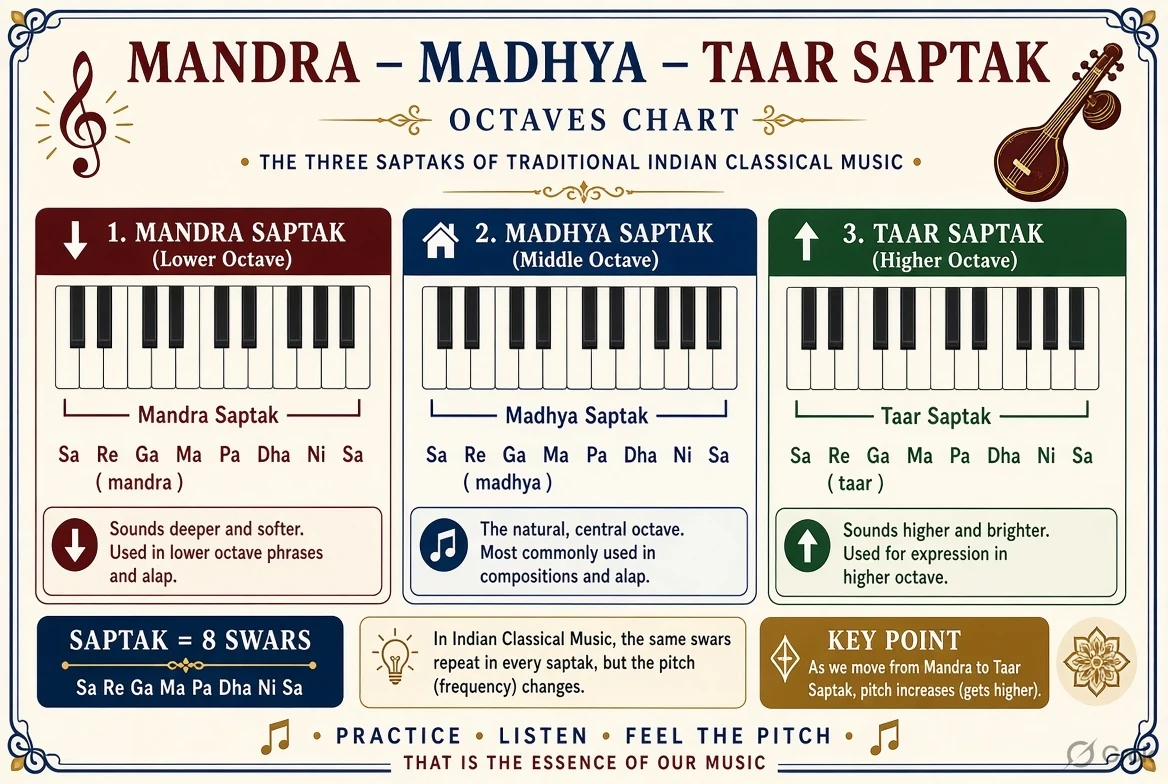
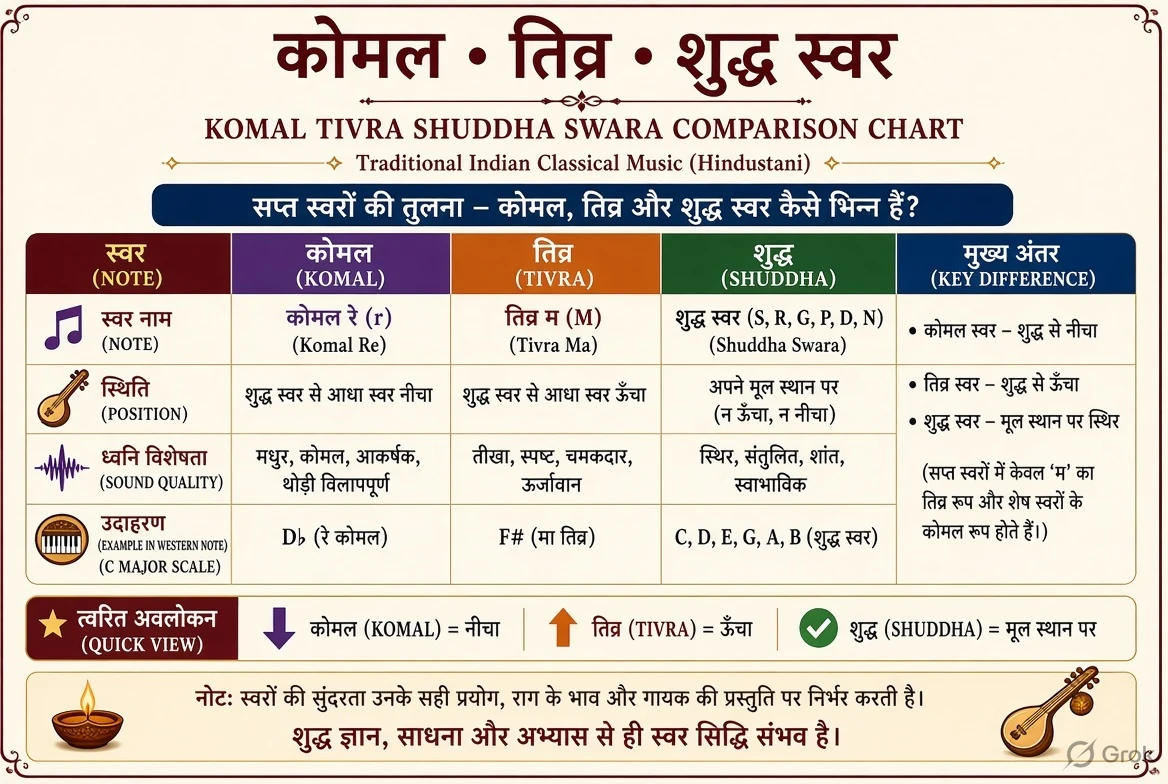
The seven swara names of Hindustani classical music are Sa, Re, Ga, Ma, Pa, Dha and Ni. A saptak is an octave or register built around these note relationships. Sa and Pa are achal or fixed in the ordinary swara scheme; Re, Ga, Dha and Ni have shuddha and komal forms, while Ma has shuddha and tivra forms. Together the seven names describe twelve commonly taught pitch positions. These three diagrams explain names, three registers and altered-note notation.
Updated 21 November 2026 · Always follow the notation legend used by your school.
Three swara and saptak diagrams
What is a saptak in Hindustani music?
A saptak is a sequence or range of notes across an octave, understood in relation to a selected Sa. In beginner teaching you commonly meet mandra saptak (lower register), madhya saptak (middle register) and taar saptak (higher register). A melody can travel through these ranges; a singer does not have to stay within one group while performing a raga. The diagrams show the relative arrangement rather than a fixed universal singing pitch.
It is helpful to start at a comfortable tonic, sing Sa Re Ga Ma Pa Dha Ni Sa, then return down the sequence. If your Sa changes because of your vocal range or instrument, the musical relationships still make sense. That is why treating Sa as always one particular Western keyboard note misrepresents the relative nature of much Indian classical practice. A tanpura or electronic drone can hold the chosen tonic for listening.
Seven swaras and twelve pitch positions
The saptak names are seven, but four swaras—Re, Ga, Dha and Ni—have a lower komal form as well as their shuddha form. Ma has a raised tivra variant. Sa and Pa are normally achal in the familiar Hindustani scheme. That gives seven basic positions plus five altered forms, commonly discussed as twelve positions within the octave. The term ‘shuddha’ is a named swara form, not a promise that every performance follows Western equal temperament.
Beginners sometimes ask why there are only seven written syllables when an instrument has twelve keyboard positions. The answer is that notation distinguishes swara identity and its variant. Depending on the raga, a certain form is chosen and treated with characteristic approach, intonation and ornamentation. Pitch positions provide a teaching map; they do not, by themselves, fully encode meend, andolan and other musical gestures.
Shuddha, komal and tivra: which notes change?
In the basic chart, Sa and Pa remain the fixed reference points. Re, Ga, Dha and Ni may be komal, meaning a lower form relative to their shuddha positions. Ma may be tivra, meaning a raised form compared with shuddha Ma. There is no standard ‘komal Ma’ or ‘tivra Re’ entry in this familiar introductory Hindustani classification. A clear revision table showing this instantly helps students avoid mixing two theoretical systems.
When writing sargam, music books may underline komal notes or use a separate sign, and may put an accent or other sign on tivra Ma. The exact printed convention differs across textbooks. Always read the legend that accompanies the notation: do not assume one font’s underline or mark has the same meaning in every book. On a keyboard, count intervals only after the tonic and note variant are known.
Mandra, madhya and taar saptak notation
Mandra is the lower register, madhya is the central working register and taar is the higher register. In some commonly used written systems a dot below a note indicates mandra and a dot above indicates taar; unmarked notes indicate madhya. But educational traditions and computer fonts do not always print identical symbols. Read the key in your textbook before copying a swara line into examination answers.
A useful vocal exercise starts from middle Sa, rises gradually to upper Sa, and returns with even breath and pitch control. Do not strain to hit an extreme note because a chart shows three octaves. Choose a comfortable range, pause when the voice becomes tight and ask a teacher to adapt the practice. The chart explains positions, not the safe maximum range of each student.
Raga versus scale: why the chart is only the beginning
Two ragas can use similar-looking swaras but behave differently because of ascent, descent, typical phrases, emphasised notes and ornamentation. A raga is an artistic grammar, not merely a set of seven symbols. A scale chart is useful for recognising shuddha and altered notes, but accurate listening and a guru’s demonstration reveal the character of a raga. Treat the diagram as an orientation tool rather than a full performance rule.
For example, the all-shuddha sequence is often taught using Bilawal-related swara positions, while another raga can introduce komal or tivra variants. This comparison is helpful if framed as a beginner exercise, not as a claim that changing one note automatically creates a complete raga. Ragas have their own melodic movements, characteristic phrases and sometimes time associations.
How to read the three illustrated swara charts
The first visual lists the seven swara names in sequence and helps learners connect short forms with full names: Shadja, Rishabh, Gandhar, Madhyam, Pancham, Dhaivat and Nishad. The second chart lays out lower, middle and upper register groups. The third isolates shuddha, komal and tivra variants. Look at one visual at a time and say what the diagram actually encodes before practising from it.
If you want to create your own notebook, draw a three-row octave guide. Write the seven names, then add altered variants beside only Re, Ga, Ma, Dha and Ni. Finally note which notation signs your course uses. This produces a small personalised chart that is more reliable than copying a graphic whose legend is missing. Use the same sign convention in every exercise on that page.
Practice using voice, harmonium or keyboard
Start with the drone on a comfortable Sa. Sing the seven shuddha notes slowly and then descend. On a later round, practise identifying a komal Re compared with shuddha Re, then compare shuddha Ma with tivra Ma. Play each note as a listening example and return to Sa so the relationship remains clear. Avoid rushing through all five altered notes before the ear can recognise one pair.
For keyboard practice, label Sa at the tonic you choose rather than permanently naming one key ‘Sa’. Use a metronome only for even timing; it cannot tell you whether a raga’s intonation or ornamentation is expressive. Record a small sequence, listen for pitch stability and compare with a trusted teacher’s example. A simple, regular twenty-minute lesson is more meaningful than a complicated chart never used in sound.
Common mistakes and a useful exam revision plan
A common mistake is assuming komal means all notes move lower. In fact, only Re, Ga, Dha and Ni have komal forms in the standard seven-note classification. Another is assuming all notes except Sa can be altered; Pa is achal in this teaching system. A third is confusing the registers with note variants: a high-register Sa is still Sa, not ‘tivra Sa’. Range and swara quality are two different ideas.
To revise, memorise the seven names first, then the five altered forms. Next draw mandra, madhya and taar as three registers and mark how your book writes octave dots. Finally explain why a saptak chart does not by itself describe an entire raga. If you can demonstrate one clear ascent and descent and explain the shuddha–komal–tivra distinction, the chart has done its job.
Quick swara revision table
| Swara | Form | Notation |
|---|---|---|
| Sa / सा | Achal / अचल | — |
| Re / रे | Shuddha, Komal / शुद्ध, कोमल | Re can be lowered |
| Ga / ग | Shuddha, Komal / शुद्ध, कोमल | Ga can be lowered |
| Ma / म | Shuddha, Tivra / शुद्ध, तीव्र | Ma can be raised |
| Pa / प | Achal / अचल | — |
| Dha / ध | Shuddha, Komal / शुद्ध, कोमल | Dha can be lowered |
| Ni / नि | Shuddha, Komal / शुद्ध, कोमल | Ni can be lowered |
Frequently asked questions
How many swaras are there?
Seven named swaras and twelve commonly taught positions including altered forms.
Which swaras can be komal?
Re, Ga, Dha and Ni.
Which swara can be tivra?
Ma.
What are the three saptaks?
Mandra, madhya and taar: lower, middle and higher registers.
Is Sa always the key C?
No. Sa is selected relative to the singer or instrument’s tonic.
Sources
Raag Hindustani: Notes in an Octave · Hindustani Swara Notation. These are educational references, not a universal notation specification.





Share Your Opinion
Comments are closed on this post.