 Vista

Direct answer: A postage stamp watermark is a design embedded in the paper, whereas the perforation gauge measures separation holes over a 20 mm reference distance. A stamp called perf 11 has about 11 perforations in that interval—not 11 across its entire edge. This illustrated guide covers watermark inspection, edge types, centering and the difference between genuine production varieties and misleading rarity claims.
Updated 21 November 2026. Educational charts; do not use flammable household solvents to test stamps.
Stamp watermarks and perforation chart: four reference pictures

Stamp watermarks explained: why the picture is hidden in the paper
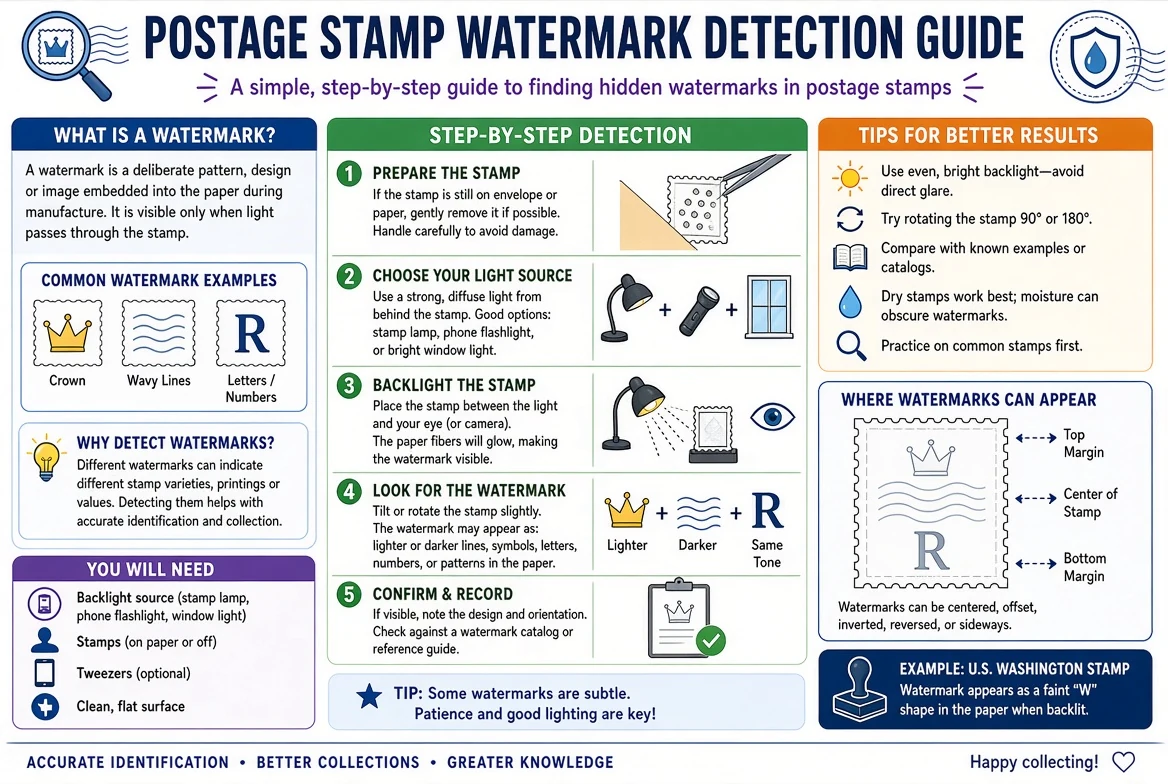
A postage stamp watermark is a deliberate variation within the paper created during its manufacture, sometimes forming letters, crowns, symbols or other designs. It is not the portrait, printed denomination or ordinary back-side ink. Paper with varied thickness or density allows an embedded image to become more visible under suitable viewing conditions. Watermarks historically helped identify paper and deter counterfeiting, and in philately they can distinguish stamp issues that look identical when viewed from the front.
Collectors often search “how to see stamp watermark” after finding two apparently identical designs listed under different catalogue numbers. The correct method is to first establish the country, issue and expected watermark varieties from a reliable catalogue. Then inspect the actual item using transmitted light or a suitable specialist optical device. The American Philatelic Society explains that certain watermark fluids can reveal patterns, but also warns that many such products are toxic or flammable. Do not make hazardous household solvents your first approach.
How to check a watermark without ruining a stamp
Begin with clean dry hands or appropriate stamp tongs and place the stamp on a safe surface. Shine a diffused light from behind or use a dedicated optical watermark detector, taking care not to apply excessive heat or pressure. Some watermarks show readily, while others are difficult to see because the paper is thick, the printed ink is dense or the stamp is still on an envelope. If a rare or valuable stamp is attached to its original cover, do not tear it free just to look for a watermark.
Specialist watermark fluids exist, but their chemical properties vary and some are hazardous, particularly around flames or ventilation issues. The American Philatelic Society cautions about solvent toxicity and flammability. Avoid petrol, lighter fluid, benzene or experimental domestic liquids. Before using a product even marketed for philately, follow its manufacturer instructions, assess suitability for the stamp and consider asking a professional. Digital optical methods and dealer examination are safer starting points when the object is fragile.
Stamp perforation gauge: what the number means
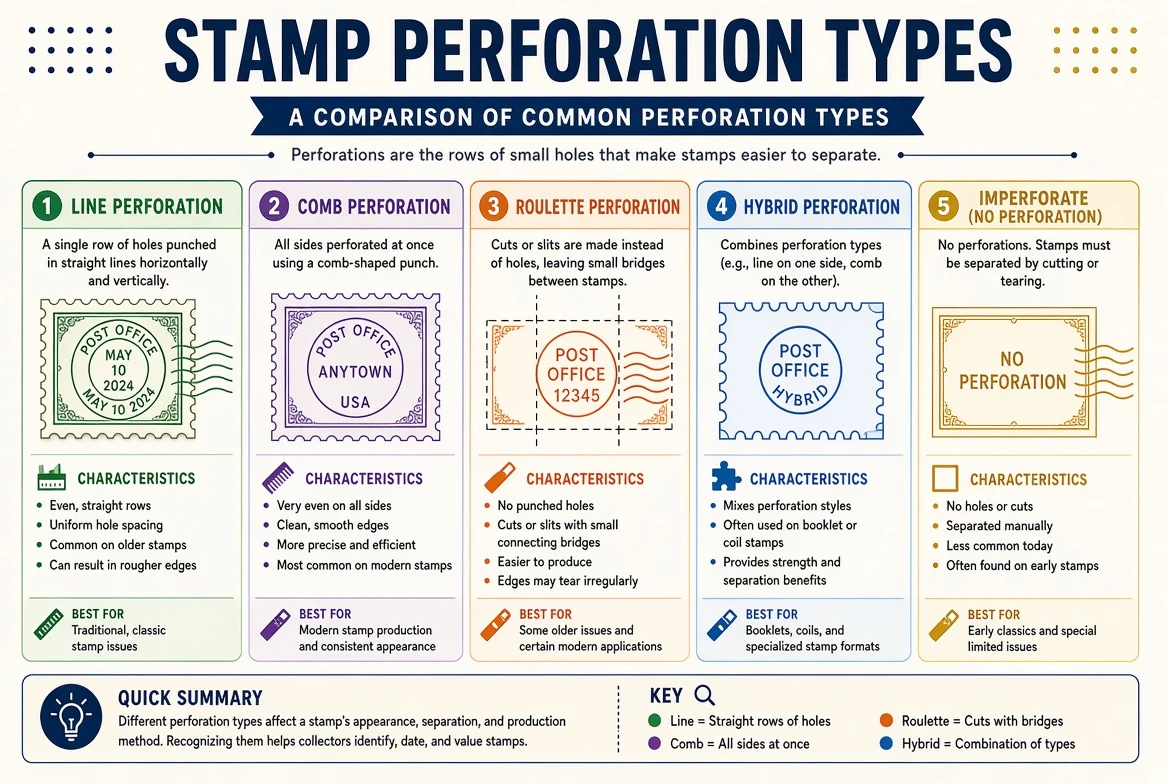
Perforation refers to the small holes or separations that allow stamps to be detached from a sheet. A stamp perforation gauge expresses how many perforation units occur over a standard length of two centimetres (20 mm). Thus a stamp described as perf 11 corresponds to about eleven perforations in that distance. The measure is not simply “11 holes along the whole edge” unless that edge happens to match the reference length. Longer and shorter sides may have different gauges.
To measure, place the stamp edge alongside the correctly printed gauge so the holes align with the dots or lines across a 20 mm reference interval. Do not stretch the paper or tilt it to make a poor match look exact. An apparent perf 11 may be an 11½ or a mixed-gauge issue, and some older stamps have uneven perforation spacing. Consult the relevant catalogue because an officially recorded gauge difference can distinguish editions, while torn or artificially altered teeth can mislead the measurement.
Line, comb, roulette, die-cut and imperforate edges
Not all stamp edges are made the same way. Line perforation and comb perforation describe different hole-punching arrangements used in printing and separation. A roulette creates cuts or slits rather than conventional round holes. Die-cut edges are common on self-adhesive stamps and may mimic classic perforations in appearance. Imperforate stamps are deliberately issued without the familiar separating holes in some series.
Therefore a smooth edge is not necessarily a valuable production error. Some stamps were officially printed imperforate, while others lost their edges through trimming or damage. Likewise an unusually jagged edge can result from poor separation, rather than the official perforation type. Examine the whole stamp and its production era before declaring a rare anomaly. The American Philatelic Society notes that many self-adhesive issues are die cut, producing differently shaped edge details from traditional soaked-off perforated stamps.
How watermark and perforation together identify an issue
A single printed design can have more than one legitimate paper or perforation variety. Catalogue editors use a combination of country, face value, colour, watermark, gauge, inscription, paper and other production details to distinguish them. If two images look identical on a phone screen, the hidden watermark or minor edge spacing may explain why their catalogue entries differ. Those identifiers can be important for serious collecting, though the value implication varies by issue.
For identification, first match the front design and overall dimensions. Next inspect the watermark safely, then measure perforations with a calibrated gauge. Check whether the stamp is used, mint, re-gummed or damaged. Finally compare the combined evidence with a recognised specialist catalogue. Never assign a highly valuable variety solely because one watermark line looks inverted in a blurry photo. Some inverted watermarks are legitimate production varieties and not all are rare errors.
Stamp centering and condition: why margins matter
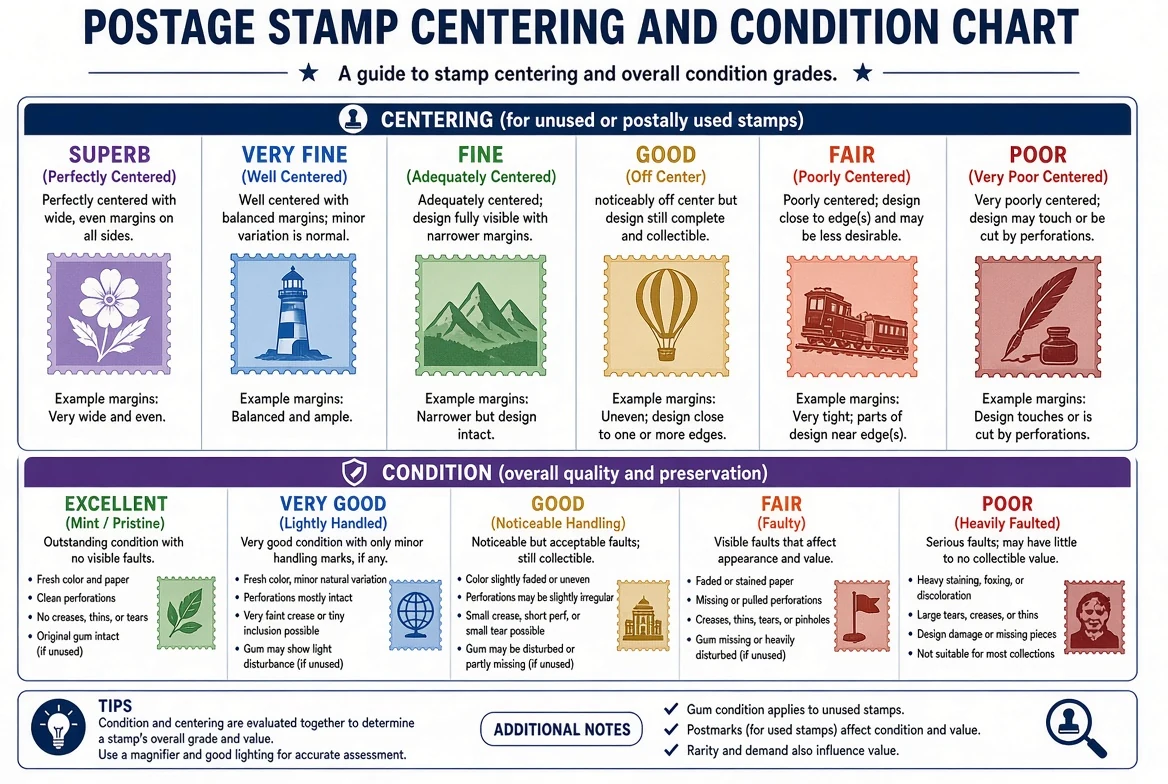
Centering describes how evenly the printed design sits within the stamp’s outer edges. A well-centred stamp has approximately balanced margins, while an off-centre design can approach or intersect the perforations. Collectors also inspect perforation tips, tears, thinning, creases, stains, unused gum and cancellation marks. The American Philatelic Society distinguishes grades such as Fine, Very Fine and Superb for centering, and grading systems may vary slightly by source.
A stamp with the expected perforation gauge but missing teeth may be worth less than an intact comparable example. A heavily cancelled issue might be common even if the same design in very fine mint condition is sought after, or vice versa depending on the issue. Catalogue values are reference figures rather than guaranteed sale prices. Do not remove original gum or soak a stamp without checking whether that would affect its condition or historical context.
Can a rare stamp have no watermark or no perforations?
Yes: some legitimate issues were printed on unwatermarked paper, and some were deliberately issued imperforate. A catalogue can list both watermarked and unwatermarked variants, sometimes with different production dates or denominations. But the absence of a visible watermark in one casual observation does not establish that the stamp was made without one. Dense print, paper type and lighting may hide it; expert equipment and comparison can be necessary.
Similarly the absence of perforations does not automatically prove an error. The American Philatelic Society warns that officially imperforate issues and trimmed stamps can be confused with production mistakes. If a high-value difference hinges on one faint design, ask for expert authentication before buying or selling. A responsible online visual chart identifies the possibilities and the limits of an image-based check rather than promising instant rarity from a single edge.
A practical beginner’s stamp identification workflow
Record the country and denomination shown on the stamp, then photograph both faces without bending or flattening fragile paper. Note whether it is loose, attached to an envelope, used, unused or self-adhesive. Inspect the paper for a watermark with gentle transmitted light or a suitable detector. Measure the gauge on both vertical and horizontal edges using a proper reference tool. Check the edge type and margins, then compare the combined details with a reputable philatelic catalogue.
When documenting a specimen, use labels such as “watermark not confirmed” or “gauge approximately 11” if uncertainty remains. Do not infer a printer’s error simply because a mark is faint. A clear chart is most useful when it teaches viewers what to measure rather than giving a sensational value estimate. Keep storage archival and dry, use appropriate mounts or stockbooks, and do not expose stamps to heat or household solvents in pursuit of a fast answer.
FAQs on stamp watermarks and perforation
What is a watermark on a postage stamp?
A design incorporated into the paper during manufacture, often visible with special lighting or equipment.
What does perf 11 mean?
Approximately eleven perforation units per 20 mm of an edge.
Can I use lighter fluid to see a watermark?
Avoid household flammable solvents. Safer optical methods and professional advice are preferable.
Does a stamp without perforations have to be rare?
No. Some were intentionally issued imperforate or have had edges trimmed.
Does a stamp watermark guarantee a high price?
No. Identification, condition, authenticity and actual collector demand all matter.
Conclusion: identify the whole stamp
Watermark, gauge, edge type and condition work together to identify a stamp. The best visual reference teaches careful measurement, responsible handling and evidence-based cataloguing instead of promising an extraordinary value from a single feature.
Trusted philatelic references
American Philatelic Society: Watermark and stamp identification FAQs; APS: Perforations, gauge, centering and stamp vocabulary; APS: A Philatelic Introduction to Watermarks; Royal Philatelic Society London: Stamp Perforation.















Share Your Opinion
Comments are closed on this post.