 Vista

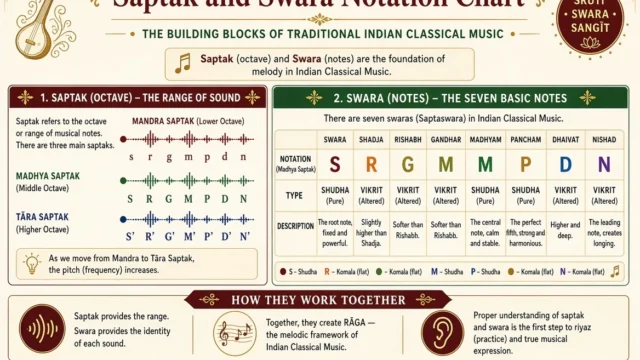
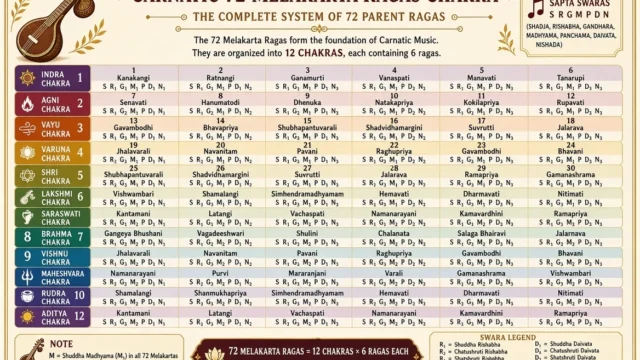
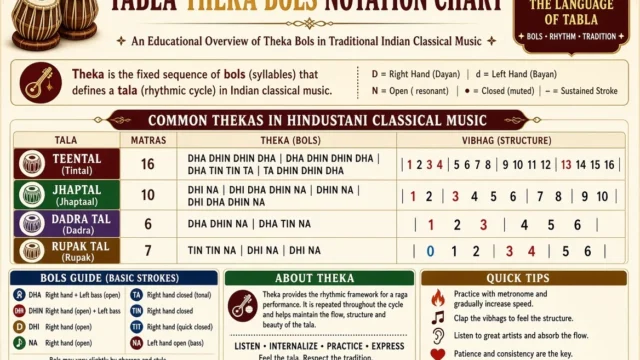
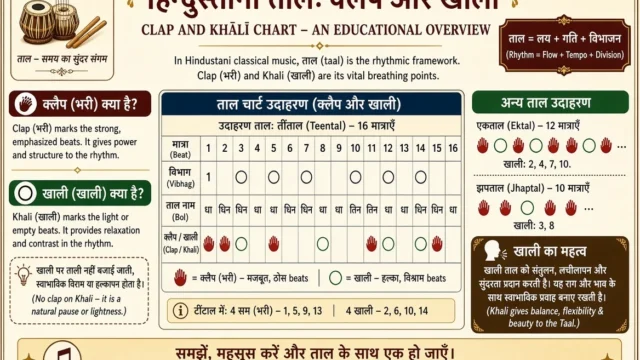
Konnakol is the art of vocalising rhythmic syllables in South Indian Carnatic music. Solkattu gives spoken sounds such as Ta, Ka, Di, Mi, Ki and Thom that make counts and rhythmic phrases easy to hear. The core beginner chart groups syllables into 3, 4, 5, 7 and 9 subdivisions; the beat cycle itself is controlled by tala. These four visual charts show syllable groups, mridangam-oriented practice patterns, tala grouping and counting references.
Updated 21 November 2026 · Transliteration and pedagogy differ across teachers.
Four Konnakol and Solkattu image charts


Konnakol, solkattu and mridangam: same language, different jobs
Konnakol refers to performing percussion syllables vocally, often while marking tala by hand. Solkattu is a broad term for the syllabic vocabulary and patterns through which rhythm is taught and performed. Mridangam is the two-headed drum central to Carnatic concerts; its players learn phrases orally as well as on the instrument. All three belong to related practice traditions, but they are not identical skills.
A student may say Ta Ka Di Mi while keeping a steady hand count, then render an appropriate phrase on the mridangam under a teacher’s direction. Do not assume each syllable always corresponds to one unique physical drum stroke. Pronunciation, phrase context, playing school and the particular exercise affect how sounds map onto the instrument. Our syllable chart is an entry point, not a fixed stroke dictionary.
Ta Ka Di Mi: what the four syllables mean
Ta Ka Di Mi is a familiar four-part rhythmic vocal pattern. In chatusra nadai, four evenly spaced syllables may be recited during each underlying beat. With a metronome at a comfortable pace, say Ta on the click and distribute Ka, Di, Mi evenly before the next click. The goal is an even pulse, clear articulation and good breath control, not speed for its own sake.
A group of four can also form part of larger phrases with gaps and accents. It does not automatically mean a composition is in four-beat tala. A cycle such as Adi tala is traditionally counted as eight beats in chatusra-jati triputa tala, and subdivisions can be changed within that cycle. Keep a distinction between how many beats are in the cycle and how many spoken subdivisions fit within one beat.
Tisra, chatusra, khanda, misra and sankeerna nadai
The familiar counts are tisra 3, chatusra 4, khanda 5, misra 7 and sankeerna 9. In a classroom, a three-part Ta Ki Ta, four-part Ta Ka Di Mi and five-part Ta Ka Ta Ki Ta offer practical entry points. Seven can be grouped as 4+3, while nine can be 4+5. These are representative exercises; other syllable arrangements are valid in different teaching lineages.
Practise these counts slowly against one steady beat. If a beat repeats every second, placing nine evenly spaced syllables into it is challenging; begin with three or four at a tempo that permits clarity. A neat rhythm grid shows the subdivision spaces, but it cannot replace listening to the phrasing. Understand each count as a rhythmic grouping, not as a magic phrase that is valid only in one tala.
Difference between tala, jati and nadai/gati
Tala is a repeating rhythmic time cycle marked by prescribed gestures or counts. Jati changes the count of the laghu component in appropriate Carnatic tala systems: tisra, chatusra, khanda, misra and sankeerna jatis correspond to 3, 4, 5, 7 and 9 laghu counts. Nadai or gati refers to subdivisions of the ongoing beat. Both sets use similar labels, making beginners understandably mix them up.
For example, Adi tala in its familiar form has eight beats arranged 4+2+2, but chatusra nadai is the common subdivision of four per beat. You could study a different nadai without claiming that the eight-beat tala itself disappeared. A diagram should label its number as beat count, laghu length or subdivision count. That one-word distinction prevents many wrong explanations online.
Read the four diagrams: syllables, patterns, tala and count
Open the first picture for the compact Ta Ka Di Mi and alternate syllable groups. Use the second image to visualise simple solkattu practice patterns that a mridangam teacher might discuss, rather than treating them as a literal hand-position chart. The third compares tala groupings with rhythmic syllables. The fourth is a counting reference that is useful while speaking and keeping time.
When looking at any chart, ask what the small boxes represent: one beat, one subdivision, or one phrase. If the graphic does not state this clearly, follow your instructor’s tala count. Some posters use simplified transliteration such as Tha instead of Ta, Dhi instead of Di, or Thom instead of Tom. Pronunciation conventions vary. Consistency across an exercise matters more than asserting that one English spelling is universally correct.
Step-by-step practice for absolute beginners
First, clap a steady pulse for one minute without syllables. Second, keep the same clap and say Ta Ki Ta in each pulse slowly. Third, switch to Ta Ka Di Mi, and record yourself; each part should be evenly spaced. Fourth, work on five counts by separating a two-plus-three group before joining it smoothly. Finally, try a seven-count phrase as four plus three without accelerating the final syllables.
Use a metronome as a reference, not as a race. Choose a pace where speech is relaxed. Mark the first subdivision with a light vocal accent, then remove the accent when you can hold the pulse internally. After a few rounds, make space for silence and see whether the next Ta lands on the click. This tests time awareness more reliably than endlessly repeating a memorised string.
Common errors: speed, wrong beat count and copied syllables
A frequent mistake is fitting four syllables into four different beats when an exercise asks for four syllables per beat. Another is speeding up during the longer seven- or nine-part group. Practice at a reduced tempo and count the beat silently. New learners also sometimes copy a spoken phrase from a video without knowing the teacher’s intended grouping; the same syllables can be organised differently.
Avoid presenting the vocal phrase as an exact automatic mridangam fingering instruction. Drum practice needs careful guidance on tone, posture and sound production. Also do not confuse North Indian tabla bols with Carnatic solkattu: both are sophisticated oral rhythmic systems, but their conventions and relationships to instruments differ. Comparing them is interesting once the basic distinctions are understood.
One-week rhythm diary and useful self-tests
Day one: learn Ta Ki Ta and Ta Ka Di Mi. Day two: alternate three and four with the same metronome pulse. Day three: add five. Day four: practise seven in 4+3 and notice where the beat lands. Day five: approach nine slowly as 4+5. Day six: keep an eight-beat Adi tala hand cycle while reciting a beginner-level pattern advised by a teacher. Day seven: record yourself and listen for uneven spaces.
Keep a notebook with columns for tala, nadai, syllables, tempo and your observation. Write the counts as numbers under each spoken syllable so you can find the place where a phrase drifts. The outcome is musical clarity, not an internet speed challenge. When an advanced korvai or mora appears, do not try to reverse-engineer it from a beginner chart alone; seek the full phrase and its intended landing point.
Nadai grouping quick-reference table
| Nadai | Subdivisions per beat | Example spoken group |
|---|---|---|
| Tisra / திஸ்ரம் | 3 | Ta Ki Ta |
| Chatusra / சதுஸ்ரம் | 4 | Ta Ka Di Mi |
| Khanda / கண்டம் | 5 | Ta Ka Ta Ki Ta |
| Misra / மிஸ்ரம் | 7 | Ta Ka Di Mi Ta Ki Ta |
| Sankeerna / சங்கீர்ணம் | 9 | Ta Ka Di Mi Ta Ka Ta Ki Ta |
Frequently asked questions
What is the difference between konnakol and solkattu?
Konnakol is vocal performance of rhythmic syllables; solkattu is the broader syllabic vocabulary and pattern practice.
What does Ta Ka Di Mi represent?
A common four-part subdivision phrase, often used to practice chatusra nadai.
Is misra seven?
Misra is associated with a seven-part grouping in this nadai reference.
Does Adi tala always mean four beats?
No. The common chatusra-jati triputa form called Adi tala has eight beats.
Can I learn mridangam by reading a chart?
A chart helps you count and remember syllables; instrument technique benefits from a teacher.
Key takeaway
Konnakol is the art of vocalising rhythmic syllables in South Indian Carnatic music. Solkattu gives spoken sounds such as Ta, Ka, Di, Mi, Ki and Thom that make counts and rhythmic phrases easy to hear. The core beginner chart groups syllables into 3, 4, 5, 7 and 9 subdivisions; the beat cycle itself is controlled by tala. These four visual charts show syllable groups, mridangam-oriented practice patterns, tala grouping and counting references.
Further reading
Konnakol nadai practice · Carnatic percussion instructional textbook archive.

















Share Your Opinion
Comments are closed on this post.