 Vista
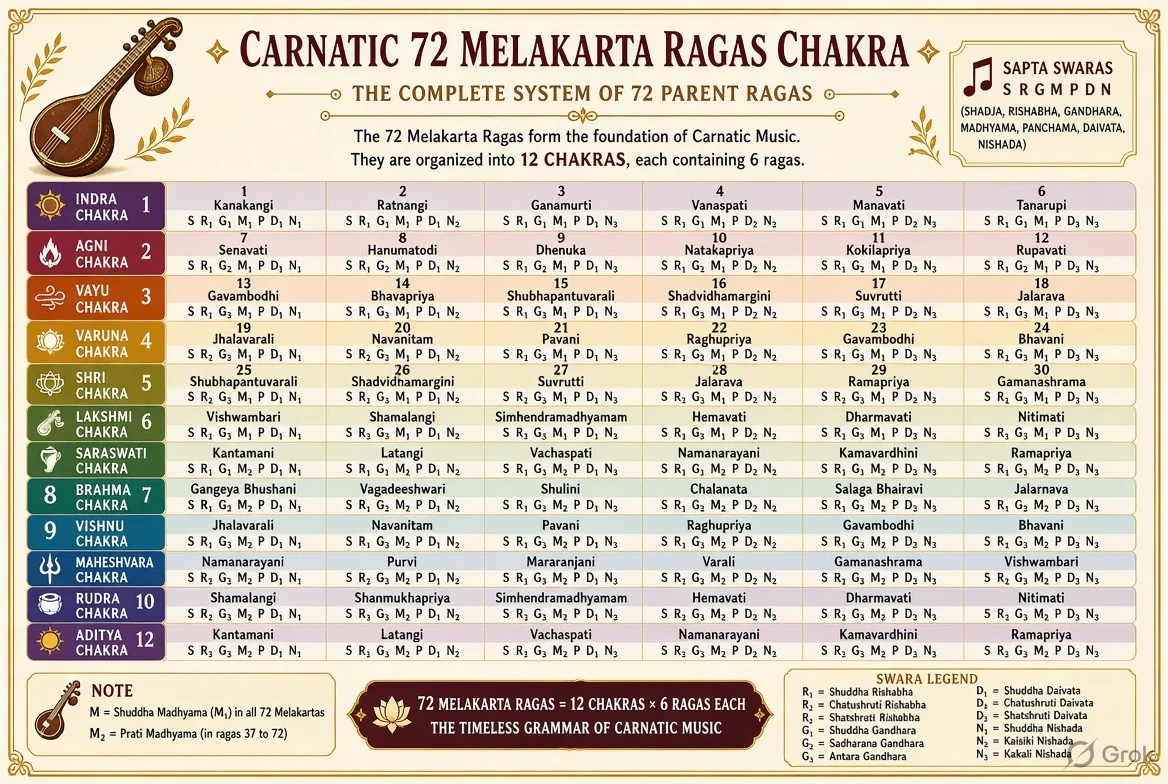
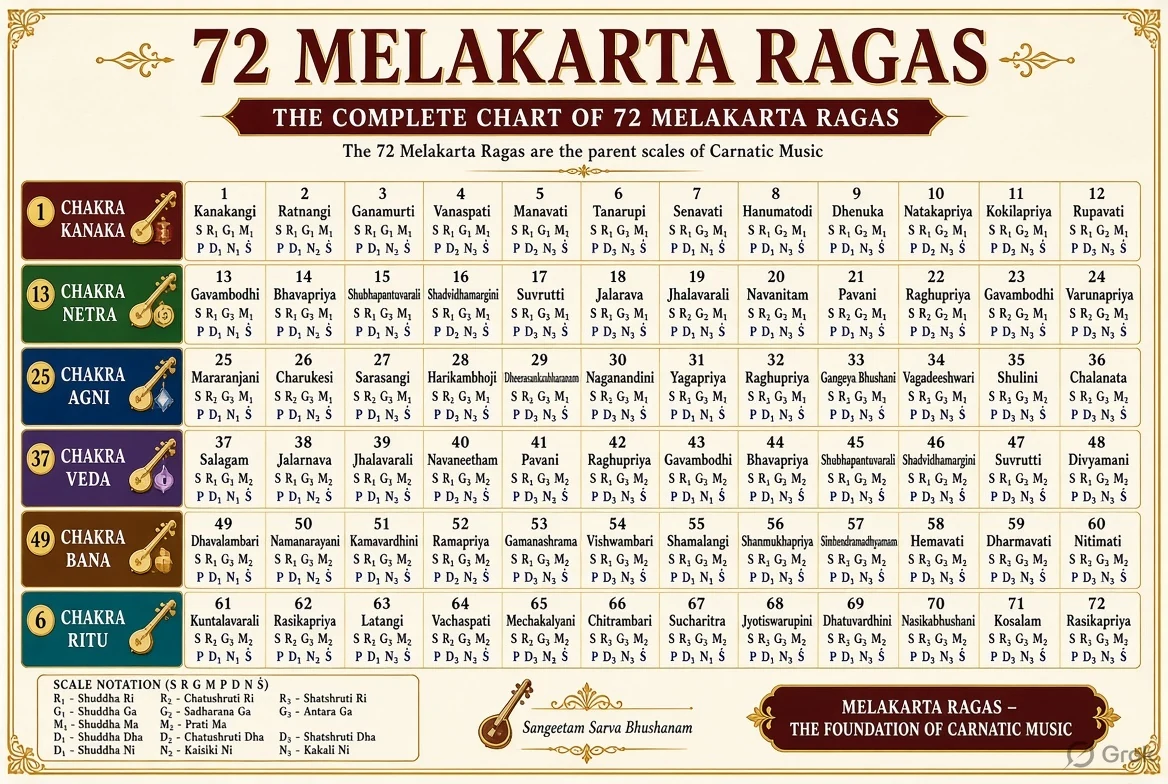
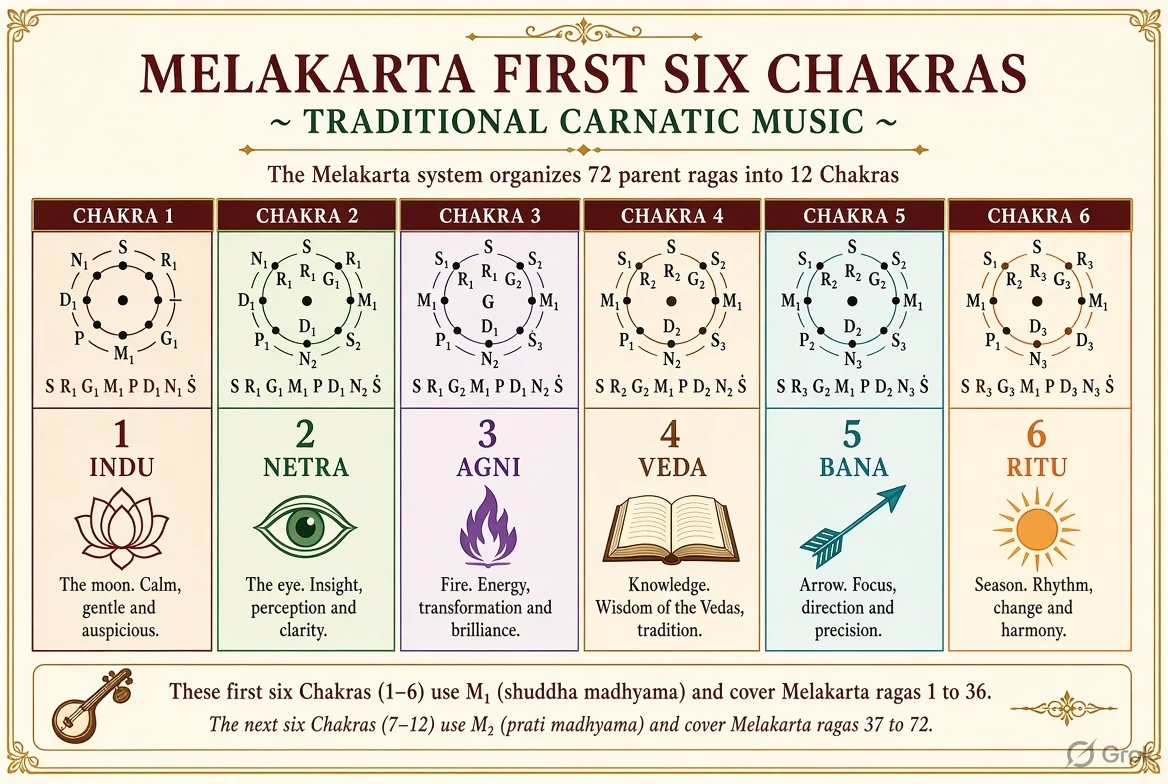
The 72 Melakarta ragas are the ordered parent scales in a widely used Carnatic music classification. They are organised into twelve chakras of six ragas each: numbers 1–36 use shuddha madhyama (M1), and 37–72 use prati madhyama (M2). Our five image charts help students identify every name, numbering rule and swara family without pretending a chart replaces listening or raga practice.
Updated 21 November 2026 · Melakarta classification and spellings may vary in historical schools.
Five visual charts to explore the Melakarta system


What is a Melakarta raga, and what does the chart show?
A Melakarta, also called a janaka raga in this classification, uses all seven swara names Sa, Ri, Ga, Ma, Pa, Dha and Ni in its ascending and descending scale, in the conventional orderly progression. Both Sa and Pa remain stable positions while the allowed combinations of Ri–Ga, Ma and Dha–Ni give the complete set of 72. A chart groups related scales structurally; it does not claim each melody sounds identical to another scale with a similar symbol.
The system is valuable for Carnatic music exams, beginner notation, instrument practice and comparing janya ragas. A janya raga derives from the parent framework but may use fewer swaras, a curved movement, or characteristic phrases not captured by a simple list. Many famous Carnatic compositions are heard in janya ragas; understanding the parent scheme is a foundation, not a shortcut that automatically teaches all of them.
Why exactly 72? Learn the combinations, not random memorisation
The six possible Ri–Ga combinations that preserve musical order are paired with six allowed Dha–Ni combinations. Multiplying six by six gives 36. Because Ma may be either M1 or M2, the result doubles: 6 × 6 × 2 = 72. Each group of six fixes its Ri and Ga, while positions one through six within the chakra change Dha and Ni. These two variables are easier to learn from a grid than from an unbroken list.
The first 36 belong to shuddha madhyama; the second 36 to prati madhyama. For example, Melakarta number 15, Mayamalavagowla, and number 51, Kamavardhini, stand 36 positions apart, demonstrating how the madhyama switch creates a related scale structure. They are nevertheless distinct ragas in music and should be listened to as distinct musical identities.
The 12 chakra names and how to read the numbering
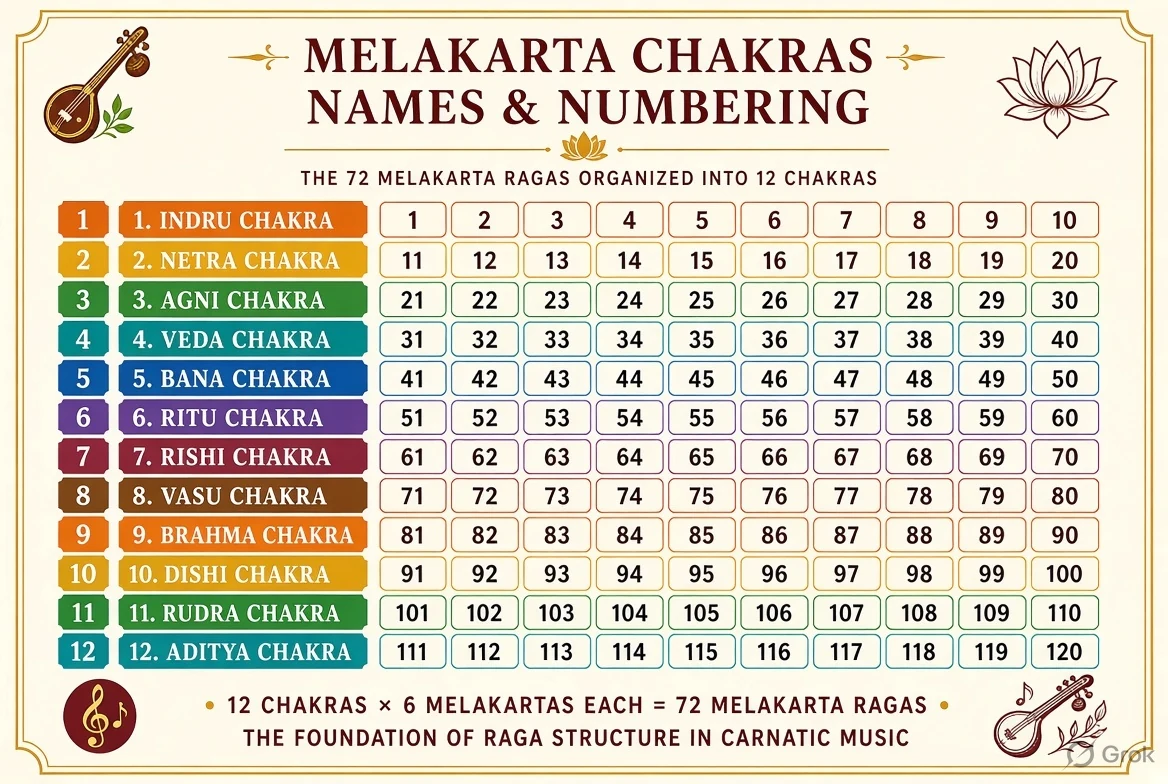
The sequence is Indu, Netra, Agni, Veda, Bana, Rutu, Rishi, Vasu, Brahma, Disi, Rudra and Aditya. Each chakra holds exactly six consecutive numbers. To find a raga’s chakra from its Melakarta number, subtract one, divide by six, take the integer part and add one. For number 29, that gives chakra five, Bana. The position within it is five, which identifies Dheerasankarabharanam on our names chart.
The chakra layout is not an exam trick. It tells students which note families can appear together. A performer who already knows a few familiar ragas can start with their numbers and locate neighbouring melas, then compare which swara positions change. This is more useful than memorising the chakra words without any sound or theory context.
Swara positions: S R G M P D N and the two madhyamas
Music textbooks often write Carnatic swaras with subscripts such as R1, R2, R3, G1, G2, G3, D1, D2, D3 and N1, N2, N3. Some labelled positions can sound at the same pitch, but the formal spelling of a Melakarta scale depends on note function and ordered relationships. Never assume that a visually similar sharp/flat piano-key diagram explains every aspect of raga identity.
The middle note Ma is especially convenient for checking the two halves: M1 appears in numbers 1–36 and M2 in 37–72. Keep Sa steady as the chosen tonic, sing the sequence slowly, and notice the interval change rather than treating the numbering as an arbitrary chart. The accompanying swara-position visual is a map, not a substitute for a teacher demonstrating gamakas and phrases.
Common examples you will actually hear
Mayamalavagowla (15) is widely encountered in beginner Carnatic exercises; Sankarabharanam (29), Kharaharapriya (22), Harikambhoji (28), Keeravani (21) and Charukesi (26) are familiar names across repertoire and classroom explanations. In the prati madhyama half, Kamavardhini (51), Shanmukhapriya (56), Simhendramadhyamam (57), Hemavati (58), Dharmavati (59) and Mechakalyani (65) are useful markers.
Do not confuse a raga number with an audio frequency, time-of-day rating or a universal ‘difficulty level’. It is the position in a particular classification. Alternate spellings such as Shankarabharanam/Sankarabharanam and Dikshitar traditions may vary across sources. Follow your institution’s named convention when preparing a syllabus answer, and verify which system a historical document refers to.
How to use the five infographic charts effectively
Begin with the complete 72-name chart and identify one raga you know. Locate its chakra and exact number. Next read the first-six-chakras graphic for numbers 1–36 and the last-six-chakras graphic for numbers 37–72. Compare their paired positions, keeping the first half and second half difference clear. Finally inspect the swara position diagram and the chakra-numbering card to understand why the names appear in that order.
For classroom notes, make a small three-column notebook: raga name, Melakarta number and chakra. Add arohana and avarohana from a verified reference only after you are certain of the raga. On a keyboard or harmonium, fix Sa at a comfortable pitch and practise one or two scales slowly. Try humming a recognisable composition under a teacher’s guidance so the name becomes a real musical experience.
Misunderstandings about Melakarta and janya ragas
A Melakarta parent scale is not the same as ‘every raga in Indian music’. Hindustani thaat categories have a different history and should not be presented as one-to-one replacements. Carnatic janya ragas can be much more than simply removing a note from the parent; prayogas, ornamentation, phrase emphasis and descent patterns matter. One row on a reference chart cannot tell a musician how to render a composition authentically.
Also, different historical naming and numbering conventions exist, especially when comparing the modern commonly taught sampurna-mela organisation with earlier schemes. The numbering on this page uses the widely taught 72-Melakarta order. Where a composition or music-school book offers a variant spelling or a different parent association, label it instead of silently overriding the source.
Practice plan: from a chart to listening, writing and singing
Day one: learn the twelve chakra names and write the 1–6 pattern. Day two: identify numbers 1–36 and their M1 relationship. Day three: match the corresponding 37–72 counterparts with M2. Day four: memorise a few anchors such as 15, 21, 22, 28, 29, 51, 56 and 65. Day five: choose a raga and sing its swaras at a steady tempo while reading the notation.
On later days, compare two scales with one controlled change, then listen to recognised performances to hear why raga grammar exceeds the raw note set. A useful self-test is to calculate chakra and position from a random Melakarta number without looking up the answer. If you can explain the 6 × 6 × 2 construction and locate the raga in the grid, you understand the chart much better than someone who only memorised a long list.
All 72 Melakarta ragas: 12-chakra reference table
| Chakra and range | Six parent ragas in order |
|---|---|
| 1. Indu (1–6) | Kanakangi, Ratnangi, Ganamurti, Vanaspati, Manavati, Tanarupi |
| 2. Netra (7–12) | Senavati, Hanumatodi, Dhenuka, Natakapriya, Kokilapriya, Rupavati |
| 3. Agni (13–18) | Gayakapriya, Vakulabharanam, Mayamalavagowla, Chakravakam, Suryakantam, Hatakambari |
| 4. Veda (19–24) | Jhankaradhvani, Natabhairavi, Keeravani, Kharaharapriya, Gourimanohari, Varunapriya |
| 5. Bana (25–30) | Mararanjani, Charukesi, Sarasangi, Harikambhoji, Dheerasankarabharanam, Naganandini |
| 6. Rutu (31–36) | Yagapriya, Ragavardhini, Gangeyabhushani, Vagadheeswari, Shulini, Chalanata |
| 7. Rishi (37–42) | Salagam, Jalarnavam, Jhalavarali, Navaneetam, Pavani, Raghupriya |
| 8. Vasu (43–48) | Gavambhodi, Bhavapriya, Shubhapantuvarali, Shadvidamargini, Suvarnangi, Divyamani |
| 9. Brahma (49–54) | Dhavalambari, Namanarayani, Kamavardhini, Ramapriya, Gamanashrama, Vishwambari |
| 10. Disi (55–60) | Shamalangi, Shanmukhapriya, Simhendramadhyamam, Hemavati, Dharmavati, Neetimati |
| 11. Rudra (61–66) | Kantamani, Rishabhapriya, Latangi, Vachaspati, Mechakalyani, Chitrambari |
| 12. Aditya (67–72) | Sucharitra, Jyotiswarupini, Dhatuvardhini, Nasikabhushani, Kosalam, Rasikapriya |
Frequently asked questions
How many Melakarta ragas are there?
Seventy-two parent ragas in twelve chakras of six each.
What is the difference between M1 and M2?
M1 is shuddha madhyama in Melakartas 1–36; M2 is prati madhyama in 37–72.
Is Mayamalavagowla number 15?
Yes, in the commonly taught 72-Melakarta order.
Is every Carnatic raga a Melakarta?
No. Many important ragas are janya ragas with their own melodic rules.
Are the charts suitable for exams?
Use them for revision, but verify names and notation against your course syllabus.
What to remember
The 72 Melakarta ragas are the ordered parent scales in a widely used Carnatic music classification. They are organised into twelve chakras of six ragas each: numbers 1–36 use shuddha madhyama (M1), and 37–72 use prati madhyama (M2). Our five image charts help students identify every name, numbering rule and swara family without pretending a chart replaces listening or raga practice.
References and further learning
Nathaniel School of Music: 72 Melakarta Ragas · Indian Heritage 12 Chakras reference. Educational charts are learning aids and do not replace a teacher or original musical performances.







Share Your Opinion
Comments are closed on this post.