 Vista
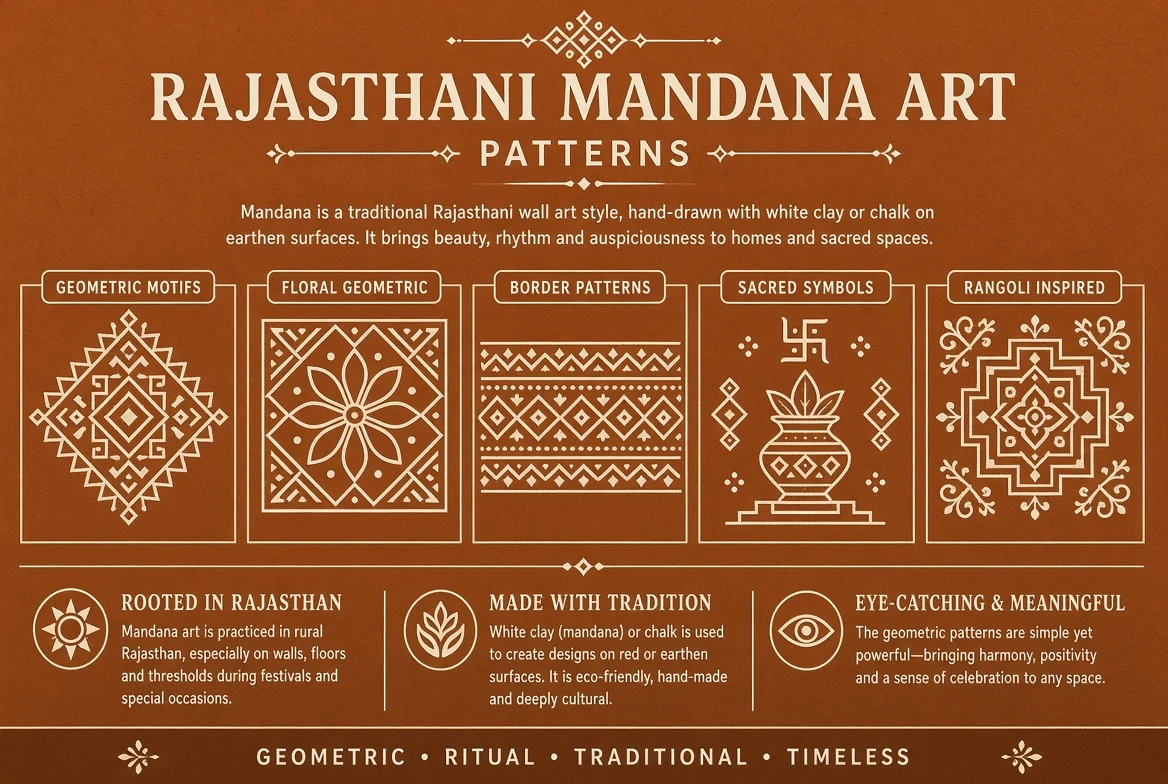
Direct answer: Rajasthani Mandana art is a traditional floor-and-wall painting practice using red-and-white patterns, geometric shapes, decorative borders and sometimes animals or plant motifs. It is associated with Rajasthan and parts of Madhya Pradesh, with different designs used in different household celebrations. Four picture charts show the shapes and technique without inventing universal symbol meanings.
Updated 21 November 2026. Illustrative reference designs, not photographs of specific original village art.
Rajasthani Mandana art patterns: four visual charts
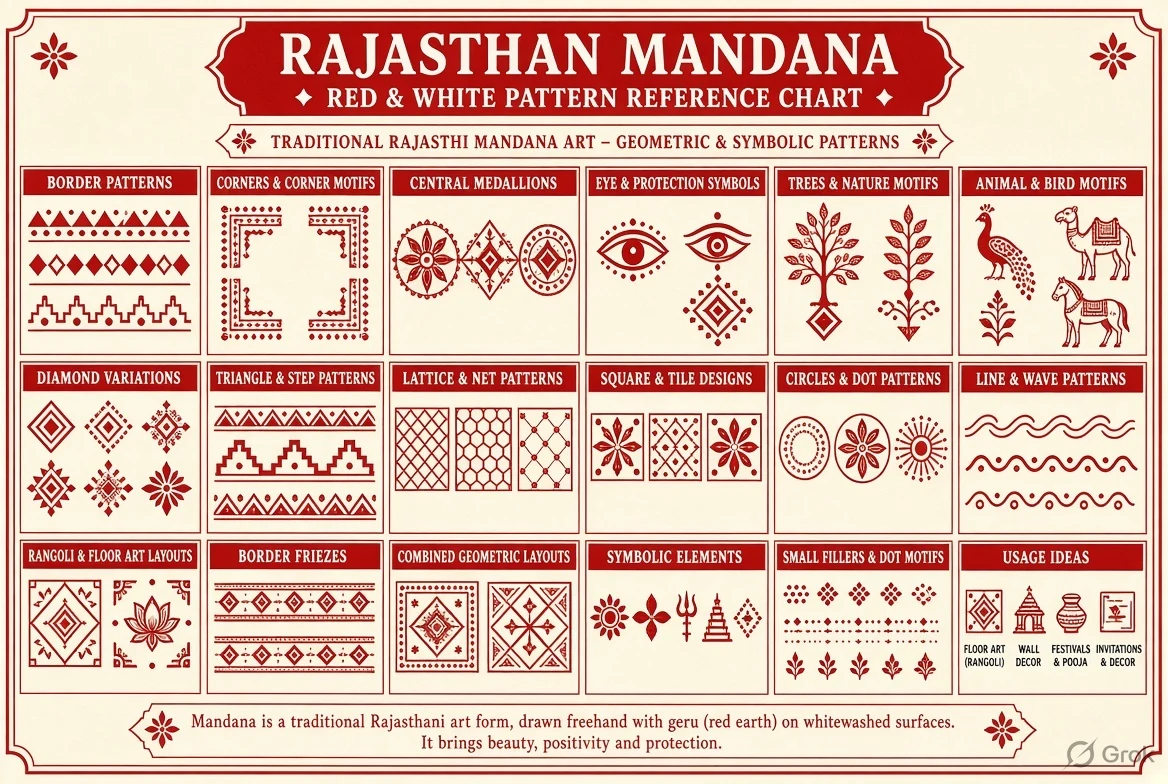
What is Rajasthani Mandana art?
Mandana art is a family of traditional decorative wall and floor paintings associated especially with Rajasthan and parts of Madhya Pradesh. Makers create geometric compositions, lines, squares, circles, floral shapes and sometimes animals or other figures on thresholds, courtyards and walls. The familiar red-and-white contrast can be achieved with prepared earth surfaces, geru or red ochre and light-coloured materials such as chalk or lime. Mandana traditions vary among regions and households; not every drawing uses the same proportions, pigments or symbolic meaning.
Rajasthan state educational material lists triangles, squares, hexagons, octagons and circles among Mandana geometry, along with different designs connected with marriage, childbirth and festivals. The Indian tribal-culture repository documents a Mandana work from Sagwara in Dungarpur, showing its continuing presence in Rajasthan. The four charts below present border patterns, floor geometry, animal motifs and red-white arrangements. They are educational illustrations rather than claims of reproducing a particular household ritual image.
Mandana border patterns for walls and thresholds
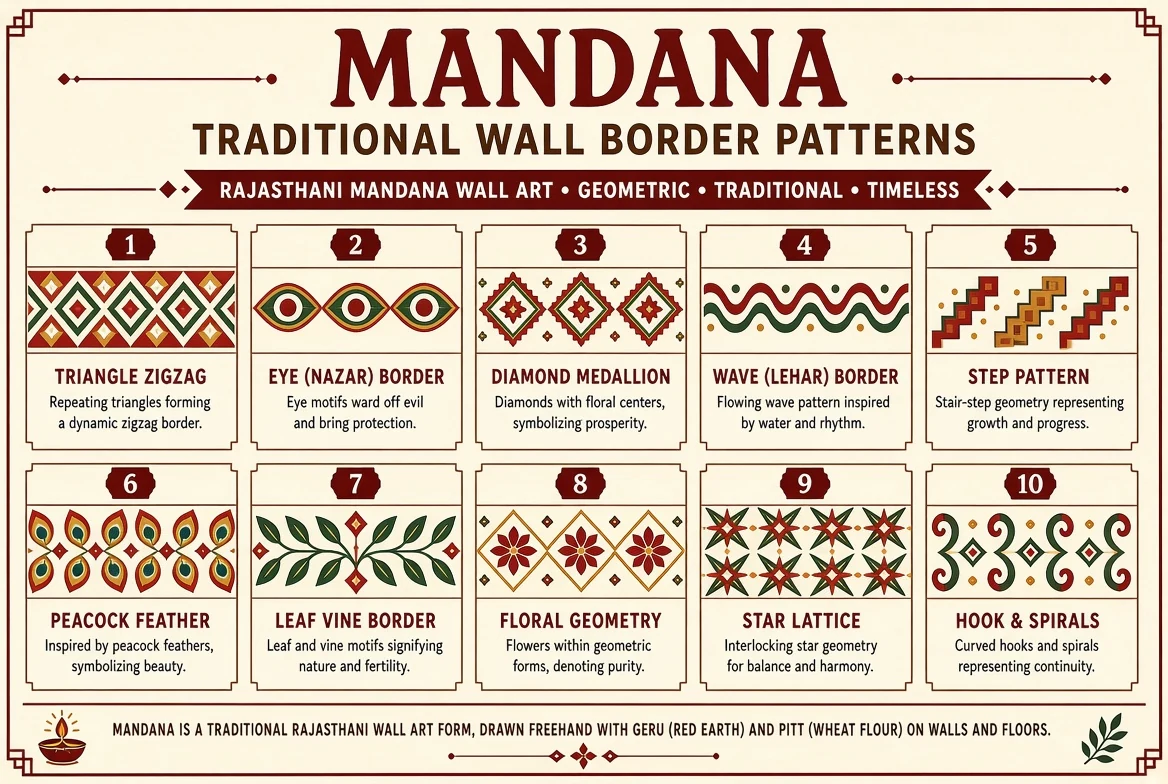
Mandana border designs help frame doorways, walls and decorated floor spaces. Repeated leaves, triangles, short strokes and curved lines can produce visual continuity along an edge. A border’s scale depends on whether it is being used on a narrow threshold or a large courtyard. Some borders support a particular festival picture, while others can be primarily decorative. A freshly drawn example therefore should not be assigned one fixed ceremonial meaning without knowing its origin.
To study a Mandana border, notice how a simple unit repeats at regular intervals and how the corners are handled. A larger wall pattern may have enough room for foliage and animals, while a short threshold strip may rely on triangles and curved outlines. Our first chart is a visual reference for designing balanced repetition, not a mandatory sacred sequence. A school craft should be labelled “Mandana-inspired border exercise” if the pupil invented or adapted the design rather than copying an authenticated traditional mural.
Geometric Mandana floor designs: squares, circles and chowk
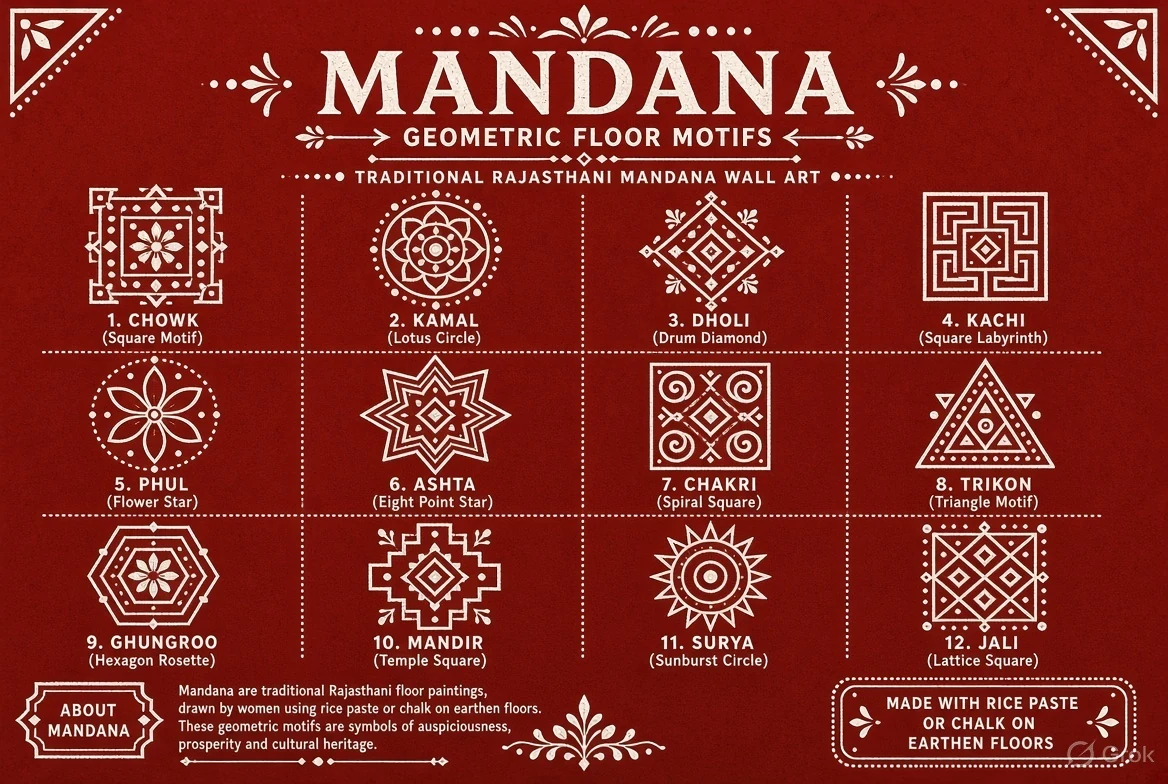
Mandana geometric floor motifs often use circles, squares, triangles and repeating units. Some regional descriptions refer to a central chauk or square-based form, and particular festive settings can call for more elaborate arrangements. Rajasthan’s school cultural-history textbook documents multiple geometry types and their association with occasions, demonstrating that Mandana is not a single rigid icon repeated everywhere. The layout may be symmetrical or organised around a recognisable central figure.
When examining a pattern, identify its outer frame, central shape and secondary motifs. A square can be surrounded by triangles or connected curved strokes, while circles may support petal-like patterns. A geometric diagram can explain construction without dictating the cultural meaning of the particular image. For a classroom project, first sketch the centre and outer edge, then fill the intervening spaces. Avoid teaching that every hexagon has a universal magical power or that one exact angle is essential to all village practices.
Peacock, animal and plant motifs: imagery beyond geometry
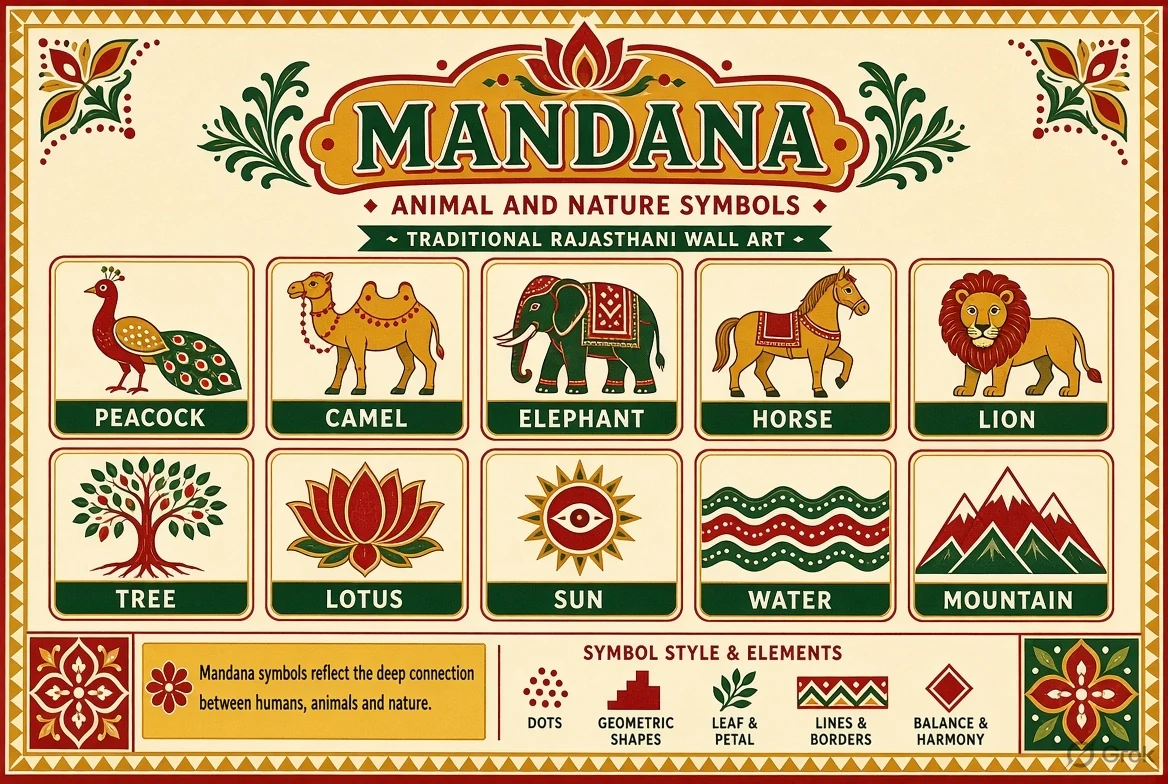
Mandana is frequently described through its geometric forms, but animal and nature motifs also appear in regional examples. Rajasthan educational texts mention peacocks, cattle, flowerpots and other figures used for different domestic occasions. These images can be intertwined with the same red-white lines used for simpler geometry. A peacock may be part of a festive composition, while a flowering plant can frame an entryway or complete a central visual design.
It is misleading to convert every peacock into an automatic prediction of prosperity or to label an unknown animal an official deity without evidence. The same species can appear in several Indian art traditions. A detailed image caption should say what is visible, where the original work comes from and how the maker or scholar explains it, if that information is known. Our third chart groups common shape types for recognition and comparison; it is not a universal dictionary of ritual symbols.
Red geru and white lines: materials and painting method
The familiar red-and-white Mandana often uses a prepared surface made with local earth materials, then light-coloured lines using chalk, lime or other available preparations. The details depend on community and region. Asia InCH describes variations in how red and white are applied between Rajasthan and Madhya Pradesh, so it would be wrong to insist that every Mandana artist uses exactly one order of pigment layers. The visual effect arises from the material surface as well as the shapes.
Some traditional house preparations may involve mud and other locally used materials. A modern art lesson should avoid prescribing unhygienic or unsafe handling; ordinary craft paper and non-toxic paint can demonstrate the colour relationship. Label that result as a school adaptation, not a historically exact ritual mural. The fourth illustration shows the red-white appearance as a reference, not a claim that its digital pixels contain actual geru or rice paste. When photographing a real piece, record its material and condition if possible.
When are Mandana paintings made?
Mandana is connected with household celebrations, ceremonies and seasonal observances. The Rajasthan Board cultural-history text provides examples associated with marriage, childbirth, festivals and the return of a person from pilgrimage. This does not mean the same composition is used for all such events. The central imagery and decorative style can be selected or adapted according to the occasion, family and village practice.
A frequent search question is “Mandana for Diwali or wedding?” Both festive and marriage-related drawings can occur within Mandana traditions, but the relevant design should be documented before assigning it a particular event. If an old image has no date, do not assert that it depicts a Diwali celebration because the lines are white. Reliable captions include the source artist and, when known, the local observance. Public exhibitions and school projects may adapt motifs without reproducing the household ritual attached to some original practices.
Mandana in Rajasthan and Madhya Pradesh
The broader Mandana practice has different regional expressions. Rajasthan sources refer to rural courtyard and wall paintings, including Bhil and Meena communities in particular areas. Cultural surveys also describe Mandana in parts of Madhya Pradesh. There can be local differences in the preparation of the background, the direction of applied lines and the choice of motifs. It is sensible to discuss “Mandana traditions” rather than imply that one type of diagram accurately depicts every community.
The tribal-culture repository’s Dungarpur example illustrates how a specific work gains meaning from its maker and location. By contrast a computer-generated red-and-white pattern has no authentic geographic provenance unless a maker’s source is stated. Do not infer that a Mandana-looking drawing must have been made in Jaipur, Udaipur or one specific village. If learning about rural art, pay attention to local terminology and real artisans instead of relying only on tourist-friendly generalisations.
Mandana vs Aipan, Alpana, Warli and Rangoli
Indian floor and wall arts can share geometry yet differ by place, material and practice. Mandana is associated with Rajasthan and parts of Madhya Pradesh and often uses red-white geometry. Aipan is linked with Kumaon in Uttarakhand, commonly with geru and white rice-paste chowki motifs. Bengali Alpana features rice-paste floor drawings including lotus and footprints. Warli art is associated with Maharashtra’s Warli communities and familiar geometric human scenes. Rangoli is a broad word for numerous floor-decoration forms.
It is tempting to group all these images as “Indian tribal mandala symbols”, but such tags erase meaningful distinctions. A triangle can appear in many traditions. A correct identification should look at the whole image, technique, artist and cultural setting. For SEO, a descriptive caption such as “Rajasthani Mandana red-and-white geometric floor motif” is far more informative than a vague promise of luck or a supernatural claim attached to a shape.
Mandana art FAQs
Where is Mandana art from?
It is associated with Rajasthan and parts of Madhya Pradesh, with regional community variations.
What colours are commonly used in Mandana?
Red earth or ochre backgrounds and contrasting white motifs are widely documented.
Are Mandana patterns always geometric?
No. Animal, plant and festive imagery can also appear in compositions.
Is Mandana the same as Kumaoni Aipan?
No. They are distinct regional traditions even when red and white colours overlap.
Do Mandana shapes guarantee prosperity or good luck?
No. Specific meanings must be understood in the household or community context rather than assumed from one shape.
Conclusion
Mandana’s geometry and regional context deserve careful documentation. Use borders and floor motifs as visual learning aids while giving the actual makers, materials and occasions their proper place.
Sources and regional references
Rajasthan education board: History and Culture, Mandana traditions; Government tribal repository: Mandana art from Dungarpur; Asia InCH: Mandana Wall and Threshold Art; Tribal Welfare Research Institute: Mandana and related folk traditions.


















Share Your Opinion
Comments are closed on this post.