 Vista
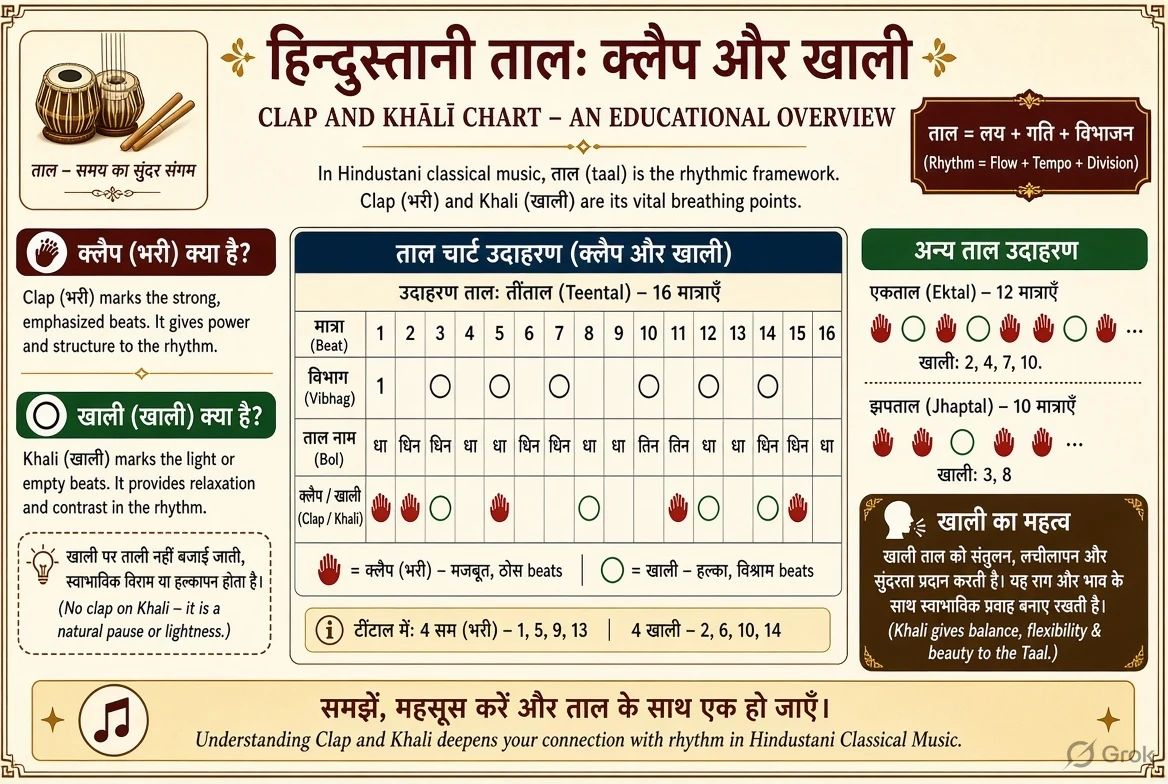
Direct answer: In a standard Hindustani Taal Clap–Khali Chart, Teentaal has 16 beats (claps 1, 5, 13; wave 9), Dadra has six beats (3+3) and Keherwa has eight (4+4). Sam begins the cycle and Vibhag means a beat group. Four diagrams show how to count them without skipping Khali beats.
Updated 21 November 2026. Elementary notation; tabla bols and presentation can vary by instructor.
Hindustani Taal Tali Khali: four illustrated charts


What are Sam, Tali, Khali and Vibhag in Hindustani taal?
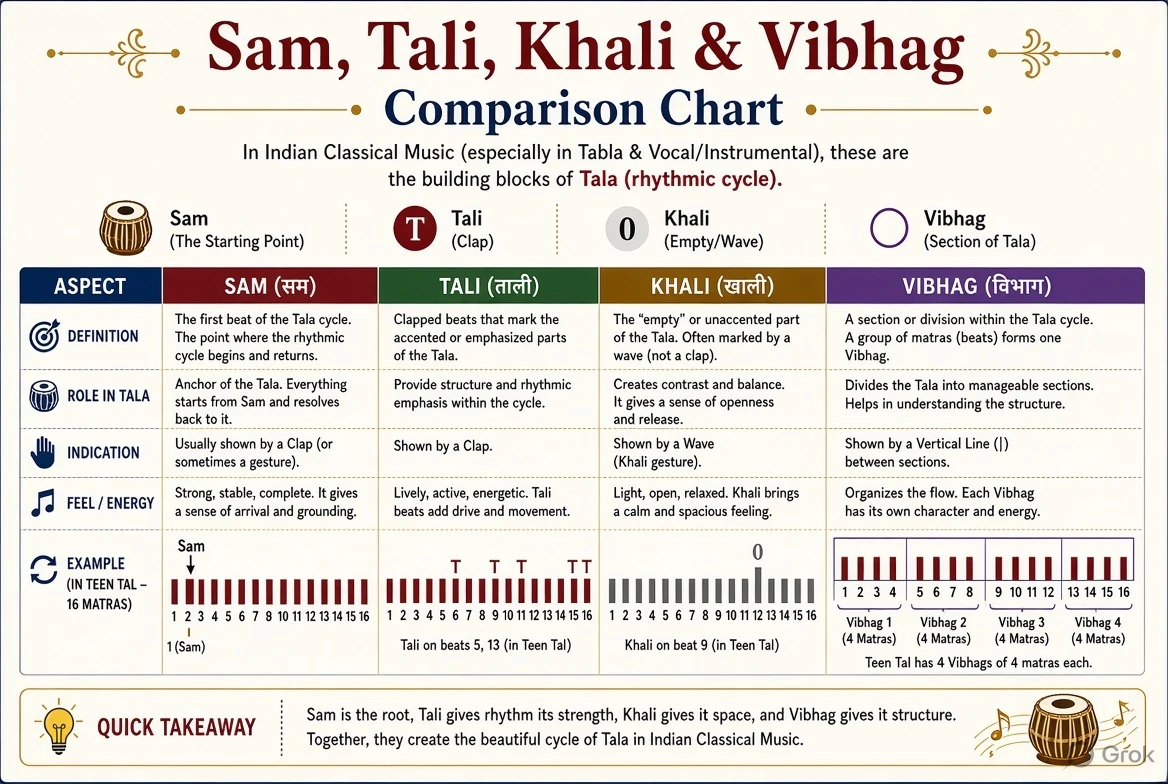
A Hindustani taal is a recurring rhythmic cycle made up of counted beats called matras. Its sections are vibhags, and performers often identify important positions using hand gestures. Sam is the first beat of the cycle and an important point of musical arrival. Tali is a clapped point, while khali is commonly indicated by a wave of the hand. These signs help musicians and dancers keep their place in the rhythmic structure rather than treating a rhythm as an endless row of undifferentiated numbers.
The academic introduction to Tala in Pustakalaya explains matra counts, divisions, claps, waves and the theka—the characteristic bols commonly used to identify a cycle. Our visual guide compares 16-beat Teentaal, six-beat Dadra and eight-beat Keherwa, then explains the core terms. A note of precision: khali does not mean “stop making sound” or “there is no beat.” The beat continues and may carry tabla strokes, but its position in the cycle is represented by a different gesture and a lighter musical identity.
Teentaal: sixteen matras, four groups and clap pattern
Teentaal, also written Tintal or Tritaal, is one of the most commonly taught rhythmic cycles of Hindustani music and Kathak. It contains 16 matras grouped as 4+4+4+4. The first beat is the sam, marked with a clap and often the symbol X. The second group begins at beat 5 with a clap, the third at beat 9 with a khali wave, and the fourth at beat 13 with a clap. Standard shorthand for the group markers is X 2 0 3.
A widely taught theka sounds like “Dha Dhin Dhin Dha | Dha Dhin Dhin Dha | Dha Tin Tin Ta | Ta Dhin Dhin Dha,” although teachers and performances can show variations in pronunciation or bols. Count from one to sixteen and return to one to feel the complete avartan. The first image helps identify the clap and wave markers, which do not have to be sounded by a performer in every physical practice. A diagram is especially useful for the student who can recite the bol but loses track of where the third, khali vibhag begins.
Dadra Taal: six beats divided into three plus three
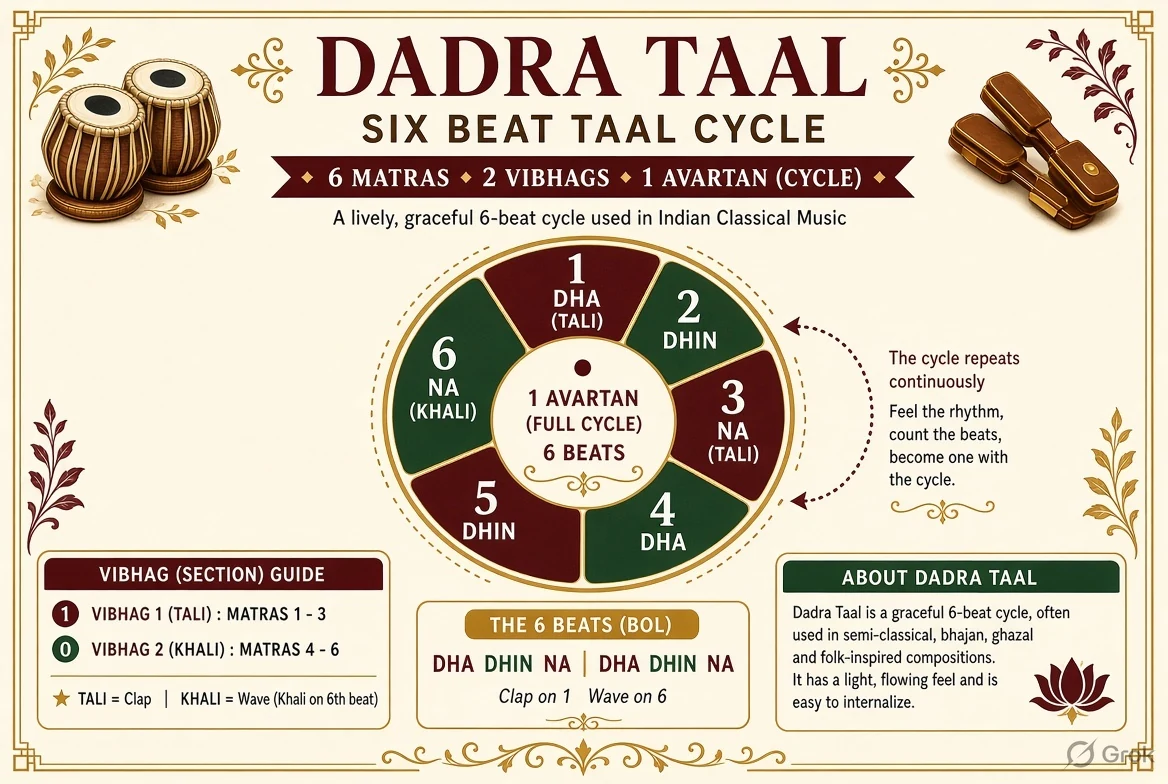
Dadra Taal is commonly taught as a six-matra cycle, often organised as 3+3. The sam falls at beat one and the second group, commonly indicated as khali, begins at beat four. A familiar elementary theka is “Dha Dhi Na | Dha Tu Na” or related variants in tabla teaching. Spoken syllables differ between teachers, and an accompaniment may change its texture according to the song; the six-beat structure is the more stable reference point for this simple diagram.
Dadra is often encountered in lighter Hindustani vocal styles, folk-associated music and popular songs. It is important not to infer that every song with the word “Dadra” in its genre title is identical to one fixed tabla accompaniment. The chart provides the basic cycle and hand-counting pattern, not a complete list of all ways to play Dadra. Practise the count first, then speak the two groups, keeping the return to beat one clear. A wave at beat four signals khali without removing the fourth, fifth or sixth beats.
Keherwa or Kaharwa: eight beats in two groups
Keherwa Taal, also spelled Kaharwa or Keharwa, is commonly represented as eight matras in two groups of four. Sam is at beat one, and the second group starts at beat five with a khali wave in a familiar learning scheme. The basic division is 4+4, which makes it approachable for beginners. It appears in many devotional, folk and popular music contexts, although there are many variations in playing style and accent.
A familiar theka can be spoken as “Dha Ge Na Ti | Na Ka Dhi Na,” with other commonly taught variants. Do not mistake the example bol for the only valid accompaniment in all genres. Start by counting evenly from one to eight, clap at one, wave at five and repeat. Some performances use different accents or elaborations while retaining the cycle. Our Keherwa chart is a simple reference for remembering the layout, not proof that all eight-beat songs use exactly the same drum strokes.
Sam is not merely the loudest beat
Sam is the beginning of the rhythmic cycle and often becomes a powerful moment of arrival in Hindustani performance. A vocalist, instrumentalist or Kathak dancer may construct a phrase that resolves at the sam after passing through several matras and vibhags. It is common to describe sam as important or accented, but beginners should avoid assuming it is always the physically loudest note on stage. Musical emphasis is shaped by composition, phrasing and performance.
The symbol X is often used for sam in common tabla notation, but the layout of a printed table does not replace the act of listening. Try counting a Teentaal cycle while listening to accompaniment. Notice how the first matra feels like a point of return even when the instrument’s actual volume varies. A teacher may ask students to mark the sam with a clap or verbal cue to strengthen orientation. The gesture is a learning convention that represents musical structure, not an instruction that every performer must clap throughout the entire concert.
What exactly does Khali mean in a taal chart?
Khali is often translated as “empty,” but in rhythm teaching it is better understood as a designated light or un-clapped vibhag marked by a wave. There is still a counted beat and often still percussion sound in a khali section. The tabla’s tonal quality can change because the bols may differ from the clapped portions. In Teentaal, for example, the khali group begins at beat nine and is commonly played with a different tonal character from the earlier clapped groups.
Misunderstandings arise when an infographic labels a khali beat as “complete silence.” If the student then leaves out an entire beat, the timing of the avartan becomes incorrect. To practise, continue counting clearly while changing only the hand symbol from clap to wave. In a three-part comparison, Teentaal khali begins at beat nine, Dadra at beat four and Keherwa at beat five. These are standard learning patterns; some rhythmic cycles have different structures and more than one khali group.
Taal notation: X, 0, 2, 3 and other symbols
Students frequently encounter X, 0, 2 and 3 above groups in a taal notation chart. In a commonly used notation convention, X marks sam, 0 marks khali, and numbered markers identify subsequent clapped divisions. Thus Teentaal may be shown as X 2 0 3. The markers describe vibhag positions, not the number of times to strike the drum at each beat. The actual matras must still be counted within each group.
Notation can be presented differently across music schools and printed editions. Sometimes bars or vertical lines separate the groups; sometimes a teacher uses hand signs without writing numerical labels. A student should know both the symbol and the underlying beat position. When publishing charts online, avoid cropping off the 4+4+4+4 or 3+3 group divisions. Those details make a visual genuinely useful rather than merely decorative. A practical caption should state which beat receives the clap or wave.
Practising the clap-wave cycle at different laya
Begin with a slow and steady laya, or tempo, and count aloud without percussion. Clap at the specified tali markers and wave at the khali marker. Once you can complete several cycles without losing the sam, speak the basic theka bols at the same pace. Only then gradually increase speed, maintaining the same number of matras. A metronome or tala practice app can help beginners preserve timing, though it does not replace a knowledgeable instructor.
Different speeds are commonly described as vilambit (slow), madhya (medium) and drut (fast). Changing laya should not secretly change a six-beat Dadra cycle into eight beats. Nor should learning to clap Teentaal lead you to force every song into sixteen beats. Identify the actual taal first. For singing, percussion or Kathak, ask the teacher how that piece sits within its rhythmic cycle; the correct sam may be particularly important for concluding a phrase.
Hindustani taal clap and khali FAQs
How many beats are in Teentaal?
Sixteen, commonly grouped into four vibhags of four: 4+4+4+4.
Where are the claps and khali in Teentaal?
Claps on beats 1, 5 and 13; khali wave at beat 9 in standard teaching.
What is the Dadra Taal beat count?
Six matras, divided 3+3, with a khali section beginning at beat four.
How many matras are in Keherwa?
Eight, commonly grouped 4+4, with khali beginning at beat five.
Does khali mean a silent beat?
No. It denotes a light or waved section, not an omitted beat or mandatory silence.
Conclusion: maintain every matra
Practise the whole avartan while changing the clap and wave gestures at the correct sections; Khali changes the grouping, not the existence of the beat.
Research and notation references
Pustakalaya: Tala, Rhythm and Metre; Naadabrahma: Hindustani Taal Library; Meend: Taal structures and theka; NoteHeads: Teentaal Dadra Keherwa.

















Share Your Opinion
Comments are closed on this post.